TL;DR
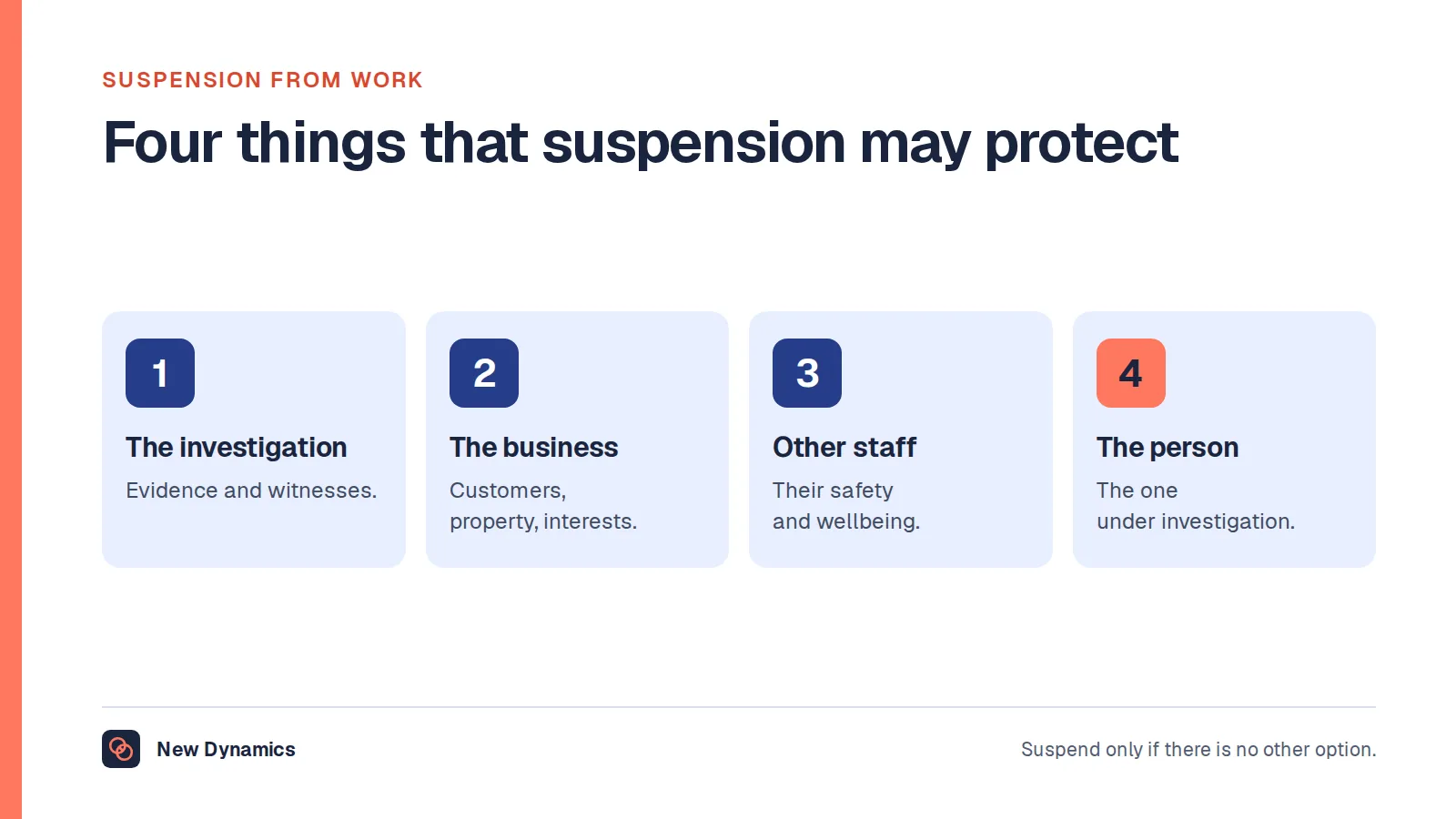
- Maternity suspension on medical grounds means an employer suspends an employee because she is pregnant, has recently given birth or is breastfeeding, and a health and safety risk to her or her child cannot be removed. It is a protective step, not a disciplinary one.
- HSE sets the order: adjust working conditions or hours; if that is not possible, offer suitable alternative work; only if that is not possible, suspend on paid leave. The Employment Rights Act 1996 gives the employee a right to be offered suitable alternative work first, and a right to be paid while suspended.
- Pay is a week's pay for each week of suspension, unless she unreasonably refuses suitable alternative work. From 1 October 2026 the time limit for a tribunal complaint about pay or alternative work is six months. This is general information about Great Britain, not legal advice.
A pregnant lab technician works with a chemical her risk assessment flags as harmful. Her manager's first instinct is to send her home "to be safe". That instinct is understandable, but it skips two steps the law expects to come first, and getting the order wrong is how a protective decision turns into a claim.
This article explains maternity suspension on medical grounds: when it applies, what an employer must try first, what the employee is paid, and how long she has to complain if it goes wrong. It covers Great Britain and is general information, not legal advice.
A suspension like this is a set of dated steps: the risk assessment, the adjustment, the offer, the review. See how New Dynamics workflows give each step an owner and a date, so nothing waits on someone remembering.
For the wider picture of maternity leave and pay, see our guide to maternity leave for employers. This is a different thing from a disciplinary suspension from work.
What maternity suspension means
Section 66 of the Employment Rights Act 1996 says an employee is suspended from work on maternity grounds if, because of a relevant health and safety requirement or recommendation, "she is suspended from work by her employer on the ground that she is pregnant, has recently given birth or is breastfeeding a child."
She remains employed throughout. The section says she is regarded as suspended only while she continues to be employed but is not provided with work, or does not perform the work she normally did before the suspension.
When it applies: the risk assessment comes first
HSE's guidance for employers on protecting pregnant workers and new mothers says "You must carry out an individual risk assessment for pregnant workers and new mothers." That applies to workers who are pregnant, "have given birth in the last 6 months", or are breastfeeding.
Suspension only arises when that assessment finds a significant risk that cannot be controlled or removed.
The order: adjust, offer alternative work, then suspend

HSE's guidance on the individual risk assessment sets out what to do if you cannot control or remove the risk, in this order:
- Adjust the working conditions or hours to avoid the risk.
- If that is not possible, give suitable alternative work. HSE notes: "The Employment Rights Act 1996 states that suitable alternative work should be offered, where appropriate, before any suspension from work."
- If that is not possible, suspend on paid leave for as long as necessary to protect her health and safety and that of her child. HSE says: "If you cannot put the necessary control measures in place, you must suspend the worker on full pay in line with the Management of Health and Safety at Work Regulations."
HSE also says to record your findings and share them with the worker, and with her safety representative if she has one.
The right to be offered suitable alternative work
Section 67 gives the employee a right: where the employer has suitable alternative work available, she "has a right to be offered to be provided with the alternative work before being suspended from work on maternity grounds."
To be suitable, the work must be:
- "suitable in relation to her and appropriate for her to do in the circumstances", and
- on terms and conditions that, if they differ from her normal ones, "must not be substantially less favourable to her".
HSE's shorthand is that the alternative work should be "on the same terms and conditions, including pay."
Pay during suspension
Section 68 says an employee suspended on maternity grounds "is entitled to be paid remuneration by her employer while she is so suspended."
How much? Section 69 sets it as "a week's pay in respect of each week of the period of suspension", reduced proportionately for part weeks. Any contractual pay for the same period counts towards it, so she is not paid twice.
There is one exception. She is not entitled to this pay for any period in which the employer offered suitable alternative work and she "unreasonably refused to perform that work."
If something goes wrong: complaints and time limits
Section 70 lets an employee complain to an employment tribunal that her employer:
- failed to pay the remuneration she is owed while suspended; or
- failed to offer her suitable alternative work before suspending her.
The time limits changed on 1 October 2026. Both complaints must now be presented within six months: for pay, beginning with the day the pay relates to; for alternative work, beginning with the first day of the suspension. The tribunal can extend this where it was not reasonably practicable to complain in time. The change was made by the Employment Rights Act 2025 and brought into force by S.I. 2026/954, which has transitional provisions, so check which limit applies to earlier days.
Handling it well

- Do the individual risk assessment promptly, as soon as you are told about the pregnancy, birth or breastfeeding.
- Look hard for adjustments and alternative work before suspending. Suspension is the last step, not the safe default.
- Put the offer in writing, with the terms, so it is clear the work is suitable and on the same terms.
- Pay correctly: a week's pay for each week, with contractual pay counted towards it.
- Review regularly. Risks change through pregnancy and after the birth, and the suspension should last only as long as necessary.
- Keep in touch. A suspended employee is still employed; keep her informed, and make sure the suspension does not affect her development or reviews.
Frequently asked questions
What is maternity suspension on medical grounds?
It is when an employer suspends an employee because she is pregnant, has recently given birth or is breastfeeding, and a health and safety risk to her or her child cannot be removed. Section 66 of the Employment Rights Act 1996 defines it, and the employee stays employed throughout.
Does an employer have to offer alternative work before suspending?
Yes, where suitable alternative work is available. Section 67 gives the employee a right to be offered suitable alternative work before being suspended on maternity grounds. HSE's order is to adjust conditions or hours first, then offer alternative work, then suspend.
Is maternity suspension paid?
Yes. Section 68 entitles the employee to be paid while suspended, and section 69 sets the amount at a week's pay for each week. She loses that pay only for a period in which she unreasonably refused suitable alternative work.
How long does a maternity suspension last?
As long as necessary to protect her health and safety and that of her child, according to HSE. Review the risk regularly and end the suspension when the risk is gone or can be controlled.
What is the time limit for a tribunal claim?
From 1 October 2026, six months: for unpaid remuneration, beginning with the day concerned; for failure to offer alternative work, beginning with the first day of the suspension. Transitional provisions apply to earlier days.
Your next step: check your process before you need it
- Confirm managers know an individual risk assessment is required for pregnant workers, new mothers and breastfeeding employees.
- List roles with known risks, and the adjustments or alternative work you could offer.
- Set up payroll to pay a week's pay for each week of any suspension.
- Add a review date to every suspension, and a named contact.
For keeping in touch and planning the return, read and download our employee handbook guide. The guide is free to read, and the PDF uses our short download form.
Want risk assessments, reviews and return plans with an owner and a date? Book a New Dynamics demo and bring your current pregnancy risk assessment process. You can also email contact@new-dynamics.com.