TL;DR
- The nine box grid plots performance on one axis and potential on the other, giving nine cells. Each cell is a prompt for a different conversation, not a verdict or a label to carry around.
- Potential is the least defined judgement in performance management and the most open to bias. Anchor it in observed behaviour: learning speed, progress without a settled brief, and work taken on outside the usual role.
- Acas says selection criteria should be based on facts that can be measured and not affected by personal opinions, and the ICO requires records about people to be accurate and limited to what you need. A grid applied mechanically fails both tests.
The nine box grid is the most widely used tool in performance management that almost nobody defines properly. Drawing the grid takes a minute. Agreeing what the vertical axis means takes a great deal longer, and most organisations skip that part.
This article covers what the grid is, how to run a calibration session with it, how to define potential so it is evidence rather than impression, and the fairness and record-keeping duties that apply in the United Kingdom.
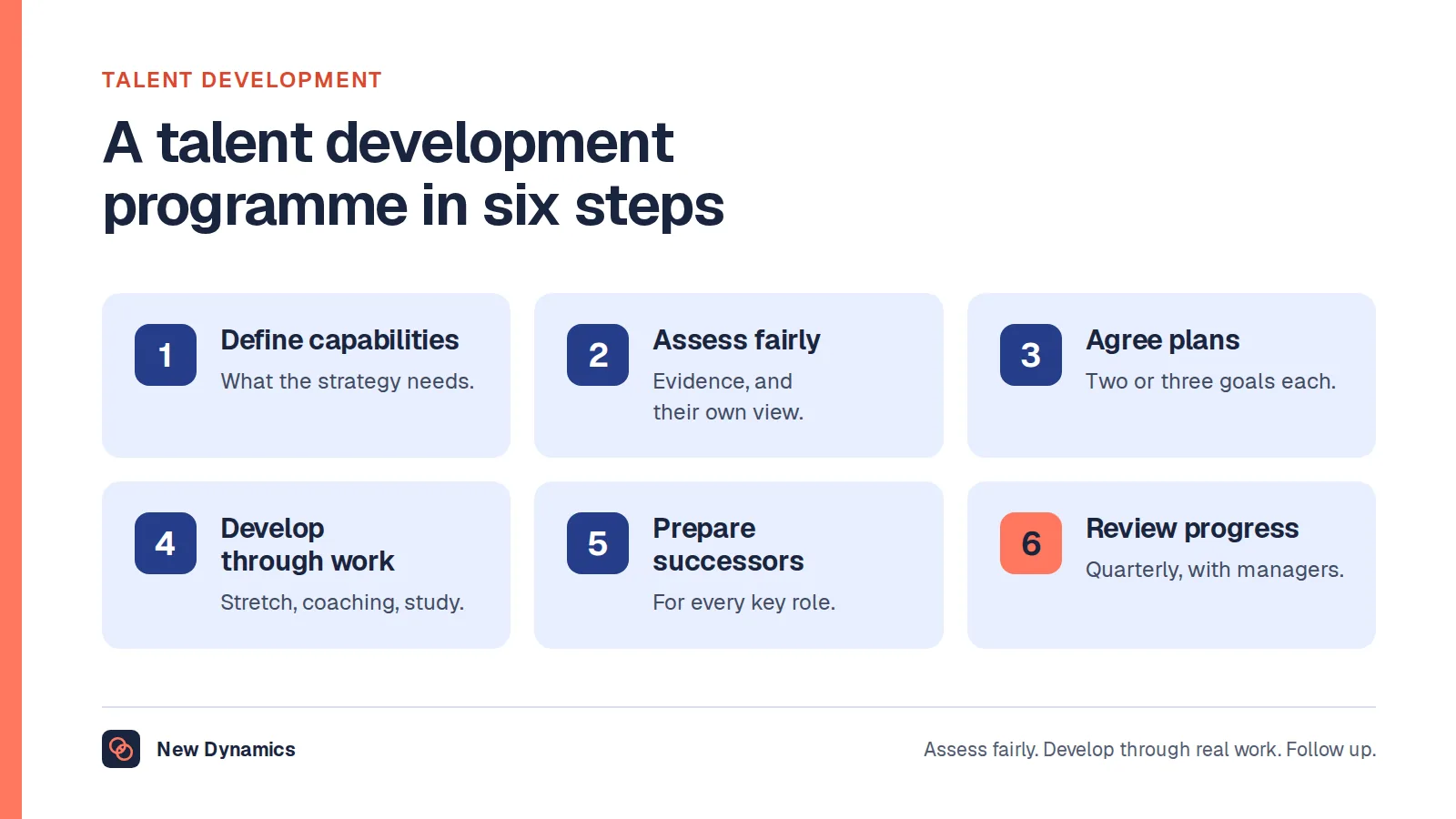
A grid is only as good as the evidence sitting behind each placement, which is a review-cycle problem before it is a grid problem. See how New Dynamics performance reviews gather that evidence through the year rather than in the final fortnight.
What the nine box grid is
The grid is a three by three square. Performance sits on one axis, usually the horizontal one, and potential on the other. Each person in scope is placed in one of the nine cells. It is also called the 9 box matrix, the 9 blocker, the talent grid, or a 9 box talent review, and in some organisations a talent management 9 box matrix. The mechanics are identical in every version.
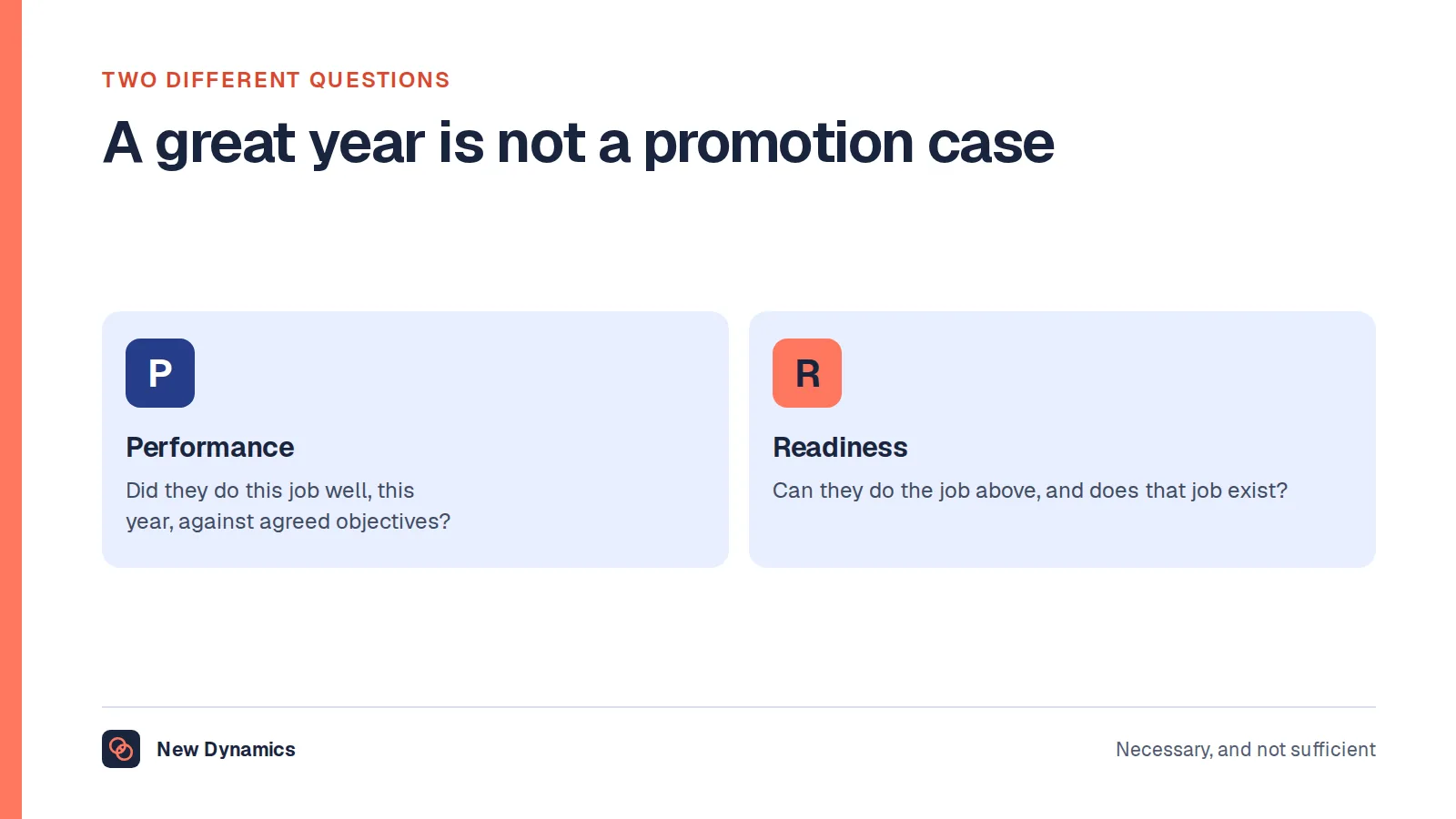
Two things make it useful. It separates two judgements that managers otherwise run together, because strong current performance and readiness for different work are not the same thing. And it forces a group of managers to say out loud why they think what they think, which is the actual value of the exercise.
One thing makes it risky. Performance can usually be evidenced. Potential is a prediction, and a prediction is where bias lives.
The nine cells, and the conversation each one should start
Name the cells plainly. Clever names become labels that follow people around.
| Placement | What it usually means | The conversation it should start |
|---|---|---|
| Low performance, low potential | Not delivering, and no evidence of more to come | Is this the right role, what support is missing, and is a capability process needed |
| Low performance, moderate potential | Not delivering yet, some signs of capability | What is in the way: workload, clarity, a new role, a manager change |
| Low performance, high potential | Clear capability, results not arriving | Is the person in the wrong job, or badly matched to the work in front of them |
| Moderate performance, low potential | Steady, doing the job as it is | Keep the job interesting and keep the knowledge from leaving with them |
| Moderate performance, moderate potential | The middle of the grid, where most people sit | What would move either axis, and which one is worth investing in first |
| Moderate performance, high potential | Capability ahead of current results | A stretch piece of work with real exposure, and someone watching it closely |
| High performance, low potential | Excellent at this job, not looking past it | Recognition, depth and retention, without pushing a promotion nobody wants |
| High performance, moderate potential | Strong, could do more with the right opening | Which gap they could cover, and what would need to be true first |
| High performance, high potential | Delivering now and ready for different work | The next role, the honest timetable, and what happens if it does not appear |
Read the right-hand column again. Every cell leads to a conversation with the person, not a decision about them. A grid that produces no conversations has produced nothing.
How to run a calibration session with the grid

A calibration session using the grid runs in a set order. Skipping a step is how the exercise turns into a negotiation between managers.
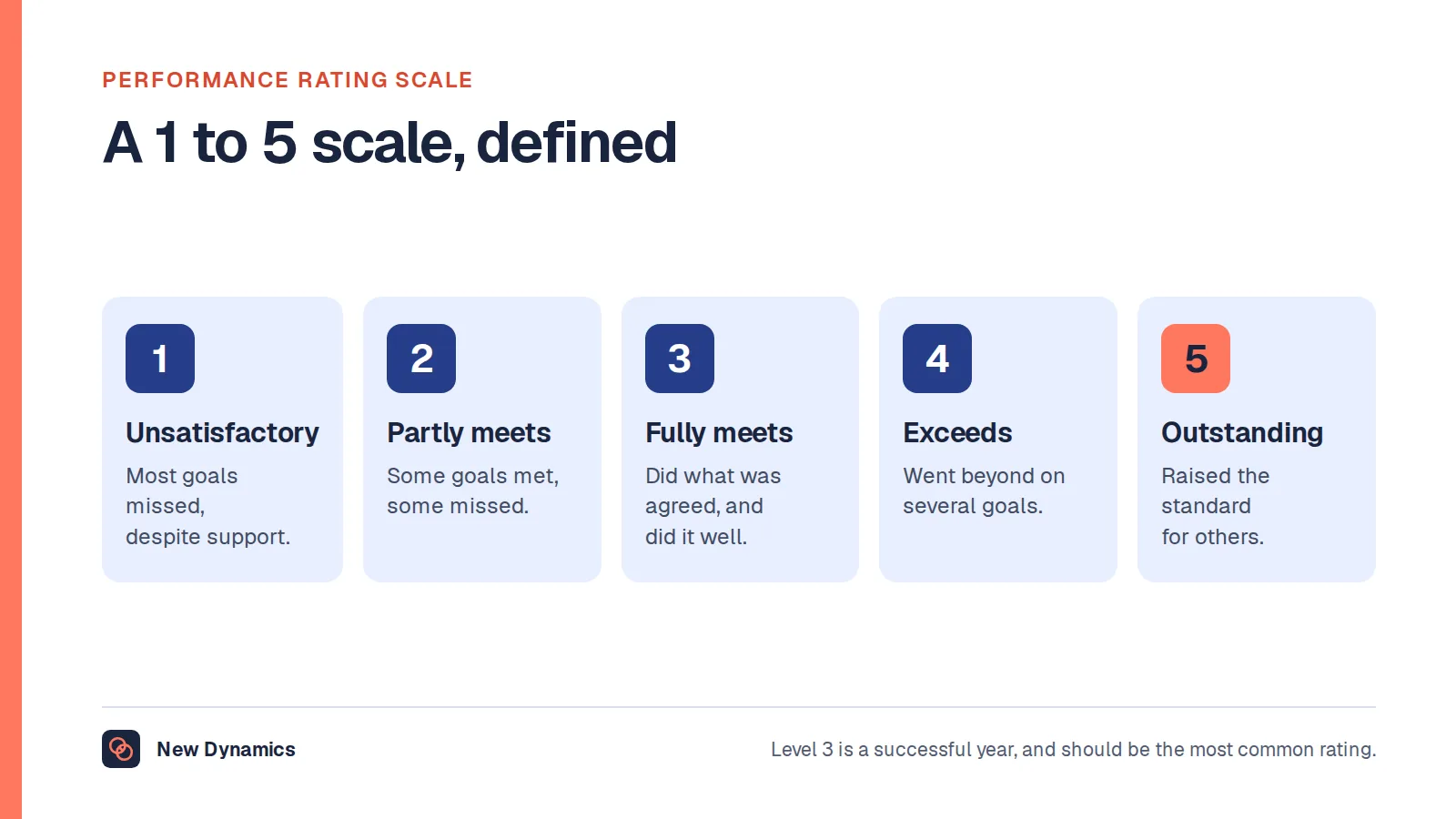
- Agree the definitions before anyone places anyone. Write one sentence for each level of performance and each level of potential, in the words of your own organisation. Circulate them in advance. If two managers in the room are using different definitions, the output is noise.
- Agree the scope. One job family, one level, or one department. A grid that mixes a graduate intake with a senior leadership team compares nothing with anything.
- Managers place their own people first, in writing, with evidence attached. Each placement arrives with what was observed and roughly when. No evidence means no placement.
- Take one cell at a time, not one manager at a time. Going manager by manager rewards whoever presents best. Going cell by cell makes the group compare like with like.
- Test each placement with the same question. What did you see, and when did you see it. Anything that cannot survive that question moves or comes out.
- Read the pattern, not just the placements. Count placements by sex, ethnicity, age, disability, working pattern, part-time status and length of service, wherever the numbers are large enough to protect anonymity. Also count by manager. One manager with everybody in the top row is telling you about the manager.
- Record the reason, not only the cell. A cell with no reason beside it is unusable next year and indefensible if challenged.
- End with actions and owners. Every placement leaves with something that happens next and someone who owns it.
Our performance calibration guide sets out the meeting mechanics in more detail, including how to handle a manager who will not move.
The hard part: what potential actually means

Most articles about the 9 box grid stop at the diagram. The reason the tool disappoints is almost always the vertical axis.
Potential is the least defined and most bias-prone judgement in performance management. It asks a group of people to predict future capability from a partial view of past behaviour, usually in a meeting, usually at speed. Without a definition, people fall back on whoever comes to mind.
What potential should mean
Define it as behaviour you can point to.
- Learning speed. How quickly did unfamiliar work become competent work. Name the piece of work.
- Handling ambiguity. Did they make progress when the brief was unsettled, the data incomplete or the stakeholders in disagreement.
- Taking on unfamiliar work. Did they pick up something outside the usual role, and what happened.
- Behaviour under correction. What did they do with difficult feedback, measurably, afterwards.
- Working through other people. Did they get an outcome through people who did not report to them.
Each of those has an answer that is either a specific example or nothing. That is the point.
What potential must not mean
- Confidence. Fluency in a room is a presentation skill. It is not a prediction of anything, and it is unevenly distributed in ways that track protected characteristics.
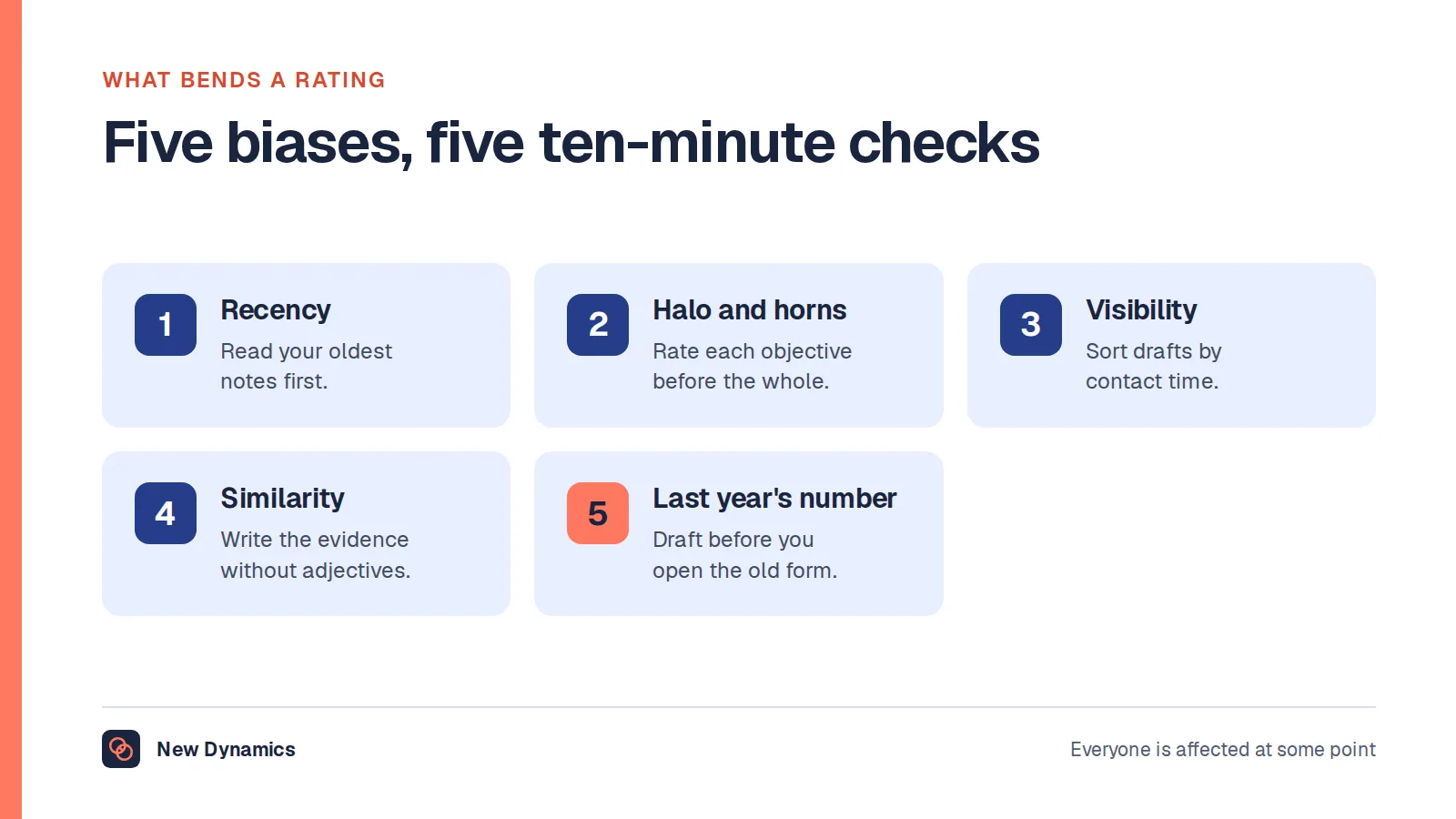
- Similarity to the assessor. The feeling that someone reminds you of yourself at that stage is the oldest bias in talent assessment.
- Availability for long hours or travel. This filters out carers, disabled employees, part-time staff and people on a family-related leave pattern, and it measures circumstance rather than capability.
- Tenure, or being next in line. Length of service is a fact, not a potential rating.
- Visibility to senior people. Proximity to the people in the room is not a quality of the employee.
- Being liked. Including by you.
A practical test: for every placement above the middle row, ask the manager to name the piece of work that evidences it. If the answer is a general impression, the placement is an impression.
The legal and fairness risk
This section describes the position in the United Kingdom and is general information rather than legal advice. Take advice on your own circumstances.
Acas describes a performance review as a chance to discuss someone's work, including "what they are doing well, any areas for improvement, whether they need more support or training, their career and any development objectives". On records, it says that "it's important to keep a written record of what is discussed" and that the record "should be shared with the employee afterwards". A grid placement that is never discussed with the person sits outside that description entirely.
Discrimination law applies to the judgement the grid records. Acas states that "discrimination law (Equality Act 2010) protects people against discrimination at work", that discrimination "means treating someone 'less favourably' than someone else" because of a protected characteristic, and that this can include "excluding someone from opportunities or benefits". A potential rating that gates access to development, stretch work or promotion is exactly that kind of opportunity. If the rating rests on availability for long hours, or on confidence, the route to indirect discrimination is short and obvious.
Grid placements are also records about identifiable people, so data protection applies. The ICO says that organisations "must make sure the personal information you hold is adequate, relevant, and limited to what you need for your purposes" and "must take all reasonable steps to keep any personal information you hold about your workers accurate and up-to-date". It lists "appraisal or performance review records" among the employment records this covers, and requires that you tell workers your purposes, your lawful basis, your retention periods, who you will share the information with and "their rights over their information".
Two consequences follow. A three-year-old potential rating that nobody has revisited is unlikely to be accurate, and an inaccurate record is a problem in itself. And a grid kept in a private spreadsheet, never mentioned to the people in it, is hard to square with telling workers what you hold and why.
If you searched for a civil service 9 box grid, the structure is the same, but the wording, the levels and the talent scheme rules are set departmentally. Work from your own published scheme guidance rather than a generic grid, and remember that public bodies carry equality duties in addition to the ones on every employer.
Whether to tell people their box
Both positions are defensible, and the honest answer depends on what you are prepared to say out loud.
The case for telling people. It is their information and they can ask for it. Acas expects the content of a performance discussion to be recorded and shared. A placement nobody will say to a person's face is usually one that was not properly evidenced, so disclosure disciplines the whole exercise. And someone who does not know they are seen as a steady specialist rather than a future director cannot make decisions about their own career.
The case against telling people. A cell is a crude summary of a long conversation, and "moderate potential" lands badly however carefully it is phrased. A top-row placement can read as a promise the organisation cannot keep, particularly when no role is coming. Grids also move, and telling someone they have dropped a row without being able to explain what changed does damage.
The workable middle is to share the substance without the coordinates. Tell the person what was said about their performance, what the group saw as their strengths, what evidence was missing, and what happens next. That is the content of the cell. The grid reference itself is an internal shorthand, and in our view it is not worth defending if you are not also willing to discuss the reasoning behind it.
What is not defensible is a secret grid with real consequences. If a placement decides who gets development funding or a stretch project, the person is already being treated differently on the basis of a record they have never seen.
What goes wrong

- Forced distribution into the cells. Requiring a set percentage per cell replaces judgement with arithmetic. The grid is a prompt for discussion, not a quota system, and a team of nine good people does not contain one underperformer by law of nature.
- A grid that never changes. If this year's grid matches last year's, either nobody developed or nobody looked. Both are findings worth acting on.
- No evidence behind a placement. The most common failure, and the one that makes every other problem worse. A placement with no example attached cannot be explained to the person, defended if challenged, or relied on next year.
- Using it as a redundancy selection tool. This is a different exercise with its own legal requirements, and reaching for last year's grid is a serious mistake. Acas says that redundancy selection criteria "should be as objective and measurable as possible", meaning they "should be fair, be based on facts that can be measured and not be affected by personal opinions", and that "you must apply the scoring criteria in the same way for all employees in the pool". A potential rating is a prediction shaped by personal opinion, which is the opposite of that standard. Build redundancy criteria for the redundancy process.
- One grid for everybody. Mixing levels and job families produces a comparison nobody can interpret.
- Treating the cell as the output. The output is a set of conversations and actions. The cell is filing.
- Letting the grid drive pay. Potential is a prediction. Paying for it, rather than for delivered work, is hard to explain and harder to defend.
Where the grid fits with the review cycle
A plain statement, because it matters when you are comparing software. New Dynamics does not sell a succession planning module, and we do not position 9 box succession planning as a product. What the platform holds is the evidence a calibration conversation needs: performance review records across the cycle, goals and how they moved, feedback from more than one manager, and a history that shows what somebody actually did rather than what the room remembers.
If you want a grid, draw it in a meeting with that evidence in front of you. The tool is a square. The work is the definitions, the evidence and the conversations afterwards.
Frequently asked questions
What is the 9 box grid used for?
It structures a group discussion about performance and potential. Managers place each person in one of nine cells, then explain the placement with evidence, and the group tests the reasoning. The useful output is a set of development conversations and actions, not the diagram.
What are the two axes of the nine box grid?
Performance on one axis, usually covering what the person has delivered against their objectives, and potential on the other, covering evidence that they could take on different or larger work. Performance looks backwards at facts. Potential looks forwards, which is why it needs the stricter definition.
How do you measure potential fairly?
Define it as observable behaviour and require an example for every placement. Learning speed on a named piece of work, progress made when the brief was unsettled, work taken on outside the usual role, and what happened after difficult feedback. Rule out confidence, similarity to the assessor, and availability for long hours.
Should employees know which box they are in?
There is a reasonable case either way, and the decision should be made before the session rather than afterwards. Sharing the substance, meaning what was said, what evidence was missing and what happens next, matters more than sharing the grid reference. A placement with real consequences that the person has never been told about is the version that is hard to defend.
Can you use a 9 box grid for redundancy selection?
Treat it as a separate exercise. Acas guidance on redundancy selection asks for criteria based on facts that can be measured and not affected by personal opinions, applied the same way for everyone in the pool. A potential rating is a prediction, so build criteria for the redundancy process rather than reusing a talent grid. Take legal advice.
Is the nine box grid the same as succession planning?
No. A 9 box talent review is one input to a conversation about who could cover which role. Succession planning is a wider exercise covering critical roles, risk and timing. New Dynamics does not sell a succession planning module, so if that is your main requirement, say so early in any software conversation.
Your next steps
- Write your own definitions for the three levels on each axis, in your own words, and circulate them before anybody places anybody.
- Require an example with a rough date for every placement above the middle row. Drop the placements that cannot produce one.
- After the session, count placements by group and by manager, with a threshold that protects anonymity, and look at what that tells you.
- Decide your disclosure position in advance, write it down, and apply it to everyone the same way.
- Diary a date to revisit the grid, so last year's prediction does not quietly become a permanent record.
For the meeting itself, read and download our performance calibration guide. The guide is free to read, and the PDF uses our short download form. Our post on rating employees fairly covers the consistency problem that calibration exists to solve.
Want the evidence in one place before your next calibration session? Book a New Dynamics demo and bring the grid you used last time. You can also email contact@new-dynamics.com.