TL;DR
- Industrial and organisational psychology is the science of behaviour at work. OpenStax Psychology 2e defines it as “a branch of psychology that studies how human behavior and psychology affect work and how they are affected by work”, and splits it into industrial, organisational and human factors psychology.
- You can start for nothing. Two openly licensed sources, OpenStax and the Noba Project module by Berrin Erdogan and Talya N. Bauer, are free to read and citable, which no paperback summary of them can claim.
- Be careful with positive psychology. A 2019 PLOS ONE meta-analysis found the effect of positive psychology interventions on wellbeing was “small but significant (approximately r = .10)”, with effects on depression “variable, dependent on outliers, and generally not statistically significant”.
Most management advice arrives already digested. A post cites a book, the book cites a study, the study had forty-two participants, and by the time it reaches your team meeting it has become a rule. Organisational psychology books are the way back up that chain, to where someone measured something and wrote it down.
This is a reading and watching route for someone who manages people, not someone sitting an exam: the discipline, how it differs from the business shelf at the airport, where to read it free and legally, how to judge a study, where positive psychology and positive psychology coaching fit, and the Shawn Achor TED talk.
If your reason for reading is that your own review cycle is not telling you much, start with how New Dynamics performance reviews handle evidence and completion, then come back for the theory.
Two notes. Nothing here is clinical, psychological or therapeutic advice; if work is affecting your health, speak to a doctor or a registered practitioner. Where this article mentions regulation of psychologists it describes the position in the United Kingdom, as general information rather than legal advice. No book below is ranked, and each title was checked on a publisher page or a library catalogue before it was named.
What industrial and organisational psychology actually is
Industrial and organisational psychology, usually shortened to I-O psychology in the United States and called occupational psychology in the United Kingdom, is the study of people at work using the methods of psychology.
The openly licensed textbook Psychology 2e from OpenStax, in section 13.1, puts it this way: industrial and organisational psychology is "a branch of psychology that studies how human behavior and psychology affect work and how they are affected by work". That second half matters. The field is not only about getting more out of people, but equally about what work does to the person doing it.
OpenStax section 13.1 names three divisions:
- Industrial psychology covers the matching of people and jobs: job analysis, selection, training and performance appraisal.
- Organisational psychology covers what happens once people are inside: motivation, satisfaction, teams, leadership, structure.
- Human factors psychology covers the design of the work itself, including tools, tasks, workload and safety.
The same section dates the field. Hugo Münsterberg published Psychology and Industrial Efficiency in 1913, "which covered topics such as employee selection, employee training, and effective advertising", and from 1929 to 1932 Elton Mayo and colleagues ran the studies at "a plant near Chicago, Western Electric's Hawthorne Works" that OpenStax says "mark the origin of organizational psychology".

In the UK the framing is different and worth knowing. The British Psychological Society's Division of Occupational Psychology describes occupational psychology as "the application of the science of psychology to work", and says it "promotes the professional interests of occupational psychologists and those in training in the United Kingdom (UK)". It lists leadership, motivation, engagement, training, psychological assessment, wellbeing and organisational change as its members' areas, which is roughly the contents page of your HR function.
Why the two names matter when you search
"Industrial and organizational psychology books" and "organisational psychology books" are the same shelf spelled two ways, so if a search looks thin, swap the spelling. American sources say I-O; British sources say occupational or work psychology.
How the discipline differs from popular business writing
A business book and a research paper do different jobs, and the difference is not simply that one is rigorous and the other is not. A business book has to be readable, and readability here means one clear mechanism, a memorable name for it and stories that make it stick. The author is allowed to select the examples. That is not cheating, it is the form. But selection is exactly what research design exists to prevent. Four practical differences follow.
- Direction of cause. Business writing reports that successful companies do X and infers that X causes success. Research design asks whether X came first, whether something else explains both, and whether the companies that did X and failed are in the sample. They usually are not, because they no longer exist to be studied.
- Effect size. A business book says a practice "works". A paper says how much, for whom, and with how much uncertainty. A modest effect sold as a transformation is a disappointment waiting to happen.
- Accumulation. A paper is a brick, not a building. The field's conclusions live in meta-analyses and replications. A single striking paper is where a finding starts.
- Who gets the last word. Peer review is slow and imperfect, but adversarial by design. A book's claims are checked by its readers, after publication, if at all.
This does not make business books worthless. Some are the only accessible route into a real literature. It does mean reading order matters: take the question from the business book, then find out what the field says about it.
The open access route: free, citable and legitimate
Before you spend anything, there are genuinely open textbooks and modules on this subject. Open does not mean low quality. It means the licence lets you read, quote, print and reuse the text with attribution.
OpenStax, Psychology 2e, chapter 13. The whole chapter is given to industrial and organisational psychology, and section 13.1 is the definition quoted above. OpenStax is published by Rice University, and the book is free to read in a browser or as a PDF.
OpenStax, Organizational Behavior. The companion volume for the organisational half of the field. The preface names J. Stewart Black and David S. Bright as senior contributing authors, gives the publication date as 5 June 2019, and states the terms plainly: "You can access this textbook for free in web view or PDF through openstax.org, and for a low cost in print." It is licensed "under a Creative Commons Attribution-NonCommercial-ShareAlike 4.0 (CC BY-NC-SA) license", and covers "individual and group behavior at work, as well as organizational processes such as communication in the workplace and managing conflict and negotiation".
The Noba Project module on I-O psychology. If a whole textbook is too much, start with one authored module. Industrial/Organizational (I/O) Psychology is written by Berrin Erdogan (Portland State University and Koç University) and Talya N. Bauer (Portland State University), under the same kind of Creative Commons licence. It defines the field as "the scientific study of behavior in organizational settings and the application of psychology to understand work behavior", and frames it around questions a manager would recognise: "What motivates employees at work?" and "How can organizations recruit and select the people they need in order to remain productive?"
One practical note. Because these are openly licensed, with named authors and stable URLs, you can quote them in an internal paper or a board note and show your source. A page screenshotted from a bestseller cannot be used that way.
How to read a study without being fooled by it
This is the skill the whole reading list exists to build. Four tests, in order.

Sample size, and who was in it
Ask how many people, then ask who. A result from undergraduate volunteers in a laboratory is about undergraduate volunteers in a laboratory until someone shows otherwise. A result from one employer's staff survey is about that employer.
There is an unusually honest, first-hand illustration of this. Dana Carney, first author of the 2010 power posing paper that launched a decade of pre-meeting advice, later posted her own position on the work on her University of California, Berkeley faculty page. She writes: "I do not believe that 'power pose' effects are real." Her own list of facts about the study includes "The sample size is tiny", "The data are flimsy. The effects are small and barely there in many cases", and, flatly, "The final sample size was N = 42." She describes checking the result as data came in, "something like 25 subjects run, then 10, then 7, then 5", and notes: "Back then this did not seem like p-hacking."
Forty-two people, one laboratory, more than fifteen years ago. That is the evidential base of advice given since to millions of job candidates.
Effect size, not just significance
"Statistically significant" means the result is unlikely to be pure chance given the test used. It says nothing about how large or useful the effect is. With a large enough sample, trivial differences become significant; with a small one, large apparent differences may be noise.
So look for the size, usually reported as a correlation (r) or a standardised mean difference (d). Rough orientation: an r of about 0.10 is small, around 0.30 moderate, 0.50 and above large and unusual in real workplaces. A percentage improvement with no measure of spread and no comparison group is marketing.
Replication
One study is a hypothesis with data attached. What matters is whether an independent team, not the original authors, got the same answer. If a finding has circulated for a decade with no independent replication, that absence is information.
Publication bias
Journals have historically preferred results that found something, so studies finding nothing are written up and published less often and the record over-represents positive findings. This is why pooled analyses that correct for it so often shrink an effect. The 2019 meta-analysis discussed below says this about its own corpus: "small sample size bias was pronounced in many of the analyses."
And a fifth test, for managers: would this change a decision? Before redesigning a process around a study, write down what you would do differently and whether the effect is big enough to notice through the noise of a real workplace. If the honest answer is "we would mention it in a workshop", change nothing yet.
Books about judging evidence
These are the titles that teach the four tests above. Each was confirmed on the publisher's own page or in a library catalogue, with the publisher's wording quoted.
Stuart Ritchie, Science Fictions: Exposing Fraud, Bias, Negligence and Hype in Science. Published by Vintage; the Penguin UK page gives the publication date as 16 September 2021 and describes the author as "a Lecturer at the Institute of Psychiatry, Psychology and Neuroscience at King's College London". The publisher's description says that "With bias, careless mistakes and even outright forgery influencing everything from austerity economics to the anti-vaccination movement, he proposes vital remedies." It is written from inside psychology, which makes it useful rather than merely sceptical.
Alex Edmans, May Contain Lies: How Stories, Statistics and Studies Exploit Our Biases, And What We Can Do About It. Penguin, 17 April 2025 on the publisher's page, which opens: "Our lives are minefields of misinformation. Statistics, stories and studies lie to us on a daily basis." Edmans is a Professor of Finance at London Business School. This is the book to hand someone who keeps forwarding studies.
Daniel Kahneman, Thinking, Fast and Slow. Penguin, with a 22 February 2024 edition date on the publisher's page. The standard account of the two systems of thinking and of the biases that make a plausible workplace story feel like evidence. Some studies it describes have themselves been contested since, which is instructive in its own right.
Jeffrey Pfeffer and Robert I. Sutton, Hard Facts, Dangerous Half-Truths, and Total Nonsense: Profiting from Evidence-Based Management. Harvard Business School Press, 2006, confirmed in the Open Library catalogue record, which gives the by-statement as "Jeffrey Pfeffer, Robert I. Sutton." This is the book that put evidence-based management into general use, and it is about management fads rather than science.
Eric Barends and Denise M. Rousseau, Evidence-Based Management: How to Use Evidence to Make Better Organizational Decisions. Kogan Page, first edition, 3 September 2018, per the publisher's page, whose description begins: "Decisions in businesses and organizations are too often based on fads, fashions and the success stories of famous CEOs." It sets out using "critically evaluated evidence from multiple sources, organizational data, professional expertise, stakeholder values and scientific literature". Of everything here, this is closest to a method you can apply on a Monday.
Books about the discipline itself
Paul E. Spector, Industrial and Organizational Psychology: Research and Practice, 8th edition. Wiley, July 2021, per the Wiley page, which says the author "balances employee and organizational perspectives by covering issues relating to both employee well-being and productivity". That balance is why a textbook beats a trade book: it has no thesis to sell. An earlier, seventh edition appears in the Open Library catalogue if you are borrowing rather than buying.
Do not read a textbook cover to cover. The chapter titles are the real value: they tell you what the field considers a question worth asking, which is rarely what the business shelf is excited about this year.
Christopher Peterson and Martin Seligman, Character Strengths and Virtues: A Handbook and Classification. Oxford University Press, 2004, confirmed in the Open Library catalogue record. This is the reference work behind the strengths language now found in appraisal forms everywhere, and the classification itself is more cautious than the questionnaires derived from it.
Several titles that would belong here are missing because the publisher page would not open or the catalogue record was ambiguous. A reading list with an unverified title in it is worse than a short one.
Where positive psychology fits, honestly
Positive psychology is a subfield, not a synonym for workplace psychology. The Positive Psychology Center at the University of Pennsylvania, which Martin Seligman directs, defines it as "the scientific study of the factors that enable individuals and communities to thrive". Its arrival shifted a research agenda that had been overwhelmingly about dysfunction, which was useful. What followed was less tidy.
What is reasonably well supported
- Work conditions matter and are measurable. Manageable demands, some control, support, decent relationships, a clear role, change that is explained. This is the part of the subject with the firmest footing.
- Brief exercises have small average effects. Gratitude journals, acts of kindness and strengths exercises show a small positive average effect on wellbeing when trials are pooled. Small is not nothing, and not a programme.
- The vocabulary is useful. Strengths, meaning and engagement give managers words for parts of work that had none.
What is contested
Several of the subfield's best known findings have had a hard time when people tried to repeat them, and the pooled effects are smaller than the popular versions suggest.
The most useful single document is the meta-analysis published in PLOS ONE by Carmela A. White, Bob Uttl and Mark D. Holder, Meta-analyses of positive psychology interventions: The effects are much smaller than previously reported, published on 29 May 2019 under a Creative Commons Attribution licence. Re-analysing earlier pooled estimates and correcting for small-sample bias, the authors report that "the effect of PPIs on well-being were small but significant (approximately r = .10), whereas the effect of PPIs on depression were variable, dependent on outliers, and generally not statistically significant". On the evidence base they write: "small sample size bias was pronounced in many of the analyses."
Read that alongside the power posing statement quoted earlier. Both are the research community correcting itself in public, which is the system working, slowly.

What this means for a manager
Do not buy a happiness programme on the strength of an r of 0.10, and do not conclude that wellbeing is a myth either. Fix the conditions, which are well evidenced and within your control, and treat individual positivity exercises as optional extras for people who want them, never a substitute or a requirement. Our employee wellness programme article covers the conditions, and the HR statistics hub holds our sourced figures.
What positive psychology coaching actually is
"Positive psychology coaching" describes coaching that borrows its framework from positive psychology: working from strengths rather than deficits, setting goals around what the person wants more of, and using structured exercises drawn from the research literature. Three things get used interchangeably.
Coaching psychology is the professional discipline. The British Psychological Society's Division of Coaching Psychology defines it as "the scientific study and application of behaviour, cognition and emotion to deepen our understanding of individuals' and groups' performance, achievement and wellbeing, and to enhance practice within coaching", work that should be "ethically, empirically and theoretically based".
Positive psychology coaching is an approach within that, defined by where its content comes from rather than by any single technique.
Coaching as a job title is unregulated in the United Kingdom, and this is the part managers most often get wrong. The Health and Care Professions Council regulates fifteen professions whose titles are protected by law, and its page on the professions it regulates states: "The professions we regulate have one or more designated titles that are protected by law. To use one of these titles, an individual must be registered with the HCPC." Practitioner psychologist is one of the fifteen, and occupational psychologist is one of its designated titles. "Coach", "positive psychology coach" and "wellbeing coach" are not.
This is general information about the position in the United Kingdom as described on the regulator's own page, and it is not legal advice. Check the register and take your own advice before commissioning anything.
What to ask before you commission coaching
- What qualification do you hold, awarded by whom, and is any of it on a regulated register?
- Which approach are you using, and what evidence would you point me to?
- What will you not do? A good answer draws a clear line at anything clinical.
- What happens if something outside coaching comes up? There should be a referral route.
- Who sees the notes, and what does the employer get told?
That last question matters more than the method. Coaching bought by an employer and delivered to an employee carries an obvious confidentiality tension, and it should be settled in writing before the first session.
If what you are actually describing is better conversations between managers and their teams, that is a different purchase. Our guide to one-to-ones covers the structure, and New Dynamics feedback covers keeping a record between the formal cycles.
The Shawn Achor TED talk, and why it keeps coming up
A large share of the searches that lead people here are some version of "TED talk happy" or "Shawn Achor TED", so here is what is on the page.
The talk is The happy secret to better work, given by Shawn Achor. The TED page records the event as TEDxBloomington and displays "May 2011"; its own page data gives the recording date as 11 May 2011, publication on TED as 1 February 2012, and a running time of 723 seconds, about twelve minutes. When we opened the page in November 2026 it showed more than 27 million plays, which is a fair part of why these searches exist at all.
TED's own summary of the talk reads: "We believe we should work hard in order to be happy, but could we be thinking about things backwards? In this fast-moving and very funny talk, psychologist Shawn Achor argues that, actually, happiness inspires us to be more productive."
What the talk argues
Achor's case is that the standard formula runs the wrong way round. Organisations and schools, he says, work on "If I work harder, I'll be more successful. And if I'm more successful, then I'll be happier", which he argues is "scientifically broken and backwards" for two reasons: every success moves the goalposts, so the promised happiness never arrives, and causation runs the other way, because a positive brain performs better. What shapes your experience of work, on his account, is not your circumstances but how you process them: "it's not necessarily the reality that shapes us, but the lens through which your brain views the world that shapes your reality."
The last three minutes are the practical part. He proposes daily habits, kept up for three weeks, that he says retrain that lens: three gratitudes written out, journaling one positive experience, exercise, meditation, and "random acts of kindness", specifically one email praising or thanking somebody in your support network. That last suggestion is the most transferable thing in the talk.
How to watch it critically
The talk moves fast and carries a run of large percentages. It states that "90 percent of your long-term happiness is predicted not by the external world, but by the way your brain processes the world", and that "only 25% of job successes are predicted by IQ, 75 percent of job successes are predicted by your optimism levels, your social support and your ability to see stress as a challenge instead of as a threat". Those quotations come from the transcript on the TED page, read on 5 November 2026.
Treat all of them as claims, not findings. The TED page shows no citations for any of them, and a conference talk from 2011 is not a reference. If you want to use one of these numbers in a document that matters, the honest options are to find and read the underlying studies, or to leave the number out and keep the idea.
The idea survives scrutiny better than the percentages do. For using that language without it ringing hollow, see our happiness at work quotes.
Achor's own book is The Happiness Advantage: How a Positive Brain Fuels Success in Work and Life, Crown Currency, 14 September 2010. The publisher's description states the thesis bluntly: "Happiness fuels success, not the other way around." Read it as the long version of the talk, with the same reservations about the numbers.
A route through all of this in six weeks
An order that works, at an hour or two a week.
- The field. OpenStax section 13.1 and the Noba module. Free, about ninety minutes together.
- The talk. Watch the Achor talk, then write down which claims you would need evidence for before repeating them in a meeting.
- The sceptic's toolkit. Start Ritchie or Edmans, and read Carney's power posing statement in full. Two pages, and it will change how you read the rest.
- Positive psychology, properly. The Penn centre's framing, then the PLOS ONE abstract, side by side.
- Method. Barends and Rousseau, or Pfeffer and Sutton, depending on whether you want a method or an argument.
- Your own organisation. Pick one practice you run and write down what evidence you would need to know whether it works. This is the only week that changes anything.
Turning reading into something that happens at work
Reading changes judgement slowly. It does not change a process. Three things do.
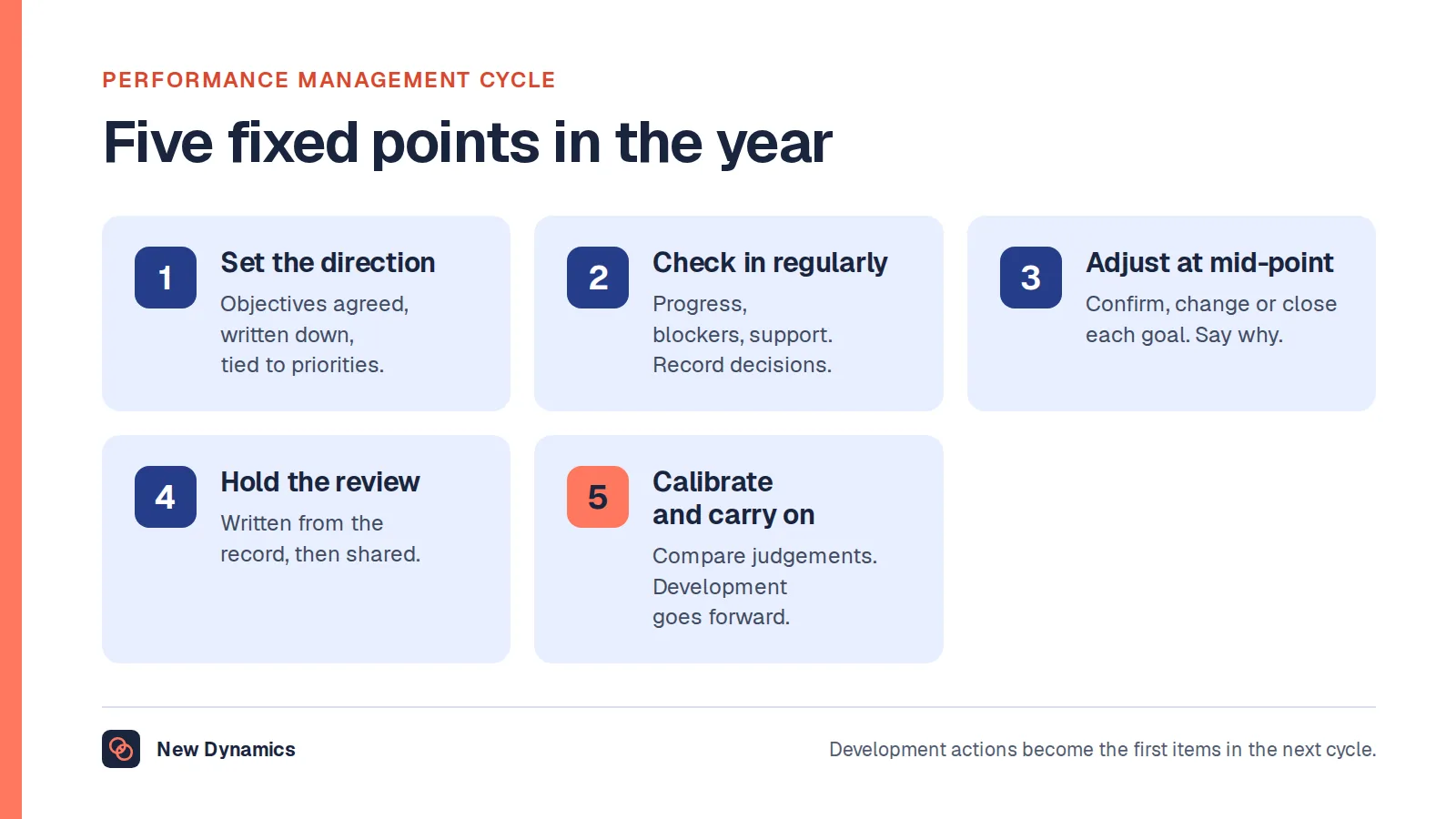
Write down what you are measuring, before you change it. If you cannot say the current completion rate, response rate or median time, you cannot tell whether the new approach helped. The performance management cycle article covers where those points sit in a normal year.
Change one thing at a time. A review process that changed its form, its timing, its rating scale and its software in one quarter has taught you nothing about any of them.
Keep the evidence trail. The gap between a research mindset and an ordinary appraisal is that one keeps records as it goes and the other reconstructs the year from memory in March. A running record of feedback, goals and check-ins is the difference between an assessment and a recollection, and it is what New Dynamics goals and OKRs is built around.
Frequently asked questions
What is the difference between organisational psychology and industrial organisational psychology?
They describe the same field at different widths. OpenStax Psychology 2e divides industrial and organisational psychology into three branches: industrial psychology (selection, training, appraisal), organisational psychology (motivation, teams, leadership) and human factors psychology (how the work is designed). Organisational psychology is one branch of the wider field, though in everyday use the phrases are interchangeable. In the UK the field is usually called occupational psychology.
Are there free industrial and organisational psychology books I can cite?
Yes, and they are the place to start. OpenStax publishes Psychology 2e and Organizational Behavior free to read in a browser or as a PDF, both under Creative Commons licences, and the Noba Project publishes a module on I-O psychology by Berrin Erdogan and Talya N. Bauer under the same kind of licence. Because they have named authors, stable URLs and explicit licences, you can quote them in an internal paper and show your source.
Which Shawn Achor TED talk are people searching for?
It is "The happy secret to better work", given at TEDxBloomington. The TED page displays May 2011 for the event, and its page data gives the recording date as 11 May 2011, publication on TED as 1 February 2012, and a running time of 723 seconds, about twelve minutes. TED's summary says Achor "argues that, actually, happiness inspires us to be more productive". Its on-stage percentages are not cited, so treat them as claims.
Does positive psychology coaching work?
The honest answer is more modest than the marketing. A 2019 PLOS ONE meta-analysis by White, Uttl and Holder found that once small-sample bias was accounted for, the effect of positive psychology interventions on wellbeing was "small but significant (approximately r = .10)", while effects on depression were "variable, dependent on outliers, and generally not statistically significant". Coaching built on that literature can help with goal setting, for people who want it. It is not a treatment, and not a fix for workload, unclear roles or poor management.
Is a positive psychology coach a regulated professional in the UK?
No. The Health and Care Professions Council regulates fifteen professions with titles protected by law, and says that "to use one of these titles, an individual must be registered with the HCPC". Practitioner psychologist is one, and occupational psychologist is one of its designated titles. Coach, positive psychology coach and wellbeing coach are not protected, so anyone may use them. This describes the position in the United Kingdom and is general information rather than legal advice; check the register before you commission anything.
How do I tell whether a workplace study is worth acting on?
Run four checks. How many people were studied and who were they, because a laboratory sample of students is not a workforce. How large was the effect, not just whether it reached significance. Has an independent team repeated it. And how likely is it that studies finding nothing were never published. Dana Carney's note on her own power posing paper illustrates all four: she records that "the sample size is tiny" and that "the final sample size was N = 42".
Your next step: pick one practice and ask what you know
Choose one thing your organisation does to people (the appraisal form, the goal template, the engagement survey, the coaching budget) and write two lines about it. What is it supposed to achieve, and what evidence do you have that it does? If the second line is blank, you have found your reading project. Start with the free sources: OpenStax section 13.1 and the Noba module cost nothing, take an evening, and make every business book you read afterwards easier to judge.
For running a cycle that produces evidence instead of recollection, read our performance review guide. The article is freely readable; the PDF uses our short download form.
Want goals, feedback and reviews holding a record you could actually analyse, built around the process you already run? Book a New Dynamics demo and bring the form you use today, or email contact@new-dynamics.com.