TL;DR
- A performance management cycle is a year of work with a few fixed points in it: setting direction, regular check-ins, a mid-point adjustment, the review, calibration, and the development actions that carry into the next cycle. Run as a single event, it collapses into a form nobody can fill in properly.
- Five decisions shape every cycle and are usually made by accident: annual or continuous, ratings or no ratings, whether pay is settled in the same conversation, who contributes besides the line manager, and how evidence is captured through the year.
- Cycles fail for four repeatable reasons: they depend on recollection, managers start from a blank page, completion is chased rather than designed for, and nothing happens after the conversation. Each one has a fix in the design rather than in the reminders.
A performance management cycle is a year of work with a handful of fixed points in it. Most organisations run it as a single event in the autumn, and then wonder why the forms arrive late, the content is thin, the ratings do not agree with each other and nothing visible happens afterwards.
The cause is almost never effort. It is that the cycle was never designed as a year. Nobody decided when evidence would be captured, who would contribute besides the line manager, or what a manager would be looking at when they opened the form. So the form became the process.
This article sets out the cycle stage by stage, gives a worked twelve-month outline with who does what at each point, names the five design decisions that usually get made by accident, explains the four reasons cycles fail and shows how to measure one honestly. It describes the position in Great Britain and the UK where it touches process fairness, and it is general information rather than legal advice.
If you want the stages, the evidence and the reminders held in one place rather than in a spreadsheet and a folder of Word documents, see how New Dynamics performance reviews run a cycle.
What the performance management cycle actually is
Acas, the UK's workplace advice service, describes performance reviews as "a chance to discuss someone's work, including: what they are doing well, any areas for improvement, whether they need more support or training, their career and any development objectives". On frequency it is direct: "Employers should conduct regular performance reviews for anyone with the legal status of employee. It's a good idea to do them at least once a year."
That annual minimum is the floor, not the cycle. The same Acas guidance adds that "alongside more formal performance reviews, managers should still talk to employees informally about their performance on a regular basis", through regular feedback, coaching and "regular check-ins, sometimes known as one-to-ones". The review is one fixed point in a year that also contains the conversations that make the review possible to write.

Five fixed points, plus the thing that connects one cycle to the next.
1. Setting direction. Objectives agreed between the employee and the manager, with the organisation's priorities already published so the goals have something to attach to. Acas says objectives "should be fair and reflect the employee's usual tasks and workload", though "they might also stretch them to develop in certain areas", and should be specific, measurable, achievable, relevant and time-bound. Our post on the goal-setting conversation covers how to run it.
2. Regular check-ins. Short, scheduled, about progress, blockers and support. This is where evidence accumulates. Our one-to-one meeting questions give the agenda.
3. The mid-point adjustment. An explicit moment to change goals that no longer make sense, record why, and deal with anything that has gone quiet. Without it, a goal written in January is reviewed in November against a world that moved in April.
4. The review. The structured look back across the whole period, written from the evidence, followed by a conversation. Acas is clear that "it's important to keep a written record of what is discussed" and that the record "should be shared with the employee afterwards".
5. Calibration. Comparing judgements across managers before anything is final.
6. Development actions. The part that carries into the next cycle, and the part most often lost.
A goals example, written at the start of a cycle
Vague: "improve project handovers."
Written for a cycle: "By the end of September, every project handover uses the agreed decision log, and the receiving team confirms in writing that it has what it needs. Baseline: four of the last ten handovers needed a follow-up call. Reviewed at the April check-in and at the mid-point." The owner is the employee, the manager reviews it at the named points, and the evidence is the log plus the confirmations. For more worked wording, see our performance goals examples.
A worked twelve-month performance management cycle
This is one defensible shape for a cycle that runs with the calendar year. Shift the months to match your financial year. The point is not the months but that every row has an owner and a named output, which is what turns a performance management template into a process people can follow.
| When | What happens | Who does it |
|---|---|---|
| December | Organisational priorities for next year confirmed and written down | Executive team |
| Early January | Cycle dates, forms and scope published; managers briefed on what has changed | HR, process owner |
| January | Team priorities translated from the organisational ones | Senior managers |
| Late January | Goal-setting conversations held and objectives agreed and recorded | Employee and line manager |
| February | Scope exceptions handled: new starters, people on leave, dual-reporting staff | HR with line managers |
| Monthly | Check-ins on progress, blockers and support, with decisions recorded, not transcripts | Employee and line manager |
| Ongoing | Feedback and recognition captured close to the event, by whoever saw the work | Colleagues, project leads |
| May | Mid-point: goals confirmed, changed or closed, with the reason recorded | Employee and line manager |
| June | Mid-point report: which goals moved, where evidence is thin, which teams have gone quiet | HR, process owner |
| September | Any additional contributors invited, with the questions and the deadline stated | HR opens it, contributors answer |
| Early October | Employee writes a self-assessment against the agreed goals and the evidence | Employee |
| Late October | Manager writes the assessment from the evidence already in the record | Line manager |
| Early November | Calibration sessions by team or job family, with changes and reasons recorded | Managers, chaired by HR or a lead |
| November | Review conversations held, records shared, development actions agreed | Employee and line manager |
| Late November | Pay decisions made in a separate meeting, where pay is linked at all | Managers and reward or finance |
| December | Cycle measured: completion by stage, evidence coverage, preparation time, quality survey | HR, process owner |
| December | Development actions become the first items in next year's check-ins | Employee and line manager |
Three details in that table do more work than the rest. The exceptions row in February stops HR managing awkward cases from memory in November. The mid-point report in June is the only thing that tells you a cycle is failing while you can still do something about it. And the last row is the only connection between one cycle and the next.
The five decisions that get made by accident

These are rarely discussed. They are usually inherited from whatever the last system did, or from whatever the form happened to contain. Each one changes what the cycle is for.
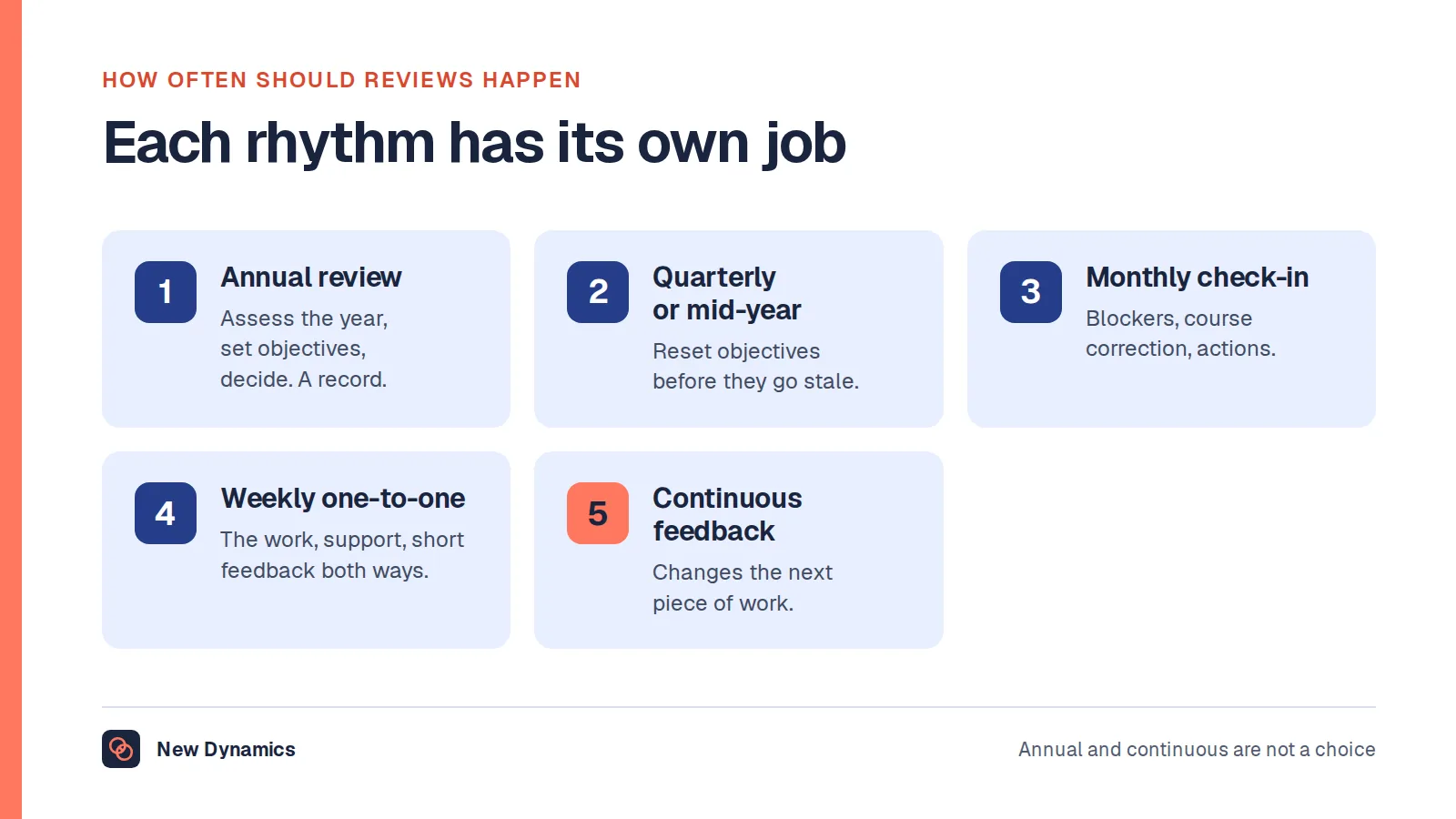
Annual or continuous. An annual review is a defined reflection point. It cannot carry every conversation someone needs in a year, and a cycle that relies on it alone is a cycle built on recollection. A continuous approach puts the conversation near the work and uses the annual point to look for patterns. In practice most organisations run both, and the useful question is what job each rhythm does. Our post on performance review frequency works through the options.
Ratings or no ratings. Ratings make comparison and reporting possible and make inconsistency visible. They also turn the conversation into a negotiation about a number. If you keep them, define each level by behaviour so a 4 means the same thing to every manager. If you drop them, decide first what the decisions that used them will run on instead, which our post on removing performance ratings sets out.
Whether pay is decided in the same conversation. People are open about weaknesses when the conversation is about development and defensive when it is about money. Holding both in one meeting usually means you get neither. Separating them costs an extra meeting and is the single cheapest improvement available to most cycles. Our post on performance reviews and pay covers the mechanisms.
Who contributes besides the line manager. One manager sees part of the work, and in project or matrix structures sometimes very little of it. Decide whether project leads, peers or second-line managers contribute, what question they are asked, and whether their input is attributed or aggregated. Decide it once, in the design, rather than letting each manager improvise in October.
How evidence is captured through the year. This is the decision that determines whether the other four work. If the answer is a text box in November, the cycle has no evidence, only recall. If notes, feedback, recognition and goal progress are captured as they happen and visible when the review is written, the review becomes a summary of a record rather than an act of memory.
Why performance management cycles fail
Four causes, and all four are design faults rather than attitude problems.
It depends on recollection. Nothing was written down between January and October, so the review covers the last six weeks and calls it a year. The fix is the capture decision above, plus a check-in that produces two lines of record rather than a feeling that the meeting went well.
Managers start from a blank page. A blank form with eight open questions and no context in it is a two-hour task per person, which is why it is late. A form that opens with the agreed goals, their current status, the feedback received and the notes from check-ins is a thirty-minute task. The work did not disappear, it moved into the year where it belonged.
Completion is chased rather than designed for. Reminder emails treat a design problem as a compliance problem. Our post on chasing performance reviews lists the causes behind a missed deadline, and most of them are fixed before the cycle opens: fewer stages, a shorter form, dates that avoid year-end close, and clarity about who owns completion.
Nothing happens after the conversation. Development actions are agreed and never mentioned again, so people learn that the cycle is a ritual. The repair is unglamorous: the actions become agenda items in the next three check-ins, with an owner and a date. Our post on what happens after a performance review covers the follow-through.
One more worth naming, because it is specific. Where performance is genuinely a problem, the cycle is the wrong instrument. Acas says employers "should take steps to try and help someone to improve, before starting a formal disciplinary procedure", that a performance improvement plan should set out "specific objectives for the employee", "a reasonable timeline to meet them" and "any further support or training they need", and that "it's important for employers to keep a record of any conversations they have with employees about performance". That is a separate, documented route, not a line in an annual form.
Calibration, briefly
Calibration is the session where managers compare their judgements before anything is final, with the evidence in front of them, and where any change is recorded with its reason. It is what stops a rating meaning "who your manager is" rather than "how the work went". It is also the stage most often missing from a cycle, because it is the only one that requires managers to be in a room together.
Two things to get right: define what can and cannot change in the session, and record the reason for every change, because a changed rating with no recorded reason is harder to explain later than the original one. Consistency matters for more than tidiness. A rating you can explain, with the evidence and the reason attached, is the only kind that survives being questioned a year later.
Our performance calibration guide covers how to run the session, and our post on the nine box grid covers the grid version and how to define potential as evidence rather than impression. This section deliberately does not repeat either.
What are performance management systems for?
Performance management systems, often searched for as performance management system software, are tools that hold the cycle: the goals, the check-in notes, the feedback, the forms, the stages and the dates. Vendor-neutral answer, with no product names and no prices: software is good at exactly three things here, and it is worth being honest that the list is short.
Evidence capture. Somewhere for a note, a piece of feedback, a recognition or a goal update to live at the moment it happens, attached to the person and the goal, and visible when the review is written. This is the thing a spreadsheet and a folder of documents cannot do.
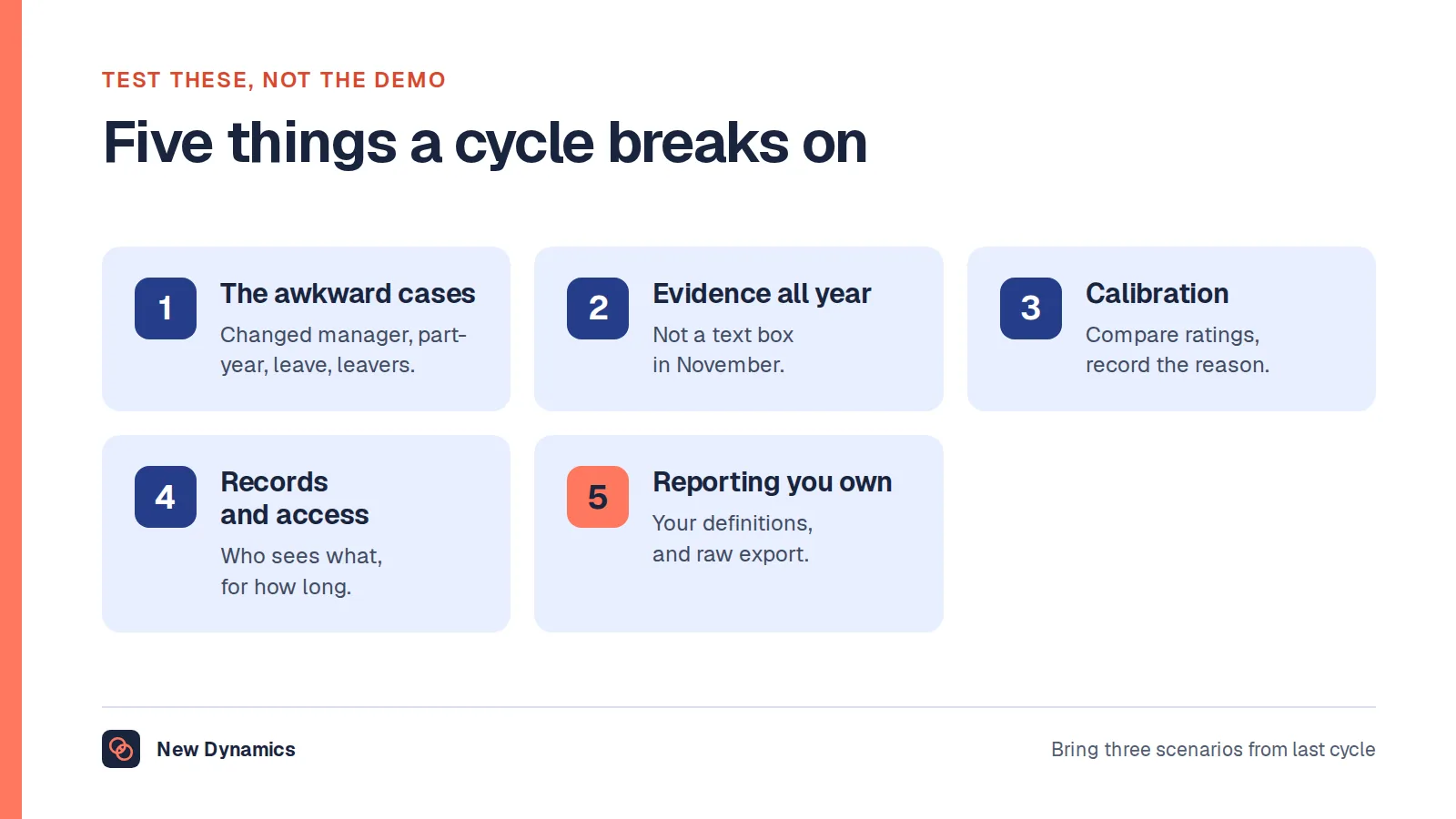
Workflow. Stages, participants, dates, reminders and the awkward cases: a manager change mid-cycle, a part-year starter, somebody on leave, a leaver. Handling those by hand is where an administrator's cycle disappears.
Visibility. Who is where in the cycle, which teams have gone quiet, how judgements are distributed, and an export so you can check the numbers yourself rather than trusting a supplied chart.
What software will not do is create agreement about what the ratings mean, or make managers want to do the review. A system will enforce whatever process you give it, which is useful when the process is agreed and painful when it is not. If you are choosing one, our post on choosing a performance management system sets out the requirements a real cycle breaks on, and the performance management handbook covers the wider process.
For completeness, and once: New Dynamics is a performance management platform for goals, feedback, recognition, reviews and onboarding.
Measuring the cycle honestly

Most cycles are measured by one number at the end, which is the least informative moment to look. Four measures tell you more, and three of them are available before the cycle closes.
Completion by stage, not overall. Ninety per cent overall can hide that self-assessments are at ninety-eight and calibration at forty. Report the funnel: goals agreed, check-ins held, contributions received, self-assessments in, manager assessments in, calibrated, conversation held, record shared. The stage where it drops is the stage to redesign. Our post on the performance review completion rate covers how to define the number so it means something.
Preparation time. Ask managers how long one review took them. If the answer is two hours per person, the form or the context is wrong, and the deadline will keep slipping whatever the reminders say.
The proportion of reviews carrying evidence recorded before the final month. This is the most useful single number in a performance cycle and almost nobody collects it. Count the reviews where at least some of the evidence cited, a note, a piece of feedback, a goal update, was recorded before the last month of the cycle. A low figure means you are running an annual recollection exercise with extra steps.
Quality, asked of the people who had the review. Three questions, worded consistently so the answers compare year to year: did the review help you improve how you do your job, did it help you agree clear objectives, and did it leave you feeling your work is valued. Those three come from the NHS Staff Survey, which is the largest published UK source on appraisal quality, so asking them the same way gives you a figure with something to compare against. The published numbers are in our post on performance review statistics; the point here is to collect your own and watch the direction.
The one-page performance management plan
Before any software, any form and any reminder, write the cycle on one page. It is the shortest useful performance management plan, and it doubles as the brief for anyone you ask to build it.
Who is in scope, including probation, part-time staff and people on leave. What happens and when, with dates. What gets recorded at each stage, and who can see it. Who contributes besides the line manager. Whether there are ratings, and what each level means. Whether pay is in the same conversation. What happens for the five awkward cases. Who owns completion. What you will measure, and when.
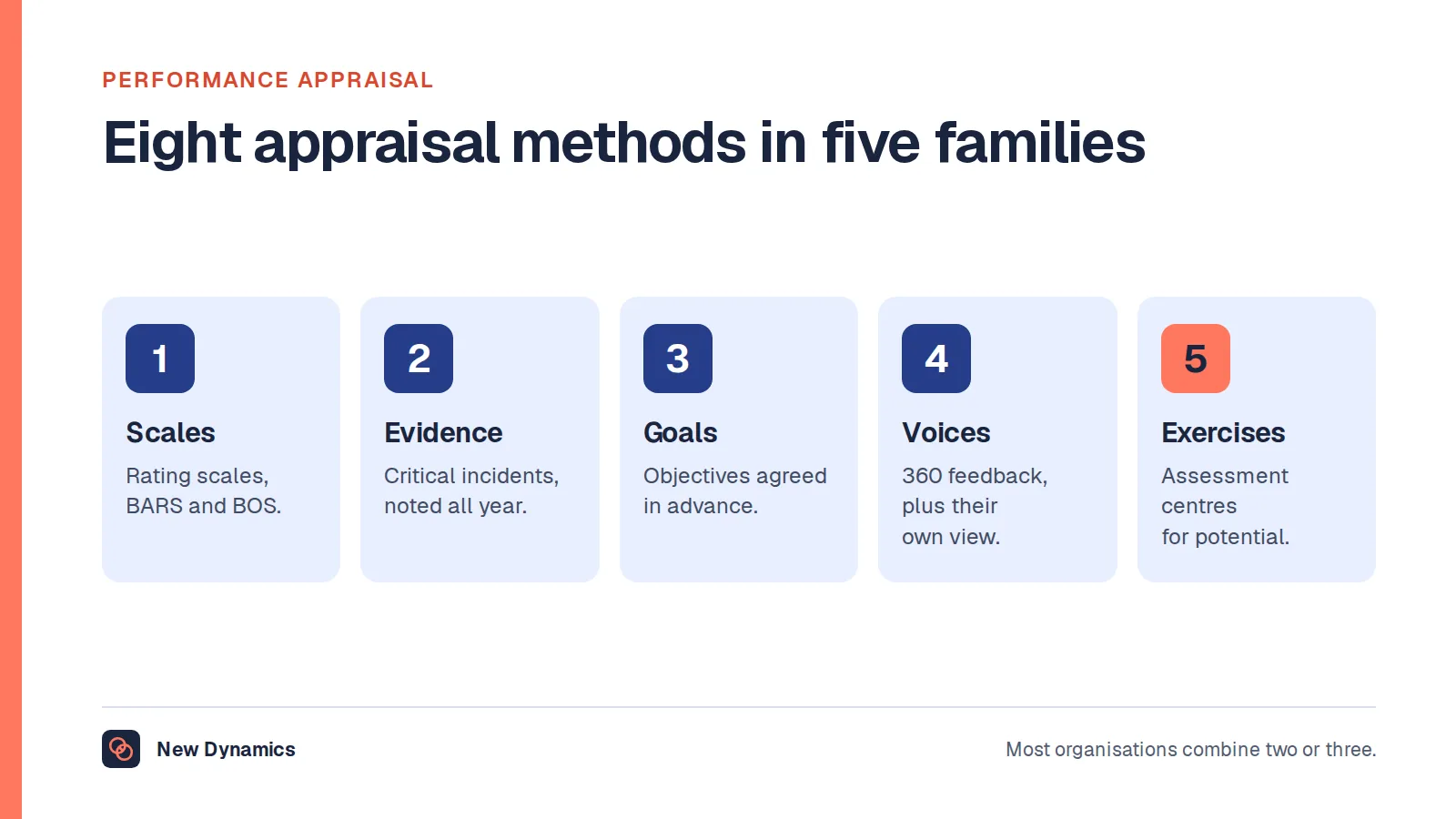
If the page is hard to write, that is the finding. A cycle nobody can describe on one page is a cycle that will be improvised in October. Our post on the performance management policy covers turning that page into the formal document, and our post on performance appraisal covers the methods available for the review itself.
Frequently asked questions
What are the stages of the performance management cycle?
Five fixed points plus one link to the next cycle: setting direction and agreeing objectives, regular check-ins through the year, a mid-point adjustment where goals are confirmed or changed, the review itself written from the evidence, calibration across managers before anything is final, and development actions that become agenda items in the following cycle.
How long is a performance management cycle?
Usually twelve months, aligned to the financial year rather than the calendar where those differ. Acas says regular reviews are advisable at least once a year, which sets the floor. The length of the formal period matters less than whether the year in between contains scheduled check-ins, because those are what the review is written from.
What is the difference between a performance management cycle and a performance management plan?
The cycle is the sequence of stages that runs across the year. The plan is the one page that describes it: scope, dates, what is recorded, who contributes, whether there are ratings, and what will be measured. A performance improvement plan is a different thing again, used where an individual's performance is a problem, and Acas expects it to set specific objectives, a reasonable timeline and the support or training needed.
Should a performance management cycle be annual or continuous?
Both, with a job for each. Check-ins keep expectations current and capture the evidence; the annual point looks across the whole period for patterns and decides development. A cycle that is only annual depends on recollection. A cycle that is only continuous tends to lose the comparison and reporting that pay, promotion and development decisions need.
What are performance management systems used for?
Three things: capturing evidence as it happens so a review summarises a record rather than a memory, running the workflow of stages, participants, dates and awkward cases, and giving visibility of where the cycle has reached, with an export you can check yourself. They do not create agreement about what ratings mean, and they enforce whatever process you give them.
How do you measure whether a performance management cycle worked?
Completion broken down by stage rather than one overall figure, the time a manager spends preparing one review, the proportion of reviews citing evidence recorded before the final month, and a short quality survey of the people who had the review, asking whether it helped them improve, helped agree clear objectives and left them feeling valued.
Your next step: design the year before the next cycle opens
- Write the twelve-month outline above against your own dates, and put a named owner in every row.
- Make the five design decisions explicitly: cadence, ratings, the pay link, who contributes, and where evidence is captured.
- Add the mid-point report in month six, so you find out a cycle is failing while you can still fix it.
- Measure the proportion of your last cycle's reviews that cited evidence recorded before the final month. That one number tells you what the cycle actually is.
For a structure that maps the stages, participants, reminders and exceptions, use our performance management process template. It is free to read, and the download uses our short form.
Want to see your own cycle, with your own form and your own dates, running end to end? Book a New Dynamics demo and bring the form you use today. You can also email contact@new-dynamics.com.