TL;DR
- The promotion changes what you are measured on. Your own work stops being the point, and the behaviours that got you promoted, personal delivery and speed, are now the ones most likely to get in the way.
- Spend the first fortnight listening, the next two weeks agreeing expectations in writing, start one-to-ones by week four, and make your first real change after day sixty rather than in week one.
- You also picked up duties nobody mentioned: you are now part of the employer's responsibility on discrimination, on work-related stress, and on following a fair procedure before anything formal happens.
You were good at the work, so they put you in charge of the people who do it. Nobody sat you down and explained that this is a different job with a different measure of success, and in most organisations nobody will. This new manager guide sets out what to do in the first ninety days, in order, with the parts that usually get skipped: managing people who were your peers a fortnight ago, the first difficult conversation, and the legal responsibilities that arrived with the title.
Everything below assumes you want to be useful by month three rather than popular by week one. Most of the work happens in a regular conversation with each person, and that is easier when the record of the year is already there. See how New Dynamics continuous feedback keeps notes, feedback and check-ins against each person as the year goes, rather than leaving you to reconstruct it later.
This article is general information about managing people in Great Britain. It is not legal advice, and an employment solicitor or your HR team should be asked about a specific case.
The shift nobody prepares you for

Three things change on the day the reporting lines move, and all three are counter-intuitive.
Your output is now the team's output. Nothing you personally produce counts for much. If you deliver brilliantly and your six people deliver badly, you have failed. This is the single hardest adjustment, because personal delivery is visible, immediate and satisfying, while management work is slow and mostly invisible until it is missing.
The behaviours that got you promoted are now liabilities. You were promoted for being fast, for knowing the answer, for taking the hard task yourself and finishing it at nine in the evening. Do that as a manager and you have taken the interesting work off your team, removed their chance to learn, and made yourself the bottleneck for every decision. The instinct to fix it yourself is the main failure mode of a first-time manager, and it feels like diligence the whole time it is happening.
Your words now carry weight you cannot feel. A musing aloud about a process becomes a project. A raised eyebrow in a meeting becomes a week of anxiety. You have not changed, but your effect on a room has, and nobody will tell you so.
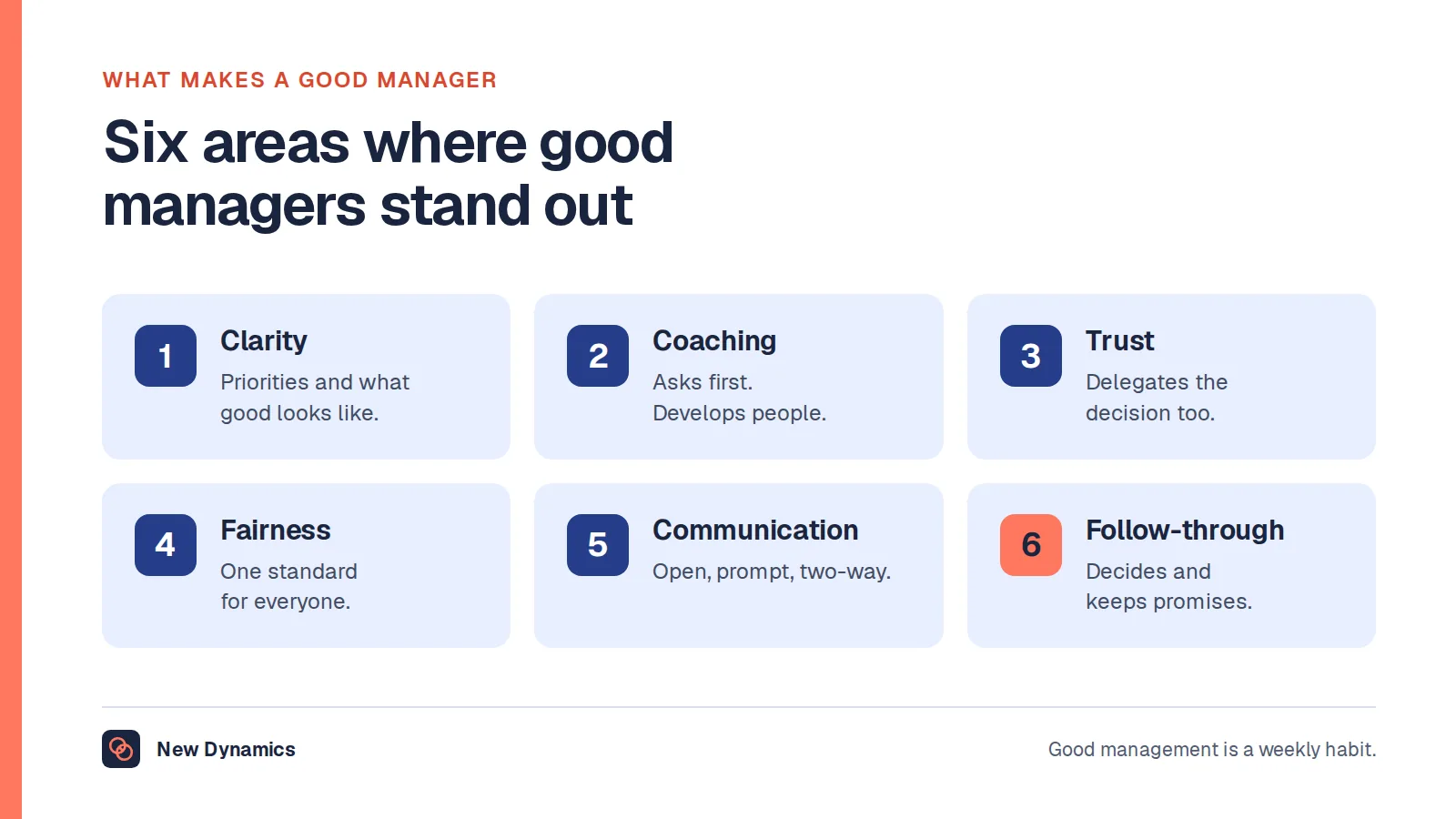
If you want the behaviours that go with the new job set out as a list, our post on what makes a good manager covers the qualities and the warning signs. This article is about sequencing: what to do, and when, while you are still new.
Your first ninety days, phase by phase

The common mistake is to arrive with a plan. The second most common is to arrive with nothing and still be drifting in month three. Work in four phases.
Days 1 to 14: listen and learn
Change nothing structural this fortnight. Specific actions:
- Hold a 45-minute conversation with every person who reports to you. Four questions: what are you working on, what is in the way, what should I know about how this team works, and what would you change if you could change one thing. Write the answers down.
- Ask your own manager, explicitly, what they expect of you in the first six months and what they would count as failure. Write down the answer and read it back to them.
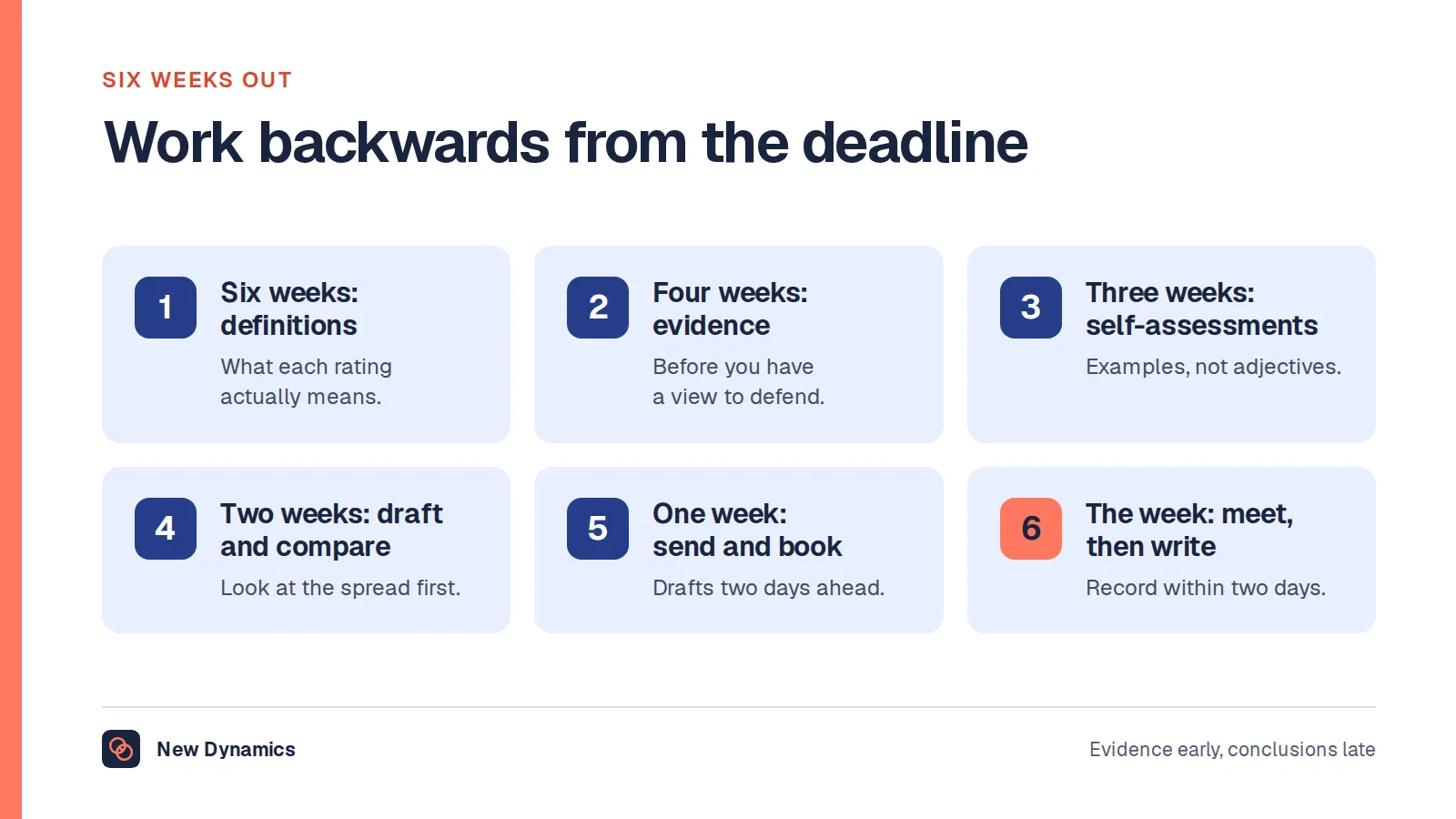
- Get the inherited paperwork: current objectives with their dates, the last review for each person, any live performance or absence issue, and anything your predecessor promised anyone. Our post on your first performance review as a new manager covers what to ask for and why a promise outlives a reporting line.
- Find out who holds the knowledge that is not written down, and who people actually ask when they are stuck.
- Ask HR which policies you are now expected to apply, and where they are.
Resist the pressure to announce a direction. You do not yet know enough, and anything you announce in week one you will have to unwind in week six.
Days 15 to 30: agree expectations
Now put things in writing, because ambiguity costs more than an imperfect decision.
- Agree no more than three priorities with each person, in writing, with what good looks like for each. Three real ones beat eight hopeful ones.
- State what each person can decide without asking you. Be specific about money, scope and signing things off. Most new teams are more cautious than their manager intends, because nobody told them where the line is.
- Say how you work: when you are reachable, how quickly you answer, what you want to hear about immediately, and what you do not need to see.
- Write down what you are taking off your own plate, and tell the person who is now doing it that it is theirs, including the decisions.
- If you inherited a documented performance issue, deal with it this fortnight. See the section on the first difficult conversation below.
Days 20 to 45: start the one-to-ones
Start these while you are still agreeing expectations, because the conversation is where expectations get maintained.
- Put a recurring 30-minute slot in the calendar with each person, weekly or fortnightly, and do not cancel it. Cancelling it twice teaches people it is optional.
- Their agenda first, yours second. A status report is not a one-to-one, and if it has become one, you can get the status from the work instead.
- Book 15 minutes after each one to write the note. That note is next year's evidence, and reconstructing it in month eleven is where unfair reviews come from.
- Acas is clear that this is the ordinary way performance is managed, not an extra. Its guidance on performance management says that alongside formal reviews, "managers should still talk to employees informally about their performance on a regular basis", and that where something is discussed, "it's important to keep a written record of what is discussed" and "this should be shared with the employee afterwards".
- Our one-to-one meeting questions give prompts for when the conversation goes flat, which it will around week six.
Days 45 to 90: make the first changes
You have earned the right to change something. Change one thing, not five.
- Pick the problem your team named most often in the first fortnight. Fixing something they told you about buys more credibility than fixing something you noticed.
- Say what you are changing, why, what you expect to improve, and when you will look at it again.
- Remove something as well as adding something. A meeting, a report nobody reads, an approval step that approves everything.
- Have one development conversation with each person about where they are heading, separate from any review.
- At day ninety, ask each person the uncomfortable question: what is one thing I could do differently that would make your work easier. Then do one of the things.
Managing people who were your peers last week
This is the hardest part of a first management job and almost every induction skips it. You are now assessing, rating and sometimes disciplining people you complained to about the last manager.
Say it out loud, once. A short conversation with each former peer in the first fortnight does most of the work: this is going to be odd for both of us, some things change and some do not, here is what changes. Pretending nothing has changed is what breeds resentment, because something obviously has.
Name what actually changes. You will stop joining some conversations. You cannot pass on everything you now know. You will have information about pay, restructures and other people's performance that you will not share, and they need to know that in advance rather than discovering it.
Expect the person who wanted your job. If someone applied and did not get it, raise it rather than waiting. Ask what they wanted from the role, say honestly what you can and cannot influence, and do not promise the next opening.
Be careful with the friendship gradient. The people you are closest to will get more of your attention, warmer feedback and the interesting work, and you will not notice. The check is mechanical: once a quarter, list your team in order of how often you speak to each of them, then look at who got the development opportunities. If the two lists match, fix it.
Fairness has to be visible, not just real. Treating a friend exactly as you treat everyone else is not enough if the team cannot see it. Put the basis for decisions in writing, especially on who gets what work.
The first difficult conversation
Delaying this is the most common new manager mistake, and it is the one that compounds. A problem raised in week three is a conversation. The same problem raised in month seven is a formal process, because by then the person can reasonably say nobody ever told them.
Three reasons new managers wait: they want to be liked, they are not sure they have the standing yet, and they tell themselves it might resolve itself. It almost never does, and every week of silence is implicit permission.
How to do the first one:
- Have it within days of the thing you noticed, not weeks. Book a private slot. Do not do it in passing or in a group setting.
- Describe the behaviour and its effect, not the character. "The report arrived on Thursday and the client meeting had already happened" rather than "you are unreliable".
- Ask before you conclude. You are new, and there is often a reason you do not know about: a second manager, an informal arrangement, a health issue, a promise from your predecessor.
- Agree one specific change and a date to review it. Vague agreement is how the same conversation happens four times.
- Write it up the same day and share the note. Not to build a case, but because a shared note prevents two honest people remembering the meeting differently.
- Separate capability from conduct in your own head. Someone who cannot yet do the job needs support and time. Someone who will not follow a reasonable instruction is a different situation with a different route.
If a conversation like this is genuinely the start of something formal, our posts on the disciplinary procedure and on what a grievance means set out the stages. For wording you can borrow, see our difficult conversations examples.
Management styles, handled sceptically
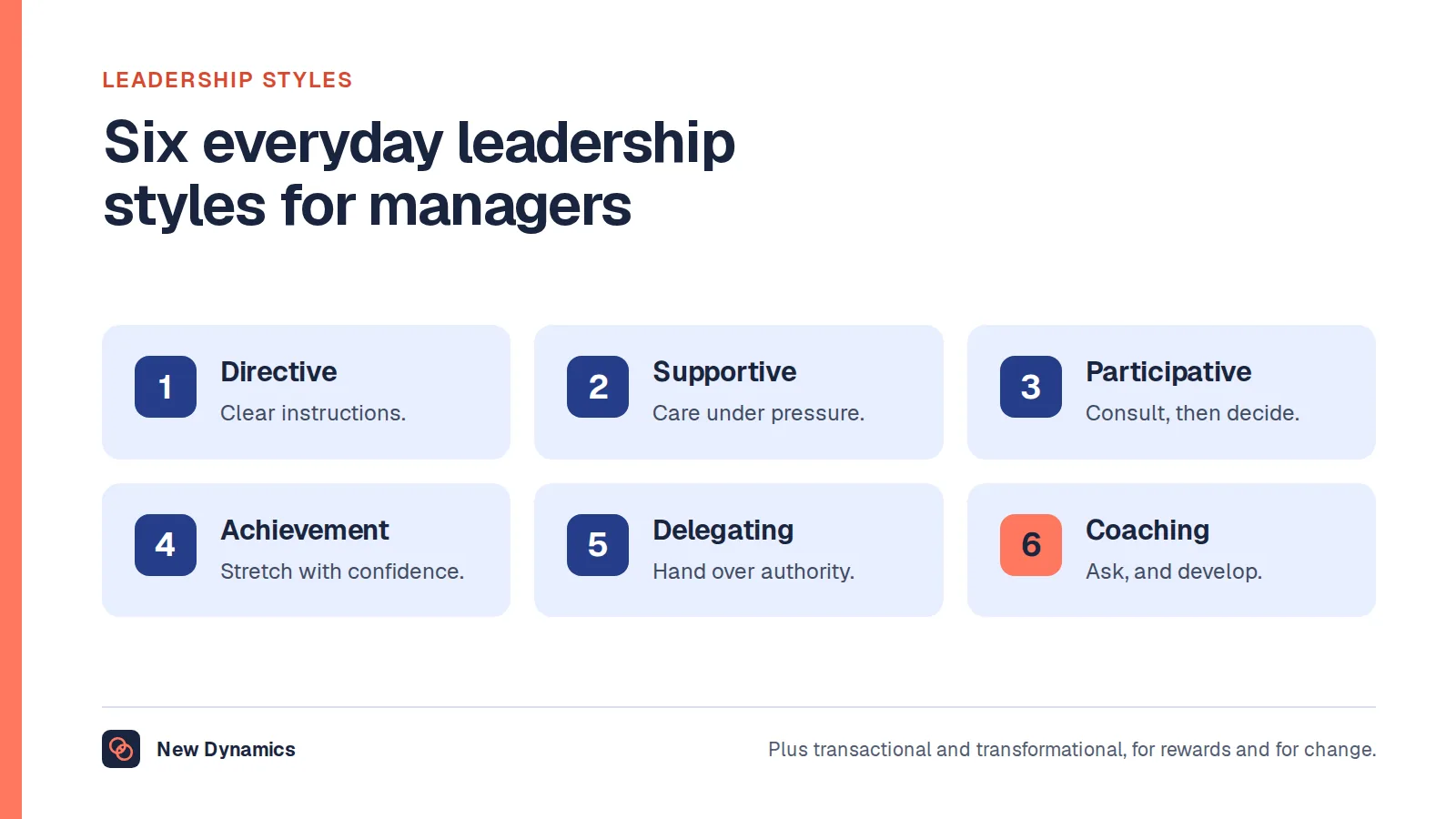
Search for management styles and you will be offered a tidy set of named types, usually between four and nine, often with a questionnaire to tell you which one you are. The honest position on these is more useful than the tidy one.
The common frames you will meet are real, in the sense that people genuinely use the vocabulary:
- Directive, consultative and hands-off, a trio descended from mid-twentieth-century social psychology, distinguishing who makes the decision.
- A grid of concern for results against concern for people, which produces four or five corner types plus a balanced middle.
- Situational models, which say the right approach depends on how experienced and how motivated the person is, and that you should move between approaches.
- Transformational against transactional, contrasting managers who motivate through purpose with those who motivate through exchange.
- Coaching, visionary, pace-setting and so on, a family of lists popularised in business writing from the late 1990s onwards.
Here is the problem. Most of these named taxonomies come from management writing, consultancy products and self-report questionnaires rather than from a replicated research base, and several were commercialised before they were tested. The categories overlap, nobody agrees on how many there are, and the questionnaires mostly measure how you describe yourself rather than what you do on a bad Tuesday. None of them should be presented to you as settled science, and we are not going to cite a vendor's model as evidence that it works.
What survives scrutiny is narrower and more practical. Treat the names as vocabulary for a decision you are making anyway: how much of this am I deciding, and how much is this person deciding. That decision changes by person and by task. The same individual needs close direction on something they have never done and complete autonomy on the thing they have done for nine years, often in the same week. A manager who picks a style and applies it uniformly is choosing to be wrong half the time.
If you want a framework with a published basis behind it, look at conditions rather than personality. The Health and Safety Executive's Management Standards describe six areas of work design, "Demands", "Control", "Support", "Relationships", "Role" and "Change", which it says "cover six key areas of work design that, if not properly managed, are associated with poor health, lower productivity and increased accident and sickness absence rates". Those are things you can actually change. Our post on leadership styles for managers goes through the named models in more detail if you need the vocabulary for an assignment or an interview.
So the answer to "what is the best management style" is that the question is slightly wrong. The judgement is per person and per task, and it is reviewable. That is less satisfying than a label and considerably more accurate.
The legal responsibilities you picked up without being told

On the day you became a manager you became part of how your employer meets its legal duties, in Great Britain, without anyone handing you the list. This is general information rather than legal advice, and the detail differs in Northern Ireland.
Discrimination. Acas states that "The main responsibility for discrimination at work lies with employers", that "Employers can be held responsible for the actions of their workers. This is called 'vicarious liability'", and that "Anyone who discriminates against someone at work is also responsible for their own actions". In practice, you are now making the decisions where discrimination happens: who gets the development opportunity, how a flexible working request is handled, what a reasonable adjustment looks like, how a pregnancy or a disability affects what you expect. The Equality Act 2010 protects, in Acas's words, "anyone who works for an employer, contractors and self-employed people hired to personally do the work, job applicants, former workers". Our post on the definition of discrimination covers the characteristics and the forms it takes.
Health and safety, including stress. The duty on work-related stress is not optional wellbeing activity. The Health and Safety Executive says that "Employers have a legal duty to protect workers from stress at work by doing a risk assessment and acting on it", and that "This is the same duty you have to protect people from other health and safety risks". You are the person who sets workload, deadlines and how much say people have in their work, so you are where that risk assessment either works or does not. The HSE also advises that where you think a worker is struggling, "If you think that a worker is having problems, encourage them to talk to someone, whether it's their line manager, trade union representative, GP, or their occupational health team".
Fair process. Acas is direct about the standard: "Employers must follow the Acas Code of Practice. It says how they should follow fair procedures", and the Code sets "The minimum standards an employer should follow for any disciplinary or grievance case". Acas also notes that "Workers and employers can often raise and deal with problems at work early and informally. When that's not possible, they can use formal" procedures. As the line manager you are usually the first stage of both: the person who hears the informal concern, who receives a grievance before it goes anywhere else, and whose contemporaneous notes decide whether a later formal step looks fair. Three practical rules follow. Do not improvise a process you have not read. Tell HR early rather than after you have already said something you cannot withdraw. Keep notes with dates, because the question later will be what was said and when.
Confidentiality and records. You now hold information about pay, health and performance that belongs to the employer and the individual, not to you socially. Keep it in the system, not in a personal spreadsheet or a message thread.
What your employer owes you
Managing well is not purely an act of individual willpower, and if you are struggling in month two it is worth knowing what should have been provided.
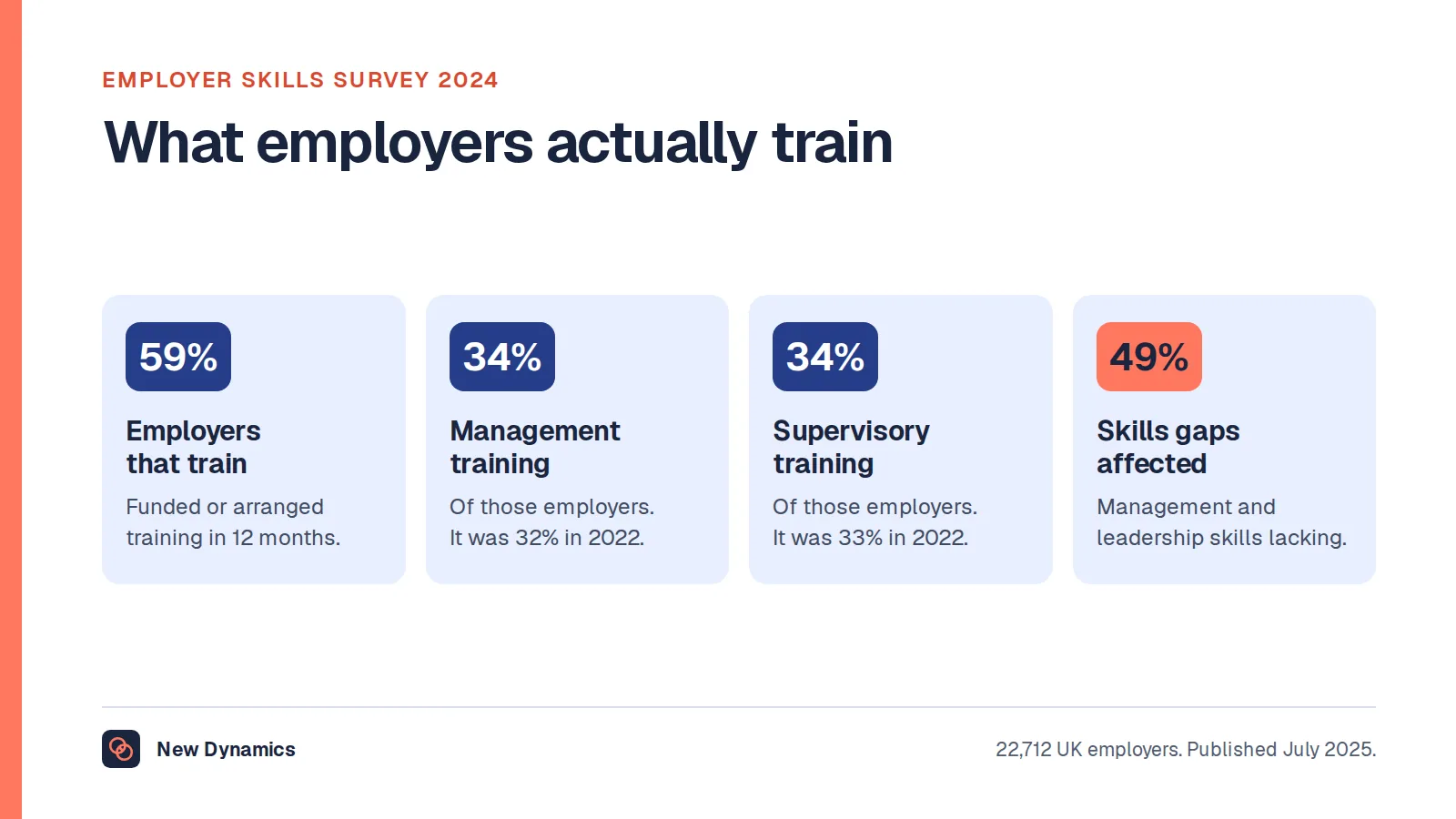
Training, ideally before the start date. For what is actually published in the United Kingdom about how many managers are trained, and what nobody counts at all, see our post on manager training statistics. The short version is that the official picture is thinner than the confident figures circulating online.
A named person to ask. Not "HR" as an abstraction, but a person you can message about a specific situation without it becoming a case. If nobody has named one, ask your manager to name one. This single thing prevents most first-year mistakes.
A realistic span of control. If you have fourteen direct reports, a weekly one-to-one with each is mathematically impossible alongside your other work, and you will quietly drop the people who are doing fine. That is a structural decision, not a personal failing, and it is worth raising with evidence. Our post on how many direct reports per manager sets out how to argue it.
Time in the job description. Management work needs hours in the week. If your previous workload came with you untouched, the management part is what will get dropped, and nothing will visibly break for about six months.
A manager of your own who manages you. You should be getting the one-to-one you are expected to give. If you are not, ask for it directly.
Frequently asked questions
What should a new manager do in the first 90 days?
Spend the first fortnight listening: a 45-minute conversation with each person, the inherited paperwork, and a clear answer from your own manager about what they expect. In the second fortnight agree three written priorities per person and say what each person can decide without asking you. Start recurring one-to-ones by about week four. From day sixty, make one change, ideally the problem your team named most often.
What is the biggest mistake a first-time manager makes?
Delaying the first difficult conversation. A concern raised within days is a short conversation about a specific behaviour. The same concern raised seven months later is a formal process in which the employee can fairly say nobody ever told them. The related mistake is continuing to do the work yourself, which removes your team's chance to learn and makes you the bottleneck.
How do you manage people who used to be your peers?
Have one short, direct conversation with each of them in the first fortnight about what changes and what does not. Say explicitly that there is information you will now hold and not share. Raise it with anyone who applied for the role rather than waiting for it to surface. Then watch the friendship gradient: list your team by how often you speak to each person and check who has been getting the opportunities.
What is the best management style for a new manager?
There is no best one, and the named style taxonomies are weaker evidence than they look. Most come from management writing and self-report questionnaires rather than a replicated research base. The useful version of the question is per person and per task: how much of this am I deciding, and how much is this person deciding. Direct closely on work someone has never done, and stay out of the way on work they have done for years.
What are the different types of managers?
In everyday use, the types people mean are either levels, such as team leader, line manager, middle manager and senior manager, or approaches, such as directive, consultative and hands-off. Levels are real and defined by your organisation. Approaches are vocabulary rather than measured categories, so treat a label as a description of what someone did in a situation, not a fixed personality type.
What legal responsibilities does a new manager have in the UK?
You become part of how your employer meets its duties. Acas says the main responsibility for discrimination at work lies with employers, that employers can be vicariously liable for their workers' actions, and that individuals are also responsible for their own. The Health and Safety Executive says employers have a legal duty to protect workers from stress at work by doing a risk assessment and acting on it. You are also normally the first stage of a grievance or disciplinary matter, and Acas requires employers to follow its Code of Practice. This is general information for Great Britain, not legal advice.
Your next step: book the conversations before anything else
- Put a recurring 30-minute one-to-one in the calendar with every person who reports to you, this week, with a 15-minute writing slot after each.
- Ask your own manager what they would count as failure in your first six months, and write down the answer.
- Ask HR to name one person you can ask about a specific employee situation without it becoming a case.
- Name the conversation you have been avoiding, and book it for a date within the next seven days.
For an agenda, prompts and a note-taking structure for the conversation that carries most of this, read and download our manager one-to-one guide. The guide is free to read, and the PDF uses our short download form.
Want your new managers working from a record of the year rather than their memory of the last fortnight? Book a New Dynamics demo and bring your last two years of promotions into management. You can also email contact@new-dynamics.com.