TL;DR
- A development conversation asks someone to name what went wrong. A pay conversation asks them to make their case. Run both in the same meeting and the second wins, which is why reviews tied directly to money produce less honest conversations.
- There are three workable models: a direct link from rating to increase, a loose link where the review informs a moderated recommendation, and no link at all with pay set by level and market. Each is defensible and each costs something different.
- Acas says the process for deciding performance-related pay should be fair and objective, and that employers must avoid treating people less favourably because of a protected characteristic. Equal pay sits alongside it: men and women must get equal pay for equal work.
Everybody in the room knows the review decides the pay rise, and nobody says so. The employee arrives ready to argue their year rather than examine it. The manager, who wanted a development conversation, gets a negotiation. The honest discussion about what went wrong in the spring never happens, because it would be expensive.
This article covers whether reviews should drive pay at all, three models with their costs, how to run the two conversations apart, what to say when someone asks mid-review, and the fairness checks performance pay needs. It describes the position in Great Britain and is general information, not legal advice.
Separating the conversations is easier when the evidence is already recorded. See how New Dynamics performance reviews keep goals, feedback and the written record in one place.
The conflict, stated plainly
Acas describes a review as a chance to discuss "what they are doing well", areas for improvement, "whether they need more support or training" and "their career and any development objectives". Three of those four need candour: the employee has to be willing to say what they found hard.
A pay conversation asks for the opposite behaviour. It rewards advocacy, confidence and a tidy story. Put both in one hour and people behave rationally, which means they argue rather than reflect. That is not a character flaw, it is the design.
Three models

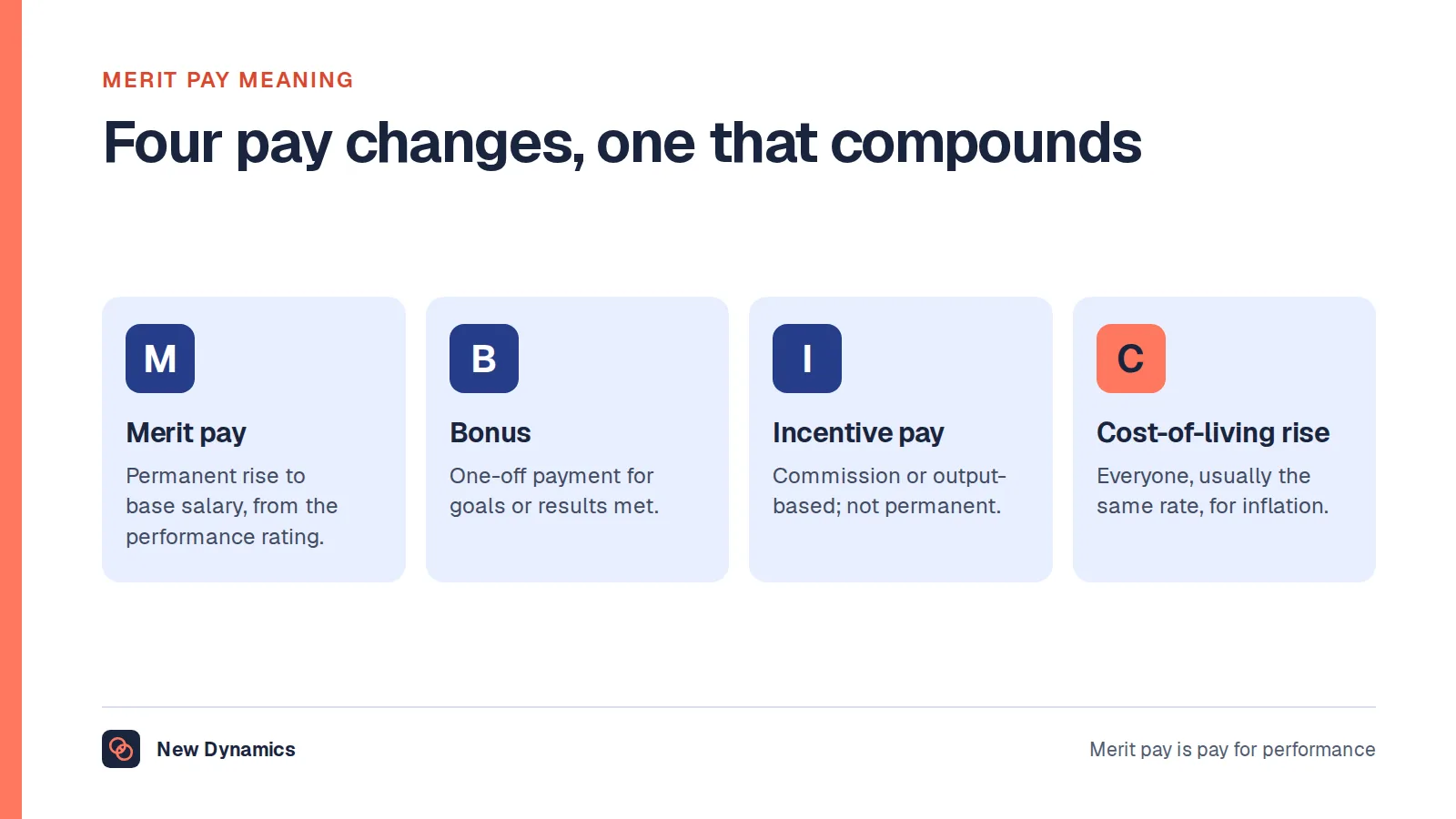
Direct link. A rating maps to an increase, usually through a matrix that also considers position in range. Acas lists "annual pay rises linked to individual performance", commission and target-based bonuses among the forms performance-related pay takes.
Good for: transparency, predictability, simple administration, and a visible reason for every number. Costs: the honesty of the conversation, pressure on ratings, and an argument about the matrix every year.
Loose link. The review informs a manager's recommendation, which is moderated across a group alongside the ratings and the evidence.
Good for: judgement, context, and the ability to recognise things a rating does not capture. Costs: more work, a harder explanation, and a real risk of invisible bias if the moderation is weak.
No link. Pay follows level and market position, with increases applied consistently. The review is for development, feedback and progression readiness.
Good for: candid reviews, and removing the annual anxiety from the conversation. Costs: strong performers may feel unrecognised unless progression is genuinely responsive, and managers lose a lever they are often expected to have.
All three are defensible. What is not defensible is pretending there is no link when everybody knows there is one.
Which model suits which organisation
- Direct links suit volume roles with countable output, where targets are objective and everyone can see the same numbers. They suit a sales floor far better than a research team.
- Loose links suit mixed work, where results depend on collaboration and a single number would flatter whoever happened to own the visible piece. They need a real moderation conversation to work, which costs manager time.
- No link suits organisations that want candour more than differentiation, or whose pay is already tightly banded, or who have found that their ratings cannot bear the weight of money without inflating.
Two practical tests. First, could you explain this year's decision for any individual in two sentences to somebody outside the team? Second, would your managers describe the link the same way you would? If either answer is no, the model is not the one you think you have.
Whichever model you choose, say so
The worst version of this is the unwritten rule: a link that exists in practice, is never published, and is denied in the meeting. People work it out, and then they distrust both the rating and the increase.
Publish the model, the dates and the decision maker before the cycle opens. Our post on removing ratings from performance reviews makes the same point from the other direction: if the label goes but the decision stays, the basis has to be visible somewhere.
Separating the two conversations

- Set the sequence at the start of the cycle. Reviews in one window, pay decisions communicated in another, with the gap stated in advance.
- Leave a few weeks between them. Long enough that the review is not read as a pay negotiation, short enough that the delay does not look like avoidance.
- Hold the development conversation first, and finish it. Objectives, support, career. No numbers.
- Answer honestly if asked. "Yes, this feeds into pay. The decision is made in March by the department, and I will tell you the outcome in the week of the fifteenth either way." Denying the link costs more than naming it.
- Deliver the pay news as its own conversation, however short, and give the reason. A payslip is not a message.
One more rule worth having: never let a pay decision arrive without a human sentence attached, and never let that sentence be the first time someone hears their rating.
Fairness checks performance pay needs

Acas is direct that "the process for deciding this should be fair and objective" and that "employers must avoid treating people 'less favourably' because of a protected characteristic", warning that where workers do not see it as fair they are likely to be "less motivated", "dissatisfied at work" and "more likely to leave".
Four checks, run before the money moves:
- Distribution of outcomes by manager. The same spread problems that affect ratings affect increases, as our post on rating an employee fairly sets out.
- Outcomes by working pattern and leave. Part-time, shift and anyone who had a period of family or sick leave. Pro rata the amount, never the standard.
- Equal pay. Acas states that "by law, men and women must get equal pay for doing equal work". Repeated small differences in performance awards compound over years, which is how a gap appears between people doing the same job.
- A written reason for every decision. Not a paragraph, a sentence. It is also what makes a later question answerable.
When there is no money
Pay freezes, caps and tight pools are common, and the honest handling is the same: say it before the review, not after.
A review held while people believe an increase is coming, in a year where it is not, damages trust twice. Tell people what the pool looks like, run the review for the record and the development, and be clear that the rating still matters for progression and for the record even when it cannot move anyone's salary this year. Our post on merit pay covers the mechanics where there is a pool to distribute.
Frequently asked questions
Should performance reviews affect pay?
They can, and many organisations link them deliberately. The cost is candour: once the meeting decides money, people argue their year rather than examine it. If you want honest development conversations, separate the two in time, or set pay by level and market and use the review for feedback and progression.
How do you separate the pay conversation from the review?
Publish the sequence before the cycle: reviews in one window, pay communicated in another, with a gap of a few weeks. Hold the development conversation first and finish it without numbers, answer honestly if someone asks about the link, then deliver the pay outcome as its own short conversation with a reason attached.
What should you say if an employee asks about pay during a review?
Tell the truth and give dates. Confirm whether the review feeds into pay, say who decides and when, and promise the outcome either way. Then offer to come back to it, and return to the conversation you are in. Denying a link that exists is the one answer that does lasting damage.
Is performance-related pay fair?
It can be, if the process is. Acas says the process should be fair and objective and that employers must avoid treating people less favourably because of a protected characteristic, and warns that pay seen as unfair reduces motivation and increases turnover. Published rules, moderation and a written reason for each decision are what make it defensible.
Can performance pay create an equal pay problem?
Yes, over time. Acas states that men and women must get equal pay for equal work, and small repeated differences in performance awards compound between people doing the same job. Check outcomes by sex and by working pattern each cycle, in aggregate and with HR, rather than only looking at starting salaries.
What if there is no budget for pay rises this year?
Say so before the reviews happen. Run the cycle for the record, the feedback and progression, and be explicit that ratings still matter even though they cannot move salaries this year. A review that implies money which never arrives costs more trust than a frank message about the pool.
Your next step: write the link down
- Write one sentence describing how reviews affect pay in your organisation, then check whether anyone outside HR would recognise it.
- Publish the sequence and the dates before the next cycle opens.
- Give managers one line to use when asked mid-review, so nobody improvises.
- Run the four fairness checks on last year's outcomes before you design this year's.
For the policy this sits inside, read and download our compensation policy guide. The guide is free to read, and the PDF uses our short download form.
Want reviews whose evidence can carry a pay decision without becoming one? Book a New Dynamics demo and bring your current cycle dates. You can also email contact@new-dynamics.com.