TL;DR
- There is no single official list of ten personality traits. The best-supported answer in research psychology is the ten aspects of the Big Five: each of the five broad traits splits into two related but distinct parts.
- The ten are volatility and withdrawal (neuroticism), compassion and politeness (agreeableness), industriousness and orderliness (conscientiousness), enthusiasm and assertiveness (extraversion), and intellect and openness (openness/intellect).
- At work, the aspects are useful for understanding differences and for self-awareness. They are a poor basis for hiring or performance decisions on their own; judge behaviour and results instead.
Someone on the team has done a personality quiz and come back with a list of traits. A candidate asks whether a test at interview will judge their personality. A manager wonders why two equally capable people work so differently. All three lead to the same question: what are personality traits, and how many are there?
This article answers what are the 10 personality traits in the way research psychology does: the ten aspects of the Big Five model. It explains what each aspect means in plain words, how they show up at work, and where personality measures help and where they should not be used.
Personality explains how people tend to work, but reviews should judge what they actually did. See how New Dynamics performance reviews keep the conversation on behaviour, goals and evidence.
If you are preparing interviews, our post on personality interview questions covers what to ask and what a good answer looks like.
Is there an official list of 10 personality traits?
No single list is official, and many websites publish their own "top ten". The most widely used scientific model of personality is the Big Five, which groups personality into five broad traits: openness, conscientiousness, extraversion, agreeableness and neuroticism.
The best-supported answer to the question of ten comes from a study by Colin DeYoung, Lena Quilty and Jordan Peterson, published in the Journal of Personality and Social Psychology in 2007 under the title "Between facets and domains: 10 aspects of the Big Five". Analysing the detailed scales of two major personality questionnaires, they found evidence of "2 distinct (but correlated) aspects within each of the Big Five", sitting between the five broad traits and the many narrow facets beneath them. They built a 100-item questionnaire, the Big Five Aspect Scales, to measure the ten.
The 10 personality traits, explained

The names below are the scale names used in the Big Five Aspect Scales scoring keys published on the International Personality Item Pool site. The descriptions are ours, in plain words.
Openness/Intellect
- Intellect. Interest in ideas, reasoning and solving problems. Shows up as enjoying complex questions and learning quickly.
- Openness. Interest in art, imagination, beauty and new experiences. Shows up as creativity and comfort with the unconventional.
Conscientiousness
- Industriousness. Drive, persistence and getting things done. Shows up as finishing work and pushing through setbacks.
- Orderliness. Preference for structure, tidiness and following routines. Shows up as careful planning and attention to detail.
Extraversion
- Enthusiasm. Warmth, sociability and positive emotion. Shows up as energy in groups and easy rapport.
- Assertiveness. Taking charge, speaking up and seeking influence. Shows up as leading discussions and making the case.
Agreeableness
- Compassion. Empathy and concern for others' feelings. Shows up as noticing when a colleague is struggling.
- Politeness. Courtesy, cooperation and respect for norms. Shows up as avoiding conflict and keeping to agreements.
Neuroticism
- Volatility. Tendency towards irritability, anger and changing moods. Shows up as strong reactions under pressure.
- Withdrawal. Tendency towards anxiety, worry and self-doubt. Shows up as caution and holding back after criticism.
Two points help in reading the list. First, each pair is correlated but distinct: someone can be highly industrious without being especially orderly, and assertive without being especially enthusiastic. Second, none of the ten is good or bad in itself. Orderliness helps an auditor and can frustrate a start-up; withdrawal can mean caution that prevents mistakes.
How the traits show up at work

Personality describes tendencies, not fixed behaviour. People adapt to roles, teams and circumstances, and the same person can be quiet in one meeting and forceful in another. Used carefully, the aspects help with:
- Self-awareness. Knowing you score low on orderliness is a prompt to build a system, not an excuse.
- Team working. A team of assertive people may need someone to slow decisions down; a team high in politeness may need permission to disagree.
- Feedback conversations. Framing a development point around a tendency ("you tend to hold back when challenged") is easier to discuss than a judgement of character.
- Role design. Some roles reward orderliness, others intellect or enthusiasm. Matching where possible helps people do their best work.
Where personality measures should not be used
Personality questionnaires are easy to misuse. A few cautions:
- Not as the deciding factor in hiring. Judge candidates on the skills and behaviours the job needs, assessed against criteria you can explain. If you do use a questionnaire, treat it as one input, use a validated tool, and check it does not disadvantage any group.
- Not for performance ratings. Rate what someone did and achieved. "Not assertive enough" is not a performance standard; "did not raise the budget risk with the client" is.
- Not without adjustments. Acas notes that employers must ask interview candidates whether they need reasonable adjustments, including "giving someone more time to do a written test that is part of an interview". The same applies to any timed questionnaire.
- Not from a free online quiz. Many popular tests are not built on the Big Five and have little evidence behind them.
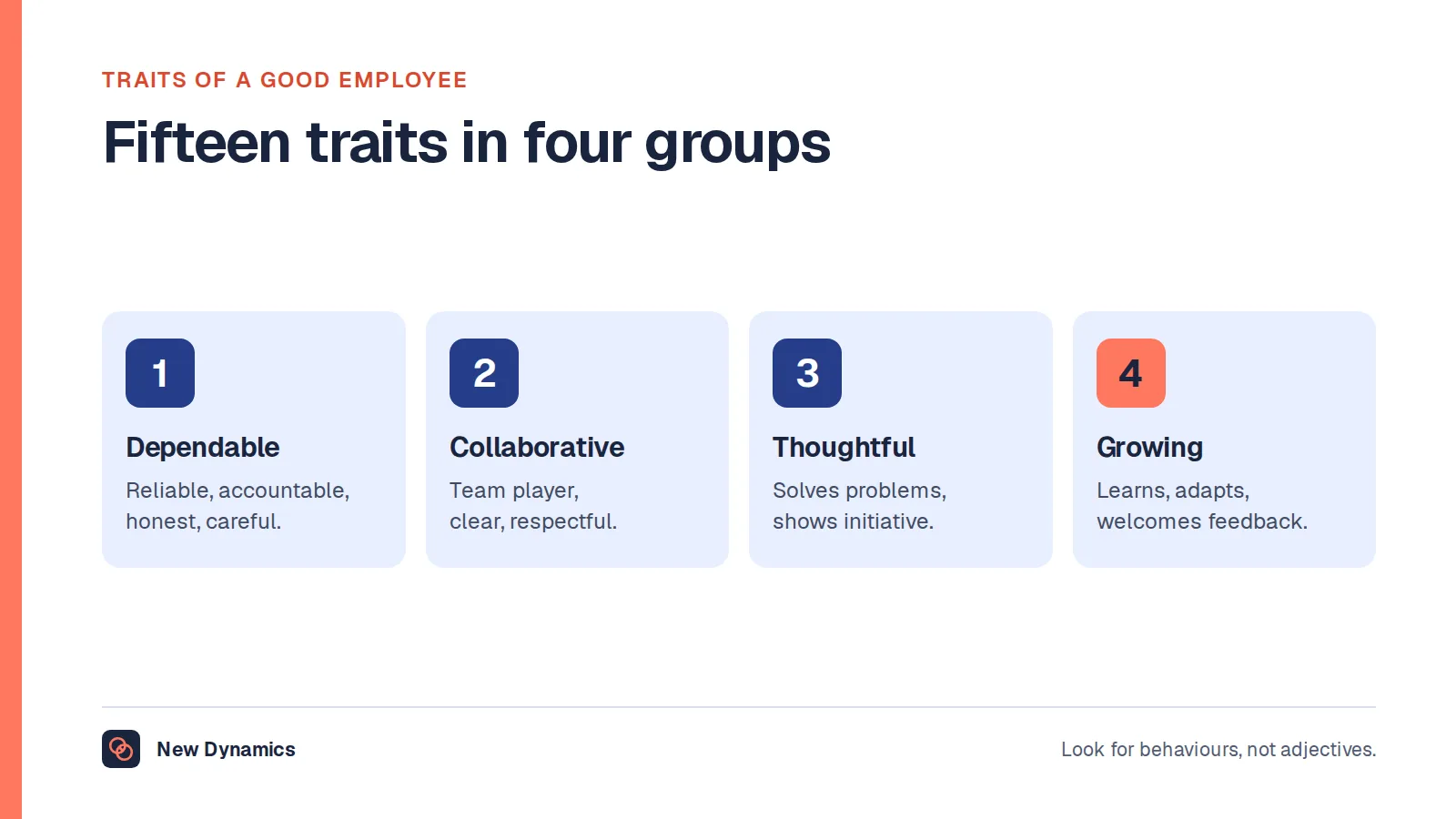
Our post on good employee traits covers the observable behaviours that matter more in practice.
Common mistakes
- Treating a trait as a verdict. Personality is a tendency, not a fixed label.
- Assuming high is always better. Every aspect has strengths and costs depending on the role.
- Confusing preference with ability. Low enthusiasm does not mean poor teamwork.
- Using scores to rate performance. Rate behaviour and results.
- Relying on unvalidated quizzes. Check what a tool measures before using it at work.
Frequently asked questions
What are the 10 personality traits?
In research psychology, the best-supported answer is the ten aspects of the Big Five: volatility and withdrawal, compassion and politeness, industriousness and orderliness, enthusiasm and assertiveness, and intellect and openness. Each of the five broad traits splits into two related aspects.
What are the Big Five personality traits?
Openness to experience (sometimes called openness/intellect), conscientiousness, extraversion, agreeableness and neuroticism. They are the most widely used model of personality in research.
Who identified the 10 aspects of the Big Five?
Colin DeYoung, Lena Quilty and Jordan Peterson, in a 2007 study in the Journal of Personality and Social Psychology. They found two distinct but correlated aspects within each Big Five trait and built the Big Five Aspect Scales to measure them.
Can personality traits change?
Personality is fairly stable in adults, but it is not fixed. People adapt their behaviour to roles and situations, and traits can shift gradually over a lifetime.
Should employers use personality tests in hiring?
Only with care, and never as the deciding factor. Assess candidates on the skills and behaviours the job needs, use a validated tool if you use one at all, check it for bias, and offer reasonable adjustments such as extra time.
Your next step: use the ten as a conversation, not a label
- Share the ten aspects with your team and ask each person which two describe them best.
- Discuss how those tendencies help and hinder the team's work.
- Agree one practical adjustment, such as who challenges decisions or who owns the plan.
- Keep reviews focused on behaviour and results rather than personality scores.
For a fair, evidence-based approach to assessing candidates, read and download our recruitment and selection guide. The guide is free to read, and the PDF uses our short download form.
Want reviews that judge behaviour and results rather than personality? Book a New Dynamics demo and see how goals, feedback and reviews fit together. You can also email contact@new-dynamics.com.