TL;DR
- A strength is something you do well, do often and find energising. A weakness is a skill or habit that currently holds your work back. Everyone has both, and interviewers and managers know it.
- The best answers follow two formulas. For a strength: name it, prove it with an example and link it to the role. For a weakness: name a real one, show that you understand its effect and describe what you are doing about it.
- The same thinking works in performance reviews. Build on strengths deliberately, and turn one or two weaknesses into development goals.
“What are your strengths and weaknesses?” is one of the oldest interview questions, and it still unsettles people. Strengths feel like boasting. Weaknesses feel like a trap. The same discomfort returns every year at review time, when a form asks for “areas of strength” and “areas for development”.
This article gives you 30 strengths and 20 weaknesses examples for work, two simple formulas for talking about them, sample answers for interviews and wording for performance reviews.
Knowing your strengths and weaknesses depends on honest, regular feedback. See how New Dynamics continuous feedback helps people to ask for it and act on it.
What counts as a strength, and what counts as a weakness?
The UK Civil Service, which assesses candidates on strengths, defines them in its Success Profiles guidance as “the things we do regularly, do well and that motivate us”. All three parts matter. Something that you do well but that drains you is a skill, and it may not be a strength.
A weakness is a skill, a habit or an area of knowledge that currently holds your work back. The word “currently” is deliberate. Most weaknesses at work can be improved or managed.
Two points help to keep this in proportion.
- Everyone has weaknesses, and the people asking know it. They are testing your self-awareness and your honesty more than your perfection.
- Strengths overdone become weaknesses. Attention to detail becomes perfectionism. Decisiveness becomes haste. Helpfulness becomes an inability to say no. Often your main weakness is hiding behind your main strength.
Two formulas
For a strength: name it, prove it, link it.
“One of my strengths is [strength]. For example, [what you did and the result]. I think that matters here because [link to the role].”
For a weakness: name it, show its effect, describe the plan.
“Something I am working on is [real weakness]. I noticed it when [effect on your work]. So I have started [specific action], and [evidence of progress].”
The National Careers Service gives the same advice in its guide to common interview questions. On strengths: “Plan your answers around 2 or 3 examples that are relevant to the job.” On weaknesses: “You should be honest when answering questions on your weaknesses. Say how you're working to improve them.”

30 examples of strengths at work
Choose strengths that the role needs, and that you can prove.
Working with people
- Building relationships: I get to know people in other teams before I need their help.
- Listening: I summarise what I have heard before I respond.
- Teamwork: I share information early, and I help without being asked.
- Empathy: I notice when someone is struggling, and I check in.
- Coaching others: I enjoy helping new colleagues to become confident.
- Handling conflict: I raise disagreements directly and calmly.
- Customer focus: I find out what the customer needs before proposing a solution.
- Influencing: I win support by understanding what others care about.
Delivering work
- Reliability: I do what I said I would, when I said I would.
- Organisation: I plan my week, and I know my priorities.
- Attention to detail: I check my work against the source.
- Working under pressure: I stay calm and keep communicating.
- Following through: I finish the last ten per cent.
- Time management: I estimate realistically, and I flag risks early.
- Quality focus: I care about getting it right first time.
Thinking
- Problem solving: I look for the cause before choosing a fix.
- Analytical thinking: I use data to test my assumptions.
- Creativity: I suggest new approaches, and I test them on a small scale.
- Decision-making: I decide in good time, and I explain my reasoning.
- Commercial awareness: I understand how the organisation makes and spends money.
- Strategic thinking: I connect today's task to the bigger goal.
- Learning quickly: I get up to speed with new tools and subjects fast.
Communicating and leading
- Clear writing: People can act on my messages after one reading.
- Presenting: I explain complex subjects simply.
- Giving feedback: I am specific, prompt and kind.
- Leadership: I make priorities clear, and I trust people to deliver.
- Delegation: I hand over the decision as well as the task.
- Initiative: I act on problems that I notice.
- Adaptability: I adjust quickly when plans change.
- Resilience: I recover from setbacks, and I ask for support when I need it.
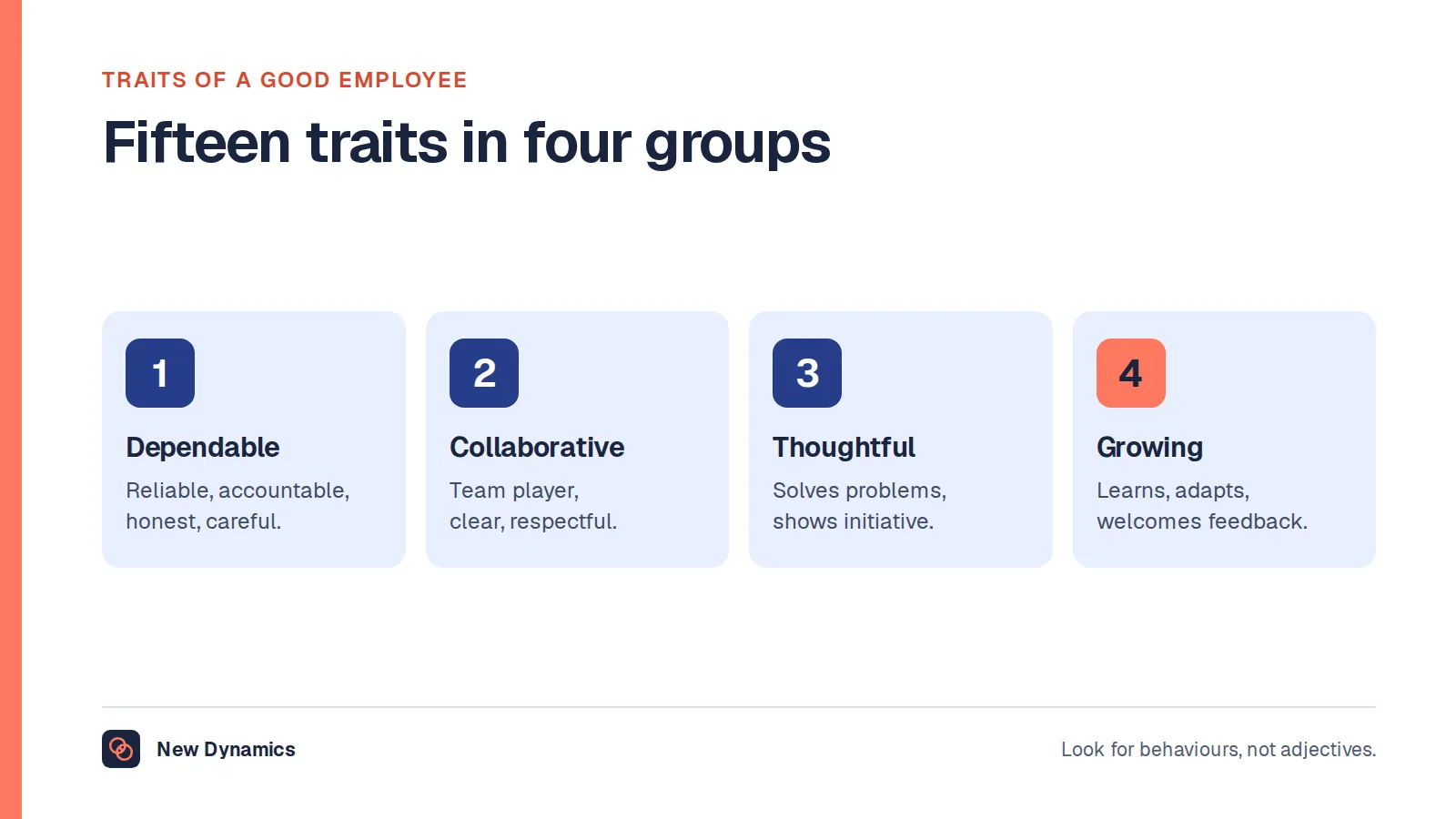
For more, see our traits of a good employee and our guide to soft skills for a CV.
20 examples of weaknesses at work, with ways to improve
Each is a real, common weakness, written with an action. Pick one that is true for you and that is not central to the job you are applying for.
- Delegating. I tend to do things myself because it feels quicker. I now hand over one recurring task each month, with a clear outcome.
- Saying no. I take on too much and then work late. I now check my priorities with my manager before accepting new work.
- Public speaking. Presenting to large groups makes me nervous. I volunteered to present at our monthly meeting, and I ask for feedback each time.
- Perfectionism. I can spend too long polishing. I now agree what “good enough” looks like at the start, and I set a time limit.
- Impatience. I get frustrated when decisions are slow. I have learned to ask what is needed to move forward.
- Asking for help. I struggle on alone for too long. I now set myself a limit of an hour before I ask.
- Giving difficult feedback. I used to avoid it. I now prepare with a simple structure, and I raise issues within a week.
- Time management on long projects. I underestimated how long things take. I now break projects into milestones, and I review them weekly.
- Too much detail. My updates were too long. I now put the conclusion in the first two lines.
- Speaking up in meetings. I used to stay quiet and share ideas afterwards. I now prepare one point in advance for every meeting.
- Taking criticism personally. I used to get defensive. I now write the feedback down, thank the person and reflect for a day.
- A technical gap. I have limited experience with a particular tool. I am taking a course, and I have built two practice projects.
- Financial knowledge. I was less confident with budgets. I asked our finance partner to walk me through ours, and I now review it monthly.
- Networking. I find it uncomfortable. I set myself a goal of one new conversation at each event.
- Switching off. I checked email late into the evening, and it affected my energy. I now stop at seven.
- Multitasking. I tried to do too many things at once, and I made errors. I now block time for focused work.
- Being too blunt. My directness could come across as harsh. I now ask a question first, and I check how my message landed.
- Procrastinating on dull tasks. I put off administration. I now do it first thing on Fridays.
- Over-committing to deadlines. I gave optimistic dates. I now add a margin, and I confirm the date the next day.
- Limited management experience. I have not managed a team formally. I have mentored two colleagues and led a project group, and I am taking a management course.
Our personal development goals examples show how to turn any of these into a goal.

Sample interview answers
“What are your strengths?”
“I would pick two. The first is problem solving. Last year our team kept getting stock errors, and everyone was fixing them one by one. I traced them to a unit-of-measure mismatch between two systems and worked with IT to fix it at source. The errors stopped. The second is clear communication. I write a weekly project note, and stakeholders have told me that it is the one update they always read. I think both matter here, because this role sits between operations and customers.”
“What is your greatest weakness?”
“Delegating. When I became a team leader, I kept doing the complicated work myself, because it felt quicker. I realised that my team was not developing and that I was becoming a bottleneck. So I started handing over one recurring task each month, with a clear outcome and a check-in. My team now runs our monthly report without me, and it is better than when I did it. I still have to resist the urge to step in, but I have learned to ask questions first.”
The National Careers Service offers a shorter example: “I struggle with time management on projects. To make sure I stick to the time frame I'm creating a timetable of steps at the start of each project.”
Answers to avoid
- The disguised boast: “I work too hard” or “I care too much”. Interviewers have heard them many times.
- “I do not have any weaknesses.” It suggests a lack of self-awareness.
- A weakness that is essential to the job. Do not tell an accounts interviewer that you struggle with detail.
- A character flaw with no plan, such as “I am lazy”.
- An irrelevant weakness, such as “I cannot cook”.
Strengths and weaknesses in a performance review
The same two formulas work when you write about yourself, or about a member of your team.
For strengths: “Priya's main strength is problem solving. She traced the recurring stock errors to their cause and fixed them at source, which saved the team about five hours a week. Next year I would like her to coach two colleagues in the same approach.”
For weaknesses, which a review usually calls areas for development: “Priya tends to take on too much herself. Twice this quarter she worked weekends to catch up. We have agreed that she will hand over the weekly report by March, and that we will review her workload monthly.”
A few rules for managers follow.
- Spend as much time on strengths as on weaknesses. Building on what someone does well is often the quicker route to better performance.
- Choose one or two development areas, not six.
- Describe behaviour, with examples. Avoid labels.
- Agree the support that you will provide.
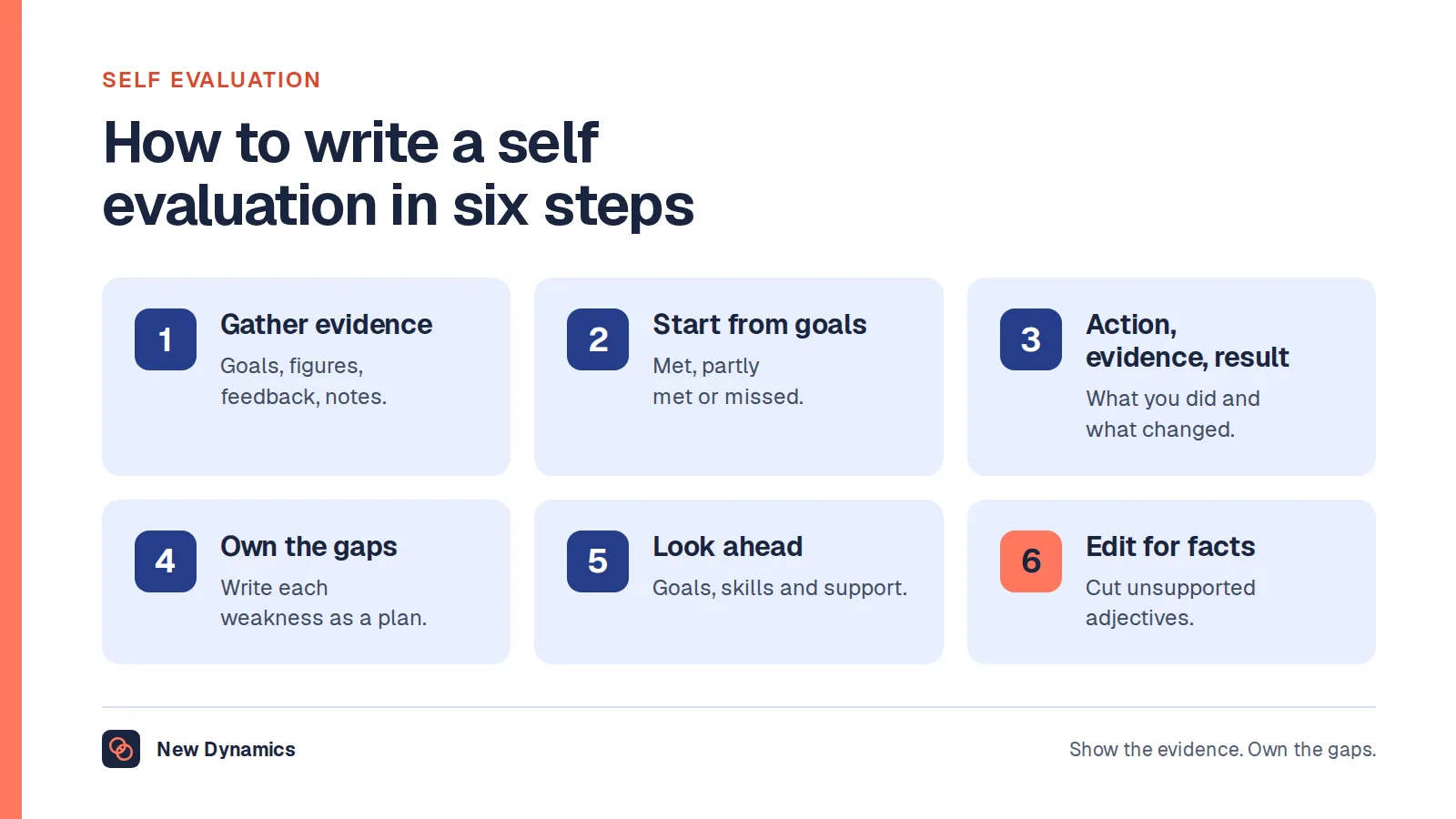
Our performance review phrases give wording by skill, and our self evaluation examples help employees to write their own.
How to find your own strengths and weaknesses
- Look at the evidence. Which tasks do you finish fastest, and enjoy? Which do you put off? What have past reviews said?
- Ask three people. “What do you see as my main strength? What one thing could I do better?” Our colleague feedback examples include 20 questions.
- Notice your energy. Strengths tend to energise you. Work that always drains you may point to a weakness, or simply to a poor fit.
- Check the overdone strength. Ask what happens when you use your best quality too much.
- Write them down, with one example for each, and revisit them every six months.

Frequently asked questions
What are good examples of strengths and weaknesses?
Good strengths include problem solving, reliability, clear communication, teamwork and learning quickly, each backed by an example. Good weaknesses are real and improvable, such as delegating, public speaking, saying no or asking for help, each with an action you are taking.
How do I answer “What are your strengths and weaknesses?”
For strengths, name two that the role needs, prove each with a short example and link them to the job. For a weakness, choose a real one that is not central to the role, explain its effect and describe what you are doing to improve.
What is a good weakness to say in an interview?
Choose something true, improvable and not essential to the job, such as delegating, presenting to large groups, saying no, or a specific technical gap. Always add the action you are taking and any progress so far.
What are employee strengths in the workplace?
Common employee strengths include reliability, teamwork, communication, problem solving, organisation, attention to detail, adaptability, initiative, customer focus and the ability to learn quickly. The most useful ones are those that the role needs most.
How do you write about weaknesses in a performance review?
Call them areas for development. Describe the behaviour with an example, explain its effect and agree a specific action with support and a review date. Limit the list to one or two priorities.
Should I focus on my strengths or on my weaknesses?
Both, in proportion. Build on your strengths deliberately, because that is where you add most value. Work on a weakness when it limits your results or your next step. Manage the rest, for example by teaming up with someone whose strengths differ from yours.
Your next step: write two of each
- Write down two strengths, each with an example and a result.
- Write down two weaknesses, each with its effect and an action.
- Ask one colleague whether they recognise the list.
- Turn one weakness into a development goal for the next quarter.
For a worksheet that turns strengths and development areas into a plan, read and download our career development guide. The guide is free to read, and the PDF uses our short download form.
Want strengths and development areas to be discussed all year, with evidence to hand? Book a New Dynamics demo and bring your current review form. You can also email contact@new-dynamics.com.