TL;DR
- An applicant tracking system holds people who applied. A recruitment CRM holds people who have not applied yet: past applicants who agreed to stay in touch, event contacts, silver medallists and speculative interest. The difference is consent and intent, not features.
- The decision is rarely about software. It is whether you have enough repeat hiring, and enough discipline to keep in touch, to justify holding people's details between vacancies.
- Whatever you buy, you must have told people you were keeping their information and why. The ICO's position on recruitment records is that information must not be kept longer than needed, and keeping details for future roles requires having said so. This is general information, not legal advice.
Every recruiter has a mental list: the three good people who came second last year, the contact from a conference, the person who said "not now, but keep me in mind". A recruitment CRM is software for that list, and the first question is not which product but whether you are allowed to keep it and whether you will actually use it.
This article explains what candidate relationship management is, how it differs from an applicant tracking system, when a talent pool earns its keep, the rules that govern holding people's details between vacancies, and what to ask before buying. It names no products.
Keeping a good candidate warm matters less than what happens after they accept. See how New Dynamics onboarding turns an accepted offer into a clear first ninety days.
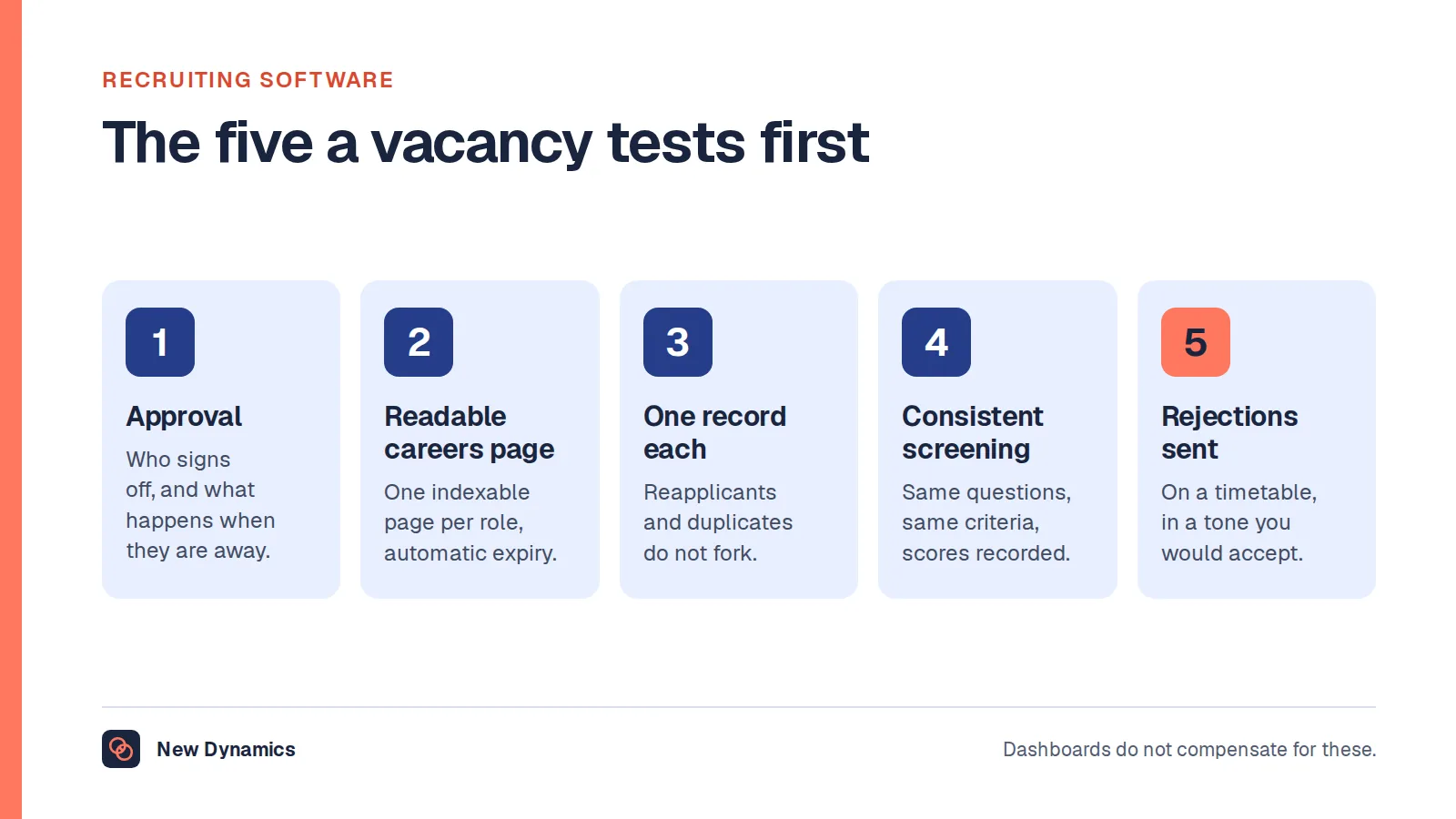
If you are still deciding on the core system, our guide to recruiting software covers the requirements a live vacancy tests first.
ATS and CRM: the actual difference

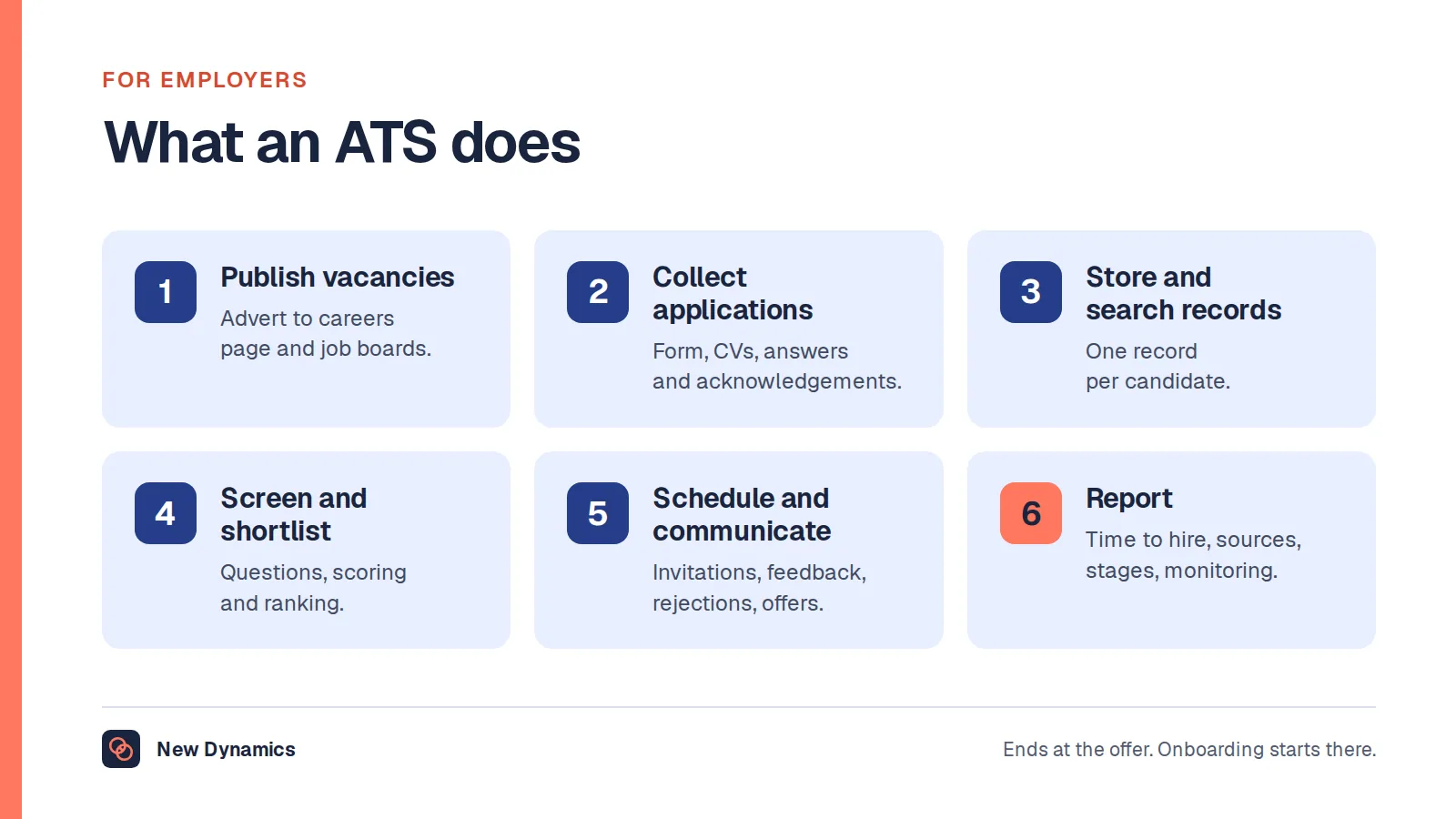
An applicant tracking system holds people who applied to a specific vacancy, with stages, decisions and a record of the process. Its job runs from application to offer.
A recruitment CRM holds people who have not applied, or who applied in the past and agreed to stay in contact: talent pools, event contacts, silver medallists, speculative approaches, alumni. Its job is to keep a relationship warm so that the next vacancy starts with a shortlist rather than an advert.
Our post on what an ATS is sets out the boundary in more detail, including where an HRIS takes over.
Two practical consequences:
- The record is different. An ATS record is a process; a CRM record is a relationship, with notes on what someone wants next and when to get back in touch.
- The failure mode is different. An ATS fails by losing a decision. A CRM fails by going stale, which it does within months if nobody contacts anyone.
When a talent pool is worth keeping
Three conditions, and you want at least two.
- You hire the same roles repeatedly. Pools work for volume and for recurring specialisms. They do not work for a role you fill once every three years.
- Someone owns the contact. A pool with no owner is a list that decays. Budget the time, or do not start.
- You have something worth sending. A reason to get in touch that is not "are you looking yet?". New teams, published work, a genuine update about the organisation.
If none of those hold, the honest answer is that your CRM will become an expensive address book, and the money is better spent on the careers page and the advert.
The rules that decide whether you can hold a pool

Holding someone's details between vacancies is not automatic, and the test is whether you told them. The ICO's guidance on recruitment records is explicit that "You must not keep information for longer than you need to." Keeping an application for a future role is a different purpose from assessing the application in front of you, and the guidance expects that you will have "previously informed candidates that you will keep their information for another purpose, and explained what this purpose is".
In practice:
- Ask at the point of application, in plain words, and record the answer in the system.
- Set a retention period for pooled records and enforce it in the software rather than in a reminder.
- Make opting out easy, and act on it everywhere, including any marketing tool you have connected.
- Keep notes professional. Everything in a CRM record can be disclosed to the person it describes.
- Do not silently import everyone who has ever applied into a marketing list. That is the single most common mistake in this category.
That last point has its own rulebook. Marketing messages sent by electronic mail to individuals are governed separately, and the ICO states that "You must not send marketing emails or texts to individuals without specific consent", with a limited exception for an organisation's own previous customers. A pool of past applicants is not a customer list, so plan for consent rather than assuming it.
This describes the United Kingdom position and is general information rather than legal advice.
What good candidate relationship management looks like
- Segments that mean something: role family, location, availability window, and whether they asked to be contacted.
- A contact rhythm you can sustain, which for most employers is a few times a year, not monthly.
- Messages a person would want: specific, short, and easy to say no to.
- Two-way updates, so people can tell you they have moved, changed field or are no longer interested.
- A clean handover to the ATS when someone does apply, with no retyping and no duplicate record.
- Honest measurement: hires from pool, time saved, and how many people unsubscribed.
Questions for the demo
- Show me the consent record for a pooled candidate, and where it came from.
- Show me retention working: a record passing its period and what happens.
- Show me the handover from CRM to the applicant tracking system, including a duplicate.
- Show me an opt-out, and everywhere it propagates.
- What does a recruiter see that tells them who to contact this week?
- What is the export, and what does the provider delete at the end of the contract?
What usually goes wrong
- Buying the CRM before the habit. The software does not create the discipline to keep in touch.
- Treating the pool as a mailing list, which is how an employer brand gets damaged quietly.
- No retention enforcement, so records from years ago sit there with nobody willing to delete them.
- Duplicates everywhere once a pooled candidate applies.
- One owner leaves and the pool goes cold within a quarter.
Frequently asked questions
What is a recruitment CRM?
It is software for managing relationships with people who have not applied to a current vacancy: past applicants who agreed to stay in touch, event contacts, speculative enquiries and silver medallists. It holds segments, contact history and reasons to get back in touch, rather than the stages of a live application.
What is the difference between an ATS and a recruitment CRM?
An applicant tracking system manages people who applied to a vacancy, from application to offer, and keeps the record of how decisions were made. A recruitment CRM manages people before that point, with the aim of starting the next vacancy with a warm shortlist. Many suppliers sell both together.
Can you keep candidate details for future vacancies?
Only if you told the candidate you would and explained why, and only for as long as you need. Ask at the point of application, record the answer, set a retention period and enforce it in the system. Importing past applicants into a marketing list without having said so is the common mistake.
Does a small employer need a recruitment CRM?
Rarely. Below a few hires a year the pool is small enough to keep as a short, well-maintained list, and the limiting factor is whether anyone contacts those people at all. Spend the money on the careers page first.
How often should you contact a talent pool?
As often as you have something genuine to say, which for most employers is a few times a year. Frequent generic messages produce unsubscribes and damage the employer brand, and the measure worth watching is not open rate but hires from the pool.
What should you measure for candidate relationship management?
Hires sourced from the pool, time from vacancy opening to first shortlist, how current the records are, and unsubscribe rates. A pool that produces no hires in a year is either the wrong pool or an unused one, and both are fixable before buying anything else.
Your next step: test the consent question
- Look at your application form and find the sentence that asks whether you may keep someone's details for future roles. If it is not there, that is the first fix.
- Count the hires you made last year that came from people you already knew. That number is your business case.
- Name an owner for the pool, and put the contact rhythm in their calendar before you look at software.
- Set and enforce a retention period for pooled records.
For the questions to ask before any AI-assisted screening touches a candidate, read and download our AI recruitment guide. The guide is free to read, and the PDF uses our short download form.
Want the handover from offer to first day to be as organised as the pipeline? Book a New Dynamics demo and bring your onboarding checklist. You can also email contact@new-dynamics.com.