TL;DR
- Recruitment SEO is mostly unglamorous plumbing: a job title people actually search for, the structured data Google requires, one indexable page per vacancy, and expired roles removed properly. Do those four and you will beat most careers pages.
- Google's job posting documentation is explicit that everything in the markup must be visible on the page, and that failing to remove expired jobs 'may result in a manual action'. A careers page full of filled roles is a liability, not a library.
- Optimising wording is where recruitment SEO meets employment law: an advert still has to comply with discrimination law, and keyword-driven phrasing about age, energy or recent graduates is where that goes wrong. This article describes the position in Great Britain and is general information, not legal advice.
Most careers pages are invisible for the same four reasons: the job titles are internal inventions, the vacancies load inside a widget search engines cannot read, every role shares one URL, and the filled jobs are still sitting there from two years ago.
None of that is fixed by writing more adverts or buying more job board slots.
This article covers recruitment SEO as a practical checklist: choosing titles candidates actually search for, the structured data Google asks for and what it must match, page structure for a careers site, handling expired vacancies, the legal line that keyword-led wording keeps crossing, and what to measure.
Getting found is the first half; what happens after the offer decides whether the hire stays. See how New Dynamics onboarding turns an accepted offer into a clear first ninety days. New Dynamics does not sell recruitment advertising or an applicant tracking system, so this is general guidance and names no products.
If the advert itself is the weak point rather than its visibility, our post on writing a job ad covers the content that makes people apply.
Start with the title, because that is the query

Candidates search for the job they do, not the job you invented. "Customer Success Ninja II" has no search volume; "customer success manager" does.
Three rules:
- Use the common title, then qualify it. "Registered nurse, nights, Leeds" rather than "RN N2 Nights (LS1)".
- Keep codes, grades and internal shorthand out of the title. Google's guidance is to use the job title alone, "without codes, addresses, or salaries".
- Put the location in the fields, not only in the title, so the structured data can do its job.
Where an internal title is genuinely different from the market title, the market title belongs in the advert heading and the internal one in the body.
The structured data Google asks for
A job page can carry JobPosting structured data, which is how a search engine understands that the page is a vacancy rather than a blog post. Google's documentation lists the properties that make a posting eligible, including "datePosted", described as "The original date that employer posted the job in ISO 8601 format", along with the description in HTML, the hiring organisation, the location and the title.
Two rules matter more than the property list:
- Everything in the markup must be visible on the page. Google states plainly that "all information in the markup must be visible on the job page". Marking up a salary you do not publish is a policy problem, not a clever trick.
- Mark up one vacancy per page. A page listing twelve roles is a list page, and treating it as a posting produces nothing useful.
Validate with Google's own testing tools after a template change, and again after your careers software updates, because these templates break quietly.
Expired vacancies are the expensive mistake
Filled roles left online waste candidate time, and search engines treat them as a quality problem. Google gives three acceptable ways to retire a posting: set validThrough to a past date, return a 404 or 410 when the page is requested, or remove the structured data. It then adds the consequence: "Failure to take timely action on expired jobs may result in a manual action."
Practical version:
- Decide, before launch, what happens automatically when a vacancy closes.
- Never leave an expired role reachable with live markup.
- Keep a landing page for people who followed an old link, and point them at current vacancies rather than a 404 with no route onward.
Page structure for a careers site
- One indexable URL per vacancy, with a readable path such as
/careers/registered-nurse-leeds/. - Server-rendered content. If the vacancies only appear after a script calls an API, assume they may not be read. Test by viewing the page with JavaScript disabled.
- A real careers hub that links to every open role, so each vacancy is one click from a crawlable page.
- Internal links from the places that already rank: the about page, the team page, relevant blog posts.
- Unique descriptions. Twenty pages of the same boilerplate paragraph compete with each other.
- Speed and mobile. Most candidates look on a phone, often on a commute.
If your applicant tracking system hosts the vacancy pages, these decisions are made by the vendor's template, and you should ask about them before you buy. Our post on ATS training covers the wider set of questions worth asking about the system you already have.
Where recruitment SEO meets the law

Writing for search tempts people into wording that employment law takes a dim view of. Acas is clear that discrimination law applies to recruitment, covering "the arrangements you make for deciding who to offer the job", and lists the protected characteristics including "age, disability, gender reassignment, marriage and civil partnership, pregnancy and maternity, race, religion or belief, sex, sexual orientation".
Phrases that creep in for search reasons and should not:
- "Recent graduate", "young and energetic", "digital native": age.
- "Must be physically fit" where the role does not require it: disability.
- Gendered job titles and "he will be responsible for": sex.
- Requirements that nobody checks and few can meet, which can amount to indirect discrimination where a practice "is the same for everyone but has a worse effect on someone because of a protected characteristic".
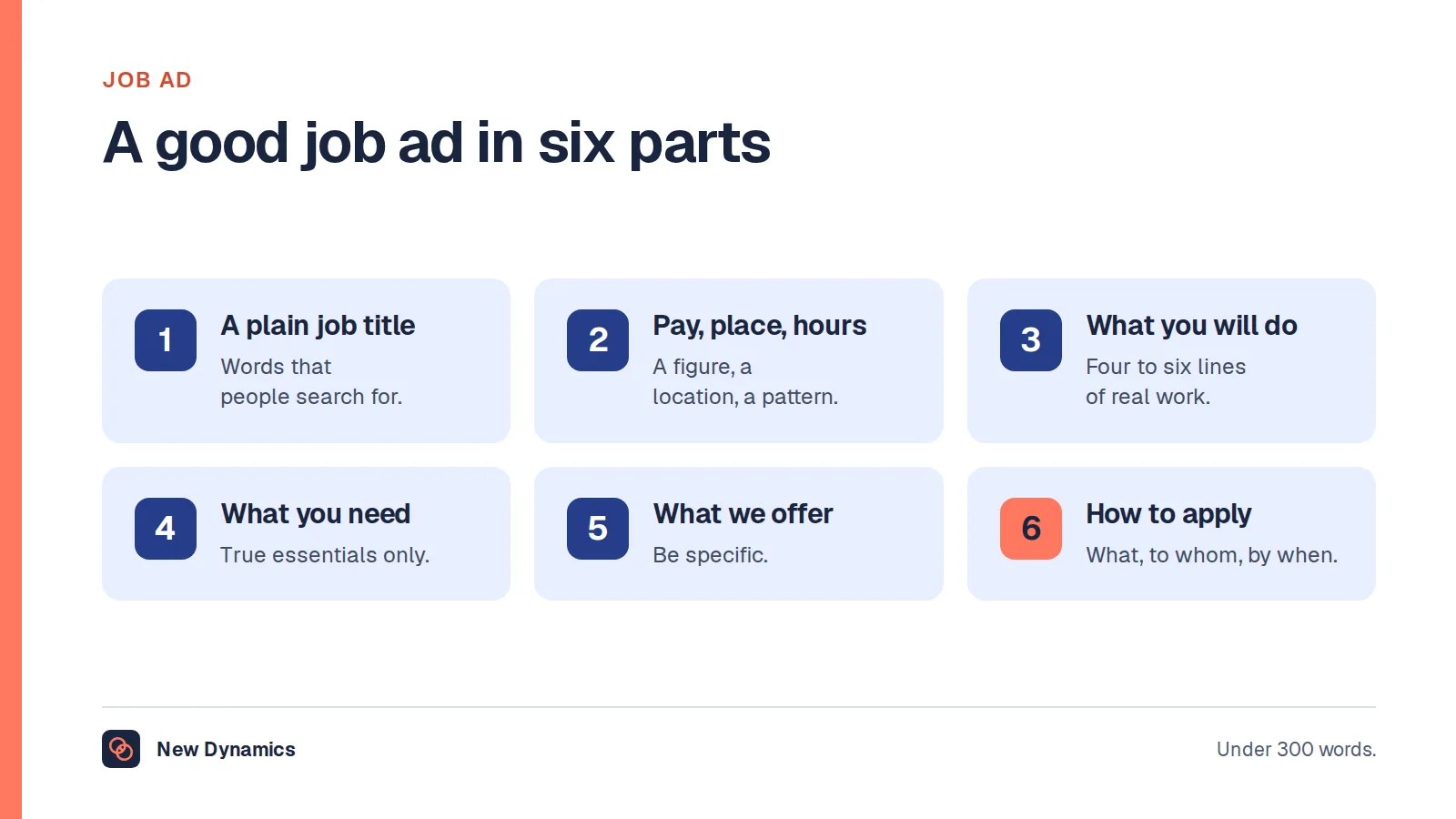
The search-friendly version of an advert is usually the plain one: the common job title, the location, the hours, the pay, and what the person will do.
What to measure

- Impressions and clicks for each vacancy page, from Search Console, not guesses.
- Indexed vacancy pages against open vacancies. A gap means your pages are not being read.
- Applications per source, separating organic search from paid listings, so you can see what the plumbing is worth.
- Time from publish to first organic application. It tells you how quickly new pages are being picked up.
- Expired pages still live. Should be zero, checked monthly.
A reasonable target for a first pass is that every open vacancy is indexed and every closed one is not. Most careers sites fail that test before anyone discusses keywords.
A sensible order of work
- Fix titles on open vacancies.
- Give each vacancy its own crawlable URL.
- Add or repair JobPosting structured data, with everything in it visible on the page.
- Automate expiry.
- Link the careers hub from pages that already rank.
- Only then think about content, such as team pages and role explainers.
Steps one to four are a few days of work for most organisations and account for most of the result.
Frequently asked questions
What is recruitment SEO?
It is making vacancies and careers content findable in search: job titles that match what candidates type, one indexable page per vacancy, valid JobPosting structured data that matches the visible page, prompt removal of filled roles, and internal links from pages that already rank.
Do job postings need structured data?
They need it to be eligible for Google's job search experience. Required properties include the posted date, the description in HTML, the hiring organisation, the location and the title, and everything in the markup has to be visible on the page itself.
How should you remove an expired job posting?
Set the valid-through date to the past, return a 404 or 410, or remove the structured data. Leaving filled roles live with active markup risks a manual action, and it wastes the time of every candidate who finds one.
Does the job title affect search performance?
More than anything else on the page. Use the title people search for, with codes, grades and internal shorthand kept out of it, and put the location in its own field rather than padding the title. An invented title has no audience, however well the page is optimised.
Can SEO wording get an employer into trouble?
It can. Adverts have to comply with discrimination law, and phrases that get added for search reasons, such as recent graduate or young and energetic, point at protected characteristics. Write the plain version: the common title, location, hours, pay and the work itself.
How long does recruitment SEO take to work?
New pages are usually crawled within days once the structure is right, but a careers site with years of expired postings and duplicate pages takes longer to recover. Fix the plumbing first and judge progress by indexed pages against open vacancies rather than by rankings.
Your next step: run the four checks
- Open three live vacancies and ask whether a candidate would type those titles.
- View a vacancy page with JavaScript disabled, and see whether the role is still there.
- Test one vacancy page for JobPosting structured data, and confirm everything in the markup is visible on the page.
- Search your own site for roles filled last year, and set up automatic expiry so the list stays empty.
For the questions to ask before any AI-assisted screening touches a candidate, read and download our AI recruitment guide. The guide is free to read, and the PDF uses our short download form.
Want the first ninety days to be as organised as the hiring? Book a New Dynamics demo and bring your onboarding checklist. You can also email contact@new-dynamics.com.