TL;DR
- Retroactive pay is money owed for work already done. It is pay for an earlier period, not a reward, which is why it behaves differently from a bonus in holiday pay and in a pension calculation.
- Minimum wage arrears are not repaid at the old rate. GOV.UK states that “Arrears are calculated according to a formula using the current minimum wage rate”, so a long-undetected underpayment costs more than the original shortfall.
- The tax looks wrong because it is right. HMRC records pay against the date it was handed over, not the period it relates to: the Full Payment Submission carries “The date you paid them, not the date you run your payroll”.
A pay rise is agreed in April with effect from 1 April. It clears the approval chain in June and lands in the July payslip. Three months of the difference arrive at once, the tax on that month looks punitive, and the worker wants to know whether they have been short-changed twice. Nobody in that conversation is wrong. The money is right, the tax is right, and the payslip is the only thing that can prove it.
This article covers what retroactive pay is, how it differs from a bonus, the four situations that create it, why the tax in the month it lands is not an error, the minimum wage rule that makes old underpayments more expensive than they were, what it does to pension contributions and holiday pay, and what the payslip has to show. It describes the position in the United Kingdom, names the United States usage at the end, and is general information rather than legal advice.
A rise that misses the payroll cut-off is an approval problem before it is a payroll problem. See how New Dynamics workflows let you set the stages, participants and reminders around a pay decision, so the effective date and the approval date are not months apart.
What retroactive pay is
Retroactive pay, usually shortened to retro pay, is pay for a period that has already ended. The work was done. The entitlement existed at the time. Only the payment is late. It is not new money for good performance but the difference between what should have been paid in an earlier pay period and what was, settled now because the correct figure was only established now.
The phrase overlaps with back pay, and in ordinary use the two are interchangeable. British employers tend to say backdated pay when a rise takes effect from an earlier date, and unpaid wages or arrears when money was owed and never paid. Our wider guide to back pay covers the causes and the claim route in more detail.
Retro pay is not a bonus, and the difference is expensive
A bonus is discretionary or performance-linked, belongs to the period it is awarded in, and is extra. Retro pay is contractual or statutory, belongs to an earlier period, and is a correction. Calling one the other is the most common way an employer gets the downstream figures wrong.
Holiday pay is where it bites. GOV.UK's guidance on holiday pay states that a worker's "'Normal' rate of pay includes commission, regular overtime payments, and any payments related to length of service or professional qualifications", and then adds the line that matters here: "It does not usually include bonus payments." Code a backdated rise as a bonus and it drops out of the normal rate, leaving the holiday pay taken during those months wrong.
Minimum wage is the second place. A one-off reward sits in the pay reference period it is paid in. A corrected hourly rate has to be applied to the pay reference periods it should always have applied to, and the arrears formula below is unforgiving about that.

The four causes
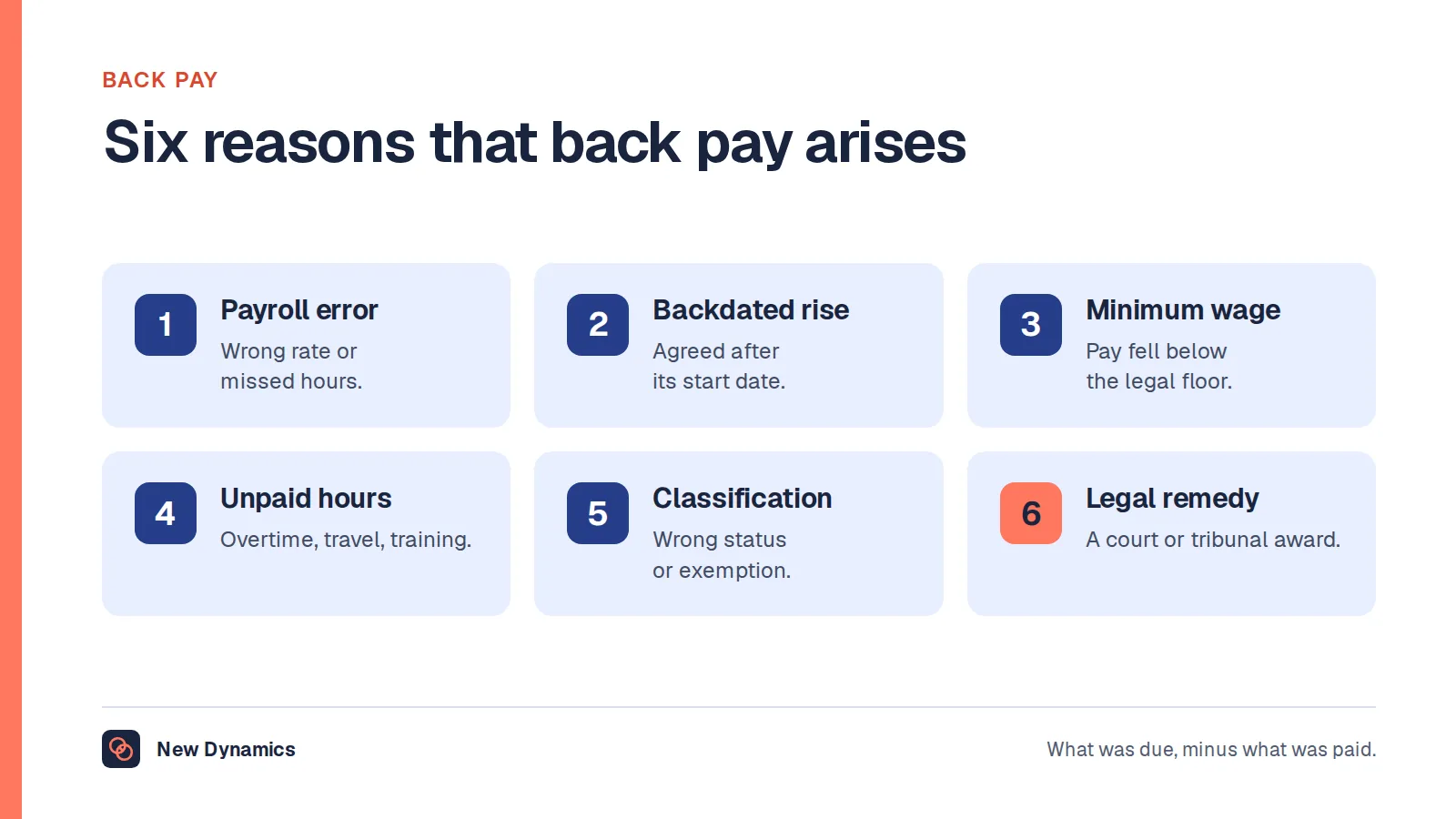
- A backdated pay rise. A review, promotion, regrading or collective award is agreed after its effective date. Nothing went wrong. The approval simply finished after the payroll cut-off.
- A payroll error. A wrong rate keyed, a missed allowance, hours entered against the wrong code, a starter set up a month late.
- A misapplied rate. The rate used was not the rate owed: the minimum wage after a birthday or an annual uprating, an overtime premium, a shift allowance, a contractual increment.
- An arrears settlement. A grievance, a tribunal claim, an HMRC minimum wage notice of underpayment or a negotiated settlement establishes that money was owed.
Causes one and two look identical on a payslip and are completely different in law, which the deduction from wages rules below make clear.

Why the tax looks wrong in the month it lands
It is not a penalty, and it is not an error. PAYE records a payment against the date it was handed over, not the period it relates to.
HMRC's guidance on what payroll information to report defines the Full Payment Submission's payment date field as "The date you paid them, not the date you run your payroll." The tax month number is "The month you paid them if you pay them monthly, quarterly, twice a year or annually". Three months of a backdated rise paid in July are July pay.
That produces two visible effects.
- A one-month income tax spike. PAYE spreads a tax code's allowances evenly across the year. A month holding four months of income briefly runs ahead of the allowance, so more tax comes off. Later months usually correct it, because PAYE is cumulative.
- A real National Insurance cost. National Insurance is not cumulative for most employees. It is worked out on each pay period separately, so combining several periods of pay into one can genuinely cost more than paying it as it arose.
HMRC does provide for a payment covering more than one earnings period. The same guidance says that "if your employee gets paid in advance or arrears for more than one earnings period, then you should reflect the number of earnings periods covered." Whether that applies depends on the facts, and the detail sits in HMRC's CWG2 further guide.
If a worker wants to read the figures back for themselves, our guide to payslip deductions explains each line.
The minimum wage rule most employers get wrong
This is the most surprising rule in UK pay administration and the one worth remembering. Minimum wage arrears are not repaid at the rate that applied when the underpayment happened. They are repaid at today's rate.
GOV.UK's manual on enforcing the minimum wage puts it plainly: "If you failed to pay the minimum wage to a worker, you must pay them the arrears they are entitled to. Arrears are calculated according to a formula using the current minimum wage rate." It then spells out the consequence: "if the current rates for that age band are higher than the rates that applied at the time of the underpayment, the amount of the arrears due to the worker will be more than the amount of the original underpayment."
The current rate means the rate now in force for the age band that applied to the worker at the time, not the band they fall in today. Where the current rate would produce a lower figure, the worker keeps the amount they were actually underpaid. GOV.UK sets the calculation out in three steps: work out the original underpayment in the pay reference period, divide it by the minimum wage rate that applied then, and multiply by the current rate.
Its worked example takes 35 hours at £11.44, which is £400.40, against £320 actually paid, giving an £80.40 underpayment. Then £80.40 ÷ £11.44 × £12.21 = £85.81, and the guidance concludes that "The worker is entitled to £85.81 in arrears." One line of that published example prints £440.40 where £400.40 is the figure the arithmetic uses. The method and the £85.81 result are unaffected.
Rates move every year, which is what gives the rule its teeth. GOV.UK's minimum wage rates page states that "The rates change on 1 April every year" and lists £12.71 an hour for workers aged 21 and over from April 2026, rising to £13.21 from April 2027. An underpayment left undetected across two uprating dates grows on its own.
GOV.UK's page for employers and the minimum wage sets the deadline: "Employers who discover they've paid a worker below the correct minimum wage must pay any arrears immediately." It also warns that "It's a criminal offence for employers to not pay someone the National Minimum Wage or National Living Wage, or to fake payment records."

Penalties and the naming scheme
Two further costs sit behind a notice of underpayment. On penalties, the GOV.UK manual states that "The financial penalty that you are liable to pay can be up to 200% of the value of the minimum wage arrears, up to a maximum penalty £20,000 per worker", halved if the employer fully complies with the notice within 14 days of service. An appeal goes to the employment tribunal within 28 days.
Then there is publication. Government runs a National Minimum Wage naming scheme, and GOV.UK's employer page warns that "There will also be a fine and offenders might be named by the government." A Department for Business and Trade announcement of 20 February 2024 named 524 employers that "were found to have failed to pay their workers nearly £16 million in a clear breach of the National Minimum Wage (NMW) law, leaving over 172,000 workers out of pocket", from investigations concluded between 2015 and 2023. For more figures on UK pay and work, see our HR statistics hub.
Self-correction is treated differently. On the voluntary declaration route, GOV.UK says that "Other than in exceptional cases, there is no public naming or financial penalties associated with any paid arrears that are declared to and accepted by HMRC using the voluntary declaration process."
The legal route to recover unpaid wages
Part II of the Employment Rights Act 1996 is the mechanism. Section 13 prohibits unauthorised deductions, and section 13(3) turns a shortfall into one: where wages paid on any occasion are "less than the total amount of the wages properly payable", the deficiency "shall be treated for the purposes of this Part as a deduction". Underpaying is legally a deduction, so the deduction rules apply to it.
Section 13(4) then carves out the payroll-error case. Subsection (3) does not apply "in so far as the deficiency is attributable to an error of any description on the part of the employer affecting the computation by him of the gross amount of the wages properly payable". A genuine computational error in the gross figure is not an unlawful deduction, which is why cause one and cause two above diverge in law. Other routes, such as a breach of contract claim, remain open.
The time limit has just changed, and this is the part to diarise. Section 23(2) now requires a complaint to be presented "before the end of the period of six months beginning with ... the date of payment of the wages from which the deduction was made". The word "six" replaced "three" with effect from 1 October 2026, by Schedule 12 paragraph 4(3)(a) of the Employment Rights Act 2025, commenced by S.I. 2026/954. The same substitution was made in section 23(4), which lets a tribunal extend the period where it was not reasonably practicable to present in time.
Two further limits survive. Section 23(3) runs the clock from the last deduction in a series. Section 23(4A) bars so much of a complaint as relates to a deduction where the payment date "was before the period of two years ending with the date of presentation of the complaint", subject to the exceptions in section 23(4B). A worker should still check their own deadline with Acas, because conciliation extends it under section 207B.
Pension contributions and holiday pay
Retro pay rarely travels alone.
Pension. GOV.UK's guidance on what you and your employer pay states that "In most automatic enrolment schemes, you'll make contributions based on your total earnings between £6,240 and £50,270 a year before tax", with total earnings including salary or wages, bonuses and commission, and overtime. The minimum contributions from April 2019 are 3% from the employer and 5% from the worker, 8% in total. Retro pay raises pensionable earnings, so contributions on it fall due, and a large sum landing in one month can carry a period above the upper limit in a way that paying it as it arose would not have.
Holiday pay. A backdated rise changes the average week's pay that holiday taken in those months should have been paid at. GOV.UK states that "Workers are entitled to a week's pay for each week of statutory leave that they take", and for shift workers with regular hours a week's pay is "The average number of weekly fixed hours a worker has worked in the previous 52 weeks, at their average hourly rate". Correct the rate and the 52-week average moves, so leave already taken may be owed a top-up. From 6 April 2026 employers must also keep annual leave and holiday pay records for at least six years.
What to put on the payslip
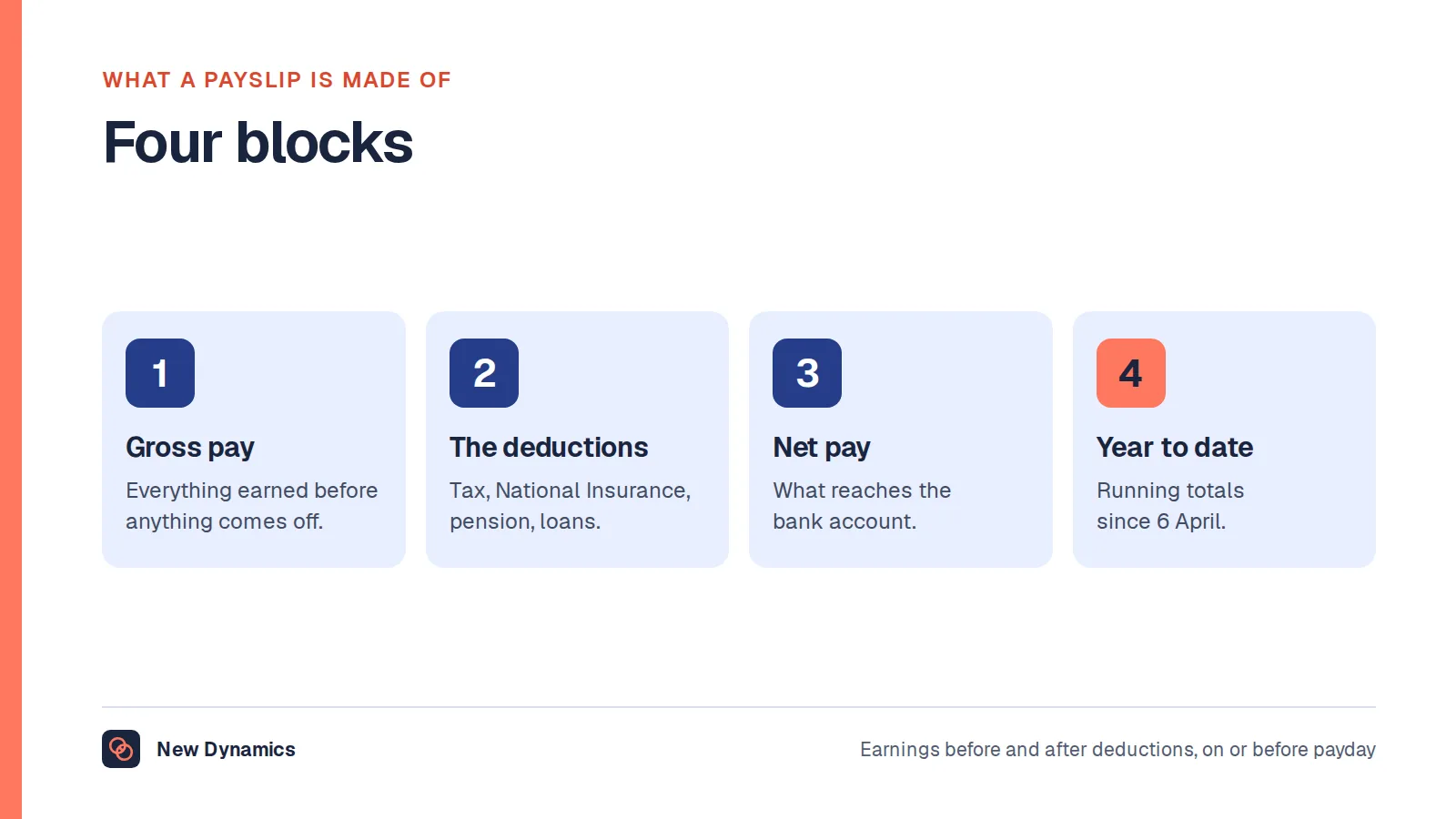
A worker can only check retro pay if the payslip separates it out. GOV.UK's payslips page requires a payslip to show "your earnings before and after any deductions", "the amount of any deductions that may change each time you're paid, for example tax and National Insurance", and "the number of hours you worked, if your pay varies depending on time worked".
Meeting the minimum is not the same as being checkable. Show these as well.
- A separate, named line, not folded into basic pay, for example "Backdated pay 1 Apr to 30 Jun".
- The period covered and the effective date, the two dates that explain the figure.
- The old rate, the new rate and the number of periods, the three inputs a worker can multiply out.
- Any pension and holiday pay correction, listed separately, so the worker can see they were not forgotten.
Correcting it in payroll
HMRC's guidance on correcting pay or deductions answers the question employers most often ask, which is whether an earlier Full Payment Submission has to be amended. For the current tax year, generally not: "To correct a mistake made in the current tax year, update the year-to-date figures in your next regular FPS."
Where you want it reported sooner, HMRC's instruction for an underpayment is specific: "Pay your employee the amount you underpaid them. On or before the day of this payment, send an additional FPS" carrying the difference in the "In this pay period" field, updated year-to-date figures, and "H - Correction to earlier submission" in the "Late reporting reason" field. HMRC asks for that corrected submission by the 19th of the tax month after the original, so the correction shows against the right month's PAYE bill. For mistakes in the tax years between 6 April 2020 and 5 April 2026, HMRC says to submit another FPS with the correct year-to-date figures.
So an earlier FPS is corrected, not retracted, and the payment date on it stays the date the money moved.
Retro pay in the United States
"Retro pay" means the same thing in the United States: wages owed for work already performed. The governing statute is the Fair Labor Standards Act. The Department of Labor's page on the FLSA states that "Covered nonexempt workers are entitled to a minimum wage of not less than $7.25 per hour effective July 24, 2009", with overtime after 40 hours in a workweek.
On time worked but not paid for, the Department's fact sheet on hours worked is direct: "Work not requested but suffered or permitted to be performed is work time that must be paid for by the employer." State law, exemption tests and claim deadlines differ, and this post does not cover them.
Frequently asked questions
What is retroactive pay?
Retroactive pay, or retro pay, is pay for a period that has already ended. The work was done and the entitlement existed at the time, but the correct amount was not paid then. It is the difference between what should have been paid in the earlier pay periods and what was.
What is the difference between retro pay and a bonus?
A bonus is extra, usually discretionary, and belongs to the period it is awarded in. Retro pay is a correction to an earlier period and is contractual or statutory. The difference matters because GOV.UK says the normal rate of pay for holiday pay includes regular overtime and commission but "does not usually include bonus payments".
Is retroactive pay taxed differently?
No. It is ordinary earnings, taxed through payroll when it is paid. HMRC records it against the date of payment, so a lump covering several months sits in one tax month. PAYE is cumulative and usually evens out, but National Insurance is worked out per pay period, so combining periods can cost more.
Why was so much tax taken off my backdated pay?
Because several months of pay arrived in one tax month, which briefly runs ahead of the allowances your tax code spreads across the year. Later months normally correct the income tax. The National Insurance difference is usually real, because it is calculated on each pay period separately.
How are minimum wage arrears calculated?
At today's rate, not the old one. GOV.UK states that "Arrears are calculated according to a formula using the current minimum wage rate": work out the underpayment in the pay reference period, divide it by the rate that applied then, and multiply by the current rate for the age band that applied to the worker at the time.
How long do I have to claim unpaid wages in the UK?
Section 23(2) of the Employment Rights Act 1996 requires a tribunal complaint within six months of the payment date, a limit that rose from three months on 1 October 2026. A series of deductions runs from the last one, and section 23(4A) generally bars deductions paid more than two years before the claim. Check your own deadline with Acas, since conciliation affects it.
Does retro pay affect my pension and holiday pay?
Usually yes. It increases qualifying earnings, so automatic enrolment contributions on it are due. A backdated rise also changes the average week's pay behind holiday already taken in those months, which can leave a holiday pay top-up outstanding.
Your next step: check one pay change
- Take the last three pay changes you processed: a rise, a promotion and a change of hours.
- For each, put the effective date next to the first payslip that showed the new rate. Any gap is retro pay.
- Check that the gap was paid, shown as its own payslip line, and reflected in pension and holiday pay.
- For any hourly worker near the minimum wage, recalculate the arrears at the current rate, not the old one.
Fixed review dates and an approval chain that finishes before the payroll cut-off remove the most common cause of all. For how to set that up, read and download our compensation policy guide. The guide is free to read, and the PDF uses our short download form.
Want pay decisions approved on a date payroll can actually meet? Book a New Dynamics demo and bring your current review calendar. You can also email contact@new-dynamics.com.