TL;DR
- GOV.UK states that employers do not have to pay workers for overtime, and Acas states that there is no automatic legal right to overtime pay. Any rate, and the way it is worked out, comes from the employment contract and has to be in the written particulars.
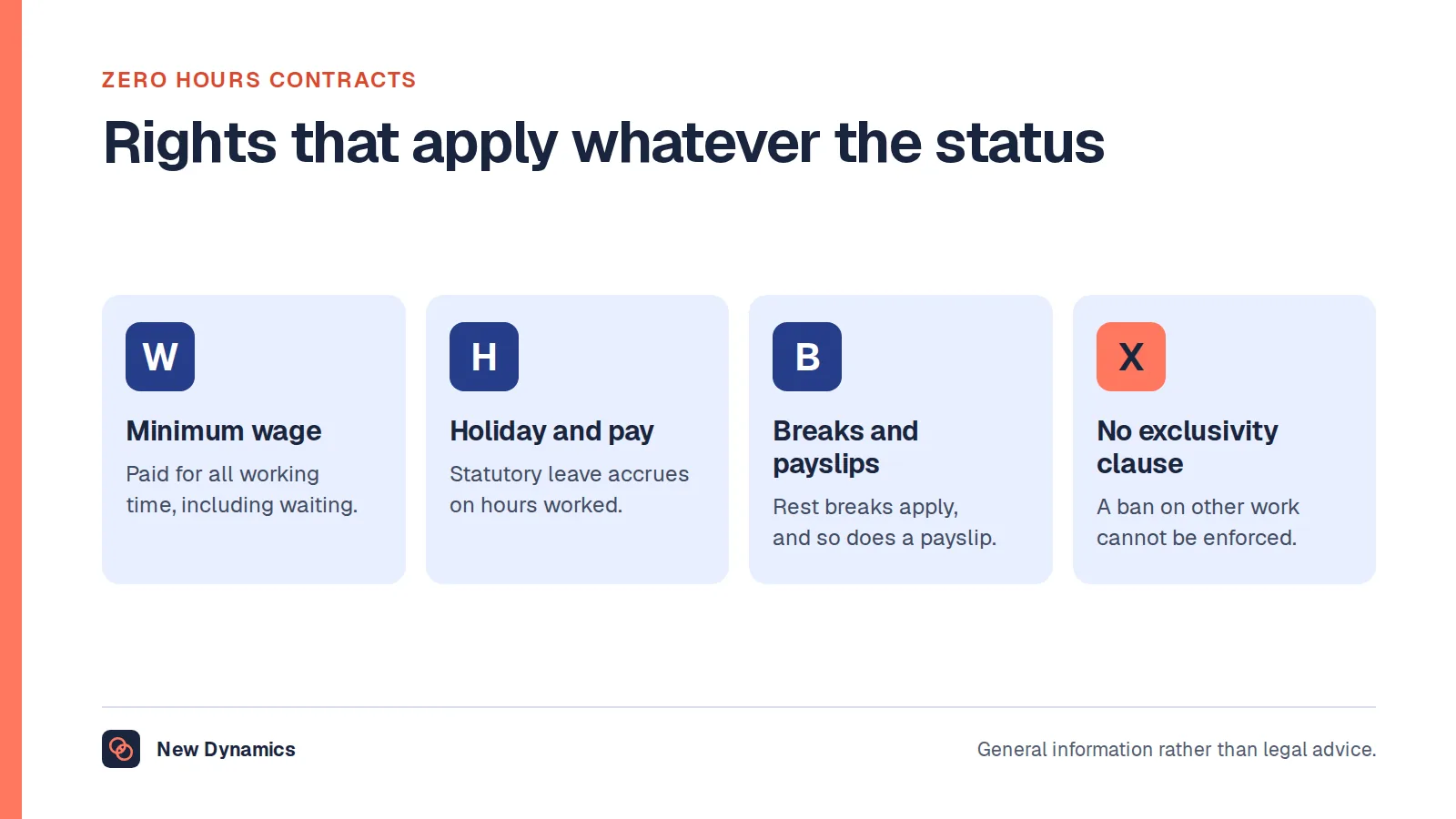
- Two statutory floors do apply whatever the contract says. Average pay across the total hours worked must not fall below the National Minimum Wage, and working time is capped at an average of 48 hours a week, normally over 17 weeks, unless the worker signs a voluntary written opt out.
- Straight time, shift differential, premium pay and the Fair Labor Standards Act are American terms. None of them is UK law. The UK rule employers most often miss is that holiday pay must include overtime that has been regularly paid over the previous year, for at least four weeks of the entitlement.
A warehouse supervisor has asked payroll what the legal overtime rate is. A manager has promised a team time and a half for a Saturday without checking whether the contract allows it. Someone on a salary has worked fifty hours a week since September and wants to know what they are owed. And a job advert from an American parent company has arrived with the words "straight time" and "shift differential" in it, which nobody in the UK office recognises.
All four questions have answers, and the first one has the answer people least expect: in the United Kingdom there is no legal overtime rate, because there is no statutory right to extra pay for overtime at all. Everything useful about overtime pay follows from that, plus two floors that apply whatever the contract says.
Overtime goes wrong at the record, not the rate. Hours get agreed in a corridor, approved by text message and then disputed three months later at the payslip. See how New Dynamics workflows keep a request, its approval and its record on one visible path.
This article is general information about published UK guidance rather than legal advice.
First, the American terms: FLSA, straight time, shift differential, premium pay
Much of the writing on this subject is American, so four of the phrases people search for have no direct UK statutory equivalent. They are real terms, they just belong to a different system. Here is each one in its own framing, once, so that you are not reading US rules as though they applied in Britain.
- The Fair Labor Standards Act (FLSA). The US federal statute that requires covered, non-exempt employees to receive, in the Department of Labor's wording on overtime pay, "overtime pay for hours worked over 40 in a workweek at a rate not less than time and one-half their regular rates". It also notes that the Act "does not require overtime pay for work on Saturdays, Sundays, holidays, or regular days of rest, unless overtime is worked on such days". There is no British equivalent of that 40 hour trigger or that time and a half rate.
- Straight time. The ordinary contractual rate, before any uplift. Straight time pay is simply hours worked at the normal rate, so the straight time pay formula is hours up to the normal threshold multiplied by the ordinary hourly rate. Straight time versus overtime, in the US sense, is the difference between those hours and the premium hours above the weekly threshold. In the UK the phrase still describes something real, the basic rate, but there is no statutory line above which it has to change.
- Shift differential. An extra amount for working a less desirable shift, usually nights, weekends or early starts, expressed either as a percentage of the base rate or as a flat sum per shift or per hour. A shift differential rate is that percentage or sum. In the UK this is a shift premium or unsocial hours payment, and it exists only because a contract or collective agreement creates it.
- Premium pay. The umbrella term for any rate above the normal one: overtime, shift differentials, weekend or bank holiday uplifts, call-out payments. In the UK all of it is contractual.
So if you arrived here searching for one of those phrases while running a UK payroll, the short answer is that the concepts translate and the entitlements do not. The rest of this article is the UK position.

There is no statutory right to overtime pay in the UK
This is the headline most pages get wrong, and the sources are blunt about it.
GOV.UK's guidance on overtime and your rights states: "Employers do not have to pay workers for overtime." It defines the starting point too: "Normal working hours are the hours fixed by your employment contract", and "Overtime usually means any time you work beyond these hours." On rates, it says only that "Your employment contract will usually include details of any overtime pay rates and how they're worked out."
Acas says the same thing on its guidance about overtime: "Some employers choose to pay employees and workers for working more hours than the employment contract says. This is usually called overtime pay", and then, plainly, "Although some employers offer overtime pay, there's no automatic legal right to it."
Three consequences follow, and they are the practical heart of this topic.
There is no legal time and a half. Time and a half, double time and a Sunday uplift are all common, all perfectly lawful, and all contractual. If your contract is silent, no rate is implied by statute.
The contract decides whether overtime can be required at all. Acas notes that the written particulars must set out "what hours are classed as overtime" and "what the rate of pay is for overtime". If the contract says nothing about working extra hours, an employer asking for them is making a request, not giving an instruction.
And unpaid overtime is lawful in principle. It is constrained, but it is constrained by two other rules rather than by an overtime right.

The floor that actually constrains unpaid overtime: the minimum wage
This is the rule that does the real work. GOV.UK's overtime page puts it in one sentence: "Your average pay for the total hours you work must not fall below the National Minimum Wage."
Acas words the same point from the employer's side: "If an employee works more hours than their employment contract says, the employer must make sure the hourly pay rate does not fall below the National Minimum Wage."
Notice the word average. The test is not whether the extra hour was paid. It is whether total pay divided by total hours still clears the hourly rate for that worker's age. GOV.UK's guidance for employers and the minimum wage sets the unit of measurement: "A worker must be paid the minimum wage, on average, for the time worked in the pay reference period." It also states that "Employers must pay workers the correct minimum wage" and that "It's a criminal offence for employers to not pay someone the National Minimum Wage or National Living Wage, or to fake payment records."
For the rates themselves, GOV.UK's page on National Minimum Wage and National Living Wage rates lists, from April 2026, £12.71 an hour for workers aged 21 and over, £10.85 for 18 to 20 year olds, and £8 for workers under 18 and for apprentices. The page notes that "The rates change on 1 April every year", so any calculation has to name the period it uses.
One detail catches employers who pay shift premiums. The same employers' guidance lists payments that do not count towards minimum wage pay, and one of the bullets is "extra pay for working unsocial hours on a shift". So a night premium cannot be used to lift someone over the minimum wage line. The basic rate has to get there on its own.
The practical consequence is a single arithmetic check. Take the pay reference period, divide total minimum wage pay by total hours worked including the unpaid extra hours, and compare the answer with the rate for that person's age. A salaried employee on a low salary working long hours is exactly the case where this fails quietly.
The ceiling: the 48 hour average week and the written opt out
The second floor is a limit on hours rather than on pay. GOV.UK's guidance on maximum weekly working hours states that "You cannot work more than 48 hours a week on average", "normally averaged over 17 weeks", and that "You can choose to work more by opting out of the 48-hour week."
The opt out has conditions, set out on GOV.UK's page on weekly maximum working hours and opting out. It "must be voluntary and in writing". The employer "must keep a record that you've opted out". The worker "can cancel your opt-out agreement whenever you want - even if it's part of your employment contract", giving "at least 7 days' notice", or "up to 3 months' notice depending on what's in your agreement". And two protections matter: "Your employer cannot force you to cancel your opt-out agreement", and "Your employer can ask you to opt out, but you cannot be sacked or treated unfairly for refusing."
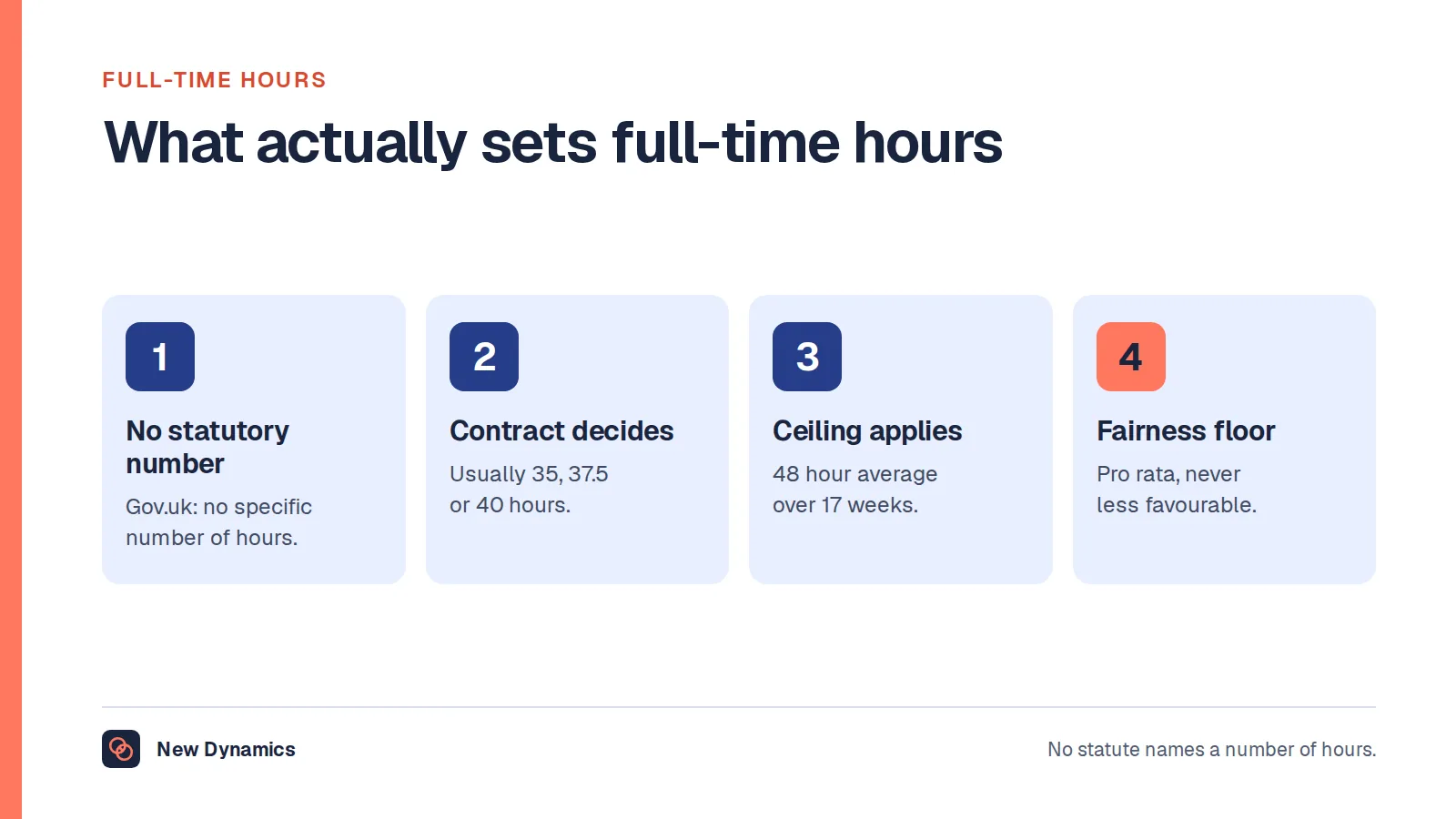
Read together with the pay position, this is the honest summary of overtime in Britain. There is no price fixed by law, but there is a limit on quantity, and the limit is individual, waivable in writing and revocable. Our article on full-time hours works through what sets normal hours in the first place, which is where the overtime threshold comes from.
The expensive one: overtime in holiday pay
If one rule on this page is going to cost an employer money, it is this one.
Acas states it on the overtime guidance in a single line: "Holiday pay must include overtime payments if an employee has regularly received overtime pay during the previous year." Its guidance on calculating holiday pay lists what has to be included, among them "other payments, for example overtime payments, if a worker has regularly been paid these during the last year", and sets the scope: "Employers must include any relevant payments for at least 4 weeks of a worker's paid holiday entitlement."
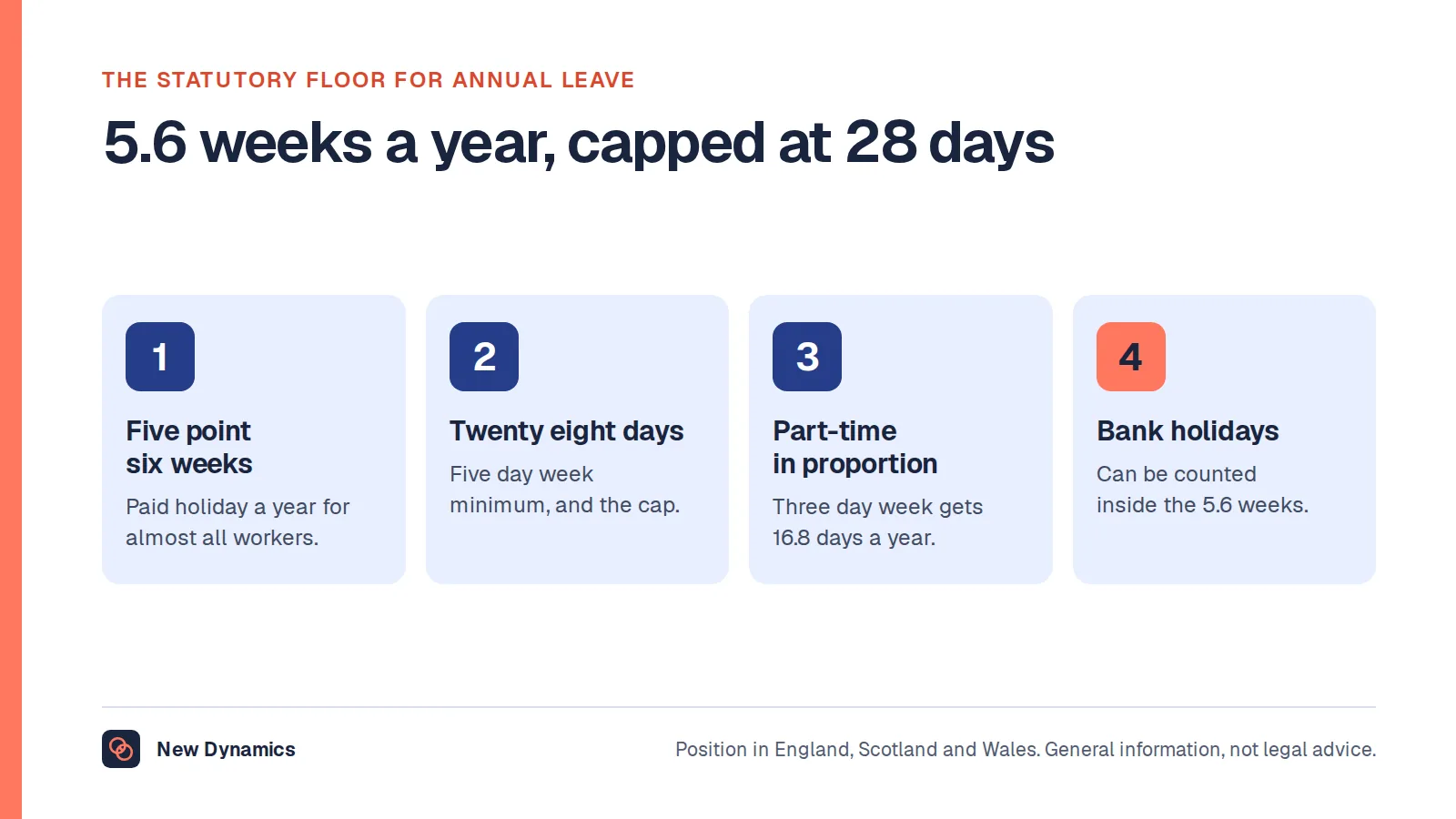
The government guidance on holiday pay and entitlement reforms uses a longer reference window for the same idea, listing "other payments, such as overtime payments, which have been regularly paid to a worker in the 52 weeks preceding the calculation date". It confirms the split that trips people up: four of the 5.6 weeks are paid at the normal rate including those payments, and 1.6 weeks may be paid at basic pay, with the regulations not stating which entitlement is used first.
Two things follow. First, a worker who does regular overtime and is paid bare basic pay on holiday is probably being underpaid, and the shortfall accumulates every year it goes unnoticed. Second, running two rates inside one entitlement is an administrative cost and an argument waiting to happen, which is why many employers simply pay all 5.6 weeks the same way. Our article on holiday entitlement covers the entitlement itself, accrual and carry over.

Voluntary, compulsory and guaranteed overtime
These three labels are not statutory definitions. They are the words employers, unions and tribunals use to describe what a contract actually says, and the distinction matters for two separate questions.
- Guaranteed overtime. The employer is obliged to offer the hours and the worker is obliged to work them. It is effectively part of normal working hours by another name.
- Compulsory, or non-guaranteed, overtime. The employer is not obliged to offer it, but when it is offered the worker has to work it, because the contract says so.
- Voluntary overtime. The employer offers and the worker can decline.
For pay, the label tells you whether someone can refuse. For holiday pay, the question is not the label at all. The Acas test quoted above is whether overtime pay has been received regularly, so a voluntary pattern that has in fact been worked and paid every month for a year is a regular payment, whatever the contract calls it. Employers who assume voluntary overtime is automatically outside holiday pay are relying on a distinction the guidance does not draw.
Time off in lieu instead of pay
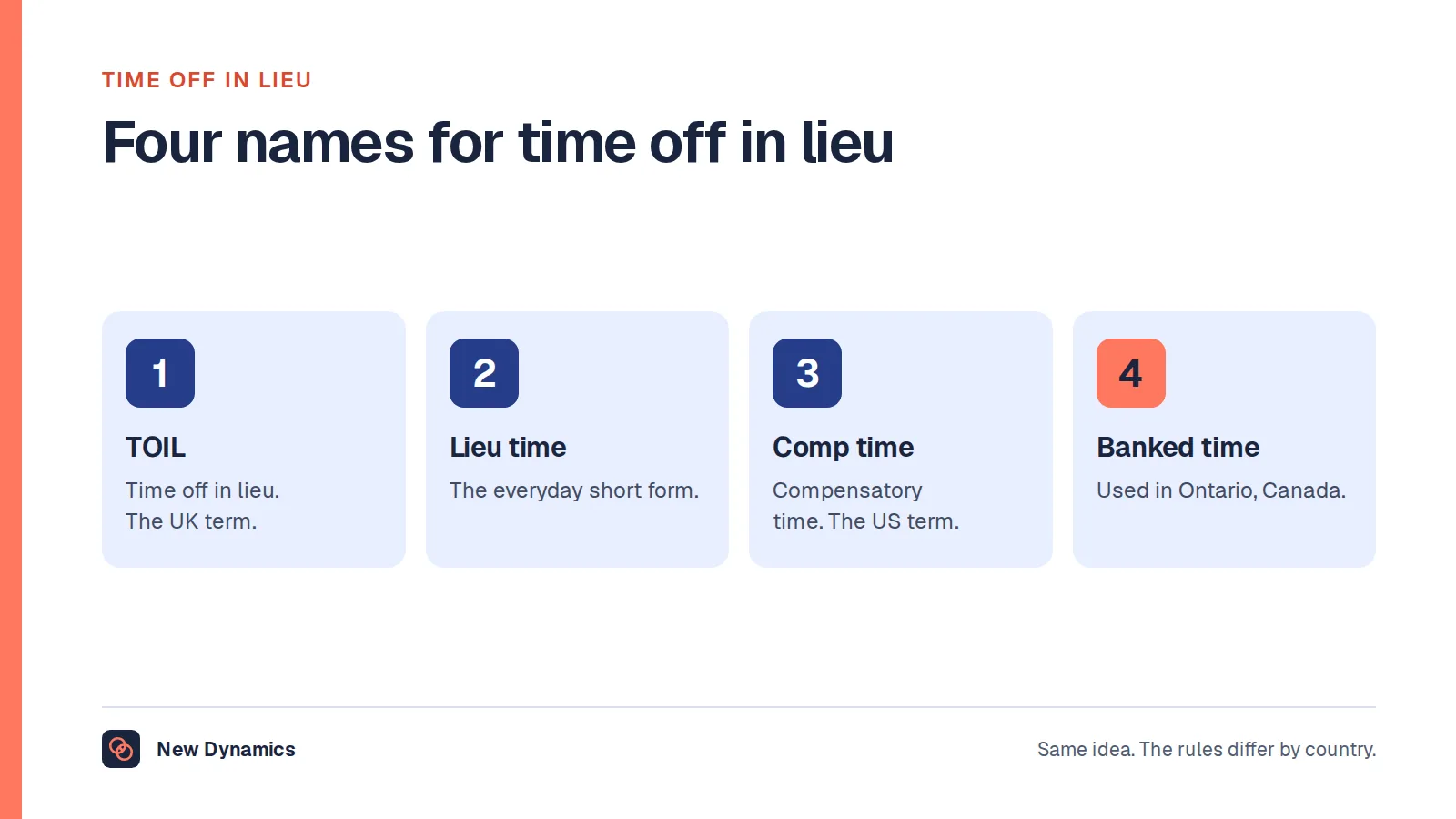
Acas notes that employers might offer either "a higher rate of pay for overtime than for normal working hours" or "time off instead of overtime pay". Time off in lieu, or TOIL, is the second option, and because it is contractual it needs to be written down before the hours are worked rather than after.
A workable TOIL arrangement answers six things: who can authorise extra hours in advance, the rate at which time accrues (hour for hour unless you choose otherwise), where the balance is recorded, how far ahead it has to be used, what happens to an unused balance when someone leaves, and who decides when the time off is taken. That last point is where most informal arrangements fail. Our article on time off in lieu sets out the policy in full.
One caution. TOIL does not switch off the two floors. Hours worked still count towards the 48 hour average, and they still count in the minimum wage division, so unpaid hours banked as TOIL can pull average pay below the rate in the period they were worked.
Salaried staff and overtime
"They are on a salary" is not an answer to a question about hours. A salary describes how pay is calculated and delivered, not an unlimited claim on someone's time, and the UK has no equivalent of the US exempt and non-exempt categories that the FLSA creates.
What a salary does mean is that extra pay for extra hours depends entirely on the contract, exactly as it does for an hourly worker. Many salaried contracts include a clause requiring such additional hours as are reasonably necessary to perform the role, with no additional payment. That clause is lawful, and it is also the clause that should prompt two checks.
Check the minimum wage division. Salary divided by actual hours, in the pay reference period, against the rate for that person's age. A modest salary and a sixty hour week is the combination that breaches it.
Check the 48 hour average. A salaried employee without a signed opt out is subject to the same limit as everybody else, and the employer is the one who has to be able to produce the record.
Then consider the retention question, which no statute covers. Persistent unpaid overtime that nobody records is invisible in the workforce data and highly visible in resignation conversations. For published UK figures on hours and pay, with publishers and periods attached, see our HR statistics hub.
Shift and unsocial hours premiums: a worked example
Shift premiums are purely contractual in the UK. There is no statutory night rate, no statutory weekend rate and no statutory bank holiday rate. What exists is whatever the contract or the collective agreement says, and the two usual designs are a percentage uplift on the base rate or a flat amount per shift.
An example calculation
The figures below are an example for illustration, not a benchmark, a recommendation or a market rate.
An example employer pays a base rate of £14.00 an hour and sets a night premium of 20% for shifts starting after 20:00. An employee works four night shifts of eight hours, which is 32 hours.
- Straight time at the base rate is 32 multiplied by £14.00, which is £448.00.
- The premium is 20% of £14.00, which is £2.80 an hour, so 32 multiplied by £2.80 is £89.60.
- Total pay for the four shifts is £537.60, an effective rate of £16.80 an hour.
Two points about that arithmetic. The £89.60 premium does not count towards minimum wage pay, because GOV.UK excludes "extra pay for working unsocial hours on a shift", so the £14.00 base rate is what has to clear the hourly minimum on its own. And if this employee works these shifts regularly, the premium is part of normal pay for at least four weeks of holiday, on the Acas test above.
What to write down
Six lines settle almost every overtime query a manager will send you.
- The normal hours, so there is a threshold overtime can be measured against.
- Whether extra hours can be required, and who authorises them in advance.
- The rate for each category: weekday overtime, weekend, nights, bank holidays, call-out.
- Whether TOIL is available instead, at what accrual rate, and by when it must be taken.
- How overtime is recorded and by what deadline it has to be submitted.
- How holiday pay is calculated, naming overtime explicitly and saying whether all 5.6 weeks are paid the same way.
Pay structures built one exception at a time are the ones that produce unexplainable payslips. Our article on piece rates covers the same discipline where pay is tied to output rather than hours.
Which jurisdiction you are in
The GOV.UK and Acas guidance quoted here applies in Great Britain, which is England, Scotland and Wales. Acas does not cover Northern Ireland.
Northern Ireland has its own separately made working time and pay legislation, and the headline is similar rather than identical. The nidirect guidance on overtime states that "There's no legal right to pay for working extra hours and there are no minimum statutory levels of overtime pay, although your average pay rate must not fall below the National Minimum Wage", that "Your contract of employment should include details of overtime pay rates and how they're worked out", and that "You only have to work overtime if your contract says so." On hours it says "Most workers can't be made to work more than an average of 48 hours a week, but they can agree to work longer." A handbook written for a Belfast employee should cite the Northern Ireland regulations and point to nidirect and the Labour Relations Agency rather than to Acas.
The minimum wage is set UK-wide, so the rates above apply in Northern Ireland too. This article is general information about published guidance, not legal advice. Take advice on your own obligations before you write a policy or change a contract.
Frequently asked questions
Is there a legal minimum rate of overtime pay in the UK?
No. GOV.UK states that employers do not have to pay workers for overtime, and Acas states that there is no automatic legal right to it. Time and a half and double time are common contractual rates, not statutory ones. The only pay rule that always applies is that average pay for the total hours worked must not fall below the National Minimum Wage.
What is straight time pay, and how is it different from overtime?
Straight time is the ordinary contractual hourly rate, before any uplift. The straight time pay formula is hours worked multiplied by that rate. The straight time versus overtime distinction is American in origin, where the Fair Labor Standards Act requires time and one-half above 40 hours in a workweek. In the UK there is no statutory threshold at which the rate has to change, so the comparison is a contract question.
Does my employer have to pay me extra for working nights or weekends?
Only if your contract says so. A shift differential, or unsocial hours premium, is contractual in the UK and there is no statutory night or weekend rate. One quirk is worth knowing: GOV.UK excludes extra pay for working unsocial hours on a shift from minimum wage calculations, so a night premium cannot be used to lift a low base rate over the legal minimum.
Do salaried employees get overtime pay?
Only where the contract provides for it, and the UK has no equivalent of the American exempt and non-exempt categories. A salary is not an unlimited claim on someone's time either. Two statutory floors still apply: salary divided by actual hours in the pay reference period must clear the minimum wage for that person's age, and working time is still capped at an average of 48 hours a week without a signed opt out.
Does overtime have to be included in holiday pay?
Yes, where it has been regular. Acas states that holiday pay must include overtime payments if an employee has regularly received overtime pay during the previous year, and that relevant payments must be included for at least four weeks of the paid holiday entitlement. Government guidance uses the 52 weeks before the calculation date as the reference window. Whether the overtime was voluntary or compulsory is not the test; regularity is.
Can an employee refuse to work overtime?
It depends on the contract. If the contract requires additional hours when they are offered, refusal is a contractual matter. If it does not, a request to work extra hours is just a request. Separately, nobody can be required to exceed an average of 48 hours a week unless they have signed a voluntary written opt out, and GOV.UK states that a worker cannot be sacked or treated unfairly for refusing to sign one.
Your next step: price it, record it, then check the holiday calculation
- Read one real contract and write down the answer to each of the six lines above. The gaps you find are the queries your managers are currently answering by guesswork.
- Run the minimum wage division for your three longest-hours roles. Total pay divided by total hours actually worked in a pay reference period, against the rate for each person's age, naming the period you used.
- Produce your 48 hour opt outs. If you cannot say who has signed one and when, that is the first gap to close, because the record is the employer's duty.
- Check one holiday payslip for someone who works regular overtime. If a holiday week pays materially less than a working week, fix the calculation before you write anything else.
- Decide whether TOIL is on offer, at what rate and with what deadline, then publish the answer rather than settling it shift by shift.
To put overtime rates, shift premiums and the holiday pay method in one document people can actually read, use our compensation policy guide. The guide is free to read, and the PDF uses our short download form.
Want extra hours requested, approved and recorded in one place instead of three inboxes and a paper timesheet? Book a New Dynamics demo and bring your current overtime process. You can also email contact@new-dynamics.com.