TL;DR
- Base salary is the fixed amount paid for the job itself, before anything variable is added and before anything is deducted. It excludes overtime, bonus, commission, shift premiums, benefits and the employer's own pension contribution.
- Being salaried is a payment arrangement, not a legal status. The United Kingdom has no exempt category: GOV.UK states that “Most people paid an annual salary are classed as doing ‘salaried hours work’”, which is its own National Minimum Wage category with its own calculation year.
- A salaried worker can still be underpaid the minimum wage. GOV.UK's own list of common causes names excess hours worked by salaried-hours workers beyond their basic set hours, and the shortfall usually lands in the last pay reference period of the year.
Two questions arrive together and get answered as if they were one. What is my base salary, and what does it mean that I am salaried? The first is about a number. The second is about which rules apply to your hours. Treating them as one is how an employer ends up telling a worker that salaried staff are not paid for extra hours, and then paying arrears.
This article separates them. First, what base salary is, what it excludes, why the advertised figure is before deductions, and the trap of annualising a part-year or part-time figure. Then what salaried employment means in the United Kingdom, where the real distinction is not salaried against hourly but the working time and minimum wage rules that apply to the way someone is paid. It is general information about the position in the United Kingdom and not legal advice.
Pay decisions are easier to explain when the evidence behind them already exists. See how New Dynamics performance reviews keep the year's goals, feedback and ratings attached to the cycle, so a salary decision is read off a record.
Base salary and salaried employment are two different questions
Base salary is an amount, the fixed sum an employer agrees to pay for the job. It answers "how much". Salaried is a method, being paid a set amount in regular equal instalments for a set number of contractual hours rather than for each hour recorded. It answers "how".
A worker can have a base salary and be paid hourly on top of it for extra hours. A worker can be paid an annual salary and still be entitled to the National Minimum Wage for every hour beyond the contract. And a worker paid an annual salary can fall outside the minimum wage category called salaried hours work entirely, because of how often they are paid.
For the structure a base salary sits inside, see our post on pay bands and job evaluation, and for the package around it, our post on the definition of compensation.
What base salary means, and what it excludes
Base salary, also written as basic salary or base pay, is the fixed amount an employer pays for doing the job, before anything is added and before anything is taken off. It is the only part of pay that does not depend on output, extra hours, company results or a manager's judgement. The quickest way to define it is by what it is not:
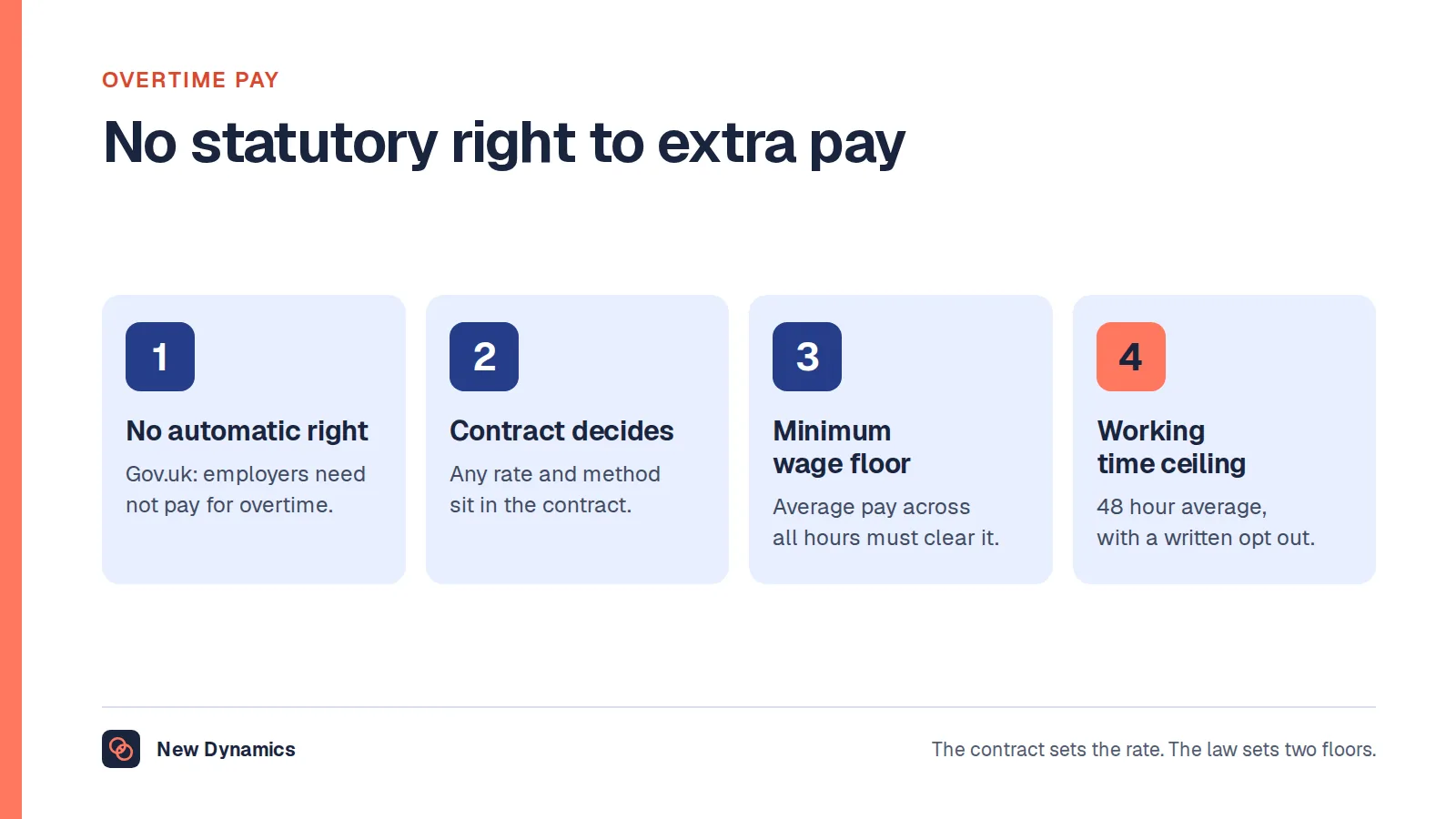
- Overtime. Pay for hours beyond the contractual hours, and a contractual matter rather than an entitlement. Acas is blunt on its guidance about pay for working extra hours: "Although some employers offer overtime pay, there's no automatic legal right to it." Our post on overtime pay covers the UK position.
- Bonus. Acas defines it in terms that put it outside base pay, on its guidance about bonuses: "A bonus is a payment an employer gives to staff in addition to their basic wages."
- Commission. Acas is equally direct on its commission guidance: "Employees can be paid commission on top of their basic salary."
- Shift and unsocial hours premiums. An addition for working nights, weekends, a particular location or a particular responsibility. Under the minimum wage rules these have a name of their own, the salary premium.
- Benefits, and the employer's pension contribution. Insurance, a car, subsidised food, anything provided rather than paid. The employer's pension contribution is a cost of employing you, not money you could spend.

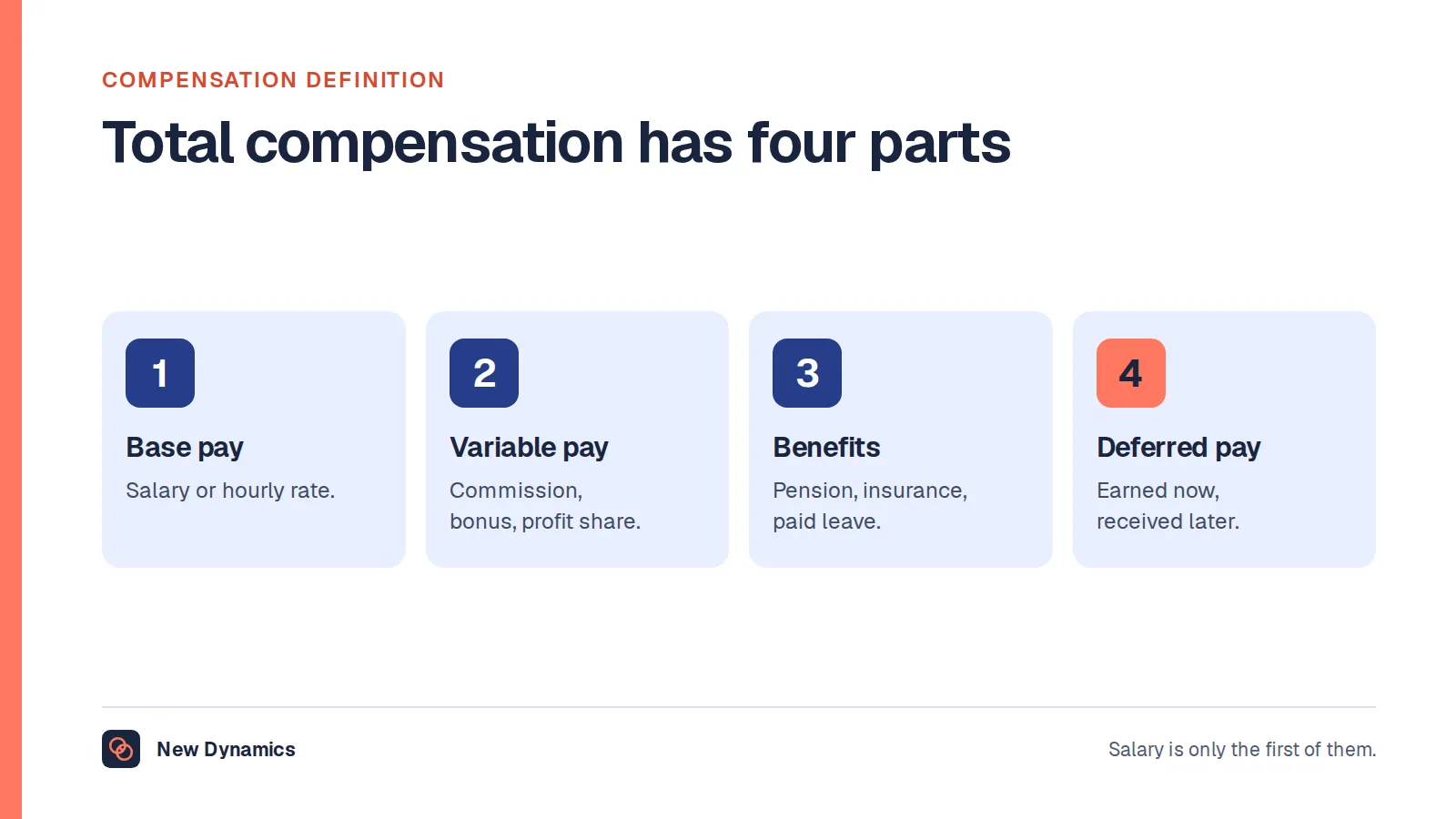
Total reward is base salary plus everything variable plus the value of the benefits. On-target earnings is base salary plus the variable pay you would get at target, a forecast rather than a figure anybody owes you. Our post on the meaning of OTE covers why that matters.
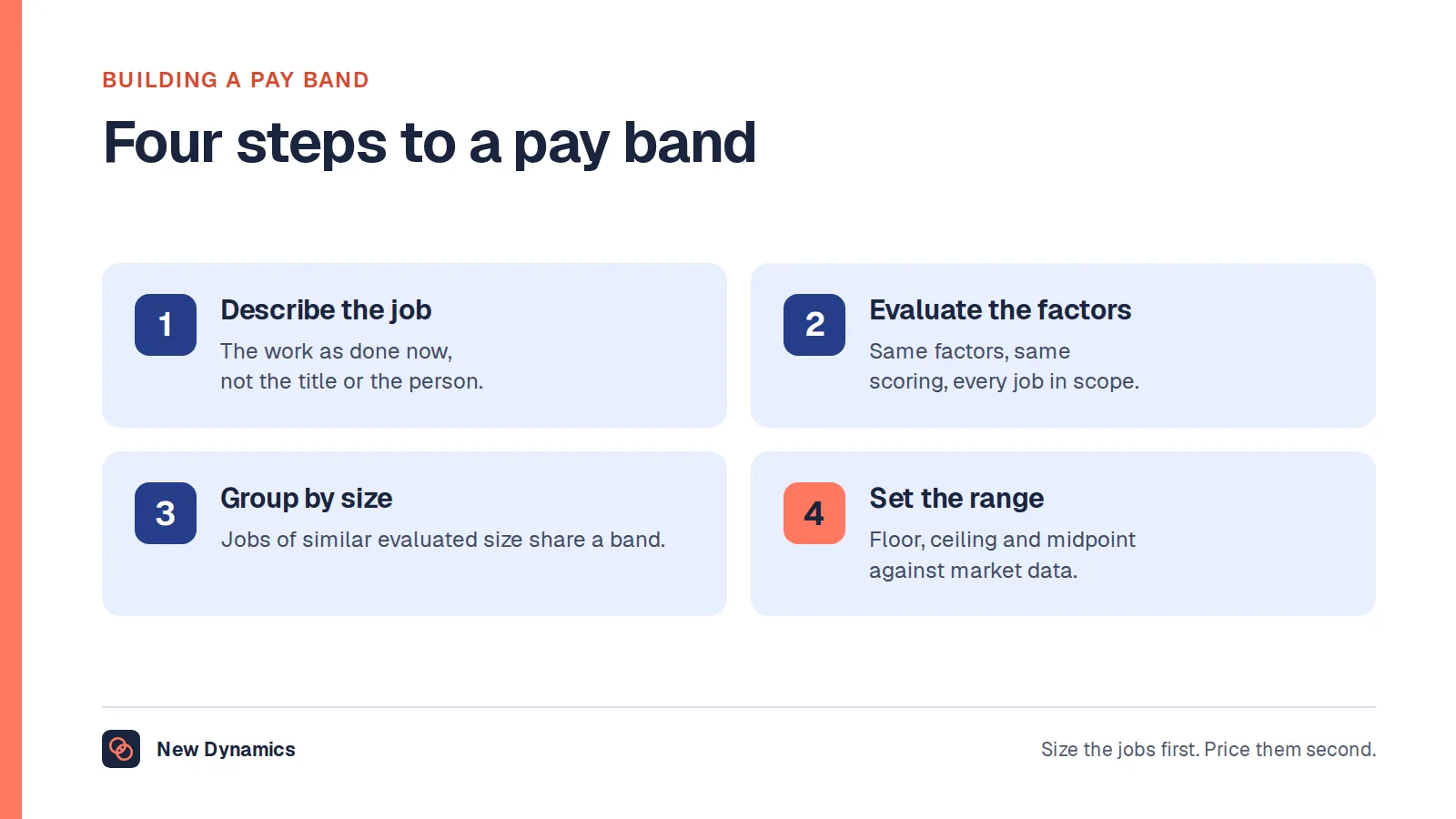
A base salary range in an advert is not a base salary. It is the band attached to a group of jobs of similar size, and where in that range a person sits depends on time in role, evaluated job content and the employer's rules. We do not publish typical base salaries for roles, and treat any figure offered as the going rate with suspicion until you know who was in the sample.
Gross against net, and why the advertised figure is before deductions
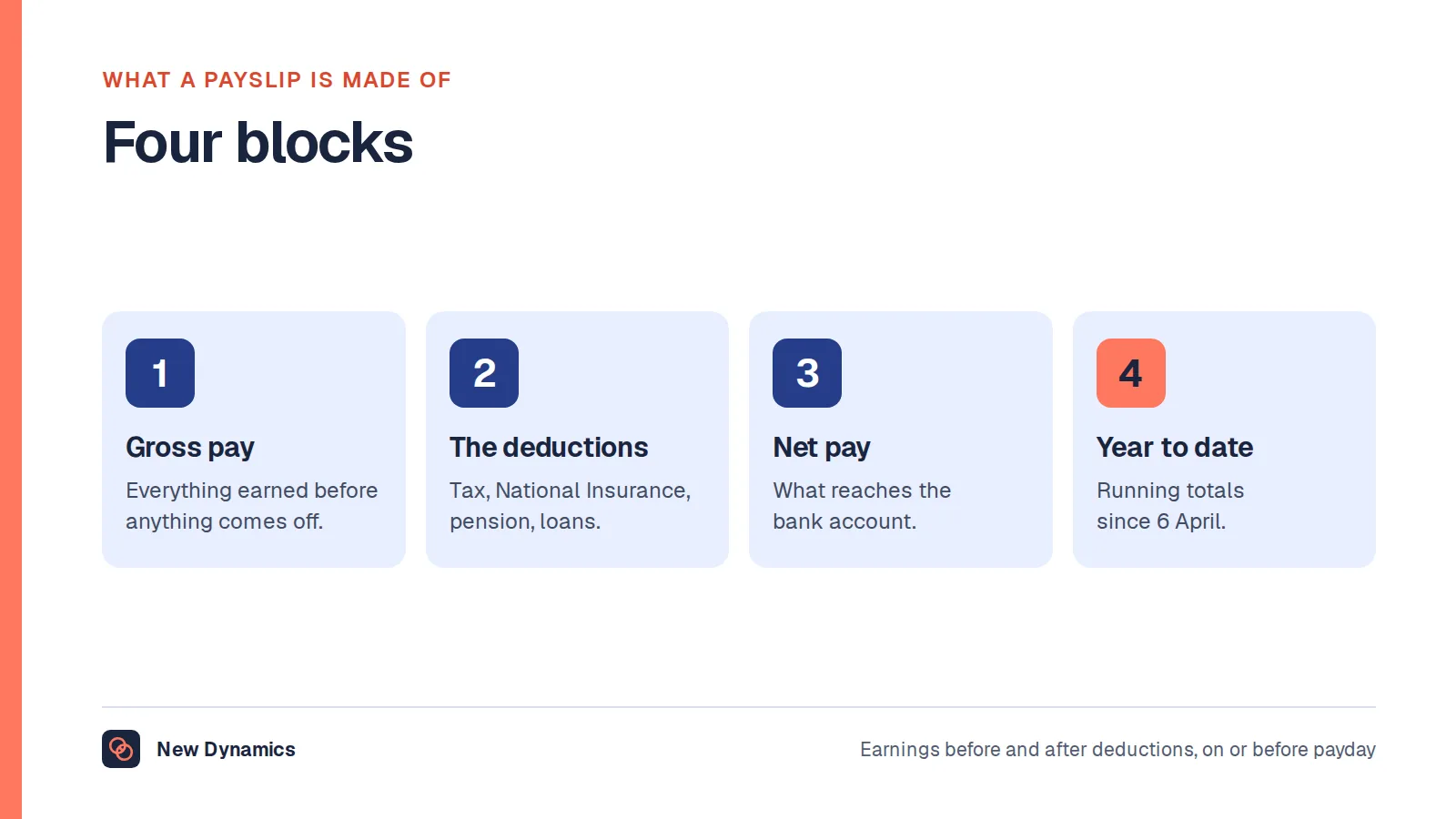
Base salary is a gross figure. So yes, base salary is before taxes, and no, it does not include tax. The deductions happen afterwards, in the pay run, which is why the money reaching a bank account never matches twelve equal shares of the advertised number. Two deductions apply to almost every employee in the United Kingdom.
Income Tax. GOV.UK's guidance on Income Tax rates and Personal Allowances states that "The current tax year is from 6 April 2026 to 5 April 2027" and that "The standard Personal Allowance is £12,570, which is the amount of income you do not have to pay tax on." On that allowance the bands run: up to £12,570 at 0%, £12,571 to £50,270 at 20%, £50,271 to £125,140 at 40%, and over £125,140 at 45%. The same page notes that "Income tax bands are different if you live in Scotland", so a Scottish taxpayer's net pay on an identical base salary differs.
National Insurance. GOV.UK's National Insurance introduction states that you pay mandatory National Insurance if you are 16 or over and are "an employee earning more than £242 per week from one job".
Then come the deductions that depend on the individual: pension contributions, student loan repayments, salary sacrifice and anything the contract permits. Our post on pay stub deductions reads a payslip line by line, and our post on payroll deductions covers lawful deductions.
Pension catches people out in both directions. GOV.UK's guidance on what you, your employer and the government pay explains that "In most automatic enrolment schemes, you'll make contributions based on your total earnings between £6,240 and £50,270 a year before tax", with total earnings including salary, bonuses and commission, overtime and the statutory payments. So the contribution is usually calculated on more than base salary, while the employer's share is not part of your salary at all. Rates and thresholds change, so check GOV.UK for the current figures and read this as a summary of guidance rather than tax advice.
Annual against annualised, and the trap in the middle
Annual base salary means the fixed base salary expressed as a full-year amount, whatever the pay frequency underneath it. That answers whether base salary means monthly or yearly: in practice both, because the yearly figure is the agreed one and the monthly figure is usually just a twelfth of it rather than a separate number anybody negotiated. Our post on pay frequency covers the weekly, fortnightly, four-weekly and monthly choices.
Annualised base salary is different. Annualising converts a figure covering some other period, or some other working pattern, into a full-year equivalent. It is arithmetic performed on a smaller number, and only as honest as the assumptions behind it.

Three things go wrong.
Annualising a part-year figure as though the year were full. Somebody joins in October, earns a part-year amount by April, and that amount gets scaled up by whoever is reading the payroll report. The scaled figure is a projection of what a full year would have paid, not what the person was paid, and the two then get quoted interchangeably.
Annualising a part-time salary into a full-time one, then comparing it with actual pay. A full-time equivalent is a comparison tool, not a salary. Acas sets out the rule the other way round, on its guidance for part-time workers: "Benefits such as pay and leave are given pro rata for part-time employees and workers. Pro rata means in proportion to hours worked. For example, someone who works full time gets paid £28,000 a year. Someone working in the same role for half the hours should get paid £14,000." Read a full-time equivalent as the amount payable and you have promised somebody double. Our post on the full-time equivalent covers the calculation.
Annualising from an hourly rate using a weekly multiplier nobody wrote down. Multiply by 52, 52.14 or 52.18 and you get three different annual figures from one hourly rate. GOV.UK accepts any of them, but attaches a condition in its manual on calculating the minimum wage: "the important thing is the employer must be able to demonstrate how the basic hours for a year have been ascertained". Can you show that working, from the contract?
Term-time and annualised-hours contracts are the one case where the word means something solid. GOV.UK's manual says that "If you employ someone to work only during some parts of the year but you pay them an annual salary in instalments throughout the year then they are a salaried hours worker". That is a real salary smoothed across twelve months, not a projection.
What the figure should say in an offer and in a contract
The written statement is where the number stops being a conversation. GOV.UK's guidance on the written statement of employment particulars states that "An employer must give employees and workers a document stating the main conditions of employment when they start work", that this "is not an employment contract", and that the employer "must provide the principal statement on the first day of employment". Two required items bear directly on base salary: "how much and how often an employee or worker will get paid", and "hours and days of work and if and how they may vary". On changes, GOV.UK gives the clock: "They must do this within one month of making the change."
That pair is worth getting right, because a salary without its hours is half a term.

Six things an offer and a contract should name. The figures in the graphic above are an arithmetic example only, not benchmark data, not a recommendation and not drawn from any survey.
- The base salary in money, as a yearly figure, with the instalment amount and frequency underneath it.
- The basic hours, in a form from which an annual total can be calculated. GOV.UK says the contract should set out "a basic number of hours for which the worker is to be paid (for example 2,000 hours in a year)" and that the worker is entitled to an annual salary.
- Every variable element, named separately. Bonus, commission, shift premium, on-call payment. Acas advises that an entitlement to a bonus or commission "should be recorded in their written statement of employment particulars", and that a discretionary scheme should say so clearly.
- What happens to hours beyond the basic hours, in pay or time off, and at what rate.
- What moves with base salary. Percentage allowances and pension contributions usually move; a flat allowance usually does not.
- When it will next be looked at. Our post on the salary increment and the annual pay review covers that process.
An offer giving one figure followed by "plus benefits" and an on-target number tells the candidate almost nothing, and leaves the employer nothing to defend.
What a salaried employee actually is in the United Kingdom
A salaried employee is someone paid a fixed amount for their job in regular equal instalments, rather than paid for each hour recorded. That is the everyday definition, and it is not a legal category that removes rights. There is no status you acquire by being put on a salary that switches off the minimum wage, the 48 hour average week, rest breaks or holiday entitlement. Statutory rights attach to being a worker or an employee, not to the method of payment. The underlying right is in the National Minimum Wage Act 1998, section 1(1): "A person who qualifies for the national minimum wage shall be remunerated by his employer in respect of his work in any pay reference period at a rate which is not less than the national minimum wage."
How salaried employees get paid does carry legal weight, because the pattern of payment decides which minimum wage category applies. GOV.UK's overview of the minimum wage for different types of work opens with the sentence the subject rests on: "The National Minimum Wage is worked out at an hourly rate, but it applies to all eligible workers even if they're not paid by the hour." It lists four categories, one being "paid an annual salary, under a contract for a basic number of hours each year (known as 'salaried hours')".
Salaried hours work: the category most writing misses
GOV.UK's page on being paid an annual salary states the position in one sentence: "Most people paid an annual salary are classed as doing 'salaried hours work'." Then the obligation: "To find out if they are getting the minimum wage you must work out how many basic hours they work in return for their salary."
Someone is usually doing salaried hours work if all four apply, in GOV.UK's words:
- "their contract states how many hours they must work in return for their salary (their basic hours)"
- "they're paid in equal, regular instalments through the year, for example monthly or every 4 weeks"
- "there is no more than a month between each payment"
- "they do not get paid more than once a week"
The legislation behind that is the National Minimum Wage Regulations 2015, where regulation 21(1) provides that "'Salaried hours work' is work which is done under a worker's contract and which meets the conditions in paragraphs (2) to (5) of this regulation." Those paragraphs require an annual salary (possibly with a performance bonus or a salary premium), a number of hours in a year for which it is paid, no other entitlement for those basic hours, and instalments that are "equal and occur not more often than weekly and not less often than monthly".
Four consequences follow that employers get wrong.
Being paid a salary does not guarantee you are in this category. GOV.UK says so directly: "Some people paid a salary may not be salaried hours workers, for example if there is more than a month between each payment." Those workers are usually classed as doing time work or unmeasured work instead. GOV.UK's manual notes the order HMRC applies: "They first 'test' for salaried hours work".
Varying hours do not break it. GOV.UK's manual is explicit: "So long as the instalments remain the same, the fact that workers actually work more hours in some weeks or months and less in others does not prevent them being salaried hours workers." Nor does exceeding the basic hours. Regulation 21(7) says work may be salaried hours work whether or not "the worker works hours in excess of the basic hours (whether the worker is entitled to be paid for those additional hours or not)".
The test is arithmetic, not judgement. Regulation 22(3) provides that "Where the pay reference period is a month, the hours of salaried hours work in that period are the basic hours divided by 12." GOV.UK's worked example runs it through: a worker aged 20 whose contract says she must work 2,040 hours each year, paid monthly, is covered for an average of 170 hours per pay packet, and on the rate of £10.85 per hour "she must be paid at least £1,844.50 a month" for her basic hours.
A shift premium cannot rescue a low basic rate. Regulation 10 lists what does not form part of a worker's remuneration for minimum wage purposes, and the last item is "payment of a salary premium". GOV.UK's manual puts it plainly: "A salary premium does not count towards pay for minimum wage purposes", so where a normal rate of £10 an hour carries an extra £5 for Sunday working, "only the £10 per hour counts for minimum wage pay". Commission, by contrast, does count. Acas states that "When calculating whether an employee has been paid the National Minimum Wage, commission payments can be included", and that the employer must top up pay where commission falls short. Two additions to base salary that feel similar are treated oppositely.
The calculation year, and how a salaried worker gets underpaid
Salaried hours work has a feature no other category has: a year of its own. The calculation year, in regulation 24, is the period across which excess hours are counted.
By default it follows the worker's own start date rather than the employer's financial year. GOV.UK's manual gives the pattern for monthly paid workers: "if they start on the first day of a month, say 1 May, their calculation year will be 1 May to 30 April in the following year while continuing in the same job". An employer can move it, to line everyone up with the tax or holiday year, but regulation 24(6) requires written notice with "an explanation of the effect of the change of the calculation year", at least three months before the new year begins, no written objection, no change in the previous six years, and no deduction, payment or extra hours as a result.
Now the failure. Once a salaried hours worker who is not paid for extra hours passes their basic annual hours inside the calculation year, every further hour has to be counted in the minimum wage sum. GOV.UK states the duty on the paid an annual salary page: "Employers must pay at least the minimum wage for any hours worked in addition to what's agreed in the worker's contract." Its manual adds that once the basic hours have been worked, "the extra unpaid hours will need to be taken into account in the minimum wage calculation" for the rest of the year.
The arithmetic is unforgiving. Monthly pay stays the same while the hours in the sum keep rising, so the hourly rate falls month by month until it crosses the line. GOV.UK's own checklist for employers names the pattern among the common causes of underpayment: "Excess hours worked by salaried-hours workers, beyond their basic set hours, causing underpayment of minimum wage typically in the last pay reference period." Leaving early does not avoid it: regulation 29 requires the excess to be settled in the final pay reference period.
GOV.UK's guidance for employers and the minimum wage sets out what is at stake. "A worker must be paid the minimum wage, on average, for the time worked in the pay reference period", and "It's a criminal offence for employers to not pay someone the National Minimum Wage or National Living Wage, or to fake payment records." If HMRC finds underpayment, "any arrears have to be paid back immediately. There will also be a fine and offenders might be named by the government."
The current rates, and the date they apply from
GOV.UK's page on National Minimum Wage and National Living Wage rates states that "The rates change on 1 April every year", and that you must be at least "aged 21 to get the National Living Wage". The rates published under the heading April 2026 are £12.71 for workers aged 21 and over, £10.85 for 18 to 20 year olds, £8 for under 18s and £8 for apprentices. The April 2027 column gives £13.21, £11.27, £8.31 and £8.31. Any calculation must name its period.
For scale, the Office for National Statistics publishes how many jobs sit below the line. In Low and high pay in the UK: 2026, released on 22 October 2026, it reports that "The number of jobs paid below the National Living Wage and National Minimum Wage in April 2026 was estimated to be 346,000, or 1.1% of the total", with the caveat that matters: "This figure is not a measure of non-compliance with legislation." All ONS estimates for 2026 are provisional and relate to the pay period that includes 22 April 2026. No official UK source publishes a typical base salary for a role. Our post on UK pay statistics sets out the measures that do exist, and the wider collection is in our HR statistics hub.
Salaried employee hours, clocking in, time off and comp time
Salaried employee hours. The contract sets them, and for salaried hours work it has to, in a form from which an annual total can be derived. "Salaried" does not mean "unlimited". The ceiling is in the Working Time Regulations 1998, regulation 4(1): unless the employer "has first obtained the worker's agreement in writing", a worker's working time, including overtime, "shall not exceed an average of 48 hours for each seven days" over the reference period, normally 17 weeks. A salaried employee without a signed opt out is subject to that limit like anybody else.
Should salaried employees clock in and out. There is no general UK duty to make salaried staff record start and finish times, but there is a duty to show the minimum wage was paid, and for salaried hours workers that means showing hours against the basic annual hours inside the calculation year. An employer whose salaried staff work well beyond their contractual hours, with no record of it, has no answer to an HMRC check. Our post on time and attendance software covers the options.
Salaried employees and time off. Holiday entitlement comes from the Working Time Regulations and applies to salaried staff exactly as it does to hourly staff, pro rata for part-timers. One detail peculiar to salaried hours work: GOV.UK's manual explains that where you pay a salaried worker their normal salary during an absence under their contract, "the time of the absence counts towards the worker's time worked for minimum wage purposes", covering rest breaks, holidays, sickness and family leave. Drop to half pay and that time stops counting. Our post on holiday entitlement covers the calculation.
Comp time for salaried employees. "Comp time", short for compensatory time, is an American term. The UK equivalent is time off in lieu, a matter for the contract rather than a statutory right. Acas notes that some employers offer "time off instead of overtime pay". Two cautions: time off in lieu does not reduce the hours already worked for minimum wage purposes, and an untracked balance of owed time is a liability that surfaces when somebody leaves. Our post on time off in lieu covers the policy.
The American exempt and non-exempt distinction is a different system
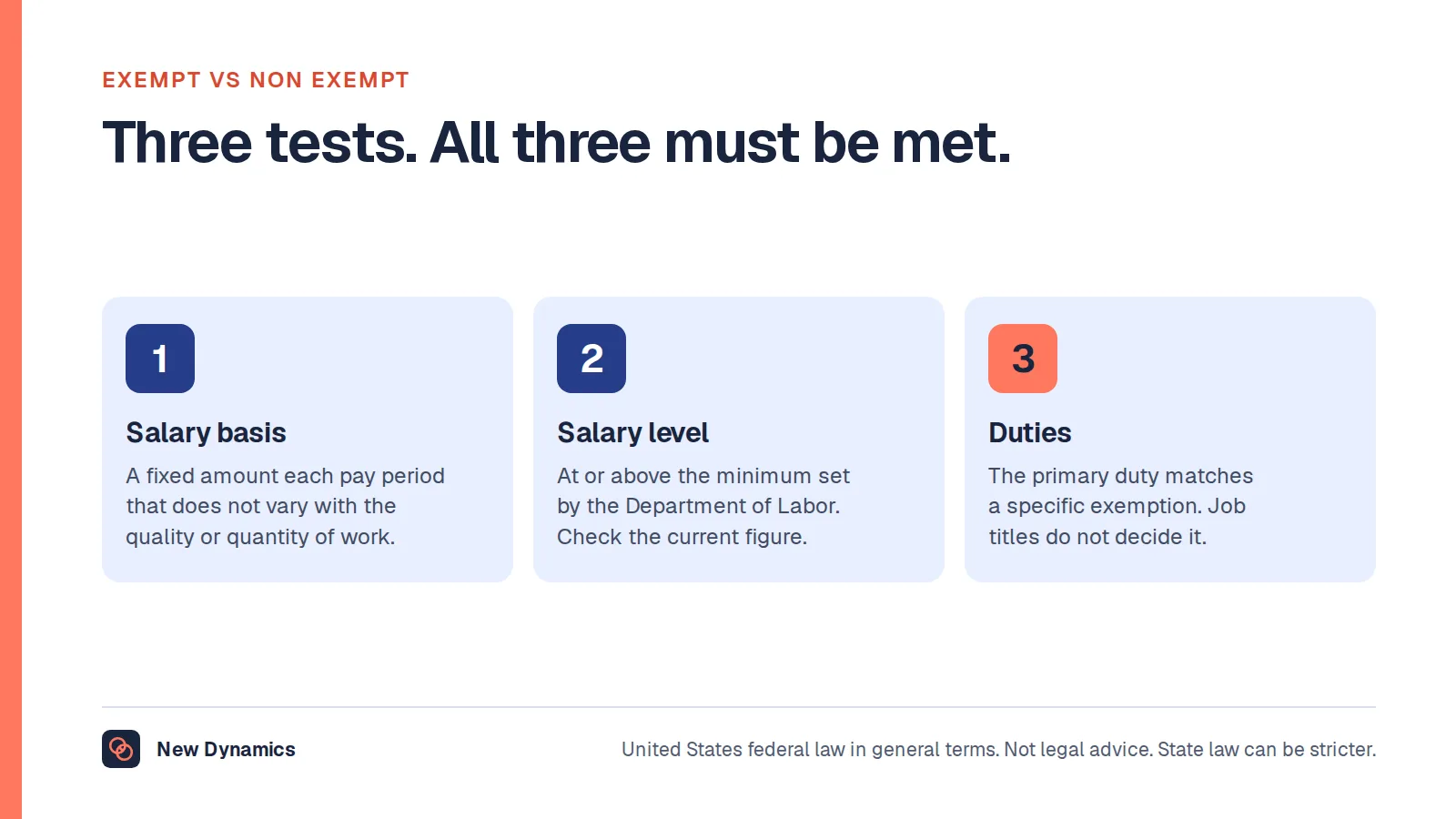
Much of the writing about salaried employment is wrong because it imports a distinction that does not exist here. In the United States, the Fair Labor Standards Act divides employees into non-exempt, who must receive overtime pay above a weekly hours threshold, and exempt, who need not, with exemption resting on tests that include being paid on a salary basis above a threshold amount. That is why, in American usage, "salaried" and "exempt from overtime" are treated as near synonyms.
Nothing of the kind applies in the United Kingdom. There is no exempt category, no salary threshold that removes the right to extra pay, and no connection between being salaried and losing a statutory entitlement. What exists here instead is the minimum wage categorisation described above, which does the opposite job: it tells you how to check that a salaried worker has in fact been paid at least the hourly floor. Our post on exempt and non-exempt employees explains the American system for readers who need it.
If you employ people in both countries, write the rule twice, and state which country each rule applies to.Base pay is only part of what a form means by income. Our post on annual income covers what the total figure includes and why gross is usually what is being asked for. A single global policy saying salaried staff are not paid for extra hours will be lawful in some American roles, unlawful in others, and in the United Kingdom beside the point while quietly breaching the minimum wage.
Frequently asked questions
What is base salary?
Base salary is the fixed amount an employer agrees to pay for the job itself, usually expressed as a yearly figure and paid in regular instalments. It excludes overtime, bonus, commission, shift premiums, benefits and the employer's pension contribution, and it is quoted before Income Tax and National Insurance.
Is base salary before taxes?
Yes. Base salary is a gross figure, stated before Income Tax, National Insurance, pension contributions, student loan repayments and any other deduction. GOV.UK gives the standard Personal Allowance for the tax year from 6 April 2026 to 5 April 2027 as £12,570, with the basic rate of 20% from £12,571 to £50,270, and notes that bands differ in Scotland.
What is annualised base salary?
Annualised base salary is a figure converted into a full-year equivalent from some other period or working pattern, for example a part-year amount scaled up or a part-time salary shown as a full-time equivalent. It is a comparison figure, not the amount payable. GOV.UK requires an employer to show how the basic hours for a year were arrived at.
What is a salaried employee?
A salaried employee is someone paid a fixed amount for their job in regular equal instalments, rather than paid for each hour recorded. In the United Kingdom it is a payment method rather than a legal status, and it removes no statutory right. GOV.UK states that most people paid an annual salary are classed as doing salaried hours work.
Can a salaried employee be paid below the minimum wage?
Yes, and usually without anybody intending it. Once a salaried hours worker passes the basic annual hours in their calculation year, every further hour counts in the minimum wage sum while the monthly payment stays the same, so the effective hourly rate falls. GOV.UK lists this among the common causes of underpayment.
Do salaried employees have to clock in and out?
There is no general duty in the United Kingdom to make salaried staff record start and finish times. There is a duty to show that the minimum wage was paid, and for salaried hours workers that means showing hours against the contractual basic annual hours inside the calculation year. Keeping no record of hours leaves nothing to show.
Your next step: check the salary against the hours
- Take one salaried contract and write down the base salary, the instalment, the pay frequency and the basic annual hours. If the annual hours do not follow from the contract, fix that first.
- Divide the instalment by the hours in the sum for that pay reference period, and compare the answer with the rate for that person's age.
- Work out each salaried worker's calculation year from their start date, and check whether anybody has already passed their basic annual hours.
- Check that no shift premium, on-call payment or unsocial hours addition is being counted towards the minimum wage, because none of them may be.
- Rewrite your offer template so base salary, basic hours, variable pay and what is not included each appear as separate lines.
For the policy behind all of this, read and download our compensation policy guide. The guide is free to read, and the PDF uses our short download form.
Want pay decisions to rest on evidence that already exists rather than being reconstructed in the meeting? Book a New Dynamics demo and bring your current review form. You can also email contact@new-dynamics.com.