TL;DR
- No UK statute creates a right to disconnect. The Employment Rights Act 2025 received Royal Assent on 18 December 2025 with 160 sections and 12 schedules, and none of them mentions switching off or disconnecting. Acas publishes five Codes of Practice, and none covers it.
- A Right to Switch Off was promised as a statutory Code of Practice, not a statute. GOV.UK's Next Steps to Make Work Pay, published 10 October 2024, named it among reforms deliverable "through other means". The government's response of 26 February 2026 did not repeat that commitment, and the implementation timeline updated 5 November 2026 does not list it.
- Rest periods are a legal entitlement. Regulation 10 of the Working Time Regulations 1998 gives a worker "not less than eleven consecutive hours" rest in each 24-hour period, and Acas says workers "have the same rights to rest wherever they're working, for example in a workplace or at home".
Somebody emails you at half past ten at night. Do you have to read it? In the United Kingdom the answer is not in a statute, because no statute addresses the question. The phrase "right to disconnect" describes laws in other countries and a policy UK governments have discussed. It does not describe anything a UK worker can enforce. What follows is what applies instead. This is general information about the position in England, Scotland and Wales, and it is not legal advice.
Out-of-hours expectations are a policy someone has to publish and keep current. New Dynamics workflows let you shape those stages and approvals around your own process, so the version people acknowledged is the version on file.
There is no statutory right to disconnect in UK law
The claim turns on an absence, so it is worth showing rather than asserting. The main employment statute of this Parliament is the Employment Rights Act 2025, which received Royal Assent on 18 December 2025. Its 160 sections and 12 schedules run from zero hours workers and flexible working through to labour market enforcement. Nothing there creates a right to disconnect, to switch off, or to decline contact outside working hours. Read end to end, the Act does not use those words once.
Acas, whose own page states that "Employment tribunals will take Acas Codes into account in relevant cases", publishes five Codes of Practice: disciplinary and grievance procedures, disclosure of information to trade unions, time off for trade union duties, settlement agreements and flexible working requests. There is no sixth code on switching off, and no Acas guidance page creates such a right.
What protects a worker who leaves an eleven o'clock message until morning is therefore the working time entitlements, the health and safety duty, and the contract.

What was promised, and what happened to it
A proposal, a government commitment and law are three different things, and only the third binds anyone.
The commitment was to a code, not a statute. GOV.UK's policy paper Next Steps to Make Work Pay, published on 10 October 2024, sorted the Make Work Pay promises into those travelling in the Employment Rights Bill and those that would not. This one went in the second group: "The government will also be able to deliver some reforms through other means, such as taking forward the Right to Switch Off through a statutory Code of Practice." A statutory code is guidance a tribunal takes into account, not a right. Legislation was never proposed.
It has since gone quiet. The House of Lords Home-Based Working Committee welcomed "that the government now plans to implement the right to switch off through a Code of Practice, rather than legislation", and asked that the code be framed around whether employees need to respond out of hours rather than whether employers may contact them. In the government's response of 26 February 2026, under its own heading "The right to switch off", the commitment is not repeated. Paragraph 49 says only that the government "will continue to progress policies aimed at alleviating stress in the workplace".
Its implementation timeline, updated on 5 November 2026, lists measures from Royal Assent through to December 2027. The right to switch off is not among them, and no consultation has opened. Treat it as deferred with no date.
What does apply: rest is an entitlement, not a courtesy
The Working Time Regulations 1998 say nothing about email. They say something more useful: how much time off a worker is entitled to, which is time an employer cannot fill.
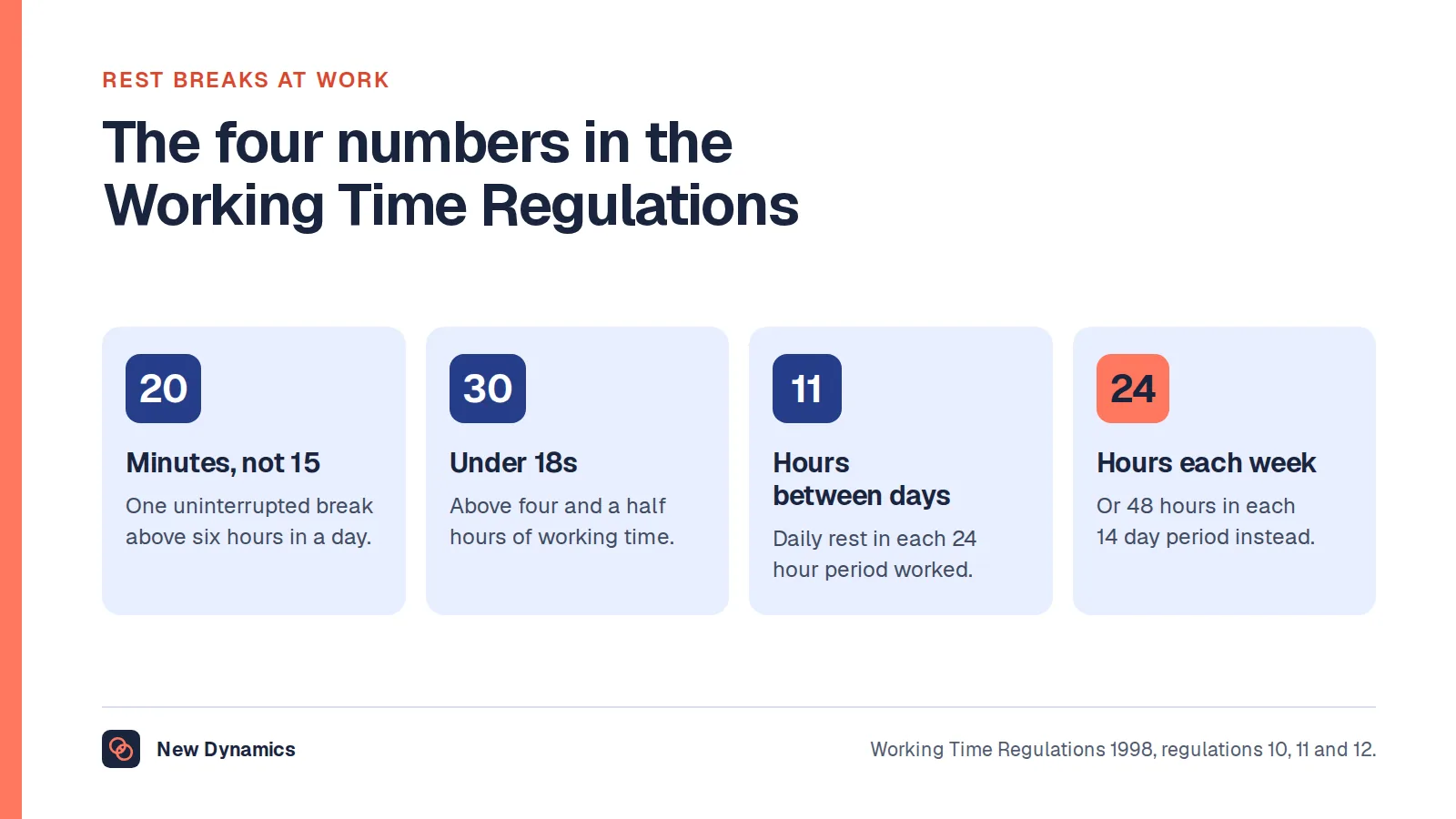
- Eleven hours between working days. Regulation 10(1) entitles a worker to "a rest period of not less than eleven consecutive hours in each 24-hour period during which he works for his employer", and a young worker to twelve.
- Twenty four hours a week. Regulation 11(1) gives "an uninterrupted rest period of not less than 24 hours in each seven-day period", or, under regulation 11(2), two such periods a fortnight or one uninterrupted 48 hours.
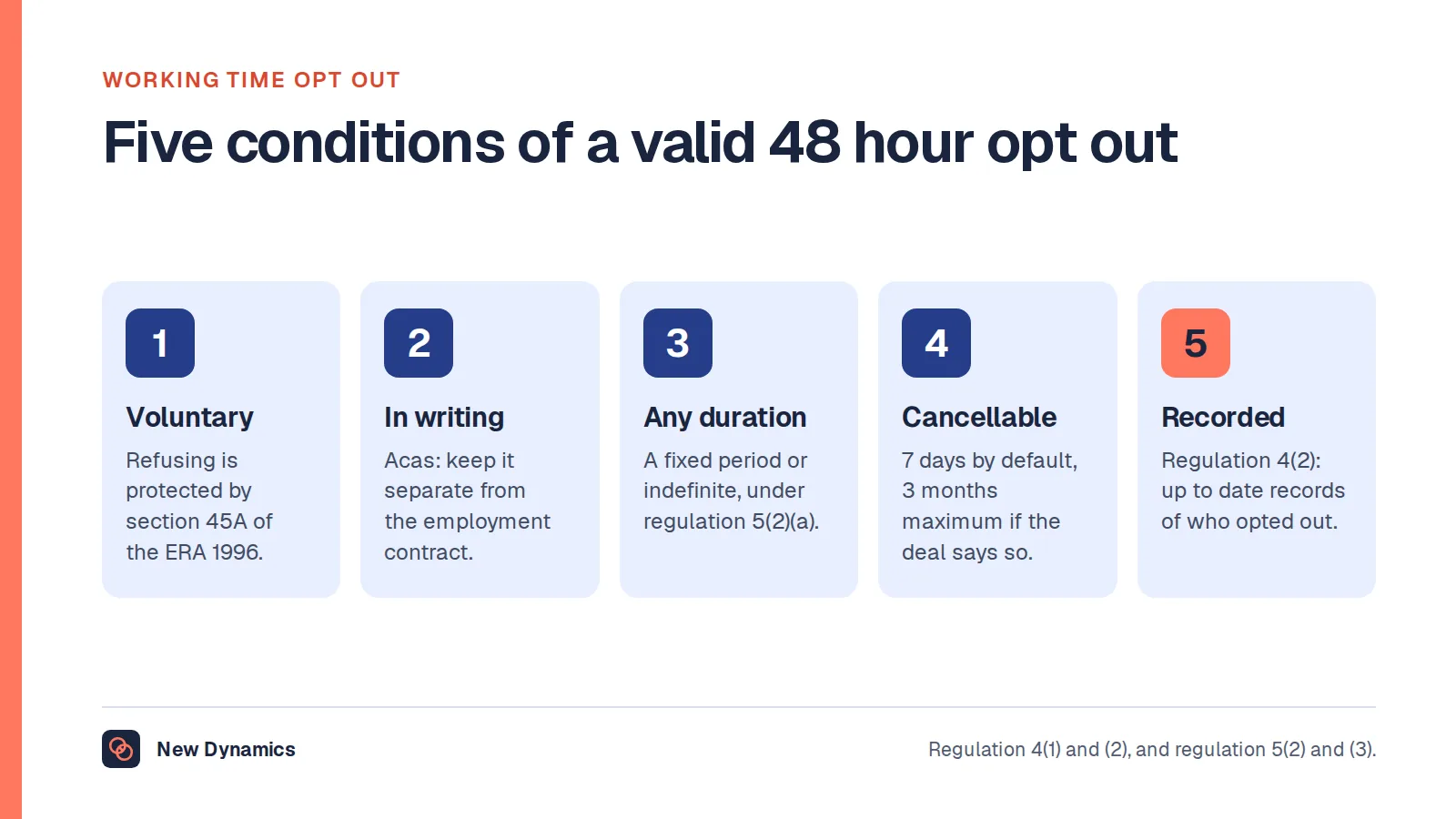
- A 48 hour average. Regulation 4(1) caps "a worker's working time, including overtime" at "an average of 48 hours for each seven days" unless the employer has the worker's written agreement, and regulation 4(3) sets the default reference period at 17 weeks. Our post on the working time opt out covers that agreement and how a worker cancels it.
Regulation 2(1) defines a rest period as "a period which is not working time". That is the legal shape of what people call switching off: an entitlement, not a favour, and home makes no difference. Acas states on the right to rest that workers "have the same rights to rest wherever they're working, for example in a workplace or at home". The in-day break is in our post on rest breaks at work.
Does answering email out of hours count as working time?
The Regulations do not settle it. Regulation 2(1) defines working time as "any period during which he is working, at his employer's disposal and carrying out his activity or duties", and there is no provision on contact, notifications or response times.
Acas applies a control test on being on call: "Time spent on call can count as working time if the worker is doing work that their employer requires them to do under their employment contract." It "does not usually count as working time if the worker is away from the workplace and can spend the time in any way they choose", and counts more readily the more control the employer has over the worker's activities, location and time. On email specifically, Acas says on-call workers keep the same rest entitlement "if they need to be available for work during this time. For example, they're checking emails or responding to phone calls." That is as close as official UK guidance comes to the question.
So work actually done in the evening is working time: it counts towards the 48 hour average and eats into the eleven hour rest period. Being merely contactable, with nothing required, usually is not. Where the line falls in a given case turns on the facts, and the Regulations will not tell you.
The health and safety duty, which is the one with teeth
Hours are a health and safety matter before they are an employment rights matter. HSE is direct in its overview of work-related stress: "Employers have a legal duty to protect workers from stress at work by doing a risk assessment and acting on it. This is the same duty you have to protect people from other health and safety risks."
HSE names six areas of work design affecting stress levels: demands, control, support, relationships, role and change. Its Management Standards say what good looks like for each. Demands covers "workload, work patterns, and the work environment", and the standard is that "employees indicate that they are able to cope with the demands of their jobs". What should be happening, in HSE's words: "The organisation provides employees with adequate and achievable demands in relation to the agreed hours of work."
That phrase does the work a right to disconnect would have done: demands are measured against agreed hours, so work routinely pushed outside them is a risk assessment question. HSE's accredited official statistics release Work-related stress, depression or anxiety statistics in Great Britain, 2025, published on 20 November 2025 with data up to March 2025, reports "964,000 workers suffering from work-related stress, depression or anxiety (new and long-standing) in 2024/25", and names as the first of its main causal factors "Workload (tight deadlines, too much work/pressure/responsibility)". Wider figures are in our HR statistics hub.
The written statement is where hours get settled
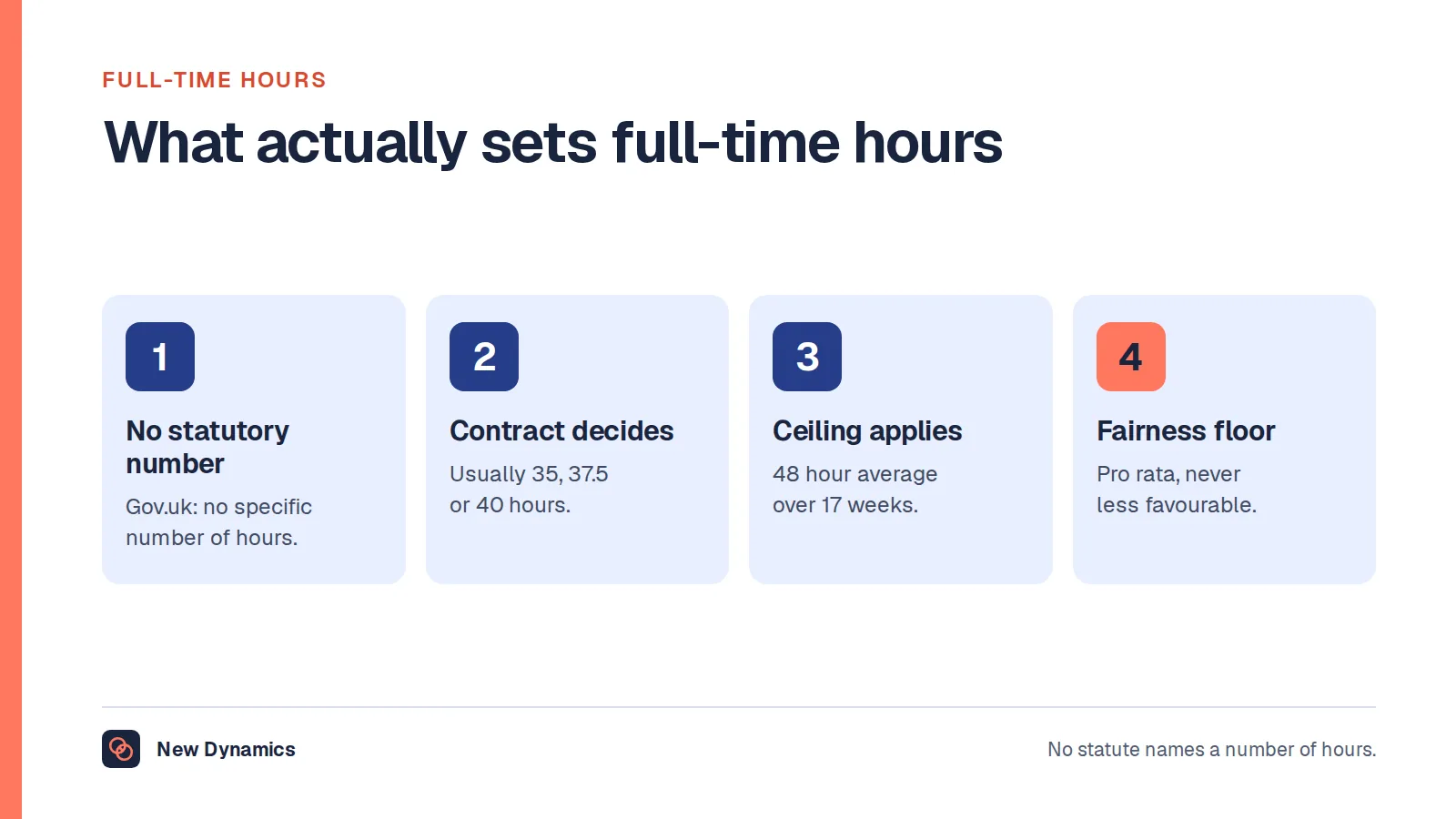
Because no statute fixes the boundary, the document that does is one every employer already has to issue. Section 1 of the Employment Rights Act 1996 requires a written statement of particulars "not later than the beginning of the employment". Section 1(4)(c) requires particulars of "any terms and conditions relating to hours of work", including "normal working hours", "the days of the week the worker is required to work" and "whether or not such hours or days may be variable". GOV.UK's guide to the written statement of employment particulars adds that the principal statement goes out on the first day and that changes must be notified within one month.
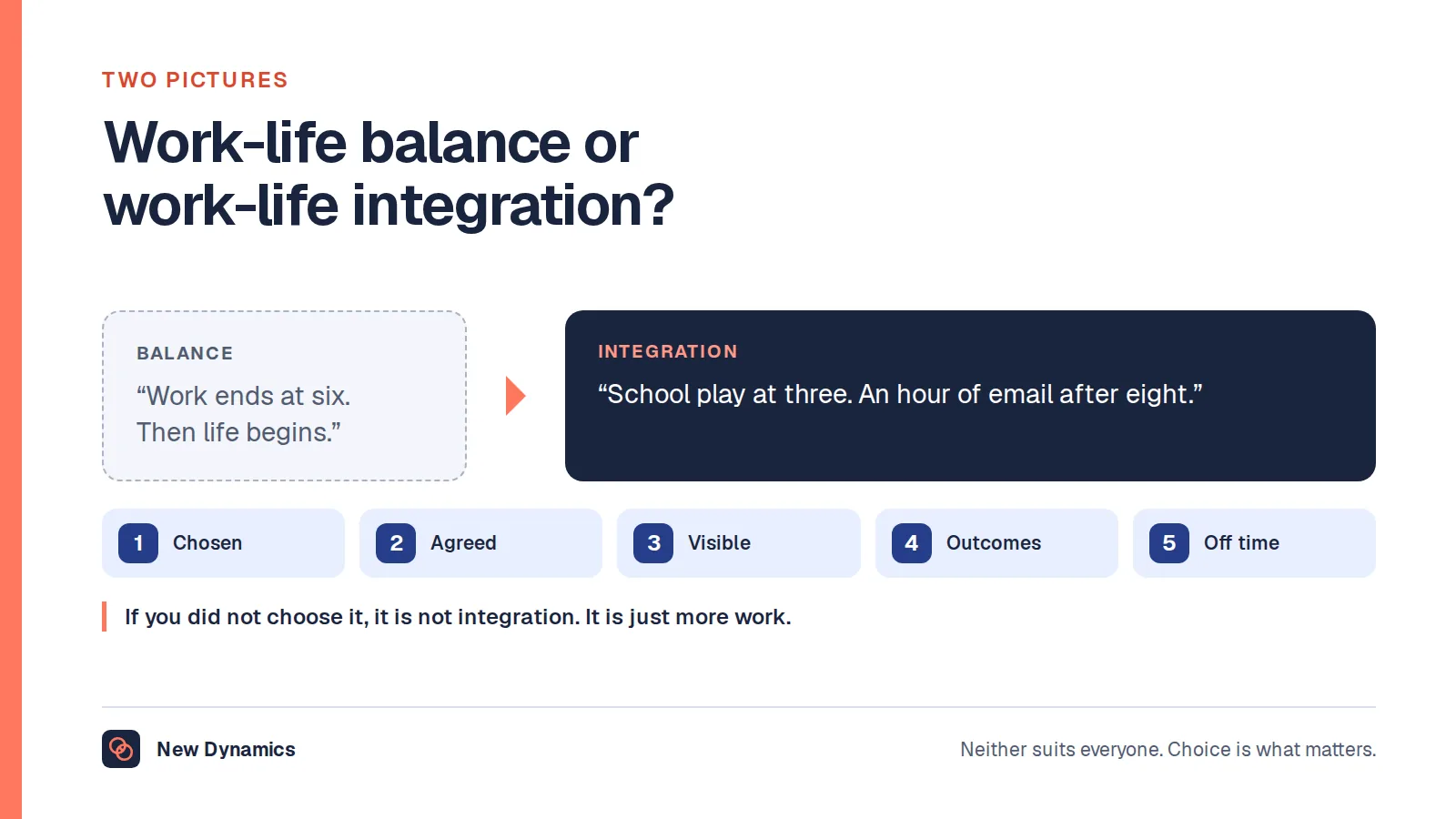
If a role genuinely involves evening cover, that belongs in the statement as a term, with the rota, the rest arrangements and any on-call payment. If it does not, the normal hours in the statement are the agreed hours, and that is the figure HSE's demands standard measures against. Our post on work life integration covers holding the line.
What an employer can do without a law requiring it
None of this is an obligation. All of it is ordinary practice.

- Write the response expectation down, channel by channel. Say whether a message sent at nine in the evening is expected to be read before the next working day. Silence gets read as yes.
- Separate urgent from everything else. One named route for emergencies, with a rota and a payment, lets every other channel carry no expectation.
- Use send-later, especially upwards. A manager drafting at midnight sets the norm whatever the policy says.
- Check hours against the statement. If evening work is routine, either the rota changes or the statement does.
Frequently asked questions
Is there a right to disconnect in the UK?
No. No UK statute or statutory instrument creates one. The Employment Rights Act 2025, which received Royal Assent on 18 December 2025, has no such provision in its 160 sections, and Acas publishes no code or guidance creating one. What applies instead is the Working Time Regulations 1998, the health and safety duty on work-related stress, and the contract.
Do I have to answer work emails outside my working hours?
Nothing in the Working Time Regulations 1998 requires you to, and nothing stops your employer sending them. Any obligation comes from your contract, and from the terms relating to hours of work that section 1(4)(c) of the Employment Rights Act 1996 requires in writing. If after-hours availability is part of the job, it should appear there.
Was the right to switch off dropped?
It was never legislation. GOV.UK's Next Steps to Make Work Pay of 10 October 2024 promised it "through a statutory Code of Practice". Answering the House of Lords Home-Based Working Committee on 26 February 2026, the government did not repeat that commitment, saying only that it "will continue to progress policies aimed at alleviating stress in the workplace". The timeline updated on 5 November 2026 does not list it, and no consultation has opened.
Does checking email in the evening count as working time?
The Regulations do not settle it. Regulation 2(1) defines working time as a period when a worker is "working, at his employer's disposal and carrying out his activity or duties", with nothing about contact or notifications. Acas applies a control test. Work actually done counts towards the 48 hour average and reduces the eleven hour rest period.
Your next step: three checks
- Read one written statement. Does it state normal working hours, the days of the week, and whether and how they vary, as section 1(4)(c) requires? If a role involves evening cover and the statement is silent, fix the statement.
- Test the eleven hours. Take the last person who sent a late message and count the hours to their first activity next morning. Under eleven is a regulation 10 problem, not a culture problem.
- Put workload in the stress risk assessment. Use HSE's six areas, and measure demands against agreed hours rather than against what people manage.
Then write the answers into one working hours and contact section a manager can apply without interpreting it. Our employee handbook guide covers the wording and where it sits relative to the contract. The guide is free to read, and the PDF uses our short download form.
Want working hours and out-of-hours policies running through one recorded process instead of a shared drive? Book a New Dynamics demo and bring your current contract wording. You can also email contact@new-dynamics.com.