TL;DR
- Statutory sick pay changed on 6 April 2026. It is now paid from the first day of illness rather than the fourth, and the lower earnings limit has gone, so there is no minimum amount a worker must earn to qualify.
- An employee can self-certify for 7 calendar days, including weekends. After more than 7 days in a row they need a fit note, which a GP, hospital doctor, registered nurse, occupational therapist, pharmacist or physiotherapist can issue.
- A manager telling colleagues why someone is off is a data protection problem, not an awkwardness. The ICO treats sickness records as special category data and says they should not be shared beyond those who need them for their jobs.
Two people open this page. One is an employer writing or fixing a sick leave policy. The other is at home at seven in the morning, feeling awful, wondering what to say and whether they will be paid. This article is written for both, because the policy only works if it answers the second person's questions.
It covers what sick leave is, who gets statutory sick pay and how much, self-certification and fit notes, how to call in sick and what to say, how much contact from work is reasonable, who is allowed to know why you are off, disability and menstrual or menopause-related absence, and what a good policy actually says. It describes the position in Great Britain and is general information rather than legal or medical advice.
Most sickness absence is mentioned first in a conversation with a manager, not in a form, so the quality of those conversations matters more than the wording of any clause. See how New Dynamics continuous feedback keeps regular check-ins on the record.
What counts as sick leave
Sick leave is time off work because you are too unwell to do your job. There is no separate legal category called medical leave in Great Britain, which is why searches for a medical leave definition land on sickness absence: the same rules cover a stomach bug, a broken wrist, surgery, a mental health crisis and a long recovery.
Acas is explicit that this is not only about physical illness. Its guidance on sick leave states that "both physical and mental health problems can count as sickness" and that "employers must treat mental and physical health as equally important".
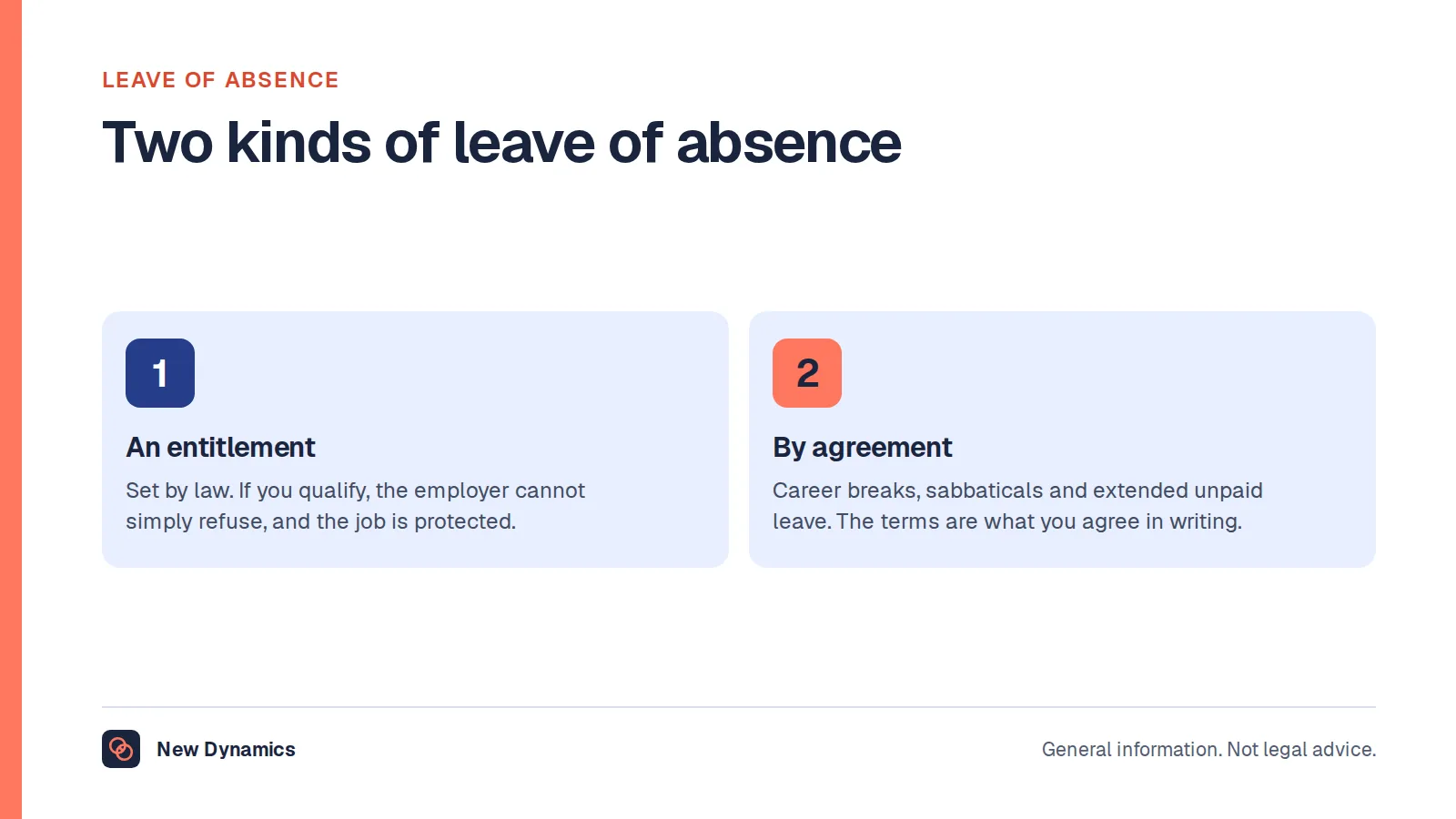
A reason for sick leave does not have to be dramatic to be legitimate. Being unfit to work is the test, not how serious the condition sounds when said out loud. Longer or planned time away for other reasons, such as study or caring for a relative, is a different thing again, and our post on the leave of absence covers that.
Statutory sick pay: what is in force now

Statutory sick pay, usually shortened to SSP, is the legal minimum an employer must pay an eligible worker who is off sick. An employer can pay more through a company, contractual or occupational scheme, but cannot pay less.
Who qualifies
Acas sets out the current statutory sick pay criteria. A worker is eligible if they "have done some work for their employer", "have told their employer they're sick within any deadline the employer has set or within 7 days", and "are classed as employed for tax purposes".
That last condition is the one that answers the zero hours question. Acas explains that those classed as employed for tax purposes "include anyone who has their tax paid automatically through PAYE. For example, employees and agency workers", while "workers who pay their own tax through self assessment are not eligible to receive statutory sick pay". Contract type is not the test. Being on a zero hours contract does not remove the right to SSP, and nor does being in a probation period: Acas states that "probation periods do not affect eligibility for statutory sick pay".
GOV.UK adds two limits on its eligibility page. You will not qualify if you "have received the maximum amount of SSP (28 weeks)" or "are getting Statutory Maternity Pay". Separate spells for the same reason can be treated as "linked" if they are "8 weeks or less apart", and entitlement ends after a continuous series of linked periods lasting more than three years.
How much, and for how long
GOV.UK's employer guide puts the amount plainly: SSP "is either £123.25 a week or 80% of average weekly earnings, whichever is lower", and "it's paid for up to 28 weeks". HMRC's table of rates and thresholds for employers 2026 to 2027 names the tax year for that figure: "the weekly rate of Statutory Sick Pay (SSP) for 2026 to 2027 is £123.25 or 80% of the employee's average weekly earnings, whichever is lower". Average weekly earnings are worked out over the eight weeks before the absence.
SSP is paid only for qualifying days, meaning the days the person would have worked. Acas gives the worked example of someone contracted Monday to Friday who is sick from Thursday and returns on Tuesday: the qualifying days are Thursday, Friday and Monday, and those are the days the employer must pay. Where there is no regular pattern, the employer and worker should agree which days count, and if they do not agree, any day the worker could have been required to work may count.
If SSP runs out, or the person never qualified, the employer must issue form SSP1, and the individual may be able to claim Universal Credit or Employment and Support Allowance instead.
What changed under the Employment Rights Act 2025
Be precise about this, because a lot of older advice is now wrong. Acas records that the Employment Rights Act 2025 "became law on 18 December 2025", that its changes "will happen in 2026 and 2027", and that "many changes have not happened yet".
The sick pay changes have happened. From 6 April 2026, Acas states, "statutory sick pay is paid from the first day of illness, instead of the fourth day" and "the lower earnings limit has been removed", so "workers do not need to earn a minimum amount to be eligible for statutory sick pay". Its sick pay page lists the two conditions that workers no longer need to meet: to "earn on average at least £125 per week, before tax", known as the lower earnings limit, and to "be off sick for at least 4 days in a row", known as waiting days.
So waiting days are gone, and the earnings test is gone. What arrived alongside them is the 80% comparison, which is why a part-time worker on low pay may now receive a percentage of their wages rather than the headline weekly figure. Anything still awaiting commencement under the Act should be described as coming, not current, and policies that quote three unpaid waiting days need rewriting.
Self-certification and fit notes
For short absences, nobody needs a doctor. GOV.UK's guide to taking sick leave says that "if employees are off work for 7 days or less, they do not need to give their employer a fit note or other proof of sickness from a healthcare professional". On return, "their employer can ask them to confirm they have been off sick. This is called 'self-certification'", and the two of them agree how, whether that is a form or an email.
Acas counts those seven days as calendar days: someone "can 'self-certify' for 7 calendar days, including weekends".
After that, evidence is required. Employees "must give their employer a 'fit note' (sometimes called a 'sick note') if they have been ill for more than 7 days in a row and have taken sick leave. This includes non-working days, such as weekends and bank holidays."
Fit notes are no longer a GP-only document. GOV.UK lists the healthcare professionals who can issue one: "GP or hospital doctor, registered nurse, occupational therapist, pharmacist, physiotherapist". The note can be printed or digital, and it says either that the person is "not fit for work" or "may be fit for work". If it says they may be fit for work, the employer "should discuss any changes that might help the employee return", and "the employee must be treated as 'not fit for work' if there's no agreement on these changes". Employers can take a copy; the employee keeps the original.
Calling in sick: how and what to say

An employer may reasonably require to be told, promptly, by a stated route. That is the whole of it. GOV.UK's eligibility guidance sets the backstop: "you must usually tell your employer you're unable to work before the deadline they set (or within 7 days if they have not set one)", and "you could lose some of your SSP if you do not tell your employer in time".
A policy should therefore say two things that many policies leave out: how to report, and by when. Acas's guidance on creating absence policies lists "how workers should report unplanned absences" among the things to include, alongside who to contact. Naming a deadline such as one hour before the shift starts, and a named person plus a fallback, removes almost all of the anxiety people feel about this.
What to say when you call in sick
Four pieces of information are enough:
- That you are unwell and not fit to work today. You do not need to name a condition, and a manager who demands a diagnosis is overstepping.
- How long you expect to be off, or that you do not know yet and will update them by a stated time tomorrow.
- Anything urgent, such as a client call at ten, a shift handover or a deadline somebody else now needs to pick up.
- How you can be reached, and when you would rather not be.
A worked phrasing, for a call or a message: "Hello, I'm not well enough to work today. I'll let you know by four o'clock whether I'll be in tomorrow. The only urgent thing is the supplier call at two, which Sam can cover if you ask them." Nothing more is required.
Should I call in sick at all?
If you are not fit to work, yes. The question behind this search is usually whether it is acceptable, and the honest answer is that working while genuinely unwell tends to cost the employer more than the absence does, through mistakes, a longer recovery and infecting colleagues. It is not a moral failure to be ill. Calling out of work is only a problem when it is not reported as the policy asks, or when the stated reason is not true, because that becomes a trust issue rather than a health one.
Contact during sick leave
This is one of the most searched questions in this whole area, and the answer is not "never" or "whenever we like". Acas states that "an employer can contact an employee who is off sick" and that "how much contact is appropriate will depend on the employee's individual circumstances", with the employer and employee agreeing what is appropriate.
Its guidance on keeping in touch during absence says employers and employees "should agree on how to stay in touch during absence and how much contact is reasonable", and that they should agree three specifics: how often, by what method, and who the employee will be in contact with, whether that is a line manager, another manager or someone in HR. Acas notes that contact "is a good chance to check on the employee's wellbeing and see if they need any support", and that such meetings are sometimes called welfare meetings.
Where the absence relates to mental health, Acas is direct about the risk of too much: employers "should agree the purpose, type and level of contact with the employee. This is to make sure it's useful and not overwhelming." If contact is too difficult for the person, the employer "could ask if there's someone else they can check in with", such as a family member or close friend.
There is also a duty not to let somebody fall out of the loop. Acas says employers should update people who are off work for any reason about "promotion or other job opportunities", "redundancies" and "reorganisations that could affect their job", and warns that if an employee off sick because of a disability misses a promotion opportunity, "this could be disability discrimination".
Practically: agreed, predictable, purposeful contact is fine. Four calls on the first morning, a message asking when they will "definitely" be back, or chasing work while someone is signed off is not, and it makes the return harder than the illness did.
Confidentiality: who actually needs to know

A manager who tells the team why a colleague is off has not just been tactless. They have probably mishandled special category data.
The ICO's employment guidance on sickness and injury records draws a useful distinction. A sickness record "contains details of the illness or condition responsible for a worker's absence". An absence record "may give the reason for absence as 'sickness' or 'accident' but does not include any reference to specific medical conditions", and the ICO notes that "a simple absence record, without any details of a worker's health condition is not likely to be special category data". Employers are encouraged to use the less intrusive record where they can.
For the records that do name a condition, the ICO is clear: "sickness and injury records include information about workers' physical or mental health. Holding sickness or injury records therefore involves processing special category data." On access, the rule is need to know: "you should not make the sickness, injury or absence records of individual workers available to others, unless it is necessary for them to do their jobs." Managers are usually given what they need for their managerial role, for example to investigate repeated or long-term absence, and the ICO says employers should make sure managers "are aware of the sensitive nature of sickness and injury records and how to handle them appropriately".
It also rules out one common practice outright: an employer "must not publish 'league tables' of sickness absences of individual workers where everyone can see a person's sickness, injury or absences". Departmental totals, with no individual identifiable, are the alternative.
So what should a manager say to the team? That the person is off sick, that they are expected back on a date if one is known, and how the work is being covered. Nothing about the condition unless the person has agreed what can be shared. Acas builds that agreement into the return to work conversation, which should cover "what they would like other workers to know about their absence and what they would like to keep confidential". If you are building the wider framework for this, our employee data protection guide covers lawful bases, access and retention for people data.
Disability-related absence and reasonable adjustments
Where absence is linked to a disability, the Equality Act 2010 changes what a policy may do. GOV.UK states that "employers must make changes to an employee's working conditions if they're disabled. These changes are known as 'reasonable adjustments' and could include working shorter hours or adapting equipment employees use at work."
Acas's guidance on disability-related absence gives examples that bear directly on absence policies: "not counting some or all sickness absence related to a disability towards any trigger points", "increasing the number of absences that will trigger a review", and "recording disability absence separately to other sickness absence", sometimes called disability leave. It says the employer "should talk with the person, listen and consider their specific situation", and may seek medical advice such as an occupational health report.
If your policy uses a scoring system, this is where it needs care. Our post on the Bradford Factor sets out how those scores behave and why a trigger should start a conversation rather than a sanction.
Menstrual and menopause-related absence
There is no separate statutory period leave or menstruation leave in Great Britain. Time off for severe period pain is sickness absence, and it is covered by the ordinary sick leave rules above: self-certify for up to seven calendar days, and expect to be paid under SSP or a company scheme on the same terms as any other illness. A message to a manager needs no more detail than "I'm unwell and not fit to work today", for exactly the confidentiality reasons set out above.
Menopause is treated more explicitly. Acas's guidance on menopause at work describes it as "a health and wellbeing concern for workers" that "needs to be handled sensitively", notes that symptoms last about four years for many people and sometimes much longer, and reminds employers that menopause affects "most women and other people who have a menstrual cycle", including some transgender, non-binary and intersex colleagues. Acas also records that from 6 April 2026, under the Employment Rights Act 2025, "employers of all sizes can voluntarily publish action plans around menopause and gender pay gaps". Voluntarily is the operative word today. Acas lists those plans as becoming mandatory during 2027 for employers with 250 or more workers, public authorities first and the private and voluntary sectors from April 2027, so a large employer can treat a plan as preparation rather than a guess about what the law might become.
The practical move for both is the same. Make it possible to report the absence without explaining the cause, train managers not to probe, and consider adjustments such as flexible start times or a temporary change of duties where symptoms are recurring.
What a good sick leave policy says
Acas's absence policy list is a reasonable template. Adapted to sickness specifically, a policy that works answers all of these:
| Question | What the policy should say |
|---|---|
| How do I report it? | The route, the named contact, a fallback, and the deadline |
| What will I be paid? | SSP as the minimum, any company scheme, and for how long |
| What evidence do you need? | Self-certification up to 7 calendar days, a fit note after that |
| Will anyone contact me? | Who, how often, by what method, and agreed with the person |
| Who will know why I am off? | Only those who need to, with the rest agreed with the person |
| What if it relates to a disability? | How to ask for adjustments and how absence is recorded |
| What happens when I come back? | A return to work conversation, and a phased return if needed |
| What if absence becomes a pattern? | Any trigger points, and that they start a review, not a sanction |
Acas also says employers should "share absence policies with the whole organisation", "make policies clear and easy to follow" and "provide training on the policies", and should involve a recognised trade union or worker representatives when creating or reviewing one. A policy nobody has read is a policy that does not exist.
Return to work conversations
The single most useful part of the process is a short conversation after the person is back. Acas's guidance on returning to work after absence notes that "it's not a legal requirement to have a return to work meeting", but that a chat as soon as possible is a chance to check the person is ready, share what happened while they were off, see what support they need, agree a phased return where appropriate, and settle what they want colleagues to know.
Acas adds that the employer should prepare: make sure the conversation is private, gather relevant records, prepare questions, and know what support is actually available to offer. Where the person is disabled, the employer "should review their reasonable adjustments". And the employer "should also look out for signs of underlying problems causing a worker's absence", such as work-related stress or a disability, while recognising that "a worker does not have to tell them anything".
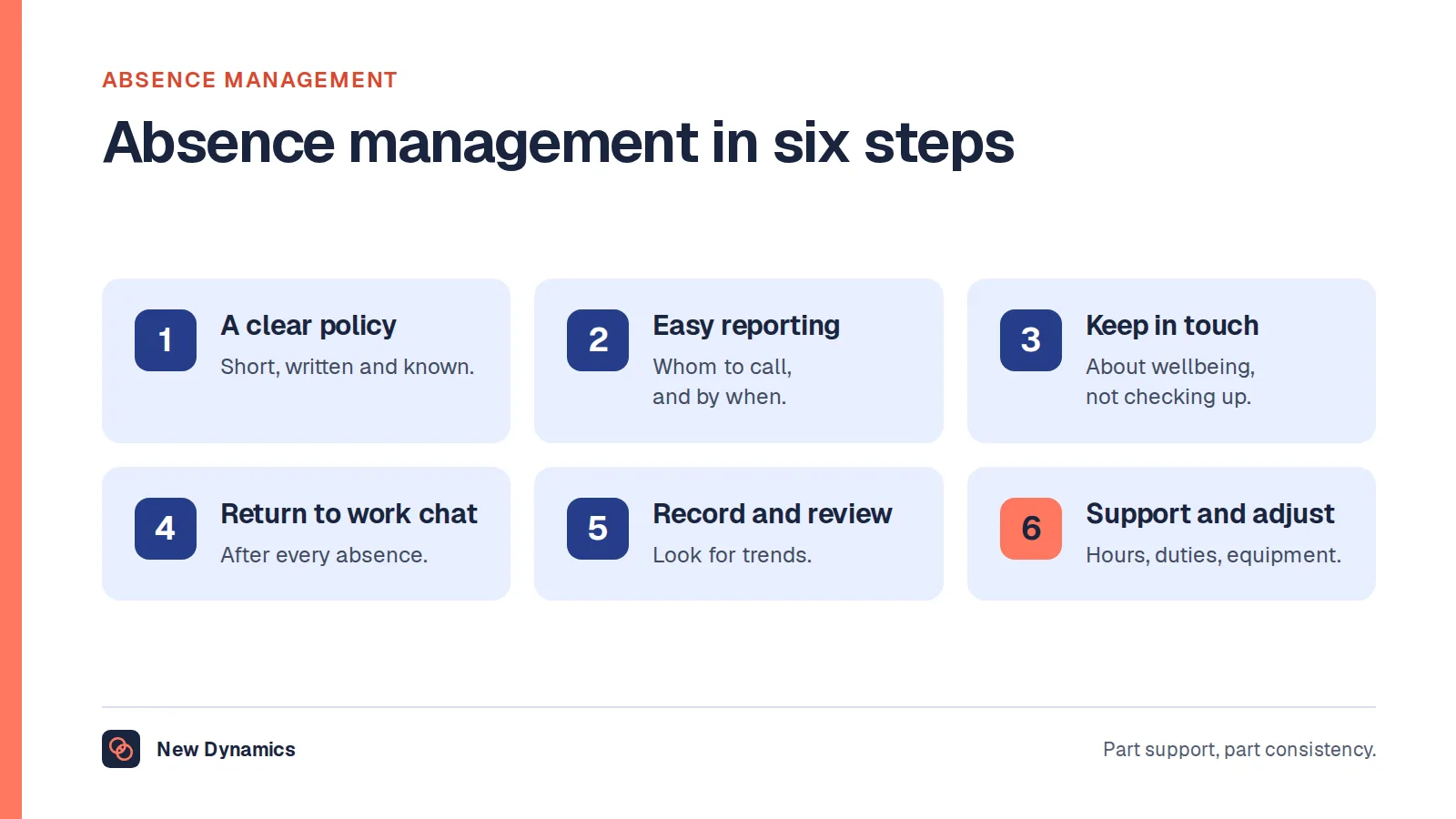
Five minutes, in private, with no form to sign, does more for attendance than any trigger table. The wider process these conversations sit inside is covered in our post on absence management.
What usually goes wrong
- A policy that punishes honesty. If reporting sickness reliably leads to a formal meeting, people stop reporting sickness and start working while unwell, or booking annual leave instead, and the employer loses sight of the real picture.
- Managers asking for a diagnosis. Nobody is required to name their condition for a short absence, and the question itself risks both a discrimination complaint and a data protection one.
- Quoting the old rules. Waiting days and the lower earnings limit both went on 6 April 2026. A policy that still says the first three days are unpaid is now telling staff something untrue.
- Telling the team why. Explained above, and the most common single failure.
- Contact that becomes pressure. Daily calls asking for a return date are not welfare contact.
- No route for the 6am message. If the named manager does not answer the phone before nine, the policy needs a second option.
- Treating mental health differently. Acas is explicit that physical and mental health should be treated as equally important.
A note on jurisdiction
This article describes Great Britain. The Employment Rights Act 2025 and the Acas guidance quoted here apply to England, Wales and Scotland. Employment law in Northern Ireland is made separately and differs in places, and the equivalent advisory body is the Labour Relations Agency, so check the Northern Ireland position rather than assuming it matches. The ICO's guidance on health data applies across the UK. None of this is legal or medical advice; take advice on your own policy and your own health.
Frequently asked questions
How much is statutory sick pay?
Statutory sick pay is the lower of two amounts: a weekly rate set by the government, or 80% of the worker's average weekly earnings. HMRC gives the weekly rate for the 2026 to 2027 tax year as £123.25, and it is paid for up to 28 weeks. An employer can pay more under a company scheme but never less.
Do you get sick pay from the first day off work?
Yes, since 6 April 2026. Acas states that statutory sick pay "is paid from the first day of illness, instead of the fourth day", so the three unpaid waiting days that older policies describe no longer apply. It is still paid only for qualifying days, meaning the days you would otherwise have worked.
Do zero hours contracts get sick pay?
Eligibility turns on employment status for tax, not on contract type. Acas says those classed as employed for tax purposes "include anyone who has their tax paid automatically through PAYE. For example, employees and agency workers", while people who pay their own tax through self assessment are not eligible. Since the lower earnings limit was removed in April 2026, there is no longer a minimum weekly wage to clear.
What should you say when you call in sick?
Say that you are unwell and not fit to work, when you will next update them, and anything urgent that somebody else needs to pick up. You do not have to give a diagnosis for a short absence. Use the route your policy names, and report it by the deadline it sets, or within seven days if no deadline is set.
Can my employer contact me while I am on sick leave?
Yes, and some contact is normal and useful. Acas says an employer can contact an employee who is off sick, that how much is appropriate depends on the individual's circumstances, and that the two should agree how often, by what method and with whom. Where the absence involves mental health, Acas says the contact should be useful "and not overwhelming".
Can my manager tell colleagues why I am off sick?
They should not, beyond what colleagues genuinely need to know in order to work. The ICO says holding records of a worker's illness "involves processing special category data" and that such records should not be made available to others "unless it is necessary for them to do their jobs". Agree what can be shared with the person, and raise it with your employer or the ICO if it was not.
Your next step: pressure-test your own policy
- Read your sick leave policy as if you were ill at six in the morning. Can you find the reporting route and deadline in under a minute?
- Search it for "waiting days", "three days" and any earnings threshold. Delete or rewrite whatever you find, because those rules ended on 6 April 2026.
- Check what it says about contact during absence, and whether it commits to agreeing the frequency with the person rather than imposing it.
- Check what it tells managers about confidentiality, and whether they have been trained on it.
- Add a line about adjustments for disability-related absence, including how it is recorded against any trigger points.
To put the policy itself into a document people will actually read, read and download our employee handbook guide. The guide is free to read, and the PDF uses our short download form.
Want absence, adjustments and return to work conversations recorded in one place instead of three inboxes? Book a New Dynamics demo and bring your current sick leave policy. You can also email contact@new-dynamics.com.