TL;DR
- A skills gap is internal and a skill shortage is external, and the Employer Skills Survey measures them separately: its 2024 edition reports 1.26 million UK employees with skills gaps at a 4.0% density, and 250,500 skill-shortage vacancies at 27% of all vacancies.
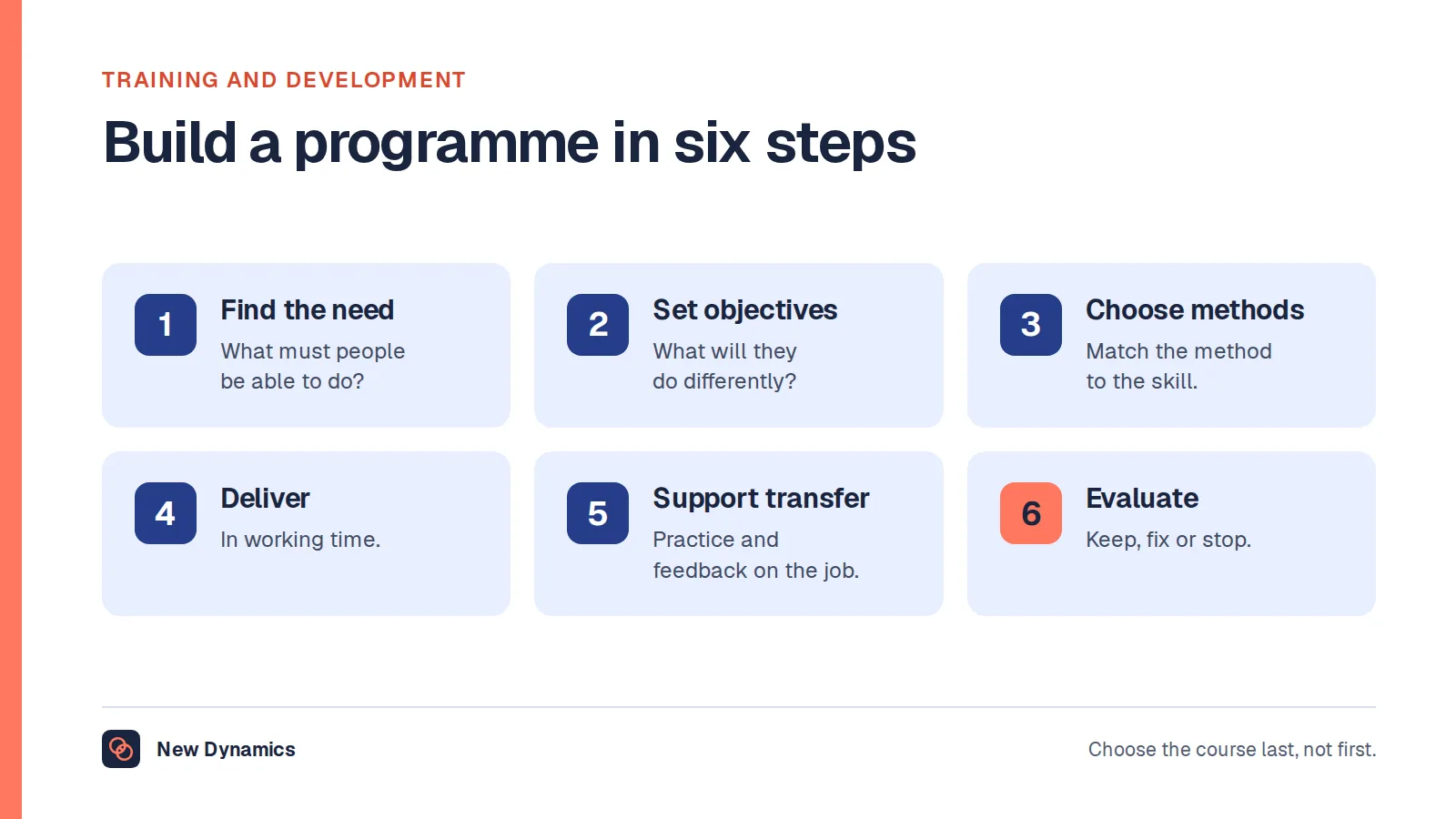
- The method is six steps: decide the scope, list only the skills the work depends on, define levels two assessors would agree on, collect current levels as evidence rather than as a rating, read off the gaps, then decide for each one whether to train, hire, redesign the work or accept it.
- The artefact that comes out is a training matrix with a named owner and a review date. A matrix nobody updates is worse than none, and an analysis that never changes a budget line is theatre.
Most skills gap analyses fail in one of two ways. Either they produce a spreadsheet of sixty skills that nobody touches again after the first month, or they produce a tidy conclusion that never changes a budget line, a rota or a job advert. Both feel like work. Neither closes a gap.
This article sets out what a skills gap actually is in the official wording, why it is a different problem from a skill shortage, and a six-step method you can run on one team in a fortnight. It ends with the artefact the method produces, a training matrix, including who should own it and how to keep it current. It describes the position in the UK and is general information, not legal advice.
A gap only closes when the development attached to it is visible next to the work. See how New Dynamics goals and OKRs keep development commitments in the same place as everything else people are measured on.
What is a skills gap? The official wording
A skills gap is a shortfall in the capability of people you already employ. The Department for Education and Skills England measure it through the Employer Skills Survey, and the glossary of the full UK research report for the 2024 edition words it like this: "Skills gaps exists when an employer thinks a worker does not have enough skills to perform their job with full proficiency. Skill gaps apply to existing employees."
Two details in that sentence do a lot of work. The first is "an employer thinks", because the measure is a judgement, not a test. The second is "apply to existing employees", which is the line that separates a skills gap from a recruitment problem.
The survey also defines the rate it reports alongside the count. Skills gaps density is "The number of employees that lack full proficiency as a proportion of all employment." That is the number worth comparing year on year, because headcount moves.
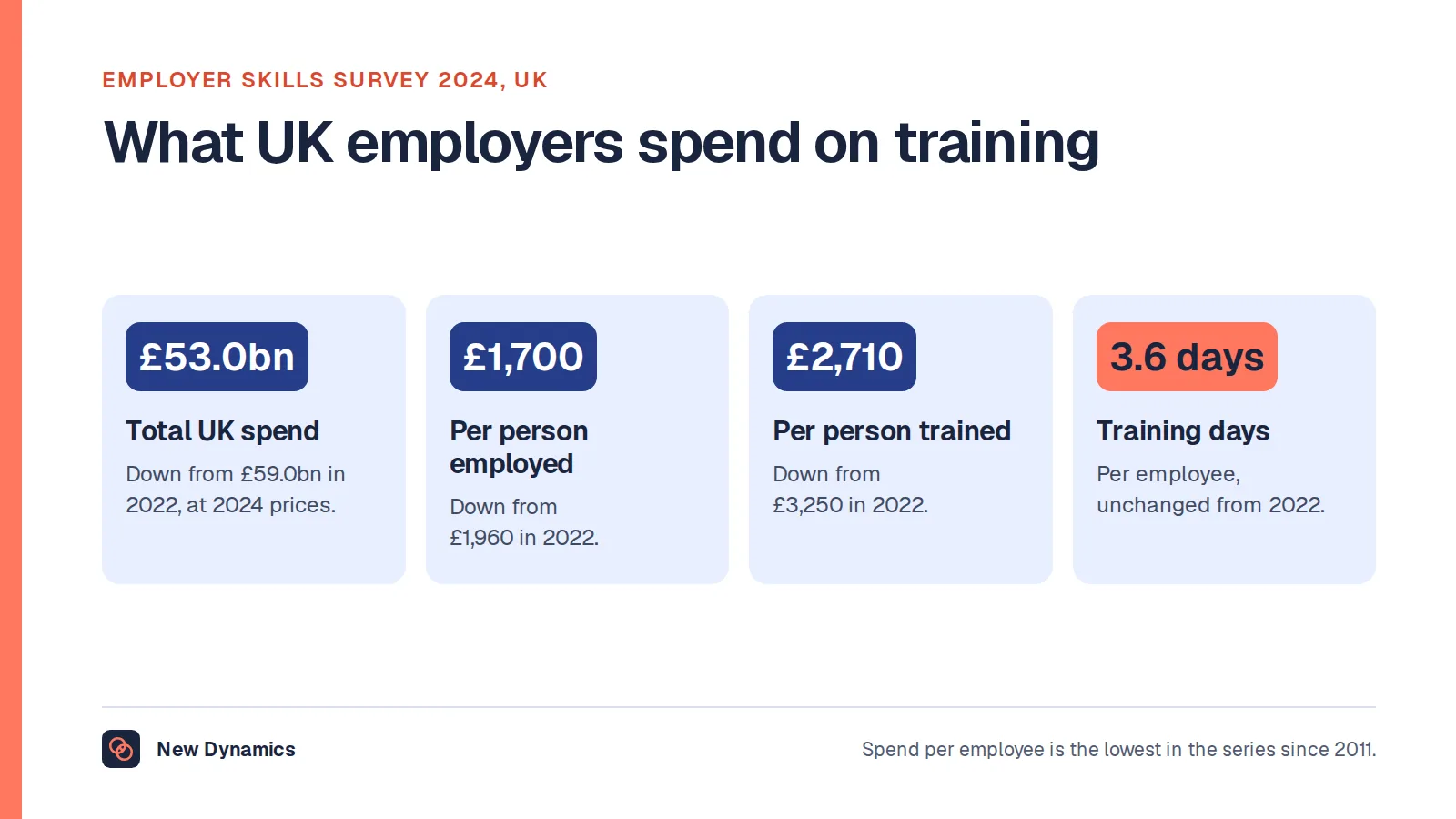
For scale, the 2024 edition of the survey reports that 4.0% of UK employees were judged to lack full proficiency, covering 1.26 million people, and that 12% of employers had at least one employee who was not fully proficient. Both are the lowest readings in a series running since 2011. For the wider training picture around those figures, including spend and training days, see our post on UK learning and development statistics rather than quoting the skills numbers alone.
Skills gap or skill shortage? Different problems, different answers

People use "the skills gap" loosely to mean any complaint about capability, which is why the two problems get the same answer when they need opposite ones. The official statistics keep them apart, and so should your analysis.
A hard-to-fill vacancy is simply one that "employers struggle to fill". A subset of those is a skill-shortage vacancy, which the survey release defines as "A specific type of hard-to-fill vacancy that occurs when an employer cannot find applicants with the required skills, qualification, or experience to do a job." Its rate, SSV density, is "The number of SSVs as a proportion of all vacancies."
In 2024 the survey reports 250,500 skill-shortage vacancies across the UK, making up 27% of all vacancies. That is less than half the 531,200 recorded in 2022, and still above the 226,500 of 2017.
The distinction matters because the levers are different:
- A skills gap is inside the building. It responds to training, to coaching, to pairing people differently, to better instructions and to redesigning how the work is divided.
- A skill shortage is in the labour market. It responds to pay, to how the role is specified and advertised, to where you look, to apprenticeships and to building the capability internally instead of buying it.
Spending a training budget on a skill shortage does nothing for the open vacancy. Writing a bigger job advert does nothing for the four people already in post who are stuck at half proficiency. Name which one you have before you start.
What is a skills gap analysis?
A skills gap analysis is a structured comparison between the capability a defined piece of work requires and the capability currently available for it, ending in a decision about each difference. The comparison is the easy half. The decision is the half that gets skipped.
One finding should shape how you read your own results. The 2024 survey reports that 78% of skills gaps were caused at least in part by transient factors, including employees being new to the role (67%) and training being only partially completed (58%). These are described as "the types of causes which would be expected to reduce over time without significant employer intervention". So a snapshot taken in the week three people joined will overstate your problem. Note how long each person has been in post before you conclude anything.

Step 1: Decide the scope before you list anything
Pick one team, one process or one upcoming change. "The whole organisation" is not a scope, it is a reason the exercise never finishes.
Write down the decision the analysis will inform: next year's training budget, whether to recruit a second specialist, whether a night shift can run without a named individual, whether the new service can launch in March. If no decision is waiting on the answer, stop here and do something else. An analysis with no pending decision is the purest form of the theatre described at the end of this article.
Step 2: List the skills the work actually depends on
List what the work requires, not everything anyone can do. Ten to twenty skills per team is the working range. Past about twenty, the grid stops being filled in a second time.
The useful test for each candidate skill is: if nobody had this on Monday, what would stop or go wrong? If the answer is "nothing much", it belongs in a note, not in the analysis. Health and safety guidance frames the comparison the same way. In the Health and Safety Executive's brief guide to training, step one is to "Identify the skills and knowledge needed for people to do their job in a safe and healthy way. Compare these against people's current skills and knowledge and identify the gaps."
Separate skills from the things that only look like skills. Training cannot fix a missing approval, an unreliable system, a vague specification or a workload larger than the hours available. If you label those as skills gaps, you will buy courses to solve a process problem and the gap will still be there afterwards.
Step 3: Define levels two assessors would agree on
This is the step that decides whether the output is data or opinion. A scale with undefined points produces numbers that cannot be compared between two managers, which makes the whole grid unusable.
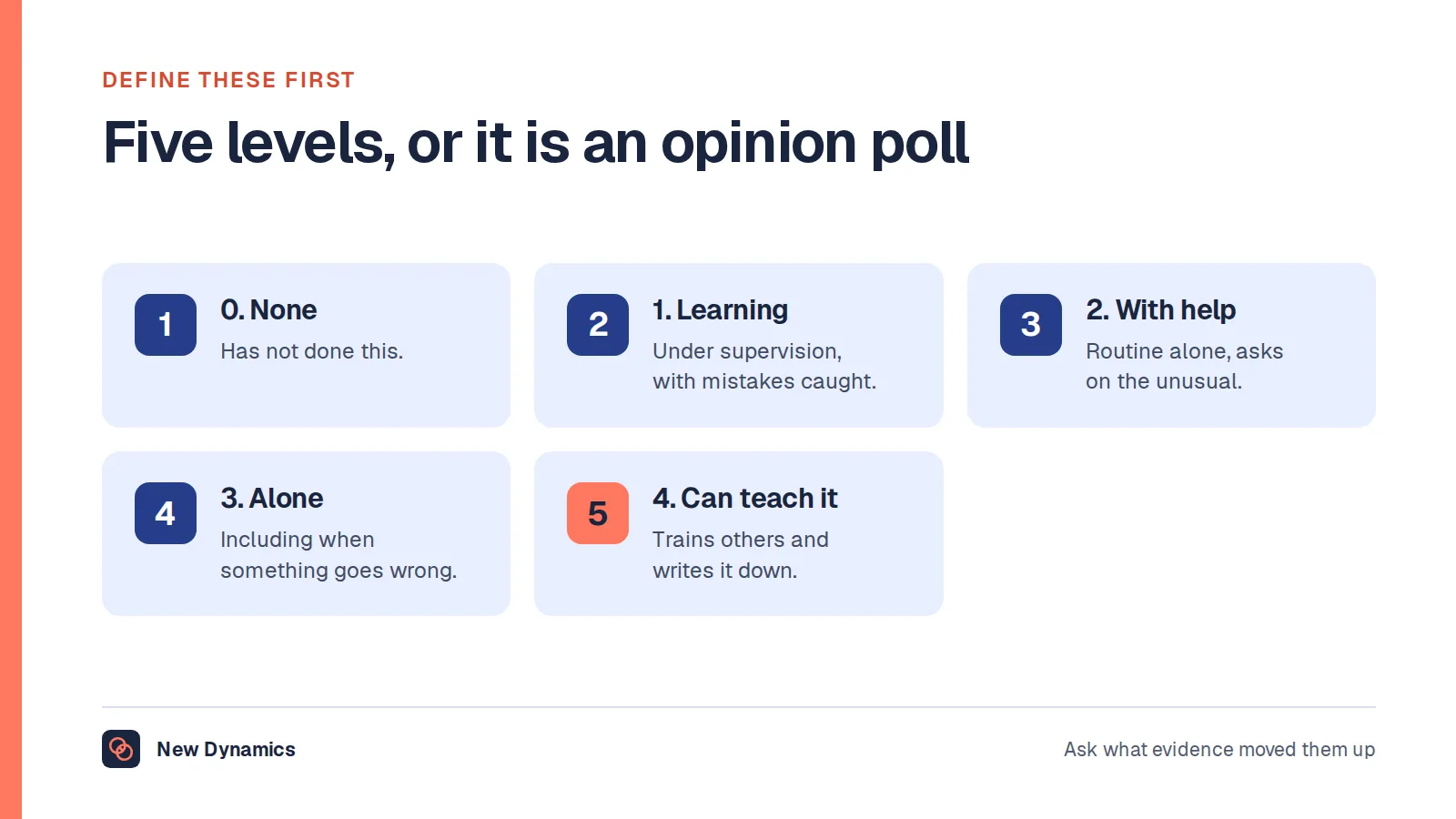
Five levels cover most work: has not done this, learning under supervision, can do the routine cases and asks on the unusual ones, can do it alone including when something goes wrong, and can teach it to someone else. The test of a definition is simple. Two assessors looking at the same person and the same evidence should land on the same level. If they do not, the definition is too vague, not the assessors.
Add two things that are usually missing. First, a way to record that there is not enough evidence yet, which is different from a zero. Second, a target level for each role against each skill, because a gap is only a gap relative to a target. Our post on skills matrix levels sets out a worked five-level scale and the evidence that moves someone up one.
Step 4: Collect current levels without turning it into a performance rating
The fastest reliable method is a short conversation per person, manager and employee together, going along their row and asking one question at each cell: what have you done that shows this level?
Self-assessment alone is the weakest input available. People with little experience of a skill tend not to know what the higher levels contain, and confident self-raters are not the same population as proficient ones. Use self-assessment to open the conversation, then anchor each level on something observable: work produced, cases handled alone, an incident handled when it went wrong, a colleague trained.
Say out loud, before you start, what the data is for and what it is not for. It is for cover risk, training priorities and who works on what. It is not a performance rating and it is not an input to pay. If people suspect otherwise, they inflate, and the exercise generates confident nonsense. The grid also holds personal data about named individuals, so keep it accurate, keep it to what you need and control who can see it.
Step 5: Find the gaps
Now read the grid in three directions, which takes about twenty minutes.
- Down a column. How many people are at or above target for this skill? One is a single point of failure, and a column with one name in it is your most urgent finding regardless of how important the skill looks on paper.
- Across a row. Where is this person relative to the target for their role, and what is the one skill that would most change what they can be given?
- Against the plan. Which skills does the work coming in the next six months need that the grid barely covers?
Rank what you find by consequence, not by the size of the number. A small gap on something the whole process depends on beats a large gap on something used twice a year.
Step 6: Decide to train, hire, redesign or accept

Every gap gets exactly one of four answers, with a name and a date against it:
- Train. The person can get there, the skill is needed in this role, and someone can teach it. Define what they will do differently afterwards and who will look at the result. Attendance is not evidence.
- Hire. The capability is needed at a level nobody present can reach soon enough, or it is needed in addition rather than instead. This is the point where your analysis crosses into the skill-shortage territory described above, so check the market before you promise a date.
- Redesign the work. Move the task to where the skill already sits, split it, automate part of it, or write the job aid that makes the hard bit routine. This is the cheapest answer and the most often forgotten.
- Accept it. Some gaps are not worth closing. Say so explicitly, in writing, with the reason. An accepted gap you have named is a managed risk. An unnamed one is a surprise waiting for the week two people are on leave.
Four answers, one per gap. If everything comes back as "train", the analysis has not been done honestly.
The training matrix: the artefact the analysis leaves behind
A training matrix is the standing record that comes out of the analysis: people down one side, skills or required training across the top, the current level or completion date in each cell, a target level per role, and a date on the whole thing. Where certificates expire, it carries the expiry date too, which is the feature that turns it from a snapshot into something operational. HSE guidance puts it plainly: "You should monitor training records so that refresher training can be given when needed."
Keeping it current is a process question, not a software question:
- One named owner. The manager of the work, not HR and not whoever built the spreadsheet. HR owns the method, the level definitions and the data protection; the manager owns the contents, because only they see the work.
- A fixed review point. Quarterly is enough for most teams and takes twenty minutes. Put it in the same meeting every quarter rather than creating a new one.
- Four triggers between reviews. Someone joins, someone leaves, someone completes training, or a certificate is within ninety days of expiry.
- Visible to the people in it. Everyone can see their own row, the level definitions and the targets. Secret grids rot, because nobody can correct them.
Skill development plans: turning a gap into a dated commitment
A skill development plan is the per person output. For each gap you decided to train, write four lines: the skill and the target level, what the person will do to get there, what will be different in the work when they arrive, and the date it will be reviewed. That is a development plan. Everything longer is usually a course list with a cover sheet.
Keep each plan attached to the person's objectives rather than filed separately, so it is read in the same conversation as the rest of their work. The matrix then has one job it can actually do: showing, next quarter, whether the level moved.
Three honest limits
Self-assessed levels are unreliable. The whole measure, including the national one, rests on judgement. The official density figure is what employers think, which is why it should be read as reported shortfalls rather than tested proficiency. Use evidence and a second opinion, and treat a single self-rating as a conversation starter only.
A matrix nobody updates is worse than none. Stale grids are actively harmful, because decisions get made from them with full confidence: a rota planned around someone who left, a launch date based on a level that was never reached. If you cannot name the owner and the review date, keep the analysis as a one-off memo instead and be honest that it expires.
An analysis that never leads to a budget decision is theatre. Running a skills gap analysis without a pending decision produces a document, a feeling of rigour and no change. Before you start, write down which decision will be made differently depending on the answer. If you cannot, the exercise is not ready.
Frequently asked questions
What is a skills gap analysis?
A structured comparison between the capability a defined piece of work requires and the capability available for it now, ending in a decision for each difference: train, hire, redesign the work or accept the gap. The comparison is the easy half. The decision is the half that is usually skipped.
What is a skills gap?
A shortfall in the skills of people you already employ. The Employer Skills Survey glossary words it as follows: "Skills gaps exists when an employer thinks a worker does not have enough skills to perform their job with full proficiency. Skill gaps apply to existing employees." It is a judgement by the employer, not a test result.
What is the difference between a skills gap and a skill shortage?
A skills gap is internal, among current employees. A skill shortage is external: the survey defines a skill-shortage vacancy as a hard-to-fill vacancy that happens when an employer cannot find applicants with the required skills, qualifications or experience. Training answers the first. Pay, sourcing and role design answer the second.
What is a training matrix?
A standing grid of people against the skills or required training for their work, holding the current level or completion date, the target level per role, certificate expiry dates where they apply, and the date it was last reviewed. It is the artefact a skills gap analysis leaves behind, and it needs one named owner.
How often should a training matrix be reviewed?
Quarterly covers most teams, and the review takes about twenty minutes once the grid exists. Update it immediately when someone joins or leaves, when training is completed, or when a certificate is within three months of expiry, because those are the four changes that make a matrix misleading fastest.
Is a skills gap analysis a performance review?
No. It assesses capability against named tasks at a point in time, not how someone performed against their objectives, and it should not feed pay. Mixing the two causes people to inflate their own levels, which destroys the data the analysis depends on.
Your next step: run it on one team this month
- Name the decision waiting on the answer. If there is not one, do not start.
- List the ten to twenty skills that team's work genuinely depends on, and set a target level per role.
- Write the five level definitions, then test them: would two managers rate the same person the same way?
- Hold one fifteen-minute conversation per person, asking for evidence at each level.
- Give every gap one of the four answers, with a name and a date, and put the review in next quarter's calendar.
For the worksheet, the worked example and the level definitions in a form you can hand to a manager, read and download our skills gap analysis guide. The guide is free to read, and the PDF uses our short download form.
Want the training and the targets to live next to the work rather than in a spreadsheet? Book a New Dynamics demo and bring your current matrix. You can also email contact@new-dynamics.com.