TL;DR
- A SMART goal template is a one-page form with a box for each part of the goal: what will change, the evidence, the support needed, why it matters and the dates.
- Copy the table in this article or download the free editable sheet. It adds two things most templates leave out: a quality safeguard and the dependencies on other people.
- Fill it in together, in about thirty minutes. Turn the goal into three or four actions, book the first check-in and keep the sheet where you will both see it.
A blank box labelled “objectives” is where many good intentions go to die. People write “improve communication” or “develop leadership skills”, and twelve months later nobody can say whether it happened.
A SMART goal template fixes this by asking better questions. This article gives you a template you can copy, a free editable sheet to download, the one-sentence format, three completed examples and an action plan to go with it.
If you would rather keep goals in a shared system than in a spreadsheet, with progress and check-ins attached, explore New Dynamics Goals & OKRs.
The SMART goal template
Copy this table into a document, or download the free SMART goal template as an editable CSV that opens in Excel, Google Sheets or any spreadsheet tool. No form is required.
| Field | What to write |
|---|---|
| Goal statement | One sentence that names the outcome, the measure and the date |
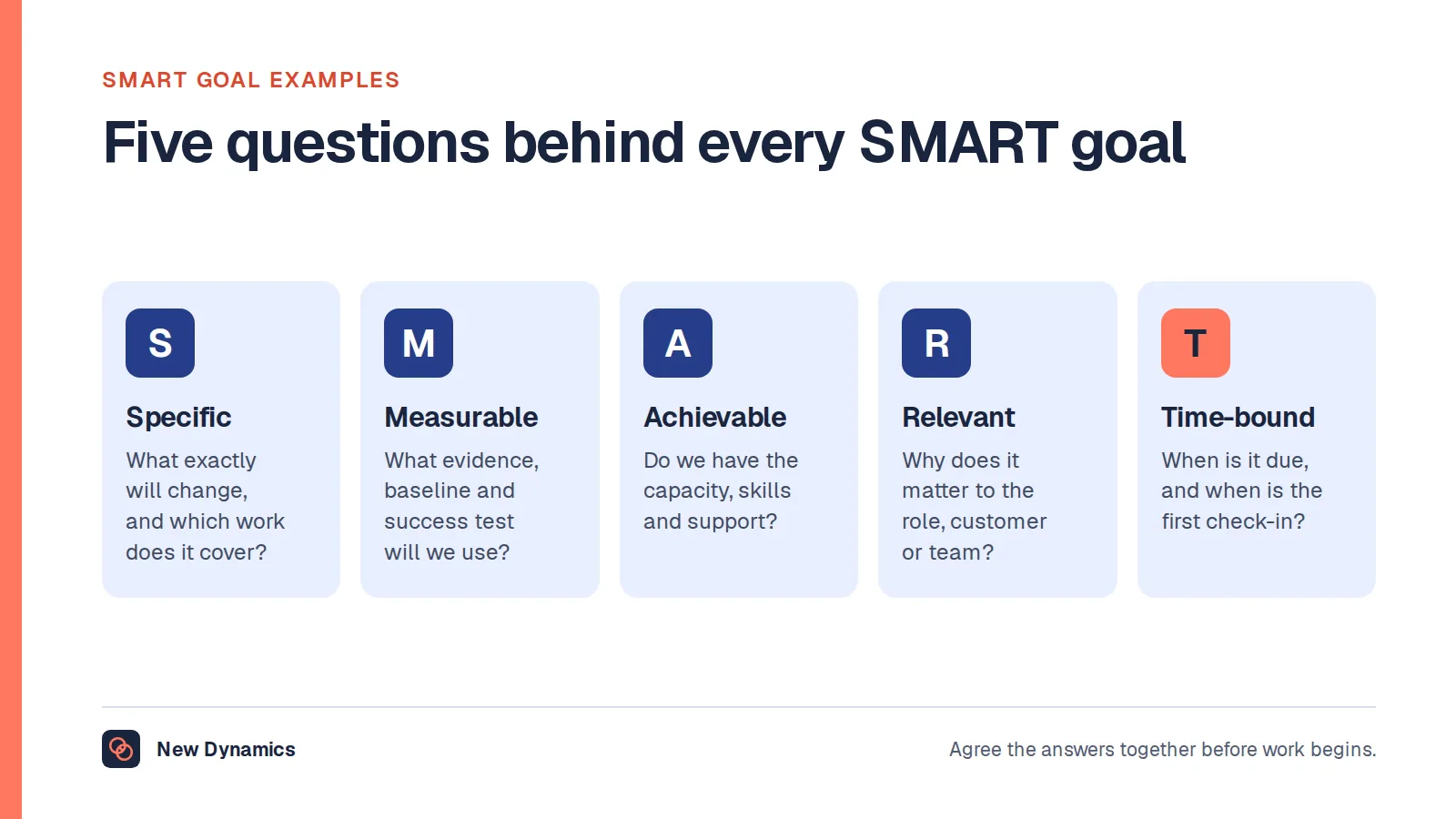
| Specific | What exactly will change? Which work is included, and which is not? |
| Measurable | What evidence will show progress? What is the starting point today? |
| Achievable | What time, skills and support are needed? What will be dropped to make room? |
| Relevant | Why does this matter now? Which priority does it support? |
| Time-bound | The completion date, and the date of the first check-in |
| Quality safeguard | What stops the number being reached in a way that harms the real aim? |
| Dependencies | Who else must act for this to succeed, and have they agreed? |
| Actions | Three or four concrete steps, each with an owner and a date |
| Check-ins | When you will review progress, and what you will look at |
Most SMART goal forms stop at the five letters. The last four rows are what make the goal survive contact with real work.
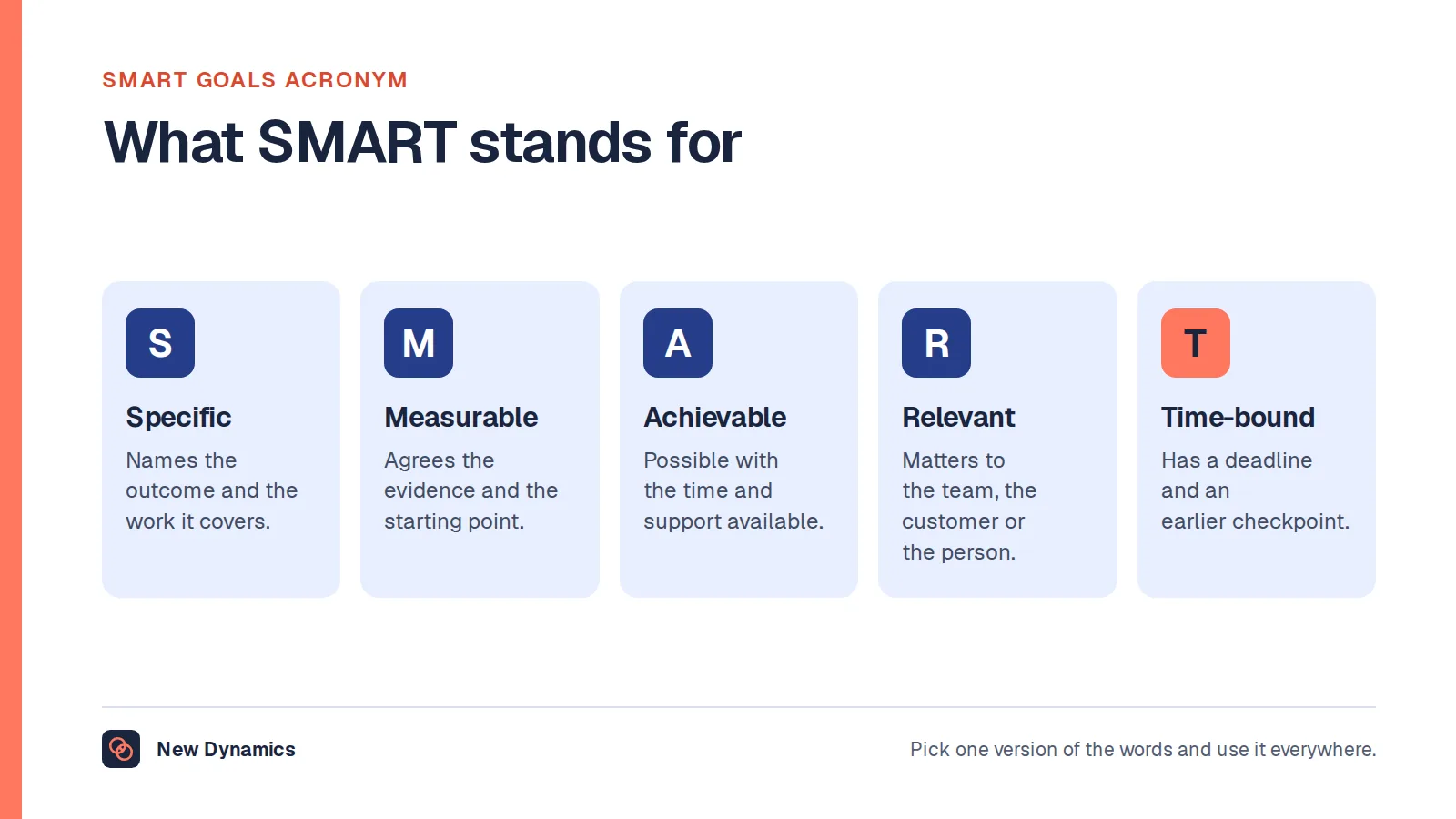
If you need a reminder of the letters, see what the SMART goals acronym stands for. The UK's National Careers Service guide to developing your skills also recommends SMART goals, which it lists as specific, measurable, achievable, relevant and time-bound.

SMART goal format: the one-sentence version
When there is no room for a form, use this format:
By [date], I will [specific outcome], moving from [baseline] to [target], while maintaining [quality safeguard]. We will review progress [how often] using [evidence].
Three rules keep it honest:
- One goal per sentence. If you need the word “and” twice, you have two goals.
- A baseline as well as a target. “Reach 90%” means little without knowing where you started.
- A safeguard. Decide in advance what must not get worse.
How to fill in the SMART goal sheet, field by field
Goal statement. Write this last. It is the summary of everything below it.
Specific. Name the outcome, and avoid naming an activity. “Attend a presentation course” is an activity. “Present the quarterly results to the board without notes” is an outcome.
Measurable. Agree the evidence before the work starts. It may be a number, a sign-off or something a colleague can observe. Our success indicator examples will help you choose.
Achievable. This is a conversation about capacity. If nothing is dropped to make room, the goal is an extra, and extras get squeezed out.
Relevant. If you cannot say which priority the goal supports, question whether it belongs on the sheet. See how to cascade goals at work.
Time-bound. Put two dates in: the finish, and an early check-in. The check-in is the one that saves goals.
Quality safeguard. Faster must not mean sloppier. Cheaper must not mean unsafe.
Dependencies. List the people whose help you need, and confirm that they know.
Three completed SMART goal examples
The figures are illustrative. Use your own baseline.
Example 1: an employee goal
| Field | Entry |
|---|---|
| Goal statement | By the end of the quarter, cut corrections in my monthly report from six to two or fewer |
| Specific | The monthly management report that I prepare. Excludes ad hoc analysis |
| Measurable | Corrections logged by finance after submission. Baseline: six per report |
| Achievable | One extra hour per report for checking. A colleague will peer-review before submission |
| Relevant | Finance currently rechecks the whole pack, which delays the board papers |
| Time-bound | Three reporting cycles. First check-in after the next report |
| Quality safeguard | The submission deadline does not move |
| Dependencies | The peer reviewer has agreed to thirty minutes a month |
Example 2: a manager's goal
| Field | Entry |
|---|---|
| Goal statement | Within six months, hold a fortnightly one-to-one with every team member, with nine in ten taking place |
| Specific | All eight direct reports. Thirty minutes each |
| Measurable | Meetings held as a share of meetings planned. Baseline: about half |
| Achievable | Block the time in the diary for the whole period. Move the weekly report to a shared document |
| Relevant | The last survey showed that people were unclear about their priorities |
| Time-bound | Six months. Check after the first month |
| Quality safeguard | Each meeting covers priorities, obstacles and development, as well as status |
| Dependencies | My own manager agrees to protect the time |
Example 3: a personal development goal
| Field | Entry |
|---|---|
| Goal statement | Within four months, rebuild the weekly sales report myself using the analytics tool |
| Specific | The weekly sales report. Includes data extraction and charts. Excludes forecasting |
| Measurable | A colleague verifies my figures against the current report for three weeks running |
| Achievable | Two hours a week of protected learning time. The analyst will answer questions |
| Relevant | It removes a single point of failure, and supports my aim of moving into an analyst role |
| Time-bound | Four months. First check-in after the training course |
| Quality safeguard | The existing report keeps running until mine has matched it three times |
| Dependencies | The analyst has agreed to one hour a fortnight |
For many more, see our 50 SMART goal examples and, for development aims, 40 career goals examples.

SMART action plan template
A goal needs actions. Add this small table under each goal.
| Action | Owner | By when | Status |
|---|---|---|---|
| Agree the checking steps with finance | Me | End of week one | Done |
| Build the checklist and test it on one report | Me | End of week three | In progress |
| Peer review before each submission | Sam | Each cycle | Not started |
| Review the correction log together | Both | After each report | Not started |
Keep it to three or four actions. If the plan needs twenty lines, the goal is probably a project, and it deserves a project plan.
SMART goal chart: tracking progress
You do not need special software to track a goal. A simple chart with four columns works:
| Date | Measure now | On track? | Note or next step |
|---|---|---|---|
| Check-in 1 | 5 corrections | Partly | Checklist built. Peer review starts next cycle |
| Check-in 2 | 3 corrections | Yes | Two errors came from a late data change |
| Final | 2 corrections | Met | Keep the peer review. Share the checklist |
Update it at each check-in. Record changes to the goal as well, with the reason. A clear history makes the end-of-year conversation fairer, as we explain in performance reviews: the good, the bad and the ugly.
Printable and PDF options
- Print this page and fill in the first table by hand. It fits on one side of paper.
- Download the editable sheet as a CSV file, which includes the fields, an action plan and three check-in rows.
- Get the PDF worksheet. Our SMART goals guide includes a reusable goal worksheet. The guide is free to read, and the PDF uses our short download form.
How to use the template in a thirty-minute conversation

- Before the meeting (employee): draft the outcome and the evidence.
- First ten minutes: agree the outcome and why it matters.
- Next ten minutes: agree the measure, the baseline and the safeguard.
- Last ten minutes: agree the support, the dependencies, the actions and the first check-in date.
- Afterwards: the employee writes the goal statement and shares the sheet. The manager confirms it.
The CIPD notes that objectives work within a wider process of feedback and development. The template starts the conversation. It cannot replace it. See the CIPD performance management factsheet.
Common mistakes with SMART goal templates
Filling in the boxes and filing the form. The sheet is worth nothing if nobody looks at it again.
Too many goals. Three to five per person per period is usually plenty.
Activities dressed as goals. “Attend training” is an action. Put it in the action plan.
No baseline. Without a starting point, nobody can tell how much changed.
No safeguard. A number reached the wrong way is worse than a number missed.
Written alone. A goal the employee did not help to write is a goal the employee does not own.
Frequently asked questions
What is a SMART goal template?
A SMART goal template is a form that prompts you to make a goal specific, measurable, achievable, relevant and time-bound. A good one also asks for a baseline, a quality safeguard, dependencies, actions and check-in dates, and fits on one page.
What is the SMART goal format?
A common format is: “By [date], I will [specific outcome], moving from [baseline] to [target], while maintaining [quality safeguard].” It names the outcome, the measure, the starting point, the target and the deadline in one sentence.
Is there a free SMART goal template I can download?
Yes. This article links to a free editable CSV that opens in Excel or Google Sheets, with no form to complete. It includes the SMART fields, a quality safeguard, dependencies, an action plan and three check-in rows.
How do I write a SMART action plan?
Start with the goal, then list three or four concrete actions. Give each an owner, a date and a status. Review the plan at each check-in. If it needs many more lines, treat the goal as a project.
How many SMART goals should I put on one sheet?
One goal per sheet keeps each goal clear. Most people can sustain three to five goals in a review period. More than that, and some will be ignored, which makes the whole list less credible.
Can I use a SMART goal template for personal goals?
Yes. The same fields work for fitness, learning or money goals. The relevant box becomes “why does this matter to me?”, and the dependencies box covers the people whose support you need.
Your next step: fill in one sheet this week
- Download the template, or copy the table.
- Choose one goal that matters this quarter.
- Fill it in with your manager or a colleague, in thirty minutes.
- Put the first check-in in the diary before you close the file.
For the full method and a PDF worksheet, read and download our SMART goals guide.
Want goals, check-ins and reviews connected in one place? Book a New Dynamics demo and bring a goal you are working on. You can also email contact@new-dynamics.com.