TL;DR
- Four different things get called a talent acquisition certification: a regulated qualification, an apprenticeship with an independent assessment, a professional body's award, and a short course with a completion badge. They are not interchangeable, and only two of them involve anyone testing you.
- Judge a programme by how it assesses, not by how long it is or how it looks on a profile. A credential nobody can fail tells a hiring manager nothing, and most hiring managers know it.
- In England the recruiter apprenticeship sits at level 3 with a typical duration of eighteen months, and it covers the end-to-end process rather than one tool. This article describes the position in the United Kingdom and is general information, not careers advice tailored to you.
Someone asks whether they should get certified in talent acquisition, and the honest answer starts with a question back: certified by whom, assessed how, and for whose benefit?
The phrase covers four quite different things. One is a regulated qualification with a level. One is an apprenticeship with an independent end assessment. One is a professional body's award tied to membership. One is a course that issues a badge for watching the videos. They sit on the same line on a profile and they are not remotely the same.
This article sets out talent acquisition certification in plain terms: the four kinds, what hiring managers actually look at, how to judge a programme before you pay for it, the apprenticeship route in England, and what to build instead if your real problem is a thin track record rather than a missing credential. It names no providers and recommends none.
The work a recruiter is certified to do ends at the offer. See how New Dynamics onboarding turns that offer into a clear first ninety days, which is where retention is won or lost.
If you are writing the role rather than training for it, our recruiter job description covers the responsibilities an employer should be setting out.
The four kinds of credential

A regulated qualification sits at a level on a national framework. Government guidance explains the idea simply: "Most qualifications have a difficulty level. The higher the level, the more difficult the qualification is." A level tells an employer roughly what depth to expect, which is more than most badges manage.
An apprenticeship combines paid work with structured learning and ends in an independent assessment. It takes the longest and is the hardest to bluff.
A professional body award is usually tied to membership, continuing development and a code of conduct. Its value is as much the ongoing obligation as the certificate.
A short course with a completion badge demonstrates that you finished the course. That has value as learning, and almost none as evidence, because nothing was tested.
None of these is dishonourable. The mistake is paying for the fourth while believing you are buying the first.
What hiring managers actually check
In practice, when a recruitment manager looks at a candidate who lists a certification, they check three things, in this order.
- Was anything assessed, and by whom? Independent assessment is the dividing line. "Completed" is not "passed".
- Does the syllabus match the job? Sourcing, screening, interviewing, employment law basics, data protection, candidate experience and reporting. A course that is mostly about one product is product training, which is useful and narrow.
- What have you done since? A credential with no applied work behind it ages fast, and interviewers ask for examples rather than certificates.
The uncomfortable implication: a certificate is a tie-breaker, not a qualification for the job. It helps most for people moving into recruitment from elsewhere, where it signals seriousness and gives vocabulary. It helps least for experienced recruiters, whose evidence is their record.
The apprenticeship route in England
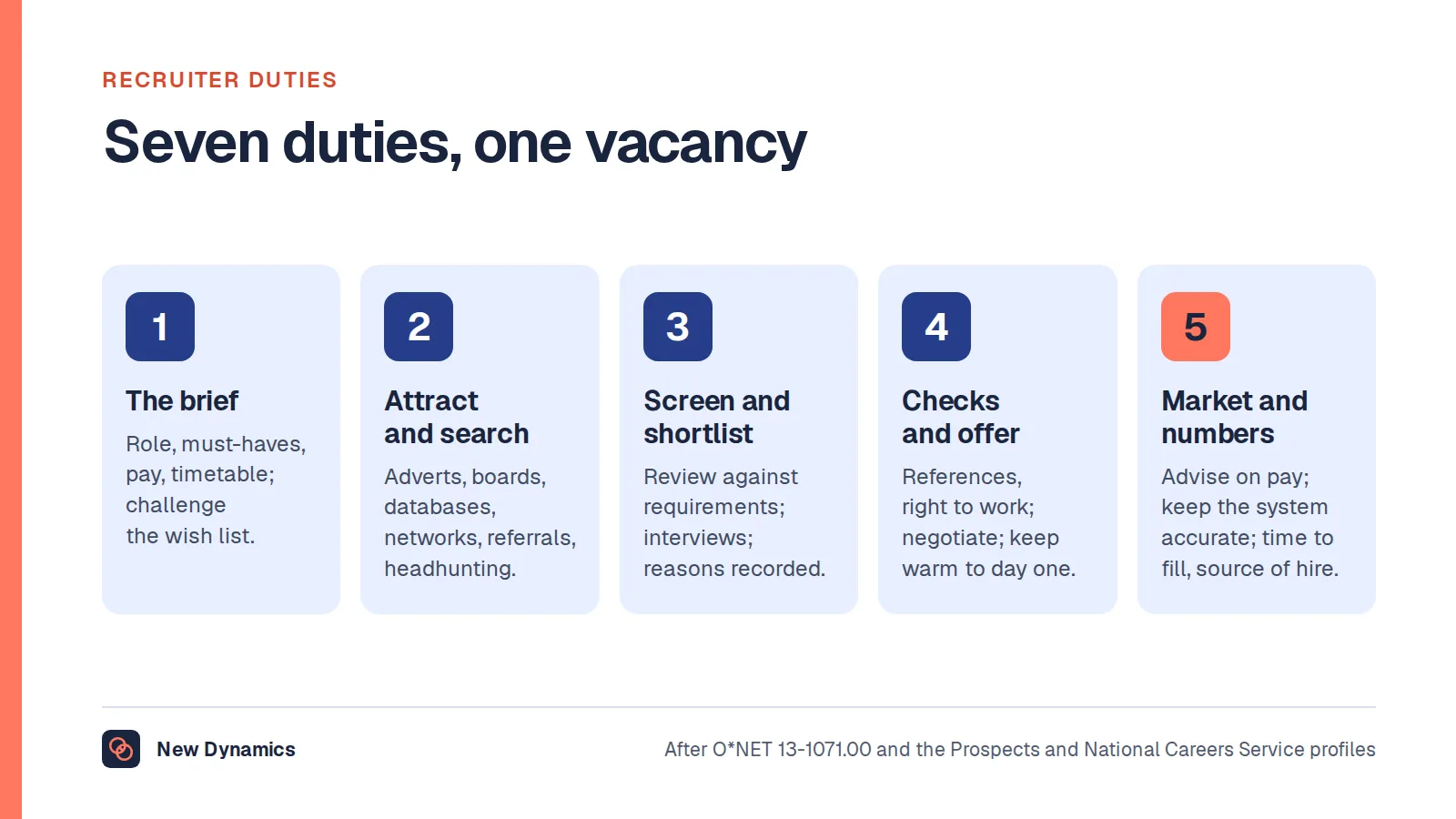
There is a recruiter apprenticeship standard in England. The published standard puts the occupation at level 3 with a typical duration of apprenticeship of 18 months, and describes the broad purpose as managing "the end-to-end recruitment process which typically involves planning, identifying, attracting, assessing, shortlisting, and onboarding candidates" to fulfil the requirements of the business brief.
Two things are worth knowing before anyone commits.
Standards change. The earlier recruitment resourcer standard, which sat at "Level: 2" with a "Typical duration: 12 months", has been retired, with employers directed to the recruiter standard instead. A credential is only as durable as the standard behind it, which is a good reason to prefer frameworks that publish their syllabus and their changes.
It is an employment route, not a shopping decision. Apprenticeships are done with an employer, which makes them the strongest option for someone starting out and irrelevant for someone already five years into the job.
How to judge a programme before you pay

Ask the provider these, and treat vagueness as an answer.
- How is it assessed? Exam, portfolio, observed practice, or nothing. Ask what proportion of entrants fail.
- Who recognises it, beyond the provider's own marketing? A level on a national framework, a professional body, or an employer group.
- What is the syllabus, in detail, and when was it last revised? Data protection and automated screening should both appear.
- How many hours of real work does it expect, as opposed to video length?
- Does it cover the law for your jurisdiction? Recruitment law differs between countries and even within the United Kingdom.
- What happens if your employer will not fund it? Payment plans and refunds matter more than the brochure.
- What do people do next? Ask to speak to someone who finished it a year ago.
What to build instead, or alongside
If the underlying problem is "my experience is thin", a credential alone will not fix it. Four things carry more weight in an interview, and most can be built in a quarter.
- A worked vacancy. Take one role end to end and write up the brief, the sourcing plan, the screening criteria, the interview structure and the outcome. Anonymise it. This is the single most persuasive artefact a junior recruiter can bring.
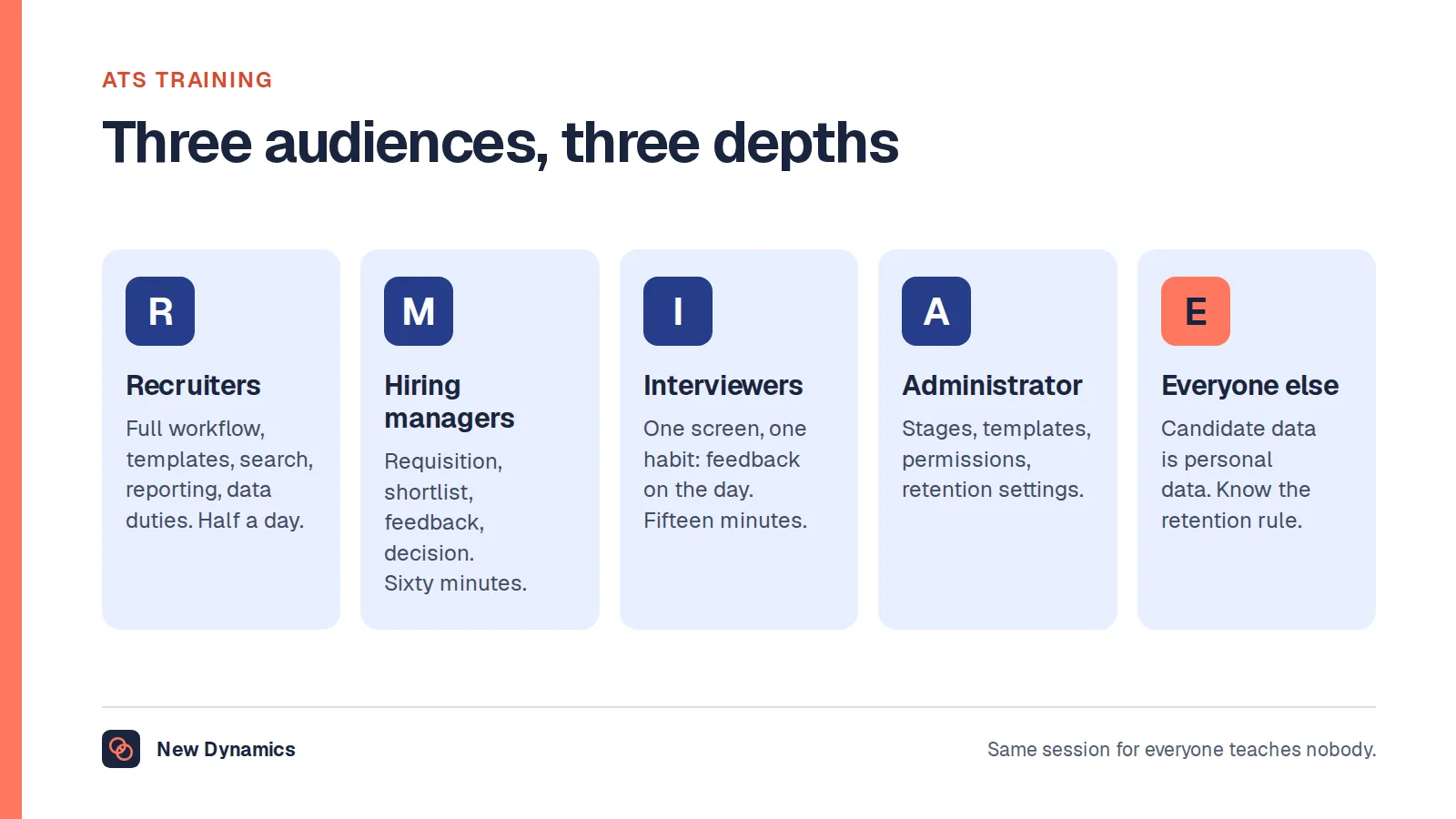
- Evidence you understand the duties. Data protection in recruitment, fair process, and oversight of any automated screening. Our post on ATS training sets out the duties that come with the system most employers use.
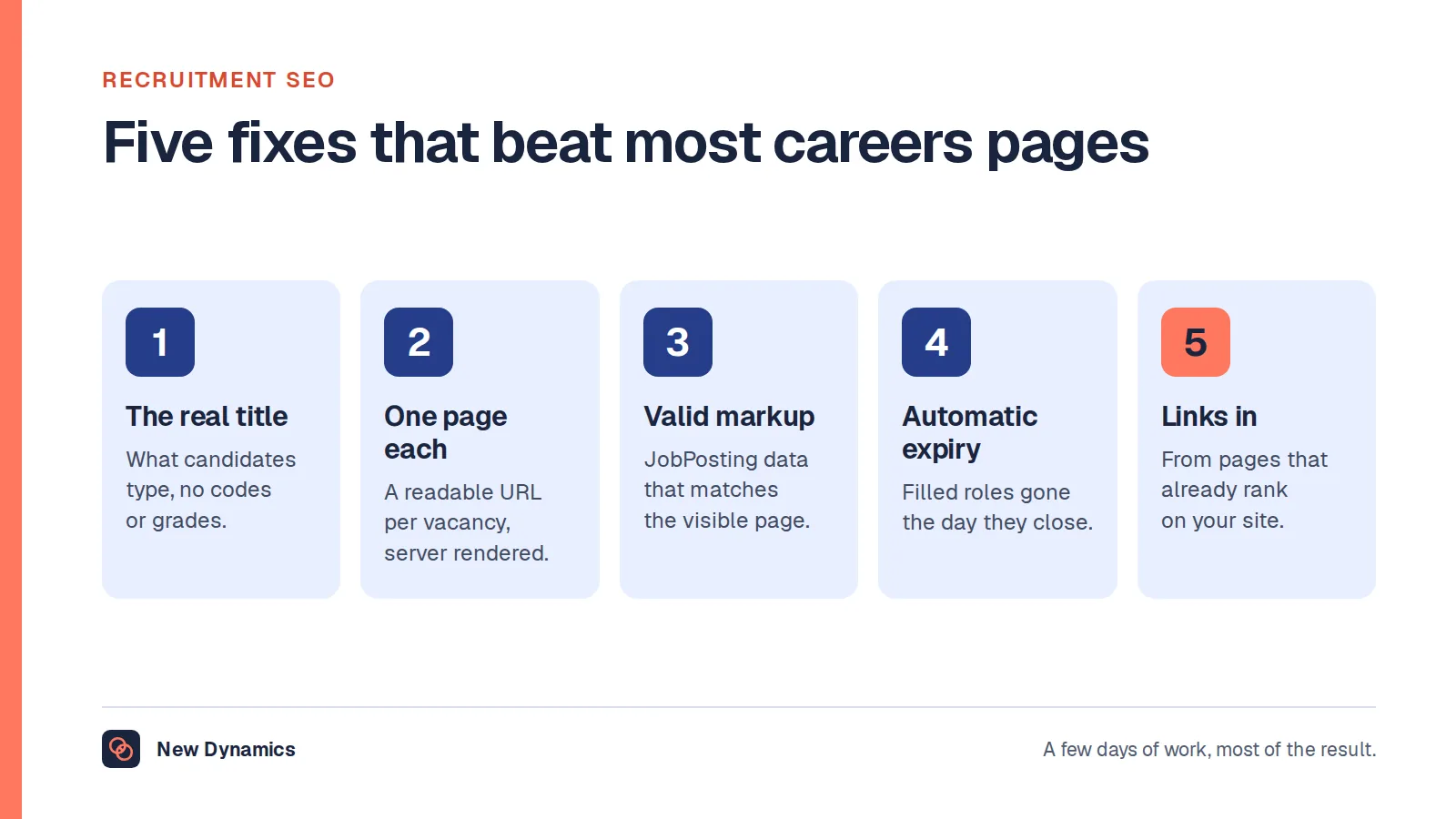
- A visible improvement. Rewrote the adverts and the application rate changed; fixed the careers pages so vacancies were findable, which our post on recruitment SEO covers.
- Two references who saw you work. Worth more than any badge.
Is it worth it?
For someone entering recruitment: often yes, if it is assessed, because it supplies structure, vocabulary and proof of commitment. An apprenticeship is stronger again, because it comes with the job.
For an experienced recruiter: usually only for a specific gap, such as employment law, data protection or the governance of automated tools, where a focused course is better value than a broad certificate.
For an employer funding it: buy the assessed version, tie it to a real piece of work, and ask what will be different in the hiring process afterwards. A certificate that changes nothing about how you recruit has bought you a logo.
Frequently asked questions
What is a talent acquisition certification?
It is any credential that says you have studied recruitment, but the term covers four different things: a regulated qualification with a level, an apprenticeship ending in independent assessment, a professional body award tied to membership, and a short course that issues a completion badge. Only the first two reliably involve being tested.
Is recruiter certification worth it?
For someone moving into recruitment it often is, provided something is assessed, because it gives structure and shows commitment. For an experienced recruiter it is usually worth it only to close a specific gap such as employment law or data protection, since by then your record is the evidence.
Do employers require a recruitment qualification?
Very few do. Most recruitment roles are open to people without a specific qualification, and interviews turn on worked examples: how you sourced, how you screened, what you changed. A credential helps most where experience is thin.
What is the recruiter apprenticeship in England?
It is a level 3 apprenticeship with a typical duration of eighteen months, covering the end-to-end recruitment process from planning and attraction through to shortlisting and onboarding. It is done with an employer, and it ends in an independent assessment rather than a completion certificate.
How do you tell a serious programme from a badge mill?
Ask how it is assessed, what proportion of entrants fail, who recognises it beyond the provider, and when the syllabus was last revised. A programme that cannot answer those four, or that nobody can fail, is selling a badge rather than a qualification.
What should a talent acquisition syllabus cover?
Sourcing and attraction, screening and selection, interviewing, employment law for the relevant jurisdiction, data protection and candidate records, candidate experience, and reporting. Any programme covering automated screening should also cover the oversight that comes with it, not just the buttons.
Your next step: test the credential before you buy it
- Write down what you actually want: entry into the field, a specific gap, or a signal to employers.
- Ask the three assessment questions above of any programme you are considering.
- If you are new to recruitment in England, check whether the apprenticeship route fits before paying for a course.
- Whatever you choose, build one anonymised worked vacancy alongside it. That is what the interview will be about.
For the questions to ask before any AI-assisted screening touches a candidate, read and download our AI recruitment guide. The guide is free to read, and the PDF uses our short download form.
Hiring into your own team and want the first ninety days to be as organised as the selection? Book a New Dynamics demo and bring your onboarding checklist. You can also email contact@new-dynamics.com.