TL;DR
- Acas is explicit that “there is no legal definition of bullying”, and describes it as “unwanted behaviour from a person or group that is either: offensive, intimidating, malicious or insulting”, or “an abuse or misuse of power”.
- Harassment is different. GOV.UK says “bullying itself is not against the law, but harassment is”, and the Equality Act 2010 makes it unlawful where unwanted conduct is “related to a relevant protected characteristic”.
- Treating someone badly because they complained is separately unlawful. Section 27 of the Equality Act 2010 says a person victimises another “if A subjects B to a detriment because” they did a protected act, which includes making an allegation.
Two people arrive at an article like this one. The first is being treated badly at work and has started to wonder whether they are imagining it. The second is a manager or HR adviser who has just been told about it, probably in a corridor, and has to do something sensible next.
It is written for both, and each section says who it is for. Broadly, what bullying is and what to do about it are for the person it is happening to; handling a report, victimisation and the duty to prevent sexual harassment are for the manager or HR adviser.
It describes the position in the United Kingdom and notes where Northern Ireland differs. It is general information and not legal advice. If this is happening to you, get advice from Acas, a trade union or a solicitor.
Much of what follows turns on what was said at the time and whether anyone wrote it down. See how New Dynamics feedback keeps a continuous, dated record of conversations, so a concern raised in March is still findable in September.
What workplace bullying is, and why UK law has no definition of it
Acas puts the central point in one clause. Its guidance on bullying at work, last updated 16 December 2025, says: "Although there is no legal definition of bullying, it can be described as" either of two things.
The first is "unwanted behaviour from a person or group that is either: offensive, intimidating, malicious or insulting". The second is "an abuse or misuse of power that undermines, humiliates, or causes physical or emotional harm to someone".
One half is about behaviour and how it lands. The other is about power, and it is the half most policies forget. A colleague can be rude; a person who controls your rota, your appraisal or your reference can do something almost identical and have an entirely different effect, because you cannot walk away from it.
GOV.UK's guide to workplace bullying and harassment uses a shorter formula: "Bullying and harassment is behaviour that makes someone feel intimidated or offended." Its examples include "unfair treatment" and "picking on or regularly undermining someone".
The absence of a legal definition means only that there is no claim in a UK employment tribunal called bullying. GOV.UK is direct about where responsibility sits: "Employers are responsible for preventing bullying and harassment - they're liable for any harassment suffered by their employees." Almost everything called bullying engages a duty that does exist: not to harass, not to discriminate, health and safety duties, or the employer's own policy.

Where bullying becomes harassment, and why that line matters
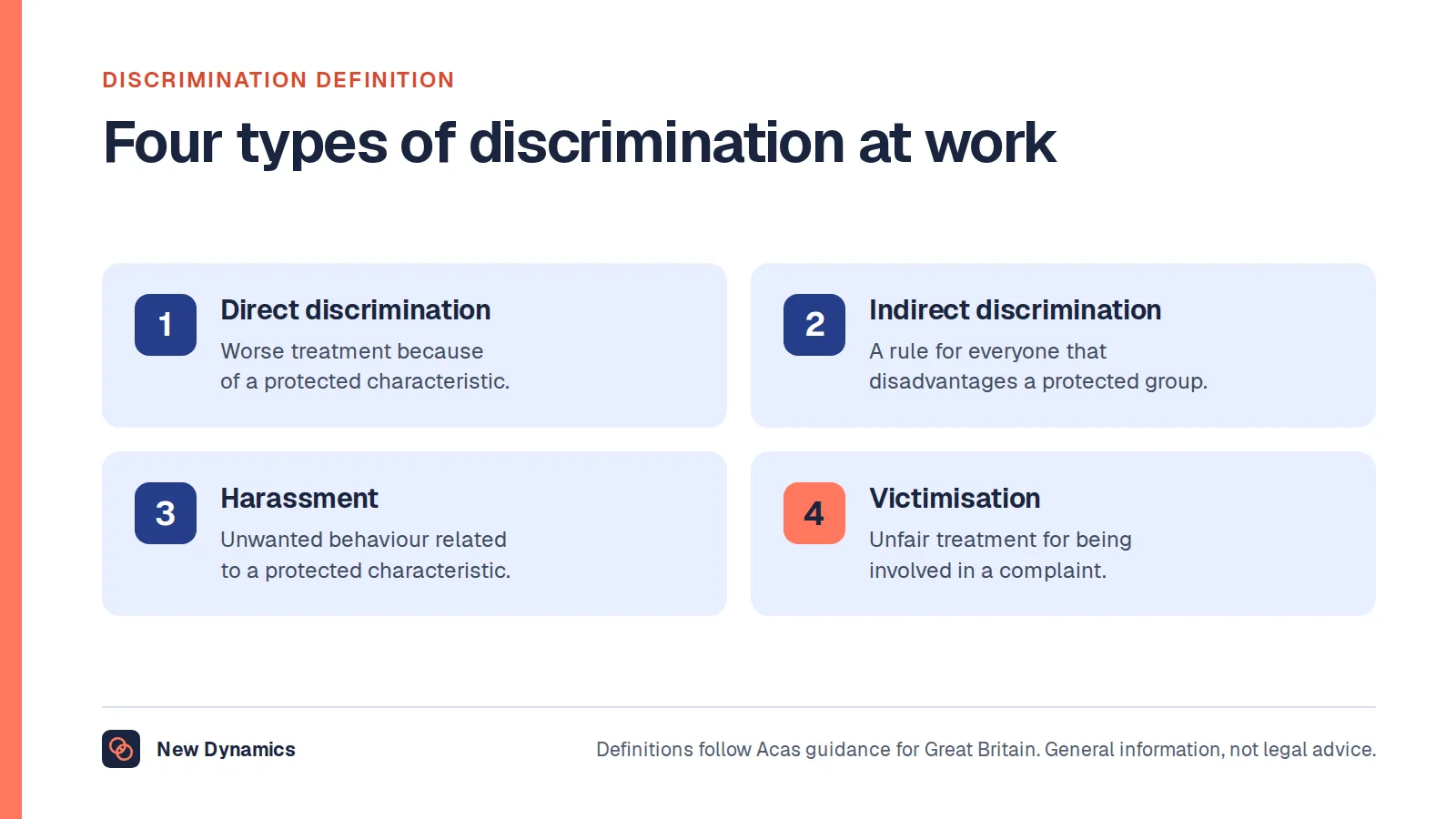
Harassment is not a stronger word for bullying but a legal category with a written test. GOV.UK states the division plainly: "Harassment is unlawful under the Equality Act 2010", and "bullying itself is not against the law, but harassment is" where the unwanted behaviour relates to a protected characteristic.
Section 26 of the Equality Act 2010, in the revised version available on 5 November 2026, sets out the test: "A person (A) harasses another (B) if (a) A engages in unwanted conduct related to a relevant protected characteristic, and (b) the conduct has the purpose or effect of (i) violating B's dignity, or (ii) creating an intimidating, hostile, degrading, humiliating or offensive environment for B."
Three phrases there do most of the work. Unwanted, not repeated or severe: Acas's page on harassment at work, last updated 30 October 2026, confirms it can be "a serious one-off incident" or "repeated behaviour". Related to, which is wider than "because of". And purpose or effect, so intention is one route and effect is the other: "It does not matter if the unwanted behaviour was intended or not." The characteristics are a closed list, given in section 26(5) as "age; disability; gender reassignment; race; religion or belief; sex; sexual orientation."
Section 26(2) adds sexual harassment, which is unwanted conduct of a sexual nature having that same purpose or effect. Section 26(4) carries the reasonableness element that people searching for a "reasonable person standard" are reaching for: in deciding whether conduct had that effect, "each of the following must be taken into account (a) the perception of B; (b) the other circumstances of the case; (c) whether it is reasonable for the conduct to have that effect." That is not the American standard. The complainant's perception counts, and so does context.
Geography matters. Section 217 of the Equality Act 2010 provides that "This Act forms part of the law of England and Wales", with only three listed sections also forming part of the law of Northern Ireland, which has its own equality legislation. Acas's advice covers England, Scotland and Wales.
What bullying looks like in practice, including the quieter forms
The loud version is easy to name and relatively rare. What more often brings people to a page like this is quieter, deniable and cumulative.
Acas's list on the bullying page includes "constantly criticising someone's work", "spreading malicious rumours about someone", "constantly putting someone down in meetings", "deliberately giving someone a heavier workload than everyone else", and "excluding someone from team social events". None of that leaves a bruise, and all of it is on an official list.
- Exclusion. The meeting invitation that stops coming, the thread you are dropped from, decisions about your own work taken while you are on leave. Each instance is explicable alone, which is why a dated record matters more here than anywhere else.
- Moving the goalposts. A target is agreed, met, then described as not what was wanted, and the standard is never written down. Asking for it in writing is often the move that ends the pattern.
- Undermining in front of others. Corrections made in meetings that could have been private, credit reassigned in front of the people who decide your progression, being talked over by the same person.
- Excessive monitoring aimed at one person. Checking that would be ordinary applied to everybody, applied to one person only. It is not the monitoring that is the problem, it is that it is aimed.
That each episode sounds small when you describe it is a feature of this behaviour, not evidence that you have misread it. Acas tells managers as much on handling a bullying or discrimination complaint, last updated 29 August 2025: "Something that seems like a small thing to you can feel very different to the person experiencing it."
"Targeting" and "being singled out": what those words usually describe
People do not generally search for "workplace bullying" first. They search for "targeting me", "targeting in the workplace" or "being singled out at work", and the word choice is worth taking seriously rather than correcting. Targeting describes a pattern, not an incident. It is the word people reach for when the individual events are defensible and the direction is not: three emails about timekeeping to one person on a team of eleven where three others are also late. No official UK source defines it, because it is not a legal term. It usually turns out to describe one of four things.
- Inconsistency. The same conduct treated differently in different people. Often not deliberate, still a real management failure, and it matters at a tribunal, because inconsistency undermines the reasonableness of a decision.
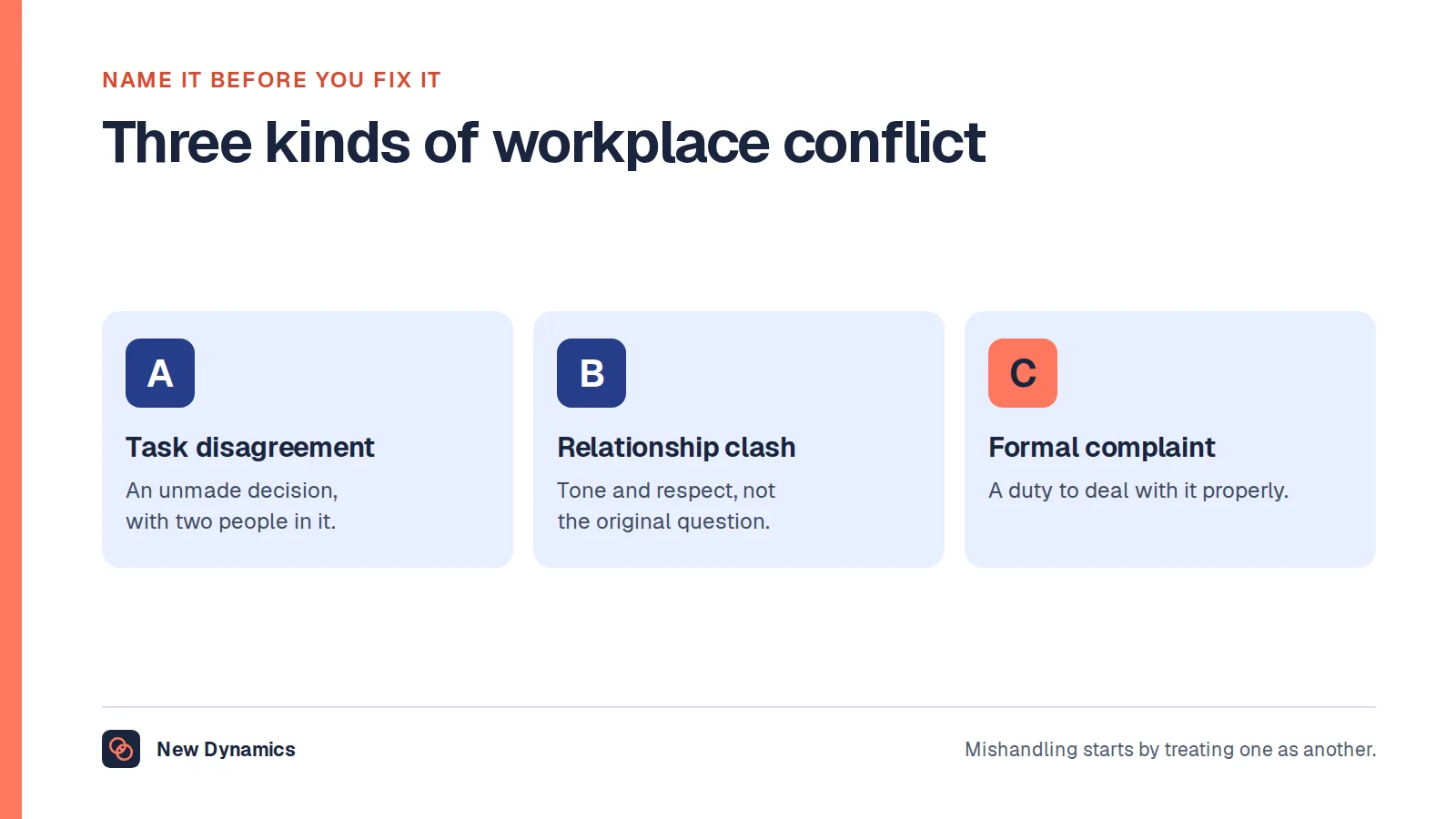
- Bullying in the Acas sense. A pattern of unwanted behaviour, or a misuse of power, aimed at one person.
- Harassment under the Equality Act 2010. If the reason relates to a protected characteristic, the Act is engaged, and the words to use are harassment or discrimination.
- Victimisation. If the pattern started after the person complained, or supported someone else's complaint, that is a separate wrong, covered below.
Each has a different first move. Inconsistency is answered with comparators, which means asking in writing how the same issue has been handled for other people. Harassment is answered by naming the characteristic and the Act. Victimisation is answered by naming the complaint that preceded it, and the date.
If it is happening to you: four steps, in this order
This section is for the person experiencing it. It follows the order Acas sets out on what to do if you think you are being bullied, last updated 16 December 2025.

1. Keep a record, starting today
Acas: "It's a good idea to keep a diary or record of the bullying, including: what happened, how it made you feel, dates and times it happened, any evidence, for example emails or screenshots of social media posts, any witnesses".
This is the step people skip and later regret, because the pattern is the case. One incident recalled eight months later is weak; eleven dated entries with two forwarded emails and the names of people in the room is something an investigator can work with. Keep it where you will still have access if your work account is closed, and keep it to facts, dates and effects rather than conclusions about motives.
2. Get advice early, not at the end
Acas's advice is to "contact the Acas helpline" and to "talk to your trade union representative, if you have one". For wellbeing it points to Samaritans and to "an employee assistance programme (EAP) if your employer has one". Advice is most useful before you have sent the long email, because tribunal time limits are short and the order of your steps can matter. This article is general information, not legal advice, which is why this step is second rather than last.
3. Try the informal route, if you can
Acas suggests speaking to the person where that feels possible: "In some cases, the person you think has bullied you might not realise the impact of their behaviour. You could talk with them, if you feel you can." For that conversation it says to "explain what they did and how it made you feel", and to "stay calm, be firm, not aggressive".
If a direct conversation is not realistic, and often it is not, Acas lists alternatives: "put this in an email, ask for support from a trade union representative, if you're a trade union member, talk with your manager or someone else at work you feel comfortable with". Informal first is a default, not a rule. It is not appropriate where the behaviour is serious, where there is intimidation, or where the person you would approach holds power over your job.
4. Raise it formally if informal steps have not worked
Acas: "You can raise a grievance if: you've already tried to resolve things informally but it did not work, you feel the situation is too serious to be resolved informally".
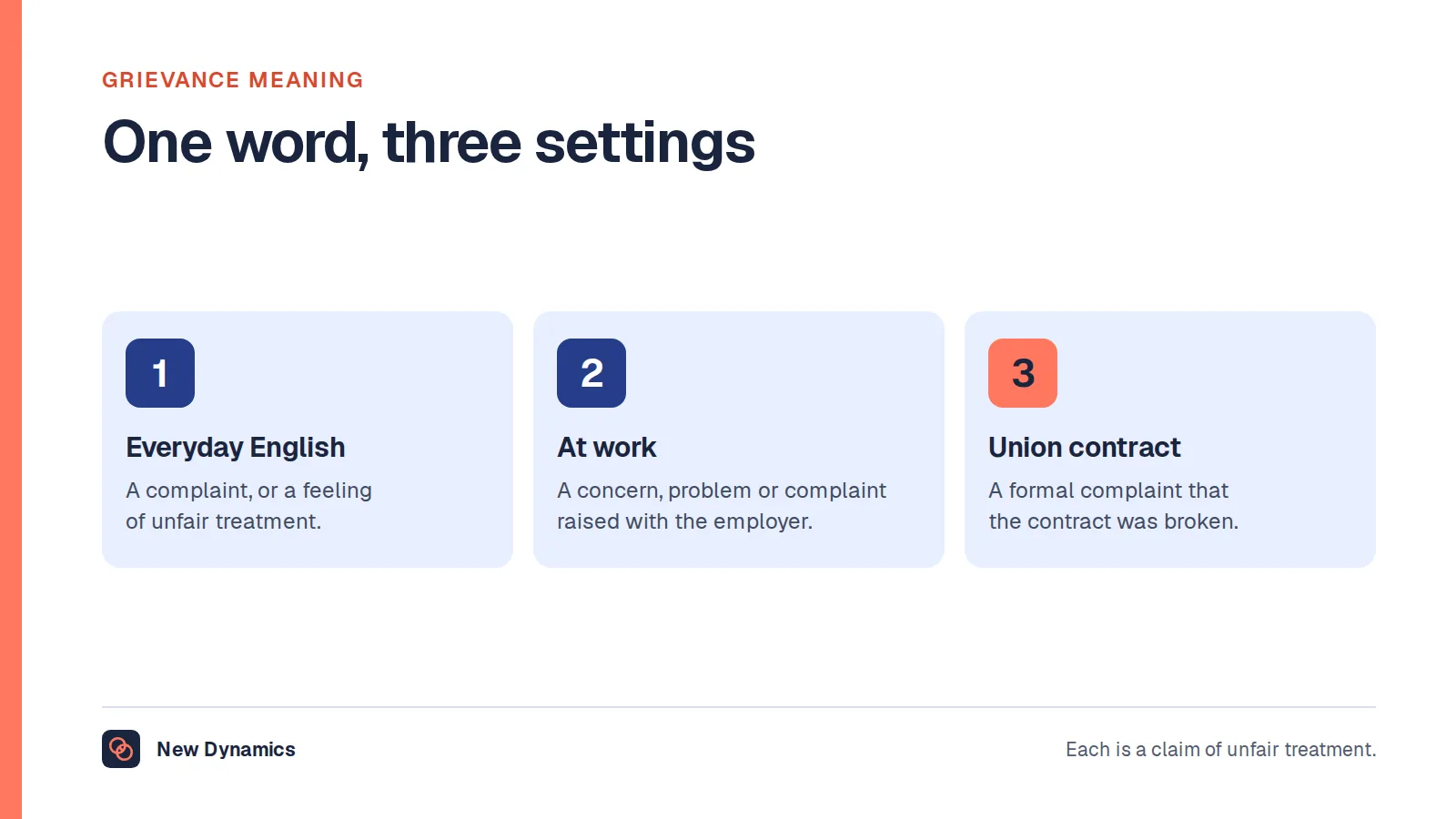
A formal complaint should be in writing, dated and specific: what happened and when, what effect it had, the evidence, and what you want to happen. If you believe the behaviour relates to a protected characteristic, say which one and use the word harassment, because that changes the legal frame the employer has to apply. Keep a copy outside the organisation's systems. Our guide to grievance meaning sets out the formal procedure, and the employer may use a bullying and harassment policy instead.
For managers and HR: what to do when bullying is reported
This section is for the person on the receiving end of the report. The duties below come from Acas's guidance on handling a bullying or discrimination complaint and its sub-pages, all last updated 29 August 2025.

Take it seriously, and look into it quickly
Acas: "As an employer or manager, you should take any bullying or discrimination complaint seriously and look into it as soon as possible."
Two failures account for most of the damage here: telling two adults to sort it out between themselves, and delay, during which the complainant concludes nothing will happen and the person accused sits under an unresolved allegation. Acas adds that a complaint made long after an incident should still be taken seriously, so lateness is a fact to weigh, not a reason to decline it.
Decide informal or formal, with the complainant's view in it
Acas: "You should try to resolve a complaint informally if possible. This is usually quicker and less stressful for everyone. However, not every situation is suitable to handle informally." What makes a situation unsuitable is usually seriousness, a power gap, or the complainant's unwillingness to sit opposite the person. The decision is the employer's, and it should be explained.
Investigate fairly, and choose the right investigator
Acas: "You should look into the complaint in a way that's fair and sensitive to: the person who made the complaint, anyone who witnessed it, anyone accused of bullying or discrimination." The investigator "should be neutral and not involved in the complaint", with a realistic qualification: "If this is not possible, for example in a small business, the person investigating must keep an open mind and carry out a fair investigation."
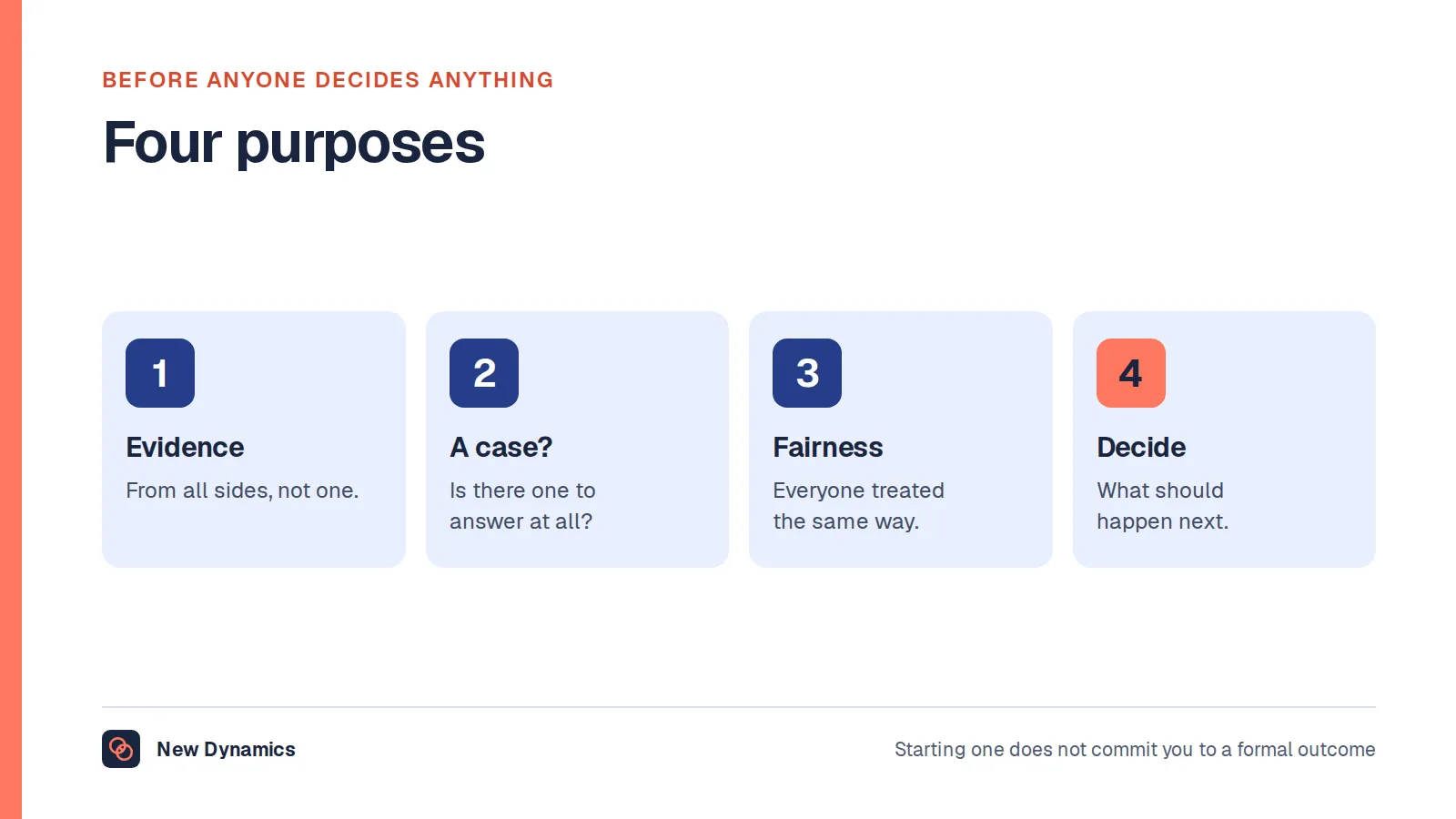
Fairness has specific content. The person accused is told what is alleged in enough detail to answer it. Witnesses are asked what they saw, not what they think of the people involved. The scope is defined and does not drift into a review of someone's character or performance. Our guide to workplace investigations covers scope, interviews and the report.
Keep it confidential, and support everyone involved
Acas: "You should handle the complaint confidentially, including any investigation." That does not mean secret from the person accused, who has to know the allegation to answer it. It means the complaint is not discussed with the team and not left where anyone can open it. A complainant "might ask to be accompanied by their trade union representative" or a colleague at a meeting about it.
Acas also says you "should tell the employee who made the complaint about any support that's available", and that "Anyone who's witnessed bullying or discrimination, or been accused of it, may also need similar support".
Record it, then check it worked
Acas asks employers to "keep a record of the complaint, any investigation findings, any steps that were taken and the outcome", and afterwards to check "that the actions taken have been effective" and "that nobody is treated unfairly or less favourably as a result of being involved with the complaint".
Victimisation: the duty not to punish someone for complaining
This duty is most often broken by accident, by someone who thinks they are reducing friction.
Section 27 of the Equality Act 2010, in the revised version available on 5 November 2026 and in force since 1 October 2010, says: "A person (A) victimises another person (B) if A subjects B to a detriment because (a) B does a protected act, or (b) A believes that B has done, or may do, a protected act."
Section 27(2) lists the protected acts, and they include "making an allegation (whether or not express) that A or another person has contravened this Act". Making an allegation is enough, and the complaint does not have to succeed. Section 27(3) sets one limit: a false allegation "is not a protected act" if it is made "in bad faith". Being wrong is not the same as bad faith. Acas puts it plainly: "If someone is treated less favourably because they were involved with a discrimination complaint, this is a type of discrimination called victimisation."
In a real organisation this is rarely dramatic. It is the complainant moved off an account to reduce tension, a withdrawn secondment, a cooler reference, a sudden appetite for formal performance management: each defensible in isolation, each a detriment that arrived after a protected act. If something has to change while a complaint is looked into, ask whether the change falls on the person who complained.
Section 109 adds that "Anything done by a person (A) in the course of A's employment must be treated as also done by the employer", regardless of the employer's "knowledge or approval", with a defence where the employer "took all reasonable steps to prevent" it. The policy, the training and the record are that defence.
The employer's duty to prevent sexual harassment
Sexual harassment carries a positive, preventive duty that other kinds of harassment do not.
Section 40A of the Equality Act 2010, in the revised version available on 5 November 2026, says: "An employer (A) must take all reasonable steps to prevent sexual harassment of employees of A in the course of their employment."
The wording changed recently. Section 40A was inserted on 26 October 2024 by the Worker Protection (Amendment of Equality Act 2010) Act 2023, and the word "all" was added by the Employment Rights Act 2025, shown on legislation.gov.uk as coming into force on 30 October 2026. Acas's page on sexual harassment, last updated 30 October 2026, states the position: "The Employment Rights Act 2025 strengthened the law so employers have to take 'all reasonable steps' to prevent sexual harassment. This includes sexual harassment by third parties."
The duty is preventive, so it is not discharged by handling complaints well after the event; it asks what was done in advance. It also has money attached. Section 124A, in force from 26 October 2024, allows a tribunal that has found a contravention of section 40 involving sexual harassment to order a "compensation uplift" which "may be no more than 25% of the amount awarded under section 124(2)(b)", after considering "whether and to what extent the respondent has also contravened section 40A(1)".
Third parties sit inside the duty, which means customers, clients, contractors, patients and the public. Because the law here changed within the last two years, check the current position on Acas or GOV.UK before relying on any summary, including this one. This is general information, not legal advice.
Stress, health and what the official statistics do and do not show
Bullying is a health and safety matter as well as an employment one. The Health and Safety Executive's work-related stress overview states the duty: "Employers have a legal duty to protect workers from stress at work by doing a risk assessment and acting on it." Its Management Standards cover six areas of work design, one of which is relationships, so a risk assessment that ignores relationships at work is incomplete.
HSE's publication Work-related stress, depression or anxiety statistics in Great Britain, 2025, published on 20 November 2025, reports "964,000 workers suffering from work-related stress, depression or anxiety (new and long-standing) in 2024/25" and "22.1 million working days lost due to work-related stress, depression or anxiety in 2024/25". On causes it says the main cause reported was workload, and that "Other factors identified included a lack of managerial support, violence and bullying, organisational changes at work and role uncertainty". The reference period it gives for that breakdown is "LFS, average estimate over 2009/10-2011/12", more than a decade older than the headline figures.
So the honest position on prevalence is this. Bullying appears in the official data as a named contributing factor to work-related stress, from a breakdown averaged over 2009/10 to 2011/12. No official UK source opened for this article publishes a current figure for how many workers are bullied. Numbers in that shape come from consultancies and membership bodies rather than a national statistics publication, so they are not quoted here. For the wider picture, the HR statistics hub collects figures with their sources and reference periods.
When resigning becomes constructive dismissal
This section is for the person it is happening to, and it comes with a caution.
GOV.UK's guidance on unfair and constructive dismissal defines it: "Constructive dismissal is when you're forced to leave your job against your will because of your employer's conduct." Among its examples is where an employer "let other employees harass or bully you". Acas's page on constructive dismissal, last updated 27 October 2026, frames it as a contractual question: "An employee can make a constructive dismissal claim if they resign because they think their employer has seriously breached their employment contract." Its examples include "being bullied or discriminated against" and "raising a grievance that the employer refuses to look into".
Now the caution, in Acas's own words: "resigning is a big step to take, and a constructive dismissal claim can be difficult to win at an employment tribunal." Acas advises raising a formal grievance first, before resigning, and says a claim must be made within "3 months minus 1 day" of either the last day of the notice period or the day of resignation. Check that figure before you rely on it, because the two official sources currently differ. GOV.UK's employment tribunals page gives "6 months if the problem happened on or after 1 October 2026", and three months for anything before that date, while the Acas page quoted here still gives three months with no mention of the change. We read both on 5 November 2026. Do not assume a claim is out of time on the shorter figure, and take advice from Acas, a union or a solicitor about your own dates.
The official guidance also pulls two ways, and that is worth knowing rather than resolving alone. GOV.UK says that if you do have a case, "you should leave your job immediately - your employer may argue that, by staying, you accepted the conduct or treatment", while Acas advises trying internal routes first. Do not resign on the strength of an article. Take advice first, from Acas, a union or a solicitor.
When the person accused is your manager
This is the hardest version and the most common one, because the power element Acas describes usually runs along the reporting line. For the person in it, three things change.
- The informal route often is not available. Speaking to the person directly assumes a conversation that can be had safely. Where they set your objectives and write your appraisal, that may not hold, and it is reasonable to say so rather than try and fail. Acas's alternatives include putting it in an email or going to a union representative.
- The complaint goes above or sideways. A complaint about a manager should not be handled by that manager. In practice that means their manager, HR, or whoever the policy names. Read the policy before you write, because it may already answer who receives a complaint about a line manager.
- Watch for the pattern afterwards. This is where victimisation under section 27 most often shows up: a rating that drops after a complaint, a probation extended, training withdrawn. Keep the record going after you complain, not just before.
For HR and the manager above, two structural points matter more than good intentions. First, decide who hears it before you need to know, because an organisation where every route for a complaint about a manager runs through that manager has no route. Where the accused is a director or the owner, say in the policy where it goes instead. Second, do not reorganise the complainant's job to make the problem quieter. Moving the person who complained, rather than managing the person complained about, is the most common route from a handled complaint to a victimisation claim.
Frequently asked questions
What is workplace bullying?
Acas describes bullying as "unwanted behaviour from a person or group that is either: offensive, intimidating, malicious or insulting", or "an abuse or misuse of power that undermines, humiliates, or causes physical or emotional harm to someone". Its examples include constantly criticising someone's work, putting someone down in meetings, and excluding someone from team social events.
Is workplace bullying against the law in the United Kingdom?
There is no claim called bullying. Acas says "there is no legal definition of bullying", and GOV.UK says "bullying itself is not against the law, but harassment is". That does not make it lawful, because most bullying engages a duty that does exist: the Equality Act 2010 where the conduct relates to a protected characteristic, health and safety duties, and the contractual duties behind a constructive dismissal claim. This is general information and not legal advice, and Northern Ireland has its own legislation.
Is there a reasonable person test for harassment?
Not in the American form, though there is a reasonableness element. Section 26(4) of the Equality Act 2010 says that in deciding whether conduct had the prohibited effect, a tribunal must take into account "the perception of B", "the other circumstances of the case" and "whether it is reasonable for the conduct to have that effect". Section 1 of the Protection from Harassment Act 1997, which extends to England and Wales and runs through the courts rather than a tribunal, uses a closer version: a person ought to know their conduct amounts to harassment "if a reasonable person in possession of the same information would think the course of conduct amounted to harassment of the other".
What should a manager do when someone reports bullying?
Acas says an employer or manager "should take any bullying or discrimination complaint seriously and look into it as soon as possible", try to resolve it informally where that is suitable, handle it "confidentially, including any investigation", and look into it "in a way that's fair and sensitive to" the complainant, witnesses and the person accused. The investigator "should be neutral and not involved in the complaint". Afterwards, record the complaint, findings, steps and outcome, and check nobody is treated unfairly for being involved.
Can I be treated badly for complaining about bullying?
No, and doing so is separately unlawful where the complaint engages the Equality Act 2010. Section 27 says a person victimises another "if A subjects B to a detriment because" they did a protected act, and making an allegation is a protected act whether or not it is upheld. An allegation made in bad faith is not protected, but being mistaken is not bad faith. If this is happening to you, get advice from Acas, a trade union or a solicitor.
Your next steps
If it is happening to you:
- Start the record today: what happened, when, who saw it, how it affected you.
- Call the Acas helpline or your union representative before you send anything long.
- Read your employer's policy and find who receives a complaint about a line manager.
- Decide, with advice, whether the informal route is safe, and if not, put it in writing with dates.
If a report has landed on your desk:
- Acknowledge it in writing today and say what happens next and by when.
- Decide informal or formal, with the complainant's view recorded, and explain the decision.
- Name a neutral investigator, or if that is impossible, say how fairness will be protected.
- Diarise a check four to six weeks later, on the behaviour and on how the complainant is being treated.
To get the written rules into one place, including the bullying and harassment policy and the grievance procedure, read and download our employee handbook guide. The guide is free to read, and the PDF uses our short download form.
Want conversations recorded as they happen, so a pattern is visible long before it becomes a complaint? Book a New Dynamics demo and bring your current process. You can also email contact@new-dynamics.com.
This article is general information about the law in the United Kingdom, not legal advice, and Northern Ireland has its own equality legislation. If bullying or harassment is affecting you, contact Acas, your trade union or a solicitor.