TL;DR
- Three different things get called workplace conflict: a disagreement about the work, a clash about how people treat each other, and a complaint that engages a formal procedure. Almost all mishandling starts with treating one as another.
- Acas says mediation “is voluntary and confidential” and that “the mediator is impartial”, and that mediation is generally not used for disputes about pay, dismissal or conduct. It works on relationships, not on entitlements.
- Alternative dispute resolution means settling a dispute without a tribunal or court hearing. In employment that mainly means mediation, conciliation and arbitration, and GOV.UK says you will usually need an Acas early conciliation certificate before you can make a tribunal claim.
Two people on the same team stop speaking to each other. Nobody can say when it started. The work is still going out, slightly late, and everyone else is now managing round the silence. The manager's first instinct is to ask HR to "look into it", and that single phrase is often the moment a solvable problem becomes a case file with a six-week life expectancy.
This article is about naming workplace conflict correctly before responding to it. It covers the three kinds that need different handling, why going formal early usually makes things worse, a conversation structure a manager can actually follow, what mediation is and is not, what alternative dispute resolution means in employment and in law, and the point at which a conflict has become a grievance or a disciplinary matter. It describes the position in England, Scotland and Wales, and it is general information rather than legal advice. Where a source is quoted, it is quoted as the publisher words it.
Most conflict at work is prevented rather than resolved. See how New Dynamics continuous feedback gives people a regular, low-key place to say the small thing before it hardens.
Acas puts the economic case for early handling in one line in its guidance on dealing with problems at work: "Many problems at work can be solved early." It adds that "If employers encourage workers to raise issues and discuss solutions, they can avoid costly disputes."
What workplace conflict actually is
Conflict at work is not a single phenomenon. It is three, and they look similar for about the first ten minutes.
A disagreement about the work. Two people want different things from the same task, budget, priority or rota. The design should be finished first; no, the data model should. The shift pattern should favour cover; no, it should favour fairness. This is not a behaviour problem. It is an unresolved decision with two people standing in it, and it is often a sign that nobody has said out loud who decides.
A clash about how people treat each other. The content of the disagreement has stopped mattering. What is now in dispute is tone, respect, exclusion, credit, interruption, the email copied to someone's manager. Relationship conflict does not resolve by deciding the original question, because the original question is no longer the problem.
A complaint that engages a formal procedure. Someone alleges something that the employer has a duty to deal with properly: bullying, harassment, discrimination, a safety risk, dishonesty, victimisation, or a breach of their contract. This is not a conflict to be smoothed over. It is a matter with a process attached, and the process exists partly to protect the person who raised it.
Almost every badly handled conflict is one of these treated as another.
Treat a task disagreement as a relationship clash and you send two people to a facilitated conversation about communication styles when what they needed was a manager to make the decision they had been left holding. Treat a relationship clash as a task disagreement and you keep re-deciding the surface question while the actual problem deepens. Treat a formal complaint as a relationship clash and you invite the person who raised a harassment allegation into a mediation with the person they named, which is both unfair and legally risky.

So the first question is never "how do we resolve this". It is "which of the three is this", followed by "and who told me so". The answer changes depending on whether you ask the two people involved, their colleagues, or the written complaint. Ask all three before you choose a route.
Why going formal early usually makes things worse
Formality is not neutral. Starting a formal procedure changes the situation it is meant to address, in four predictable ways.
- It fixes positions. Once a person has written their account down and signed it, the account becomes something to defend. Informal conversations allow people to revise their view of events without losing face. Formal ones punish them for it.
- It widens the audience. An investigation needs witnesses. Interviewing six colleagues about the atmosphere in a team converts a two-person problem into a team-wide one, and the team now knows there is a case running.
- It slows everything down. Invitations, notice periods, note taking, outcome letters and appeal windows are protections, and they are also weeks. Conflict rarely improves while it waits.
- It removes the manager. The person best placed to change the day-to-day conditions that produced the conflict (the rota, the brief, the seating, the reporting line) steps back and becomes a witness in someone else's process.
None of this is an argument against formal procedure. It is an argument for using it when it is needed, and for making the informal route a real route rather than the absence of one. GOV.UK's guide to solving a workplace dispute opens with the same order of operations: "Explain your concern to your manager to see if you can sort out any problems informally."
What informal resolution actually looks like
Informal does not mean vague, unrecorded or optional. In practice it means five things.
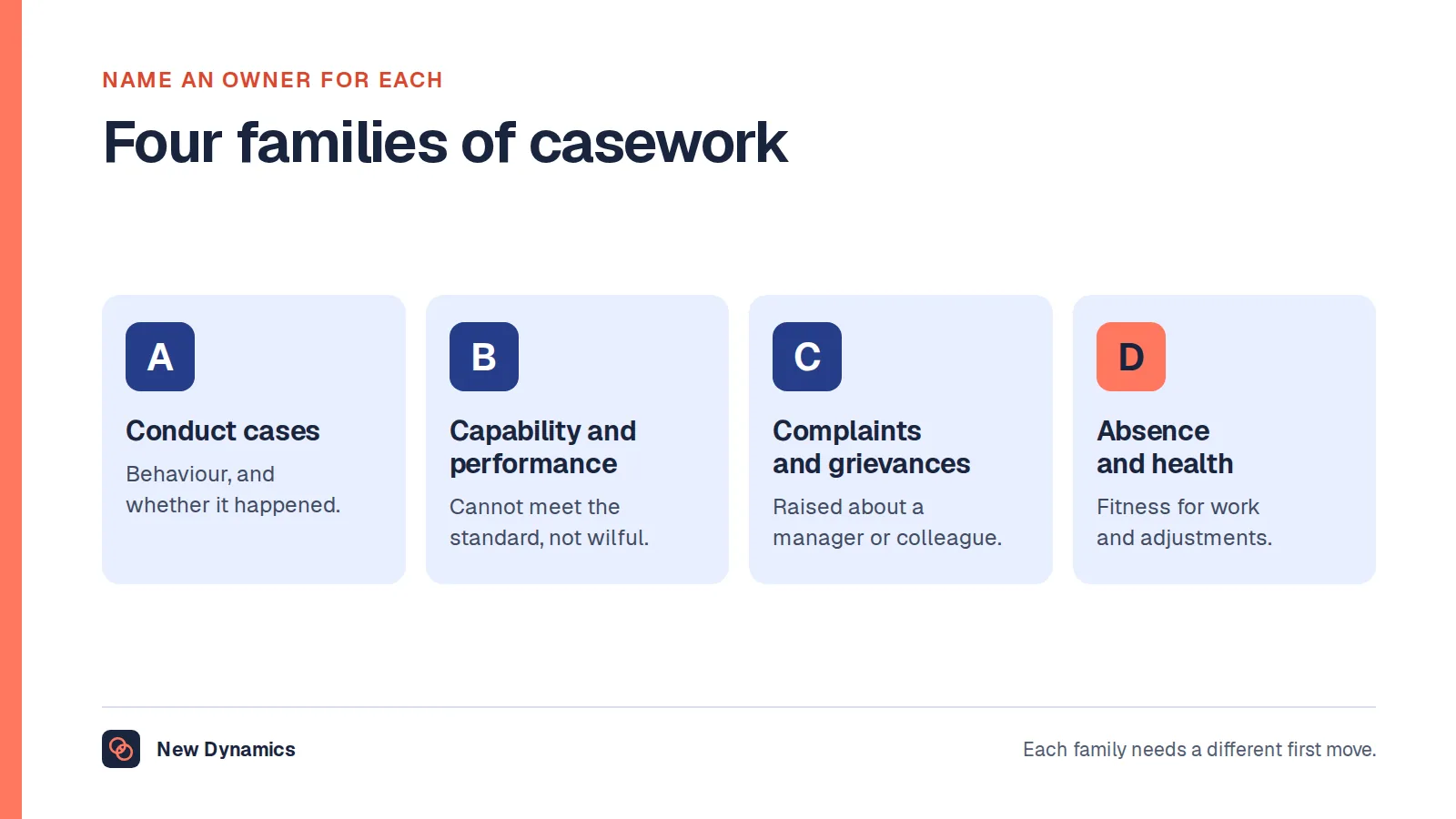
- It has an owner. One named person is responsible for the outcome, usually the line manager of the people involved, or their manager if the line manager is part of the conflict.
- It has a time box. Around ten working days from first conversation to agreed actions. Open-ended informal handling is just avoidance with a friendlier name.
- It produces specific commitments. Not "communicate better". Instead: the Monday handover happens in writing by 10am, questions about the data go to one person, and neither of you copies the other's manager into an operational email.
- It produces a short record. A paragraph noting the date, who was spoken to, what was agreed and the review date. This is not a case file. It is the thing that makes the next step possible if the first one fails.
- It has a review date. Three or four weeks later, and in the diary before the first conversation ends.
That record matters more than it looks. The most common reason a conflict runs for a year is that each new intervention starts from nothing, because nobody wrote down what was tried in March.
A manager's conversation structure for a conflict between two people
This is the sequence to follow when two people who report to you are in conflict and the matter is not a formal complaint. It assumes two separate conversations before any joint one.

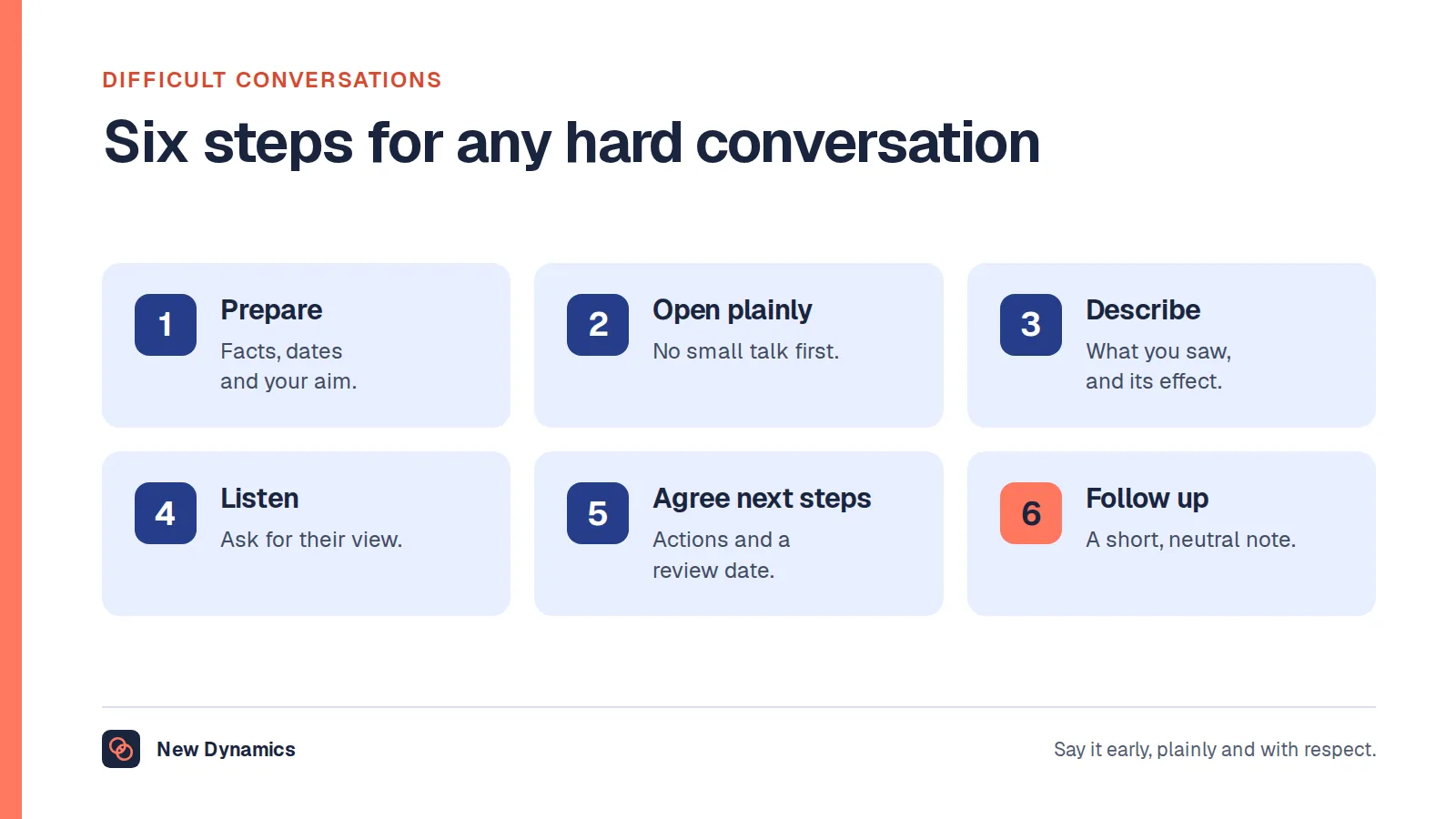
Step 1. Prepare, and decide what is yours to fix. Before speaking to anyone, write down what you actually know, separating what you have observed from what you have been told. Then answer one question honestly: is there a decision I have not made, a priority I have not set, or a workload I have not resolved that is producing this? If so, that part is yours, and no amount of facilitated conversation will substitute for making it.
Step 2. Speak to each person separately. Same framing both times, so neither is told a different story later. "I have noticed X. I want to understand it from your side, and I would like to help sort it out." Then stop talking. The aim of this conversation is information, not a verdict. Ask what happened, when it started, what they have already tried, and what they want to be different. Do not carry messages between the two meetings.
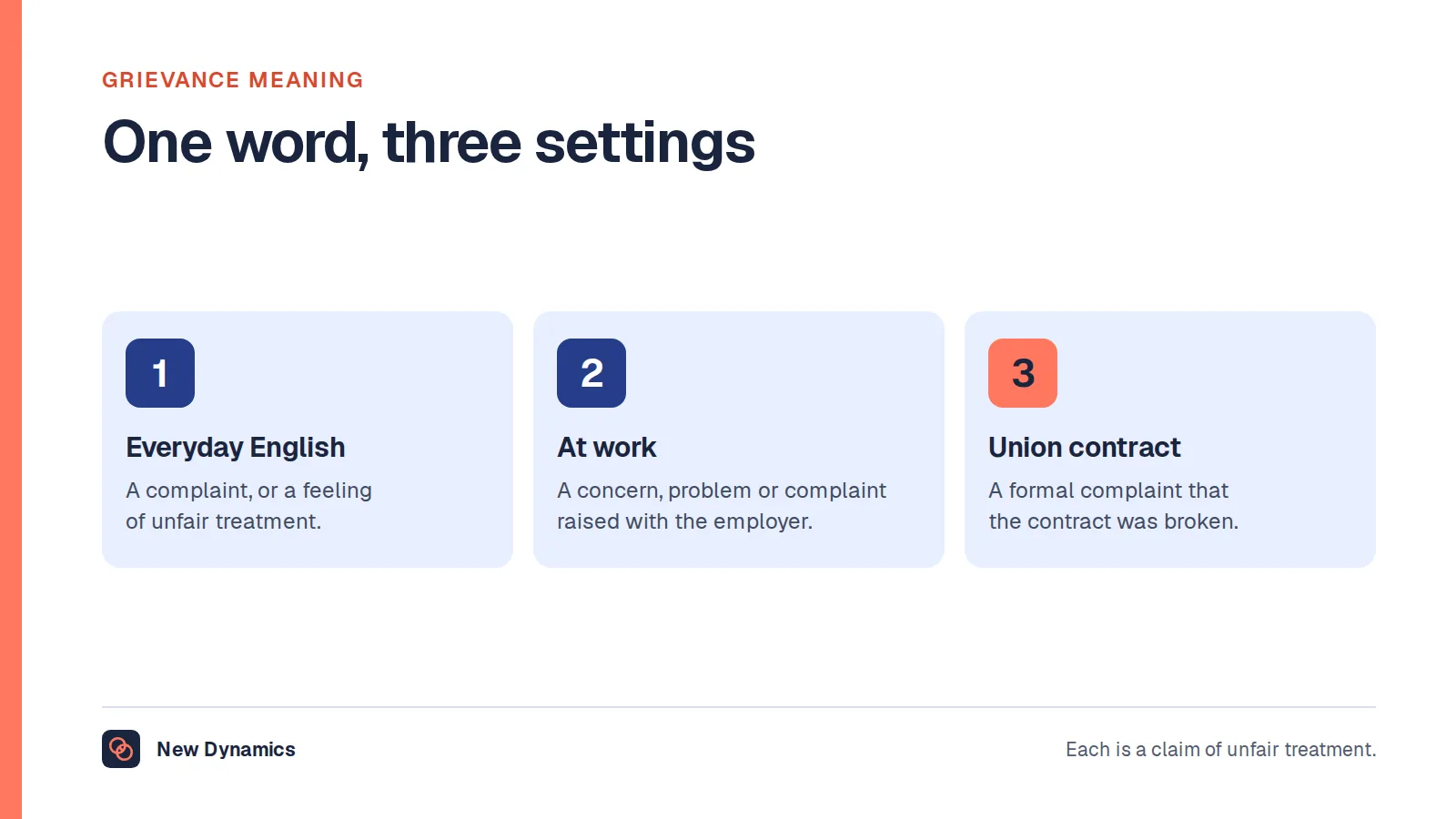
Step 3. Check whether this is a complaint. Ask directly: "Is there anything in this you want to raise formally?" If what you are hearing involves harassment, discrimination, victimisation or a safety risk, stop the informal route here and move to the formal one. Our post on the meaning of grievance sets out what a formal complaint starts, and the employee relations function explains who then owns the decision and who owns the process.
Step 4. Get agreement to a joint conversation. Both people have to agree, and both have to know what it is for. If one refuses, that is information rather than defiance, and mediation or a change in working arrangements may be the better route. Never ambush two people with a joint meeting.
Step 5. Run the joint conversation to a fixed shape. Say at the start how long it will last, that you are not there to decide who was right, and that the output is a short list of agreements. Then: each person describes the effect on their work, uninterrupted, for a set few minutes. No history further back than the current issue. You summarise what you have heard and name the two or three concrete points in dispute. You then make any decision that is yours to make, out loud, in the room.
Step 6. Write the agreement down in the room. Three or four specific commitments, each with a name against it. Read them back before anyone leaves. Send them to both people the same day, and keep them short enough to be read.
Step 7. Review on the date you set. Ask each person separately whether it has held. If it has, say so to both of them, because unacknowledged improvement decays. If it has not, you now have a dated record of a reasonable informal attempt, which is exactly what you need to justify mediation or a formal route.
For the wording of the harder parts of steps two and five, our post on difficult conversations examples has the scripts.
Mediation at work: what it is and when it works
Mediation is the next step when a manager's own attempt has not worked, or when the manager cannot be impartial because they are part of the conflict.
Acas, which both explains mediation and provides it, defines it simply in its guidance on mediation at work: "Mediation is a way to mend relationships when there is a disagreement at work." Two features define it. "The mediator is impartial. This means they do not take sides." And "Mediation is voluntary and confidential. The mediator will agree with everyone involved what information can be shared outside the mediation."
GOV.UK describes the same thing from the dispute-resolution angle: "Mediation is when an independent and impartial third party discusses a problem with you and your employer (or between you and another employee) to try and find a solution", and the key limit, that "the mediator cannot force you or your employer to accept a solution."
Three points follow from those definitions and are routinely missed.
Voluntary means refusable. An employee who declines mediation has not done anything wrong, and declining should not be held against them. A mediation that one party attends under pressure produces an agreement that lasts about a fortnight.
Confidential means the mediator does not report back. The manager who commissioned it does not get an account of who said what. They get whatever the parties agree to share, usually a set of agreed actions. Managers who expect a findings report have misunderstood the tool.
Impartial means not the line manager. A mediator can be an internal colleague trained for the role and independent of both parties, or an external mediator, including Acas itself. Acas describes its own offer as helping employers and workers "resolve disputes with expert, impartial conciliation and mediation services". Whoever does it, they cannot have a stake in the outcome or line responsibility for either person.
When mediation does not fit
Acas is explicit about the boundary: "Generally, mediation is not used to resolve disputes such as pay or issues related to dismissal or conduct." Mediation works on a relationship between two people who will both have to keep working in the same place. It does not work where:
- the question is an entitlement rather than a relationship, such as unpaid overtime or a contractual term, because that needs a correct answer rather than a negotiated one;
- the allegation is serious misconduct, harassment or discrimination, where the employer has a duty to investigate and a mediated agreement would bypass it;
- one party does not genuinely consent;
- there is a significant power imbalance that the process cannot neutralise;
- the behaviour is continuing, because an agreement reached while the conduct is live has nothing to hold it up.
Used in the right cases, mediation is the most useful conflict tool most employers own and the least used. Used in the wrong cases, it quietly converts a complaint the employer was obliged to investigate into a conversation about communication styles.
Alternative dispute resolution: what ADR means
Alternative dispute resolution, usually shortened to ADR, means resolving a dispute without a full hearing before a tribunal or a court. "Alternative" means alternative to litigation, not alternative to a formal process. ADR is itself often formal, structured and recorded.
In employment in Great Britain, the forms that matter are these.

Mediation. As above. An impartial third party helps two people reach their own agreement. Nothing is imposed, and the outcome is usually a set of working arrangements rather than money.
Conciliation. GOV.UK's guidance on mediation, conciliation and arbitration puts it this way: "Conciliation is similar to mediation but is normally used to try to find a solution: before you make a claim to an employment tribunal (known as early conciliation) after you make a claim to an employment tribunal (known as conciliation)." It adds that "Acas can offer a free service to help to settle a claim or potential claim." The practical difference from mediation is the subject matter. Conciliation deals with a legal claim or potential claim, so the outcome is typically a settlement.
Arbitration. The same GOV.UK guidance defines it: "Arbitration is when a third-party makes a firm decision on a case after considering all the issues", and sets out the condition that makes it binding: "You and your employer must agree to an arbitrator's decision being legally binding." Arbitration is the only one of the three in which somebody else decides the outcome, which is why both sides have to agree to it in advance. It is used rarely in individual employment disputes in Great Britain and more often in collective ones.
Internal appeals. Worth naming, because an appeal stage inside a grievance or disciplinary procedure is a dispute resolution step that keeps the matter out of a tribunal, and it is the one employers already have.
Acas early conciliation: the ADR step before a tribunal claim
Early conciliation is the piece of ADR with a statutory position in the process, and the one most people meet first.
Acas describes the mechanism on its early conciliation pages: "During early conciliation, an Acas conciliator tries to help you reach a legal agreement with your employer." It states the scope, that "Early conciliation is only for people who are considering making a claim to an employment tribunal", and the consent position, that "Early conciliation is voluntary. You and your employer can choose whether to take part."
The part that catches people out is that taking part is voluntary but notifying Acas generally is not. GOV.UK's guidance on making a claim to an employment tribunal says: "You'll usually need an early conciliation certificate for each respondent before you make a claim. You can get these from Acas (Advisory, Conciliation and Arbitration Service)." The same page states the time limit: "You usually have to make a claim to the tribunal within 6 months of the problem happening. If the problem happened before 1 October 2026, you may need to make a claim within 3 months."
So the order is: notify Acas, decide whether to conciliate, and only then lodge a claim. For the published volumes of conciliation and tribunal activity, with their reference periods, see our post on UK employee relations statistics.
Outside employment, ADR is a broader legal term covering the ways civil and commercial disputes are settled without a court hearing, including civil and commercial mediation, arbitration, adjudication and ombudsman and complaint-handling schemes. The detail of those routes depends on the dispute and on the rules that apply to it, so anyone in a non-employment dispute should take advice on their own situation rather than read across from the employment position.
When a conflict has become a grievance or a disciplinary matter
There is a handover point, and the sign of a function in control is that the handover is a decision with a date rather than a drift.
It is a grievance when the employee says it is, in substance if not in those words. "I want this looked at properly", "I am putting this in writing" and "I want a decision" are all grievances in everything but label. It is also a grievance when the subject matter is serious enough that informal handling would be inadequate, which Acas treats as the employee's call to make.
It is a disciplinary matter when the employer is the one with the concern, about conduct or performance rather than about the relationship. The direction of travel is the clearest test: in a grievance the employee raises something about the employer, and in a disciplinary the employer raises something about the employee. Our post on disciplinary action sets out the employer's side.
At the handover point, four things have to happen on the same day.
- Say out loud that the route has changed, to both people, so nobody learns it from a letter.
- Hand over the informal record. What was tried, when, and what was agreed. A formal process that starts without that history re-treads it.
- Change the decision maker if you have to. A manager who ran the informal attempt, formed a view and argued for an outcome is not well placed to hear the formal version. Swap the hearer rather than pretending the earlier involvement did not happen.
- Deal with the interim. Who works with whom, and on what, while the process runs. Doing nothing here is itself a decision, and usually the worst one available.
Once it is formal, the mechanics of establishing the facts are a separate discipline, covered in our post on workplace investigations.
What goes wrong
Four failure modes account for most of it.
Avoiding it. The commonest and the most expensive. A manager who hopes two people will sort it out themselves is usually watching them recruit allies instead. Conflict that is not addressed does not stay the same size, and by the time it is unavoidable, it involves six people rather than two and has a history that nobody agrees on.
Moving someone instead of resolving it. Changing a rota, a desk or a reporting line can be a legitimate part of a resolution. On its own it is a containment measure sold as a fix. Two specific risks follow. The move usually lands on whoever is easier to move, which is often the person who raised the problem, and that can look like detriment for having raised it. And the underlying issue stays in the team, ready to reappear with the next pair of people in the same positions.
HR deciding rather than enabling. When a conflict is escalated to HR and HR resolves it, four things are lost: the manager's authority over their own team, the manager's learning, the credibility of the appeal stage if the matter later goes formal, and a realistic view in HR of what is happening on the ground. The specialist's job is to advise on the route, protect the process and keep the record. The decision belongs to the manager who owns the work.
No record of what was agreed. The failure that makes all the others permanent. Without a dated note of what was tried and agreed, there is no way to show a pattern, no way to justify escalation, no way to demonstrate a reasonable response if the matter reaches a tribunal, and no way for the next manager to know any of this happened. A paragraph and a review date is enough. Nothing is not.
A closing point on geography. Acas covers England, Scotland and Wales. In Northern Ireland the equivalent body is the Labour Relations Agency, which provides the advice, conciliation, mediation and arbitration functions there, and the tribunal system and the pre-claim steps differ, so do not read the Acas process across. This article is general information rather than legal advice, and a specific dispute deserves advice on its own facts.
Frequently asked questions
What is workplace conflict?
Workplace conflict is a disagreement or breakdown between people at work. It comes in three forms that need different responses: a disagreement about the work itself, a clash about how people treat each other, and a complaint that engages a formal procedure such as a grievance. Most mishandling comes from treating one as another.
How do you resolve conflict at work informally?
Speak to each person separately first, with the same framing, to understand the issue rather than to judge it. Decide whether the cause is a decision you have not made. Get both people's agreement to a joint conversation, run it to a fixed shape, write down three or four specific commitments in the room, and set a review date three or four weeks out.
What is mediation at work?
Acas describes mediation as a way to mend relationships when there is a disagreement at work. An impartial third party, internal or external, helps both people reach their own agreement. Acas says mediation is voluntary and confidential, and that the mediator does not take sides. The mediator cannot impose a solution, and Acas says mediation is generally not used for disputes such as pay, or issues related to dismissal or conduct.
What is alternative dispute resolution?
Alternative dispute resolution, or ADR, means resolving a dispute without a full hearing before a tribunal or court. In employment in Great Britain the main forms are mediation, conciliation (including Acas early conciliation) and arbitration, alongside the internal appeal stage that most employers already have in their procedures.
What is ADR in law, and what does it cover outside employment?
In law, ADR is the general term for settling disputes without a court hearing. Outside employment it covers civil and commercial mediation, arbitration, adjudication and ombudsman schemes. The rules differ by dispute type, so take advice on your own situation rather than reading across from employment.
When does workplace conflict become a grievance?
It becomes a grievance when the employee raises it formally, or in substance says they want a formal answer, and when the subject matter is serious enough that informal handling would not be adequate. At that point, hand over the informal record, change the decision maker if they are already involved, and decide the interim working arrangements.
Your next steps: four things to do this month
- Name the three kinds in your own procedure. One page telling managers how to tell a task disagreement from a relationship clash from a formal complaint, and what to do first in each case.
- Make the informal stage real. Give it an owner, a ten-day time box, a one-paragraph note template and a review date, then record at escalation which route was chosen and why.
- Find out who can mediate for you. An internal trained mediator independent of both parties, or an external provider. Knowing the answer before you need it is the difference between mediation in week two and an investigation in week eight.
- Check your managers know the handover point. Ask three of them what they would do if someone said "I want this looked at properly". If the answers differ, that is the training need.
Most of this work happens in a one to one, long before anything escalates. Read and download our manager one-to-one guide for the question sets and the cadence. The guide is free to read, and the PDF uses our short download form.
Want concerns surfacing in a check-in rather than in a case file? Book a New Dynamics demo and bring the last conflict that took too long to resolve. You can also email contact@new-dynamics.com.