TL;DR
- Formal communication follows official channels and leaves a record: policies, contracts, reviews and announcements. Informal communication is the everyday conversation that happens alongside it: chats, quick messages and corridor talk.
- Neither is better. Informal communication is fast and builds trust. Formal communication gives clarity, fairness and evidence. Healthy workplaces use both on purpose.
- A useful rule: start informally when you can, and move to a formal route when the matter is serious, when it affects pay or employment, or when an informal approach has not worked.
A manager mentions in the corridor that your project may be cancelled. A week later, an email from the director confirms it. Both were communication. Only one was official. Knowing the difference, and when to use each, saves a good deal of confusion at work.
This article explains formal vs informal communication in the workplace: what each one is, how they differ, examples of both, when to choose which and the mistakes to avoid.
The most useful everyday channel sits between the two: a regular, honest conversation with a short record. See how New Dynamics continuous feedback supports check-ins and feedback that are easy to have and easy to find again.
What is formal communication?
Formal communication is communication that follows the organisation's official channels and structures. It is usually planned, often written, and it leaves a record. It carries authority, because it comes from someone acting in an official role.
Examples include:
- contracts, offer letters and job descriptions;
- policies, procedures and the employee handbook;
- company announcements and board papers;
- performance reviews and agreed objectives;
- meeting minutes and project reports;
- disciplinary and grievance letters;
- official emails that confirm a decision.
Formal communication usually flows in three directions: downward from leaders to staff, upward from staff to leaders, and across between departments.
What is informal communication?
Informal communication is the everyday exchange that happens outside official channels. It is spontaneous, usually spoken or sent as a quick message, and rarely recorded. It follows relationships, not the organisation chart. The informal network is often called the grapevine.
Examples include:
- a chat at the coffee machine or before a meeting starts;
- a quick question in a messaging app;
- lunch with a colleague from another team;
- a “How are you getting on?” from your manager;
- a word of thanks in passing;
- rumours and speculation.
The open textbook Principles of Management, published by OpenStax, makes the point in its section on types of communications in organizations. It says that not all of a company's influential relationships appear on the organisation chart: “A web of informal, personal connections exists between workers, and vital information and knowledge pass through this web constantly.”

Formal vs informal communication: the differences
| Feature | Formal | Informal |
|---|---|---|
| Channel | Official: letters, reports, reviews, policies | Unofficial: chats, quick messages, corridors |
| Route | Follows the organisation's structure | Follows relationships |
| Planning | Prepared, and often reviewed | Spontaneous |
| Record | Kept and retrievable | Usually none |
| Tone | Precise, neutral and complete | Conversational and personal |
| Speed | Slower | Fast |
| Authority | Official. Can be relied on | Unofficial. May be incomplete or wrong |
| Best for | Decisions, rights, obligations and evidence | Speed, relationships, ideas and early warning |
| Main risk | Slow, cold or buried in jargon | Rumour, exclusion and no record |
The same message, two ways
Informal: “Hi Sam, quick one. Could you get the Q3 numbers to me by Thursday? The board meets on Friday. Thanks!”
Formal: “Dear Sam, please submit the Q3 financial summary by 5pm on Thursday 9 October, so that it can be included in the board pack for the meeting on Friday 10 October. Kind regards, Priya.”
Both are fine. The first suits a colleague you work with daily. The second suits a request that others may need to see later, or a recipient you do not know well.
Advantages and risks of each
Formal communication
Advantages: clarity, consistency, fairness and evidence. Everyone receives the same message. There is a record if memories differ. People's rights are protected.
Risks: it is slow. It can feel cold or intimidating. Over-formality hides meaning behind jargon, and people stop reading.
Informal communication
Advantages: speed, warmth and honesty. People say things in conversation that they would never put in a report. Problems surface early. Relationships and trust are built here.
Risks: messages become distorted as they pass along. People outside the network, such as remote staff, part-timers and new starters, miss out. There is no record. And when official communication is slow or absent, the grapevine fills the gap with speculation.
That last point is worth remembering. Rumour thrives where formal communication is late. The remedy is to share official news early, even when it is incomplete.
When to use formal or informal communication
Use informal communication when:
- the matter is routine and low-risk;
- speed matters more than a record;
- you are building a relationship, or checking how someone is;
- you are testing an idea before proposing it;
- you are giving everyday feedback or thanks.
Use formal communication when:
- it affects someone's pay, contract, role or employment;
- it is a decision that others will rely on;
- the law, a policy or a regulator requires a record;
- an informal approach has not worked;
- the matter is serious, such as harassment, safety or misconduct;
- many people need exactly the same message.
Start informal, and escalate when you need to
Acas gives a good example of how the two fit together. Its guide to the grievance procedure says: “If an employee has a problem at work it's usually a good idea for them to raise it informally first.” It adds that the employer should respond even if the problem is raised informally. An employee can raise a formal grievance if raising it informally has not worked, if they do not want it dealt with informally, or if it is a very serious issue.
The same pattern works for performance. A concern is best raised first in an ordinary conversation. If it continues, it moves to a documented plan. Our negative feedback examples help with the first step.
The bridge: informal conversation, brief record
Many of the most useful exchanges at work sit in the middle. A one-to-one is a relaxed conversation, and a two-line note of what was agreed makes it reliable. After an important informal chat, a short follow-up does the same job: “Thanks for talking earlier. To confirm, I will send the draft by Friday, and you will review it by Wednesday.”
This habit protects both people, and it prevents a very common misunderstanding: two people who remember the same conversation differently. On reviews, Acas advises that it is important to keep a written record of what is discussed and to share it with the employee afterwards. Our one-to-one meeting guide shows how to keep such notes light.

How managers can use both well
- Share official news early and plainly. It starves the rumour mill.
- Be present in the informal network. Walk around, join the chat channel and listen. It is an early warning system.
- Never deliver serious news informally. Redundancy, a poor rating or a change of role deserves a proper meeting and a written follow-up.
- Do not let chat messages become policy. If a decision made in a chat matters, confirm it through the official channel.
- Include everyone. Make sure that remote and part-time staff hear news at the same time as those in the office.
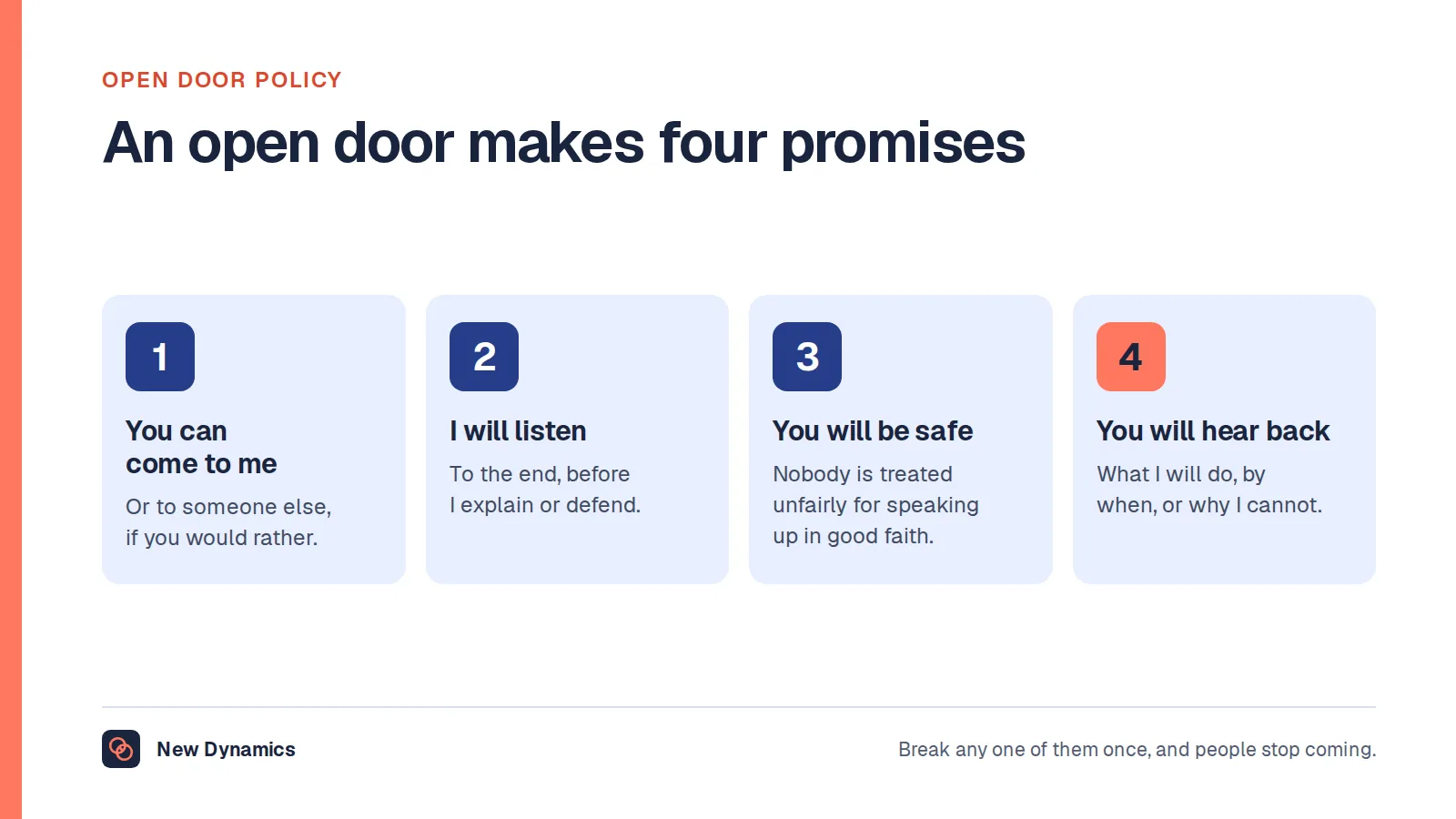
- Make upward communication easy, through one-to-ones, surveys and an open door. See how to make an open door policy real.
- Match the tone to the culture, and to the message. Warm and plain works for nearly everything.
Formal and informal language: quick guide
| Informal | Formal |
|---|---|
| Hi Sam | Dear Sam, or Dear Mr Patel |
| Can you…? | Could you please…? or Please… |
| Thanks! | Thank you for… |
| Sorry, I can't make it | Unfortunately, I am unable to attend |
| Let me know | Please let me know by [date] |
| ASAP | By 5pm on Thursday 9 October |
| Cheers | Kind regards |
Formal does not mean pompous. Plain words, short sentences and a specific request are right in both styles. Avoid slang, emojis and abbreviations when you write to people you do not know, to customers or for the record.
Common mistakes
Serious news by chat message. It feels disrespectful, and it leaves no proper record.
A formal letter for a small matter. A written warning about one late arrival, with no conversation first, damages trust.
Assuming that “everyone knows”. News shared informally reaches some people and not others.
Treating the grapevine as fact, or ignoring it entirely. It is a source of questions, not of answers.
No follow-up. A useful conversation with no note is a misunderstanding waiting to happen.
Jokes and sarcasm in writing. Tone travels badly in text. Our list of workplace jokes includes five tests for humour that is safe.
Forgetting that informal messages can be retrieved. Chat logs and texts may be read later, in a dispute or an investigation. Write accordingly.

Frequently asked questions
What is the difference between formal and informal communication?
Formal communication follows the organisation's official channels, is planned and leaves a record, such as a policy, a contract or a performance review. Informal communication is spontaneous, follows relationships and is rarely recorded, such as a corridor chat or a quick message.
What are examples of formal communication?
Examples include contracts and offer letters, policies and handbooks, company announcements, performance reviews, meeting minutes, project reports, disciplinary and grievance letters, and emails that confirm an official decision.
What are examples of informal communication?
Examples include a chat before a meeting, a quick question in a messaging app, lunch with a colleague, a manager asking how you are getting on, a word of thanks in passing, and the rumours that travel along the grapevine.
Which is better, formal or informal communication?
Neither is better. Informal communication is fast and builds trust. Formal communication gives clarity, fairness and a record. Use informal communication for routine matters and relationships, and formal communication for decisions, rights, obligations and anything serious.
When should I move from informal to formal communication?
Move to a formal route when the matter affects pay or employment, when a record is required, when the issue is serious, or when an informal approach has not worked. Acas advises that it is usually a good idea to raise a problem at work informally first.
Is email formal or informal?
It can be either. An email that confirms a decision, a contract term or a warning is formal, and it should be written carefully. A two-line note to a close colleague is informal. Remember that any email may be forwarded or retrieved later.
Your next step: add a two-line follow-up
- After your next important conversation, send a short note of what was agreed, by whom and by when.
- Notice how often it clears up a difference that neither of you had spotted.
- If you manage people, check whether remote colleagues hear news at the same time as everyone else.
- Choose one piece of official news that is overdue, and share it this week.
For ways to build regular, useful conversations, read and download our employee feedback guide. The guide is free to read, and the PDF uses our short download form.
Want check-ins and feedback that are easy to have and easy to find again? Book a New Dynamics demo and bring your current habits. You can also email contact@new-dynamics.com.