TL;DR
- 360 degree feedback collects views on one person from several directions: their manager, peers, direct reports and sometimes clients, usually alongside a self-assessment. A 360 review and a 360 survey are the same exercise under different names.
- One decision governs every other: is this for development, or is it an assessment that will inform a decision about the person. Mixing the two quietly turns candid feedback into evidence, and raters change their answers once they suspect it.
- Acas expects what is discussed to be written down and shared with the employee, and the ICO requires records about people to be accurate and limited to what you need. Both apply to a 360 report, including the comments nobody intended to keep.
Most 360 feedback cycles are designed in the wrong order. Someone picks a tool, the tool arrives with a question bank, the question bank sets the questions, and the purpose of the exercise is settled by accident somewhere in the middle. The report then lands on a desk, the recipient reads the one comment that stings, and nothing changes.
This article works in the right order: what 360 degree feedback is, the single decision that governs everything else, how to choose raters, how to write questions that produce usable answers, a question set and a form structure you can lift, the confidentiality problem that small rater groups create, and how to run the debrief so the recipient acts rather than defends.
Where someone works for more than one manager, the people who actually saw the work are often not the person who signs the review off. See how New Dynamics multi-manager reviews bring those views into one record.
What 360 degree feedback is
360 degree feedback is a structured way of collecting views on one person's behaviour at work from the people positioned around them: their line manager, peers, direct reports where they have any, and sometimes clients, suppliers or colleagues in other teams. The person normally completes the same questionnaire about themselves, so that their own view can be compared with everybody else's.
The names are interchangeable in practice. A 360 review, a 360 survey, a 360 assessment and a 360 appraisal all describe the same mechanism: several raters, one subject, one questionnaire, one combined report. The number refers to the degrees of a circle, meaning views from every direction rather than only from above.
Three things distinguish it from an ordinary appraisal. It gathers more than one perspective, so a single manager's impression is no longer the whole picture. It asks about observable behaviour rather than results against objectives. And it reports back in aggregate, usually grouped by rater type, so the recipient can see that peers and direct reports experience them differently.
Two things it is not. It is not a measure of output, so it does not replace the review of goals and delivery. And it is not a personality assessment, although badly written forms often turn into one.
The decision that governs everything else
Before you choose a tool, a question or a rater, answer one question in writing: is this cycle for development, or is it an assessment that will inform a decision about the person.
A development 360 exists to give the recipient information they cannot get any other way. The report belongs to them. Their manager or a coach helps them read it. The output is two or three behaviours to practise. Nobody scores anybody, and the numbers exist only to show where views diverge.
An assessment 360 feeds something: a promotion decision, a rating, a pay outcome, a capability case. That is a legitimate use, but it is a different exercise. It needs stated criteria, a known rater set, a right of reply, a record that can be shown to the person, and a process you would be comfortable explaining if the decision were challenged.

Why mixing them breaks the process
The two purposes pull in opposite directions, and the damage is not theoretical.
Raters answer differently once consequences are attached. A peer who would happily write "decisions arrive without the reasoning" for a colleague's development will not write it when the words might sit in a promotion file. What comes back instead is mild, uniformly positive and useless. Reciprocity appears, too: if everyone is rating everyone and ratings affect money, people trade.
The recipient also reads differently. Feedback offered as information is something to think about. The same feedback offered as evidence is something to rebut. The moment a recipient starts working out who said what in order to contest it, the exercise has failed, whatever the report says.
And a process designed for development rarely survives being used as evidence. Anonymous aggregated comments from an unspecified group cannot easily be put to the person as a fair case, because they cannot answer them properly.
So pick one, write the purpose at the top of the form in the words the raters will read, and keep it. If you want 360 feedback to inform decisions later, start with development cycles, build trust in the mechanics, and change the purpose openly rather than by stealth.
Acas describes a performance review as a chance to discuss someone's work, including "what they are doing well, any areas for improvement, whether they need more support or training, their career and any development objectives". That is the development conversation a 360 report should feed. Acas also says that "it's important to keep a written record of what is discussed" and that the record "should be shared with the employee afterwards", which is a useful discipline either way: if a finding cannot be written down and shared, it is not usable.
Choosing raters
The rater list decides the quality of the report more than the questions do.
- Pick people who have observed the work. Relevant exposure over the review period, not seniority and not sympathy. A senior stakeholder who has seen the person in two meetings knows less than a peer who shared a project.
- Cover the directions that matter to the role. For an individual contributor: the manager, three or four peers, and the internal colleagues who depend on their work. For a manager: the manager, peers, and direct reports, because the manager relationship is where the biggest perception gaps appear.
- Let the recipient nominate, then let the manager adjust. Nomination gives the recipient ownership. Adjustment stops a list made only of allies. Both names on the final list.
- Use enough raters per group to report safely. Set a minimum before you start, usually four or five responses per rater group, and merge or suppress groups that fall below it.
- Offer "not observed" on every item. Forcing a score from someone who has not seen the behaviour manufactures data.
- Keep the list to a workable size. Eight to twelve raters produces a rich report. Twenty-five produces survey fatigue and a thinner response from each.
Tell raters the purpose, who will see the report, how their answers will be grouped, and how long it will take. Then give them a deadline and chase it, because a 360 cycle with a 40 per cent response rate is worse than none: it reports a minority view as if it were the room.
Writing questions about behaviour, not personality
The difference between a useful 360 survey and a wasted one is usually visible in the first three items.
A personality question asks what someone is: "Is Sam a confident communicator?" The rater has to infer a trait, and the answer reveals more about the rater than the subject. A behaviour question asks what someone does, and how often, in circumstances the rater has witnessed: "How often does Sam explain the reasoning behind a decision to the people who have to carry it out?"
Rules that keep questions honest:
- One observable behaviour per item. If an item contains "and", split it.
- Frequency scales, not quality scales, for behaviour. "Rarely" to "almost always" can be observed. "Excellent" to "poor" invites a general impression.
- Define the anchors in the form. Say what "sometimes" means, so two raters mean the same thing by it.
- No inferred motives. Nothing beginning "does this person care about" or "is this person committed to".
- Nothing a rater could not have seen. Direct reports cannot assess board influence.
- Nothing that tracks a protected characteristic. Availability for evening calls, travel, visibility in the office and energy levels filter for circumstance, not capability.
- Pair every rated section with one open question. Numbers show where to look. Words explain what to do.
That last point about protected characteristics is a legal point as well as a design point. Acas states that discrimination "means treating someone 'less favourably' than someone else" because of a protected characteristic, that this can include "excluding someone from opportunities or benefits", and that "it can still be discrimination even if the less favourable treatment was not intended". A 360 item that rewards presence or long hours, feeding a report that gates development or promotion, is a straightforward route to that outcome. This article is general information rather than legal advice.
A 360 feedback question set you can use
Twelve rated items and five open questions. Adapt the wording to your own competencies, and cut rather than add. Every rated item uses the same five-point frequency scale plus "not observed": almost never, occasionally, about half the time, usually, almost always.
Rated items, for every rater group
- Explains the reasoning behind decisions to the people affected by them.
- Says clearly what they will do and by when, and does it.
- Raises problems early enough for something to be done about them.
- Listens to a view that differs from their own before responding.
- Shares information that colleagues need without being asked.
- Gives credit to the people who did the work.
- Asks for help when a task is outside their current capability.
- Keeps commitments to colleagues outside their own team.
- Responds to challenge without the other person paying for it later.
- Changes an approach when the evidence says it is not working.
Two extra rated items, for people who manage others
- Makes priorities clear enough that their team knows what to drop.
- Gives feedback close enough to the event for it to be useful.
Open questions
- What does this person do that you would want them to keep doing, and what effect does it have on your work?
- What is the single thing they could change that would make the biggest difference to working with them?
- Describe one situation in the last six months that shows them at their most effective.
- Where do you see them hold back, and what seems to be in the way?
- What does this person need from the organisation that they are not getting?
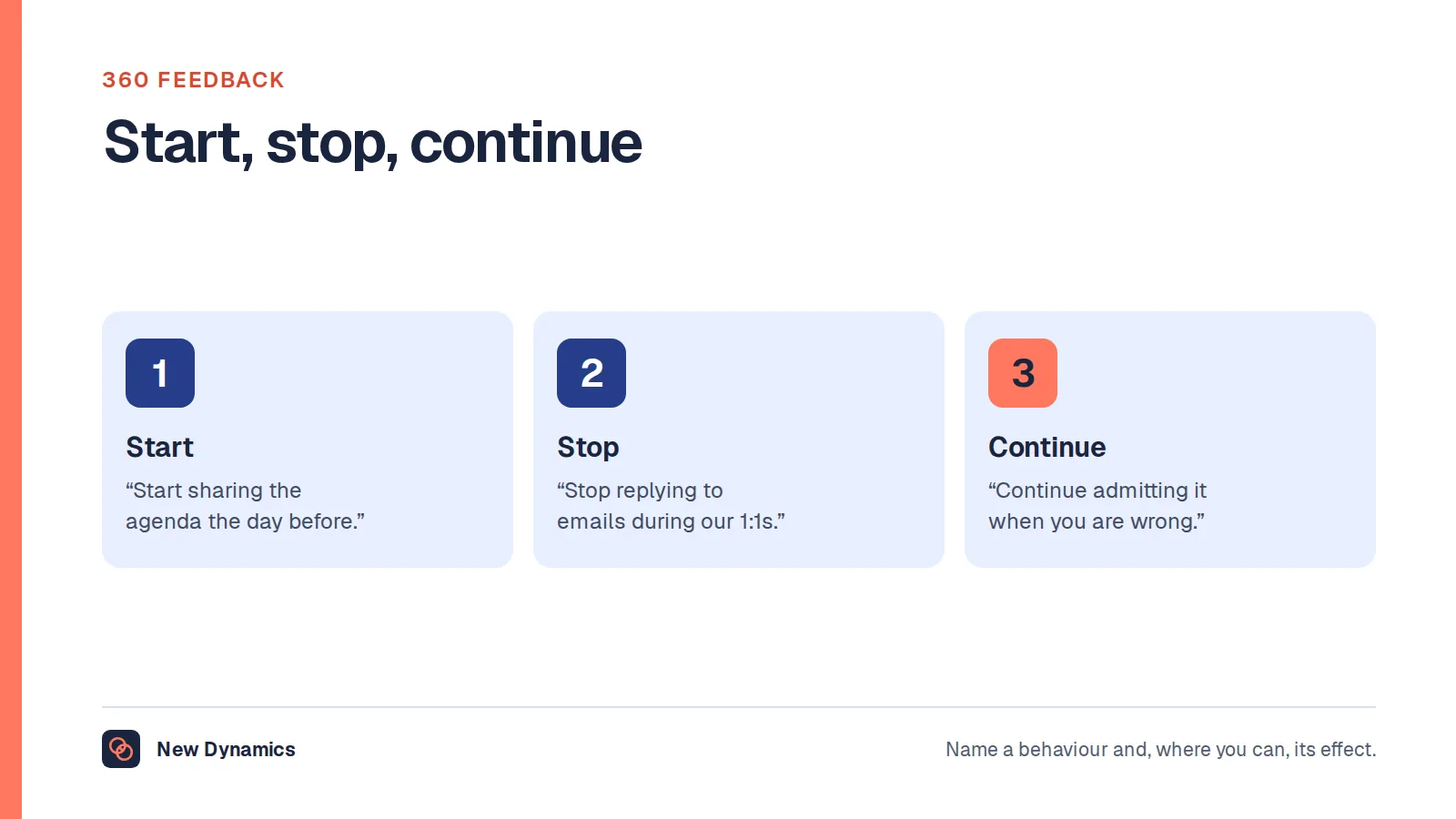
The wording of the answers matters as much as the wording of the questions. Our post on 360 feedback examples gives sample comments, in the start, stop and continue format and by skill, that you can use to show raters what a usable comment looks like.
A 360 appraisal form structure
A 360 form is six sections. The order matters, because the early sections set the standard for the later ones.

Section A: purpose and confidentiality, in plain words. Who asked for this cycle, what it is for, who will see the report, how answers are grouped, the minimum group size, how long answers are kept, and what will not happen with them. Four or five sentences, before the first question.
Section B: the rater's relationship and exposure. Rater group (manager, peer, direct report, other), how long they have worked with the subject, and how much of their work they have seen. This is what lets you report by group and discount thin responses.
Section C: rated items with a defined scale. The twelve items above, in fixed order, with "not observed" alongside. One screen per six items keeps completion rates up.
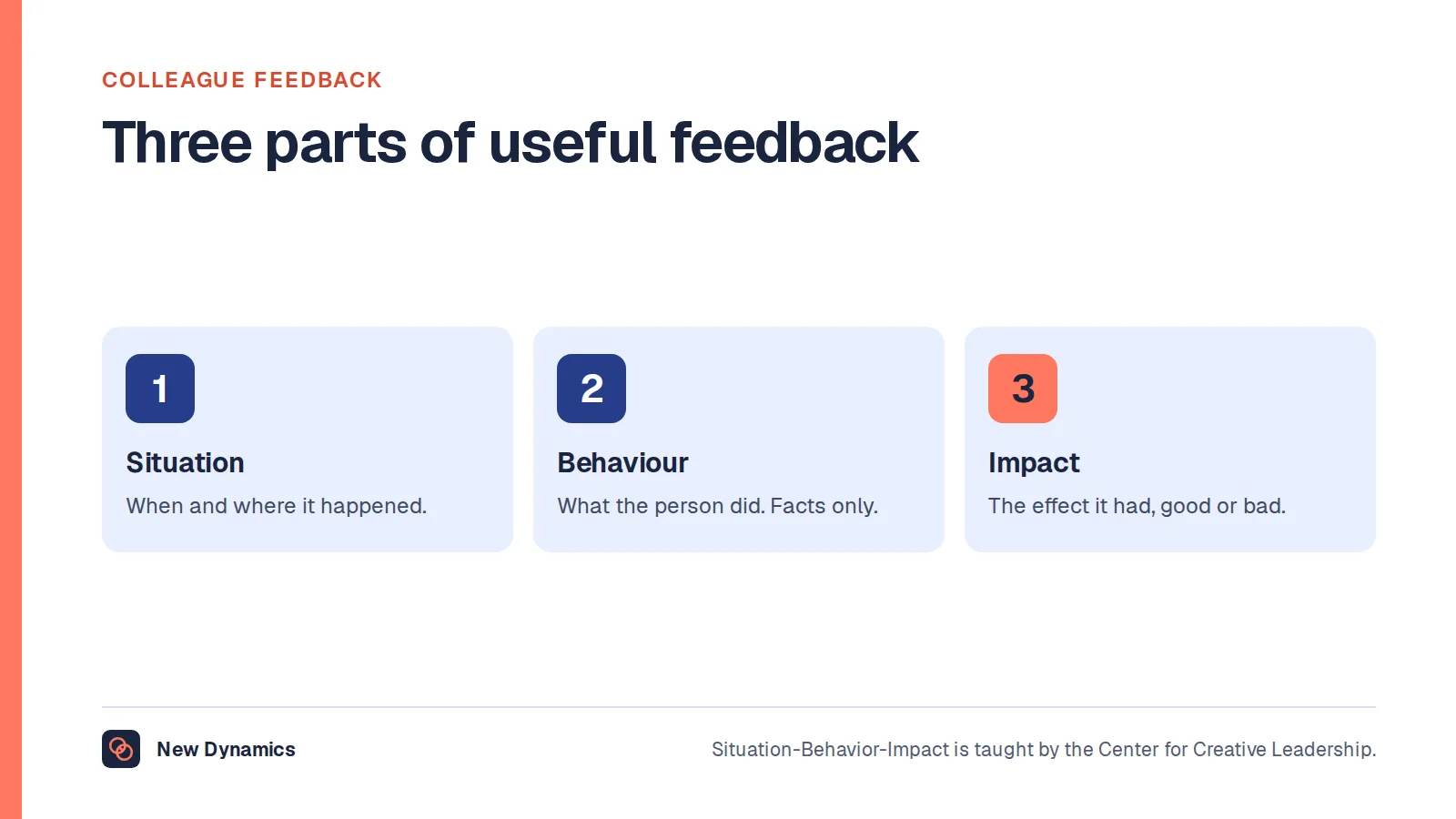
Section D: open questions. The five above. Give each a text box with a visible guide on length, and a one-line reminder: describe what you saw, say what it affected, suggest one change.
Section E: the rater's own declaration. One tick: "I have based these answers on work I observed during the period, and I have left out anything connected to a protected characteristic or to someone's personal circumstances." It takes a second and it changes what people write.
Section F: the self-assessment, on the same items. Identical questions, so the gap analysis is possible. Add two questions only the subject answers: what you expect this feedback to say, and what you would most like help with.
The report that comes out of that form should carry, per item, the self-score, each rater group's average where the group meets the minimum size, the open comments grouped by rater type and lightly edited only to remove identifying detail, and a visible note of how many people were invited and how many replied. No overall score. A single 360 number invites a ranking, and a ranking is the assessment use you decided not to make.
Confidentiality and the small-sample problem
Anonymity in a 360 cycle is a promise that is easy to make and easy to break by arithmetic.
A manager with three direct reports is the standard example. Report the direct-report group separately and anyone can narrow a comment to three people, two if one was on leave, one if the comment mentions a specific piece of work. The rater knows this, which is why feedback from small groups is so often blandly positive. The promise of anonymity has to be true before it will produce candour.
Practical safeguards:
- Set a minimum group size before the cycle opens, and say what it is on the form. Four is a common floor, five is safer.
- Merge groups that fall below the floor, or roll them into an "all raters" figure rather than reporting them separately.
- Never report a free-text comment from a group of one or two. Hold it for the facilitator instead of putting it in the report.
- Remove identifying detail from comments, including project names, dates and turns of phrase that only one person uses.
- Keep the comments and the identities apart, so nobody administering the cycle can link them casually.
- Say explicitly that the recipient will not be told who said what, and mean it. Then tell the recipient that guessing is the fastest way to waste their report.
A 360 report is a record about an identifiable person, so data protection applies throughout. The ICO says employers "must make sure the personal information you hold is adequate, relevant, and limited to what you need for your purposes" and "must take all reasonable steps to keep any personal information you hold about your workers accurate and up-to-date". It lists "appraisal or performance review records" among the employment records this covers, requires "appropriate security measures in place to prevent the personal information you hold about workers being accidentally or deliberately compromised", and says you must tell workers your purposes, your lawful basis, your retention periods, who you plan to share the information with and "their rights over their information".
Three consequences for a 360 cycle. Collect only what the purpose needs, which is a reason to cut the nice-to-have questions. Set a retention period for raw responses before you open the cycle, and apply it, because raw comments held indefinitely are neither limited to what you need nor likely to stay accurate. And write the privacy wording for raters and recipients before the first invitation goes out, not after the first complaint. Our employee data protection guide covers the wider record-keeping position.
How to debrief it so the recipient acts
The debrief is where a 360 cycle is won or lost, and it is the part most often left to an email with a PDF attached.

- Give the recipient the report before the conversation, with a day to sit with it. A first reading is emotional. Everyone goes straight to the harshest comment. Letting that happen in private rather than across a table is the single cheapest improvement available.
- Open on the gaps, not the lows. The useful question is not "what was your worst score" but "where did your own view differ most from everybody else's". A blind spot the recipient did not know about is what the exercise is for.
- Read the pattern, discard the outliers. One comment is one person. The same point from four raters in two groups is information. Say this out loud, because recipients weight single comments far too heavily.
- Name the strengths with the same precision as the development areas. Consistently high items are a description of how this person works best, which matters for the next role and the next project.
- Block the detective work. If the recipient starts identifying raters, stop the conversation and return to the pattern. Nothing useful is on the other side of that question.
- Leave with two actions, not ten. Two behaviours, each with a situation where it will be practised, each visible to someone. Put them where the rest of the work lives: see our development plan template for the shape.
- Have the recipient thank the raters and tell them the two things. It closes the loop, it proves the cycle was not extractive, and it makes the next round of answers better.
- Diary the re-ask. Six months, same items, same raters where possible. Without that, nobody ever finds out whether anything changed.
A recipient who defends is usually a recipient who was handed a verdict. A recipient who acts was handed information, in private, with help reading it.
What goes wrong
- No stated purpose. The commonest failure. Raters guess the purpose, guess conservatively, and answer accordingly.
- A purpose that changes mid-cycle. Development feedback repurposed as evidence is the fastest way to lose a rater population for years.
- Rater groups too small to protect. Three direct reports and a separate direct-report column in the report. The maths does the identifying for you.
- Personality questions. Items about confidence, attitude or commitment produce judgements that cannot be acted on and often cannot be defended.
- Everyone at once. Running a whole organisation through a first cycle guarantees a thin result and no capacity to debrief anybody properly. Start with one team or one management population.
- No debrief. A report sent by email with no conversation is a document, not a process.
- Averaging everything into one number. The moment a 360 produces a single score, someone will compare people with it.
- A cycle with no re-ask. Feedback with no second measurement is an opinion poll, not development.
- Treating low response rates as a reporting problem. They are a trust problem, and the fix is in the purpose and the confidentiality wording, not in the reminder email.
On numbers: no official UK statistics body publishes how many employers run 360 feedback, or how often these cycles change behaviour, so be sceptical of confident percentages in vendor material. Where official figures do exist for the wider workforce picture, we collect them in the HR statistics hub.
Free 360 feedback tools and what to ask software for
Free 360 degree feedback tools exist, and for a first development cycle a form builder plus a spreadsheet is a reasonable starting point. The honest limits are worth knowing before you commit: you will be merging responses by hand, you will be enforcing minimum group sizes by hand, the raw comments will sit in whoever's account built the form, and anonymity depends on one person's care. That is workable for one team and unmanageable across a company.
When you look at paid options, ask five questions that separate real 360 support from a survey tool with a new label.
- Can it enforce a minimum group size and suppress a group that falls below it, without a human remembering to.
- Can the recipient nominate raters and the manager approve them, with both recorded.
- Does it keep identities and comments separated, and can you show who can see what.
- Can you set a retention period on raw responses and have it apply automatically.
- Does the report show response rates, by rater group, alongside the results.
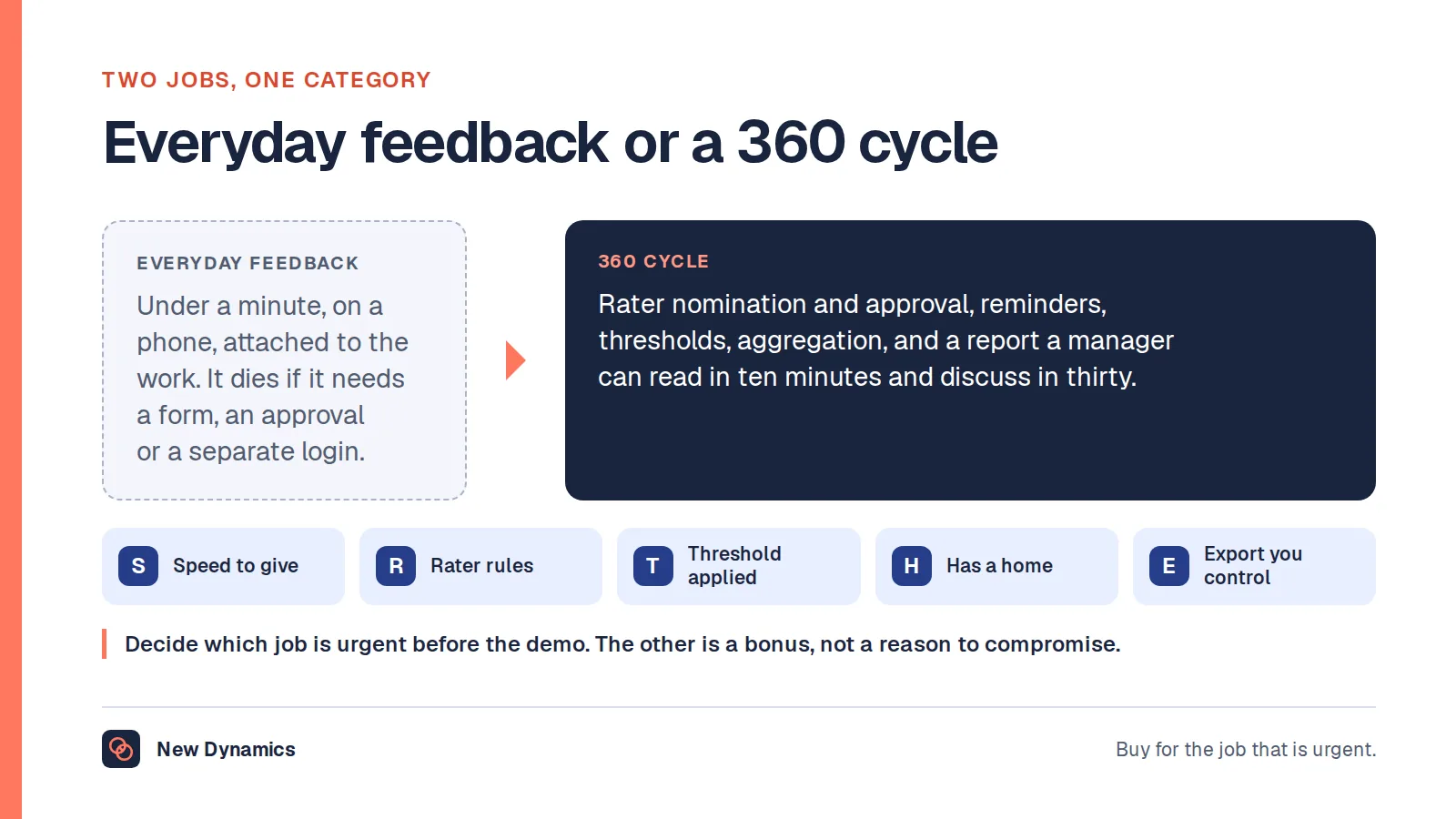
Our post on employee feedback software goes through the selection in more detail, including where 360 cycles should sit in relation to pay decisions. One plain statement about our own product: New Dynamics is a performance review platform built around your own review form, and its feedback features cover everyday feedback and multi-manager input rather than a packaged 360 survey engine. If a full 360 cycle is your main requirement, say so in the first conversation with any vendor, including us.
Frequently asked questions
What is a 360 review?
A 360 review collects views on one person's behaviour from several directions: their manager, peers, direct reports and sometimes clients, usually with a self-assessment on the same questions. The responses are combined, grouped by rater type and reported back to the person. It covers how someone works rather than what they delivered, so it complements a goals review rather than replacing it.
What is the difference between a 360 survey and an appraisal?
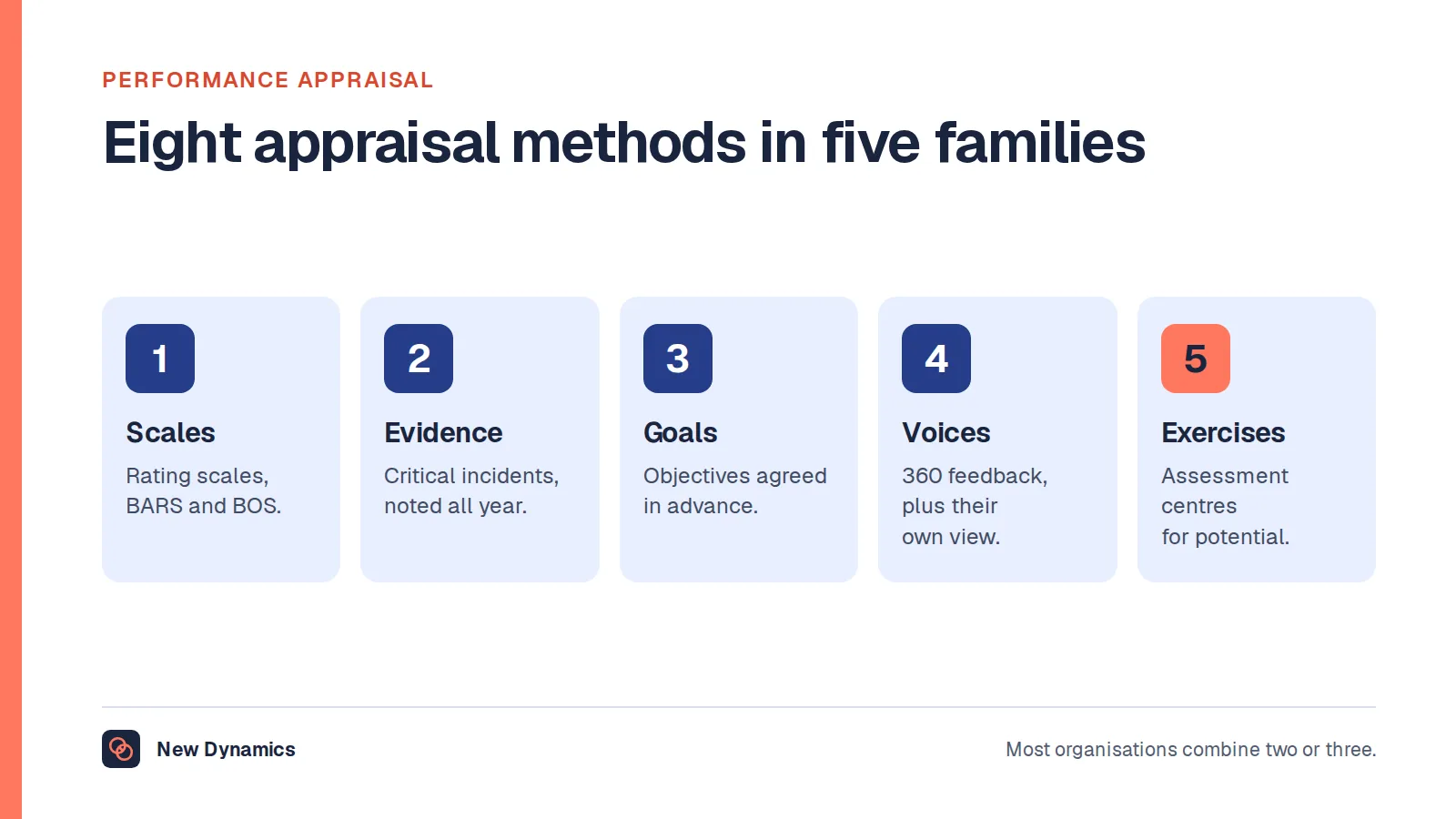
An appraisal is normally a conversation between one employee and one manager about delivery, objectives and next steps, and it usually carries a record and sometimes a rating. A 360 survey gathers behavioural observations from many people and reports them in aggregate. One looks at results and is owned by the manager. The other looks at behaviour and, in a development cycle, is owned by the recipient.
How many raters should a 360 have?
Eight to twelve raters is a practical range, with a minimum of four or five responses in any group you intend to report separately. Below that floor, merge the group into an overall figure or suppress it, because small groups make individual contributors identifiable and that makes raters cautious. Always record how many people were invited and how many replied.
Can 360 feedback be used in a performance review or for pay?
It can, but only if you designed it for that from the start, told every rater, and can show the person the case being made. Candour drops when consequences are attached, and anonymous aggregated comments are difficult to put to someone fairly. Most organisations get more value from keeping 360 cycles for development and keeping pay decisions on delivered work.
What questions should a 360 feedback form include?
Ten to twelve rated items about observable behaviour on a frequency scale, two more for people who manage others, and four or five open questions. Add a "not observed" option to every rated item. Avoid anything asking a rater to infer personality, motive or commitment, and avoid anything a particular rater group could not have seen.
Are free 360 degree feedback tools good enough?
For one team's first development cycle, a form builder and a spreadsheet will work. You take on the merging, the minimum group sizes, the editing of identifying detail and the security of the raw responses yourself. Across a company that becomes both a workload and a confidentiality risk, which is the point at which dedicated software starts to pay for itself.
Your next steps
- Write one sentence stating whether this cycle is for development or assessment, and put it at the top of the form where raters will read it.
- Set your minimum group size now, in writing, and decide what happens to a group that falls below it.
- Cut your question list to twelve rated items and five open questions, and delete anything that asks a rater to infer a trait.
- Book the debrief conversations before you send the first invitation, and send each report a day ahead of its conversation.
- Diary the re-ask at six months with the same items, so you find out whether anything moved.
For the full process, including worked examples and a working session you can run with a manager, read and download our 360 feedback guide. The guide is free to read, and the PDF uses our short download form.
Want the behavioural feedback and the review cycle in one record? Book a New Dynamics demo and bring the form you use today. You can also email contact@new-dynamics.com.