TL;DR
- Good colleague feedback describes a specific situation, what the person did and the effect it had. That is true of praise as much as of criticism.
- These 50 samples cover positive feedback, constructive feedback and short comments for peer or 360 reviews. Replace the details with your own, and keep the tone you would want to receive.
- The best feedback is the feedback you ask for. Use the 20 questions in this article to invite specific, useful comments from your own colleagues.
A request arrives in your inbox: “Please provide feedback on your colleague by Friday.” You like them. They are good at their job. And yet the box stays empty, because “great to work with” feels too thin and anything critical feels risky.
This article gives you 50 colleague feedback examples that you can adapt: positive feedback, constructive feedback and short comments for peer or 360 reviews. It also lists 20 questions you can ask colleagues when you want feedback on your own work.
Feedback works best as a habit, not a yearly form. See how New Dynamics continuous feedback lets colleagues share and request feedback in everyday work.
How to write colleague feedback
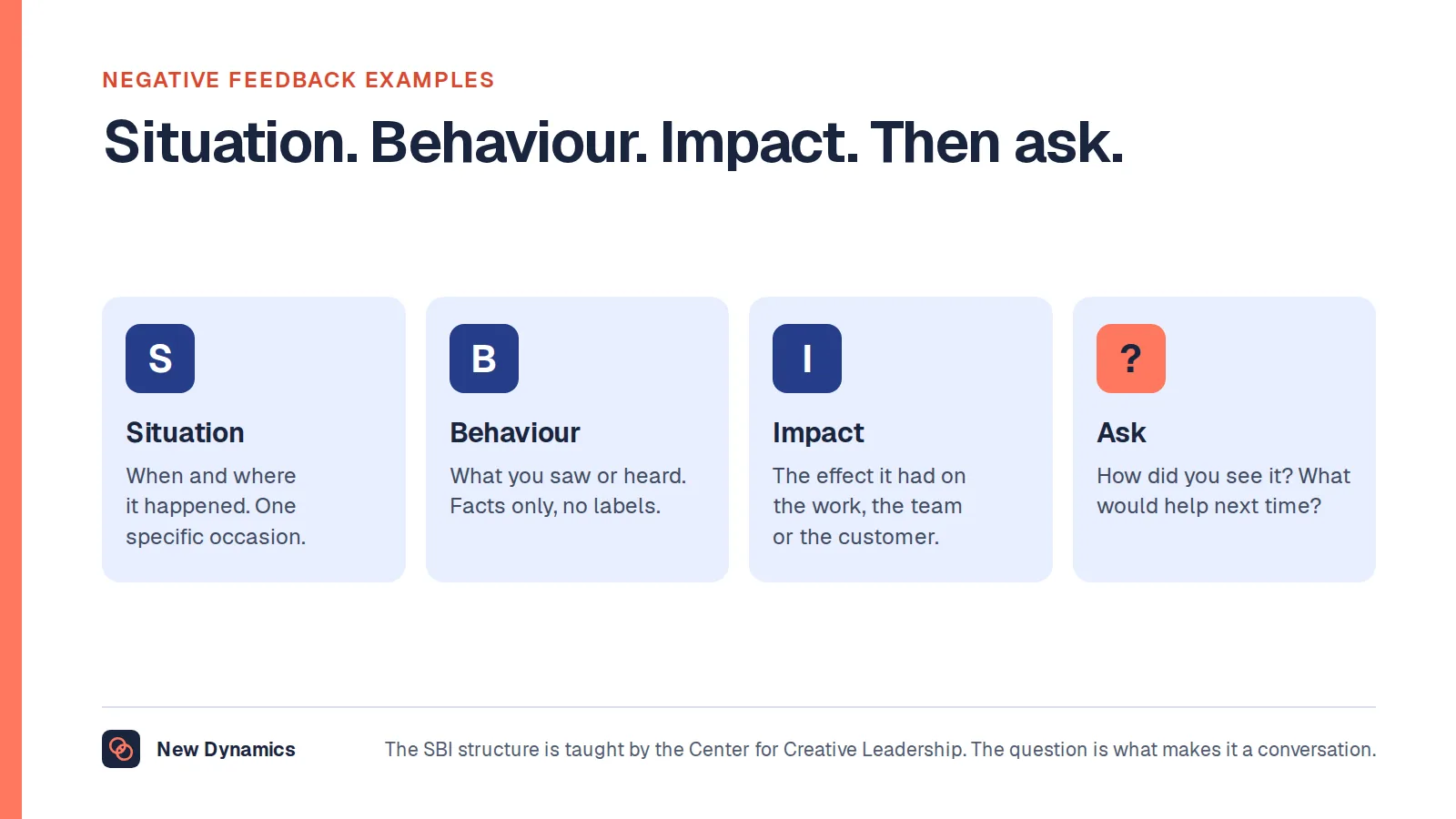
Use the structure that the Center for Creative Leadership teaches as Situation-Behavior-Impact. In the Center's words:
- Situation. “Describe the specific situation in which the behavior occurred.”
- Behaviour. “Describe the actual, observable behavior being discussed.” Keep to facts.
- Impact. “Describe the results of the behavior in terms of the impact it had, whether the effect was positive or negative.”
The Center notes that the model “can be used to give both positive and negative feedback”. It also observes that some of the most valuable feedback is given in the moment, on routine, day-to-day behaviours.
Five more rules help between peers.
- Write about what you saw yourself. Leave out hearsay.
- Describe behaviour, not personality. “Interrupted twice” can be discussed. “Arrogant” cannot.
- Be as specific with praise as with criticism. Vague praise is pleasant and useless.
- Suggest, do not instruct. You are a peer. “One thing that might help” reads better than “you need to”.
- Write nothing you would not say to the person's face. Assume that they will read it, even when the process is anonymous.

Positive feedback for a colleague: 25 examples
The names and details are fictional. Replace them with your own.
Collaboration and support
- When I joined the project in March, you spent an hour walking me through the data model. It saved me days, and I was contributing in my first week.
- During the outage last month, you stayed calm and kept the channel updated every fifteen minutes. The rest of us could concentrate on the fix because of that.
- You covered my accounts while I was on leave, and the handover notes you left were so clear that I picked everything up in an hour.
- In planning meetings you regularly ask, “Who have we not heard from?” Two of our best ideas this quarter came from people who would otherwise have stayed quiet.
- You share credit generously. When you presented the launch results, you named everyone who contributed, including the support team.
Communication
- Your weekly project note is the clearest update I receive. I always know what has changed, what is at risk and what you need from me.
- In the client workshop, you explained the pricing change in plain language. The client told me afterwards that it was the first time they had understood it.
- When you disagreed with my proposal, you said so directly in the meeting and explained why. It made the final design better, and it made me trust your praise more.
- You reply when you say you will. It sounds small, but it means that I never have to chase you.
- Your documentation for the new process meant that our team could adopt it without a single meeting.
Quality and reliability
- You caught the currency error in the forecast before it went to the board. Your habit of checking against the source saved us real embarrassment.
- I can hand anything to you and know that it will be done properly and on time. That reliability makes planning easier for everyone.
- The test cases you wrote for the billing change found three bugs before release. Customers never saw them.
- You keep our shared tracker up to date without being asked, so that the whole team can see where things stand.
- Your analysis of the returns data was thorough and honest about its limits. It gave us confidence to act.
Problem solving and initiative
- When the supplier failed in August, you had found and tested an alternative within a week. We did not miss a single delivery.
- You noticed that new customers were getting stuck at the second setup step, and you wrote the guide that fixed it. Nobody asked you to.
- You ask “What problem are we solving?” at the start of every project. It has saved us from building the wrong thing more than once.
- Your idea of pairing new starters with a buddy has made onboarding smoother for the last four joiners.
- When we were stuck on the migration, you brought in a colleague from another team. Your network solved in a day what we had struggled with for a week.
Attitude and growth
- You ask for feedback after every presentation, and you visibly act on it. Your last one was the best yet.
- You admitted the configuration mistake within minutes, which meant that we fixed it before customers noticed. That honesty sets the tone for the team.
- You stay constructive when plans change. During the reorganisation, your steadiness helped the rest of us.
- You have taught yourself SQL this year, and you now help others with their queries. The whole team is faster as a result.
- You make this a better place to work. You notice when someone is struggling, and you quietly help.
For more lines of thanks, see our employee recognition quotes.
Constructive feedback for a colleague: 15 examples
Constructive feedback between peers should be kind, specific and useful. Each example names a situation, the behaviour, its effect and a suggestion.
- In the last two sprint reviews, the demo overran by about fifteen minutes, and we did not get to questions. A shorter walkthrough, with time held back for discussion, would help us to give you better input.
- When the client asked about delivery dates on Tuesday, you committed to the 14th before checking with operations. We then had to go back and change it. A quick check with us first would protect your credibility with the client.
- I have noticed that you often take on urgent requests from other teams, and our shared deadlines then slip. It might help to agree priorities with the team lead before saying yes.
- In design discussions you sometimes move to the next point before others have finished. On Thursday, Sam stopped contributing after being cut off twice. Pausing before you respond would bring out more ideas.
- Your reports are thorough, but the key message is often on page three. A summary of two or three lines at the top would help busy readers.
- When you are under pressure, your messages become very short, and they can read as irritated. Last week two people asked me whether you were annoyed with them. A word of context would prevent that.
- You tend to fix problems yourself without telling anyone. It is generous, but the rest of us do not learn from it, and we sometimes duplicate the work. A quick note in the channel would help.
- The handover before your leave covered the open tasks but not the background. I had to contact you twice. A short “why” for each item would make the next one smoother.
- In meetings with senior people you rarely speak, although your ideas in our team discussions are excellent. I would like them to hear your thinking. Could you present the next update?
- You often join meetings five to ten minutes late, and we recap for you. Blocking five minutes before each one might help.
- Your code works well, but it has few comments, and reviews take me longer than they need to. A sentence explaining each non-obvious choice would speed things up.
- When I gave you comments on the proposal, you explained why each one was wrong before considering it. I became less inclined to offer more. Asking a question first would make it easier for people to help you.
- You say yes to everything, and I worry about your workload. Twice this quarter you have worked weekends to catch up. It would be fine to push back, and I will support you.
- The training session had excellent content, but it moved too fast for people new to the tool. A pause for questions after each section would help them to keep up.
- You copy a great many people into emails, and important requests get lost. Addressing the person who needs to act, and copying fewer others, would get you faster replies.
For more wording, and for harder conversations, see our negative feedback examples.

Short comments for peer and 360 reviews: 10 examples
Review forms often ask for a few lines on strengths and on areas to develop. These samples combine both.
- Strength: Maria is the most dependable person on the team. Work that she takes on is done well and on time. To develop: she could share her expertise more widely, for example by running a session on forecasting.
- Strength: Dev explains technical issues clearly to non-specialists, and customers trust him. To develop: his written updates could be shorter, with the decision needed at the top.
- Strength: Asha brings energy and ideas, and she gets new projects moving. To develop: following through on the final details. Two projects this year needed others to close them out.
- Strength: Tom is calm under pressure, and he helped the team through the outage. To develop: speaking up earlier when he disagrees. His concerns are usually right.
- Strength: Priya gives honest, kind feedback, and she has made my work better. To develop: delegating more. She takes on too much herself.
- Strength: Ben builds strong relationships with other teams, which unblocked the pricing project. To develop: keeping the tracker up to date, so that the rest of us can see progress.
- Strength: Lin's analysis is rigorous, and she is honest about uncertainty. To develop: presenting conclusions with more confidence to senior audiences.
- Strength: Sam is generous with his time, and new starters always mention his help. To develop: protecting time for his own priorities.
- Strength: Chloe raises problems early, and she brings options. To develop: involving other teams sooner in her projects.
- Strength: Omar sets a high standard for quality. To develop: knowing when good enough is right, so that perfectionism does not delay delivery.
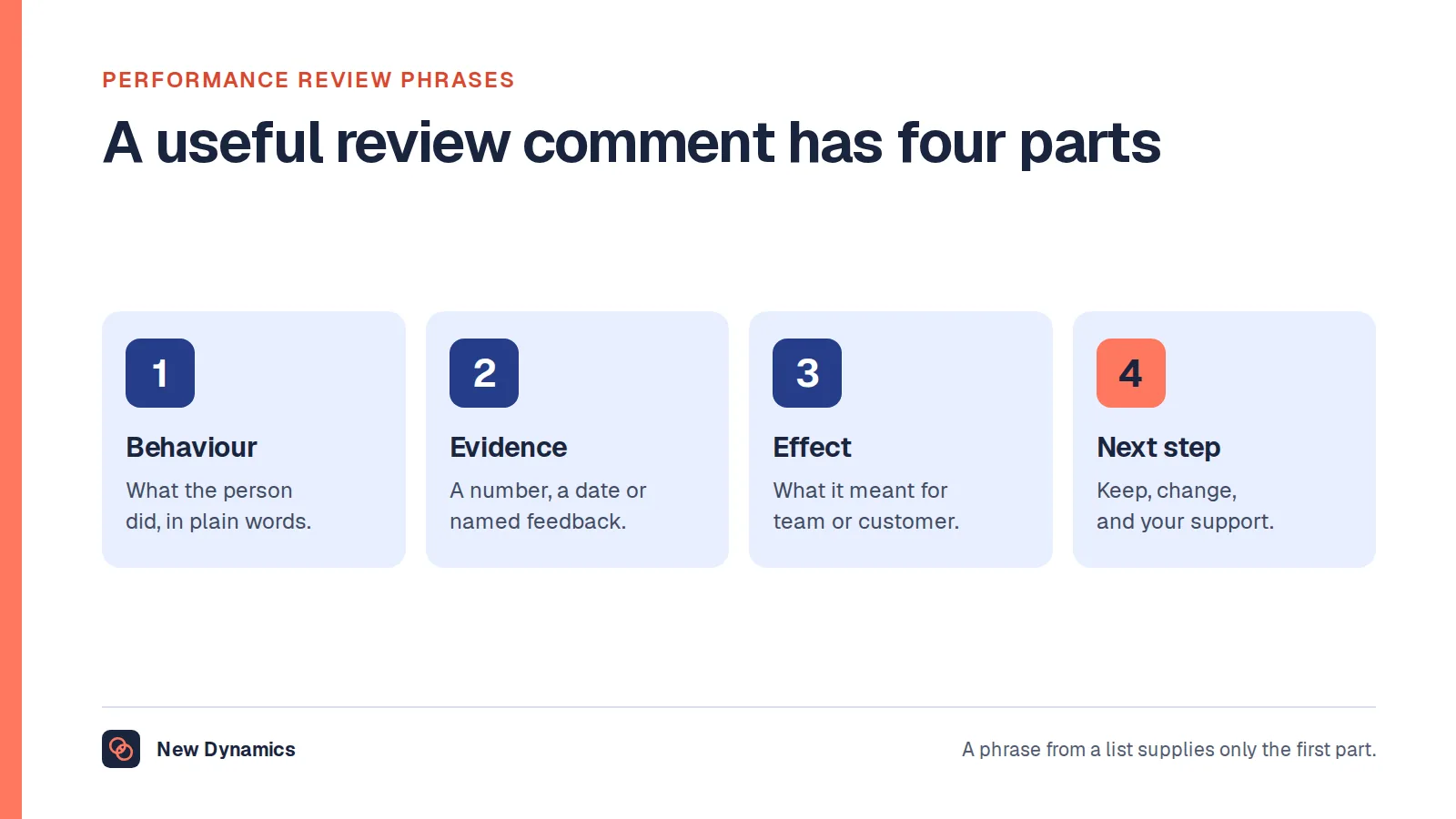
Our performance review phrases offer more wording by skill. For running a full process, see our 360 feedback guide.
20 questions to ask colleagues for feedback
“Do you have any feedback for me?” often gets “No, all good.” Specific questions get useful answers.
After a piece of work
- What is one thing I did on this project that you would like me to keep doing?
- What is one thing I could have done differently?
- Was there a point where I made your work harder? What happened?
- How clear were my updates? What was missing?
- If we did this again, what would you want from me earlier?
About how you work together
- What is it like to work with me when we are under pressure?
- When I disagree with you, how does it come across?
- Do I listen well in meetings? When have I not?
- How reliable am I? Is there anything you find you have to chase me for?
- Is there anything I do that makes you hesitate to bring me a problem?
About growth
- What do you see as my main strength? Where should I use it more?
- What is one skill that, if I improved it, would make the biggest difference?
- What do I do that may be holding me back, and that I may not see?
- Whom should I learn from, and what should I learn?
- What should I start doing, stop doing and continue doing?
After a presentation or a meeting
- What was the main message you took away?
- Where did I lose you?
- What would have made it more useful for you?
- How was my pace, and how well did I handle the questions?
- What one change would improve it most next time?
When you get an answer, say thank you. Do not defend yourself or explain. Ask a follow-up question if something is unclear, and later tell the person what you did with their comment. That is how you get honest feedback a second time.
How to give feedback that a colleague can hear
- Ask first. “Can I share an observation about the client call?” gives the person a moment to prepare.
- Choose the moment. Soon after the event, in private, and not when either of you is rushed or upset.
- Start from good intent. Assume that the person wanted a good result. The Center for Creative Leadership suggests asking about intent, which turns feedback into “a two-way dialogue”.
- Stick to one or two points. A long list overwhelms.
- Balance over time, not in every sentence. Give positive feedback often and sincerely, so that constructive comments arrive in a relationship of trust. Avoid the mechanical “praise sandwich”.
- Know the limits of your role. Serious concerns, such as harassment or safety, should go to a manager or to HR. They are not matters for peer feedback.
Feedback can travel upwards as well. See our feedback for your manager examples.
Honest feedback between peers depends on people feeling safe. Google's research into its own teams found that psychological safety mattered most for team effectiveness. We describe it in why teamwork is important. In Great Britain, the Health and Safety Executive's Support standard says that “employees receive regular and constructive feedback”, and that systems should be in place to enable and encourage employees to support their colleagues.

Frequently asked questions
How do you write feedback for a colleague?
Describe a specific situation, what the person did and the effect it had. Write about what you saw yourself, describe behaviour and not personality, be as specific with praise as with criticism, and offer a suggestion where it would help.
What is an example of positive feedback for a colleague?
“When I joined the project in March, you spent an hour walking me through the data model. It saved me days, and I was contributing in my first week.” It names the situation, the behaviour and the impact.
How do you give constructive feedback to a peer?
Ask whether you can share an observation, choose a private moment soon after the event, describe the situation, the behaviour and its effect, and offer one suggestion. Assume good intent, and ask for the person's view.
What questions should I ask colleagues for feedback?
Ask specific questions, such as: what is one thing I did on this project that I should keep doing? What could I have done differently? Is there anything you have to chase me for? What one skill would make the biggest difference if I improved it?
What should I write in a peer review?
Write two or three sentences on strengths, with an example, and one or two on an area to develop, with a suggestion. Keep to what you have seen, and write nothing that you would not say to the person directly.
Should colleague feedback be anonymous?
Anonymity can encourage honesty in formal 360 reviews, especially about senior people. Day to day, feedback given in person and by name builds more trust. Whatever the process, write as if the person will know that it came from you.
Your next step: send one piece of feedback today
- Think of a colleague who did something recently that helped you.
- Write three sentences: the situation, what they did and the effect.
- Send it to them, and consider copying their manager.
- Then choose one question from the list of 20, and ask it of someone whose opinion you respect.
For a fair way to collect feedback from several colleagues, read and download our 360 feedback guide. The guide is free to read, and the PDF uses our short download form.
Want colleagues to give and ask for feedback as part of everyday work? Book a New Dynamics demo and bring your current feedback process. You can also email contact@new-dynamics.com.