TL;DR
- Administrative services only (ASO) is a US arrangement for employer health plans. CMS defines it as one "whereby a self-insured entity contracts with a Third Party Administrator (TPA) to administer a health plan." The administrator runs the plan; the employer pays the claims.
- The difference from a fully insured plan is risk. With a fully insured plan the insurer takes on the cost of claims for a premium. With ASO the employer keeps that risk and pays the administrator a fee, often buying stop loss insurance to cap very large or very frequent claims.
- The employer also keeps legal responsibility: the NAIC notes that the employer is the plan fiduciary under ERISA and "still bears ultimate accountability for the administration of the plan". This is general information about US group health plans, not legal, tax or insurance advice.
An employer's broker suggests moving the health plan "to ASO" at renewal. The insurer's name stays on the cards, employees see the same network, and the monthly cost looks lower. What has actually changed is who pays when someone needs a transplant.
This article explains administrative services only (ASO), an arrangement used for employer group health plans in the United States: what it is, how it differs from a fully insured plan, where stop loss insurance fits, what the employer is still responsible for, and the questions to ask before agreeing to it. It is general information, not legal, tax or insurance advice. It describes a US arrangement; UK readers should not assume there is a direct equivalent.
A plan change like this lands on several owners at once: finance, HR, the broker and payroll. See how New Dynamics workflows give each renewal task an owner and a due date, so nothing waits on someone else's inbox.
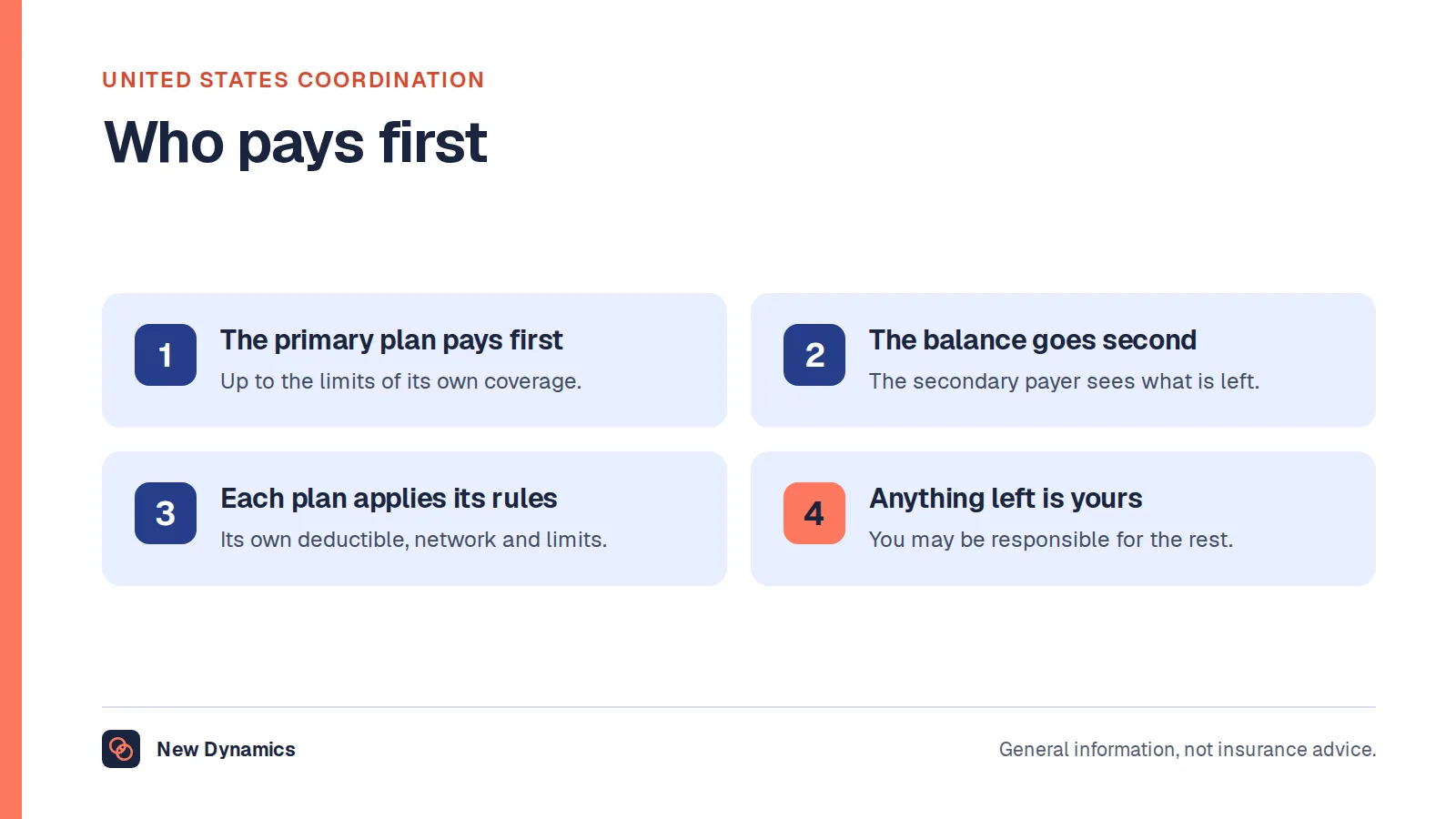
If employees are asking about holding two plans at once, our post on secondary insurance covers how coordination of benefits works.
What administrative services only means
The Centers for Medicare & Medicaid Services glossary defines Administrative Services Only (ASO) as "An arrangement whereby a self-insured entity contracts with a Third Party Administrator (TPA) to administer a health plan."
Two parts of that definition matter:
- "Self-insured entity". The employer funds the plan itself. It pays the medical claims of employees and their families from its own money, rather than paying a premium for an insurer to take that cost on.
- "Third Party Administrator". Someone else runs the plan day to day. That can be a specialist administrator or an insurance company selling administration without insurance, which is where the name comes from: the insurer provides administrative services only.
ASO compared with a fully insured plan

The National Association of Insurance Commissioners (NAIC) sets out the difference in its white paper on stop loss insurance, self-funding and the ACA. An employer that self-funds "takes on all the responsibility and risk that a fully insured employer has transferred to the insurance company." It "determines what benefits to offer, pays medical claims from employees and their families, and assumes all of the risk."
| Fully insured plan | Administrative services only | |
|---|---|---|
| Who pays claims | The insurer | The employer |
| Who carries the risk of high claims | The insurer | The employer, unless transferred to a stop loss insurer |
| What the employer pays | A premium | An administration fee, plus the claims themselves |
| Who runs the plan day to day | The insurer | The administrator, on the employer's behalf |
| Who is accountable for the plan | Shared with the insurer | The employer |
What the administrator does
The NAIC paper says that "Nearly all employers with self-funded plans, except for some of the largest employers, hire third-party administrators (TPAs) to administer their plans", including insurers with ASO contracts. It lists the kind of work they do:
- helping the employer design the benefit package and estimate its cost;
- making sure the plan complies with state and federal law and notice requirements;
- cost-management services, such as access to provider networks and care-management programmes;
- staff to deal with enrollment questions and process medical claims.
For this, in the paper's words, "employers will pay a fee and provide the 'checkbook'; i.e., the money necessary to pay the claims."
Where stop loss insurance fits
Paying claims directly leaves the employer exposed to a bad year. The NAIC describes the risk as "shock claims" (high cost but rare, such as an organ transplant) and high-utilisation claims (low cost but unusually frequent).
Many self-funded employers buy stop loss insurance to cap that exposure. According to the NAIC, a stop loss policy usually has two parts:
- A specific attachment point, which protects against one person's very large claim or series of claims. Costs above that point are covered by the stop loss policy.
- An aggregate attachment point, which protects against the total of many smaller claims. Once the employer's total claims for the year reach that point, the policy covers the rest, up to any policy limit.
Stop loss reimburses the employer. It does not turn the plan back into a fully insured one, and the NAIC is clear that the employer "remains ultimately responsible" if the stop loss insurer denies a claim or there are gaps between the policy and the plan.
What the employer is still responsible for
Handing administration to a third party does not hand over accountability. The NAIC paper states that "The employer is the plan fiduciary under ERISA" (the federal Employee Retirement Income Security Act), and that "a self-insured employer still bears ultimate accountability for the administration of the plan, so the employer must exercise due diligence in selecting a TPA."
In practice that means the employer should:
- understand what the plan document promises, because it, not the administrator, is making the promise;
- keep the money to pay claims available when the administrator asks for it;
- check that the stop loss policy matches the plan, so a claim the plan pays is a claim the policy reimburses;
- monitor the administrator's work, including claims decisions and required notices.
Questions to ask before moving to ASO

- What is the worst year we could afford? Model claims at the specific and aggregate attachment points, not at the average.
- What exactly does the fee cover? Claims processing, network access, care management, compliance notices and reporting may be priced separately.
- How do we fund claims, and how fast? Agree how often money moves and what happens if a large claim arrives early in the year.
- Does the stop loss policy match the plan? Check the definitions, exclusions and timing so there are no gaps.
- Who handles appeals and required notices? Write down which tasks the administrator owns and which stay with you.
- What happens when we leave? Ask how claims incurred before the end of the contract, but submitted later, will be paid.
Bring in a benefits adviser or attorney before signing; this is a financial and legal decision as much as an HR one.
Frequently asked questions
What does administrative services only mean in insurance?
Administrative services only (ASO) is an arrangement in which a self-funded employer pays an insurer or third-party administrator to run its health plan, but pays the medical claims itself. CMS defines it as one where a self-insured entity contracts with a third-party administrator to administer a health plan.
What is the difference between ASO and fully insured?
In a fully insured plan, the employer pays a premium and the insurer pays the claims and carries the risk. Under ASO, the employer pays the claims and carries the risk, and pays the administrator a fee to run the plan.
Is an ASO plan the same as a self-funded plan?
ASO is a way of running a self-funded plan. The plan is self-funded because the employer pays the claims; ASO describes the contract with the administrator that handles the day-to-day work.
Who is responsible for an ASO plan?
The employer. The NAIC notes that the employer is the plan fiduciary under ERISA and still bears ultimate accountability for the administration of the plan, even when a third party runs it.
Does ASO include stop loss insurance?
Not automatically. Stop loss insurance is a separate policy that reimburses the employer when claims pass agreed limits. Many self-funded employers buy it alongside an ASO contract.
Your next step: map who owns what
- List every task in your health plan: funding, claims, appeals, notices, renewals and reporting.
- Mark which ones the administrator does and which stay with you.
- Check the stop loss policy against the plan document.
- Put each internal task on someone's calendar, with a date.
For deciding pay and benefits in a way you can explain to employees, read and download our compensation policy guide. The guide is free to read, and the PDF uses our short download form.
Want renewal and benefits tasks with an owner and a due date? Book a New Dynamics demo and bring your current renewal checklist. You can also email contact@new-dynamics.com.