TL;DR
- A competency names something; an indicator describes what a person does when they have it. If the sentence contains an adjective, a trait or an outcome rather than an action, it will not survive a review conversation.
- Four tests make an indicator usable: it is observable, it repeats rather than describing one event, it is specific to a level, and it can be disagreed with. Anything that passes all four can be evidenced and coached.
- Keep the set small. Five to eight competencies, three to five indicators per level, and a deliberate check that none of them reward a communication style rather than a result, because that is where unintended unfairness lives.
Most competency frameworks fail in the same place. The headings are fine, the definitions are reasonable, and underneath each one sits a line like "demonstrates a collaborative approach", which no manager can evidence and no employee can act on. The framework then gets used once a year, badly, and quietly blamed for the ratings.
This article covers what a behavioural indicator actually is, a four-part test for writing one, a worked framework you can copy the shape of, how many to have, and how to rate against them in a review. It describes the position in Great Britain and is general information, not legal advice.
Indicators are only as good as the evidence behind them. See how New Dynamics performance reviews keep behaviours and examples together through the year.
A competency is a noun. An indicator is a sentence

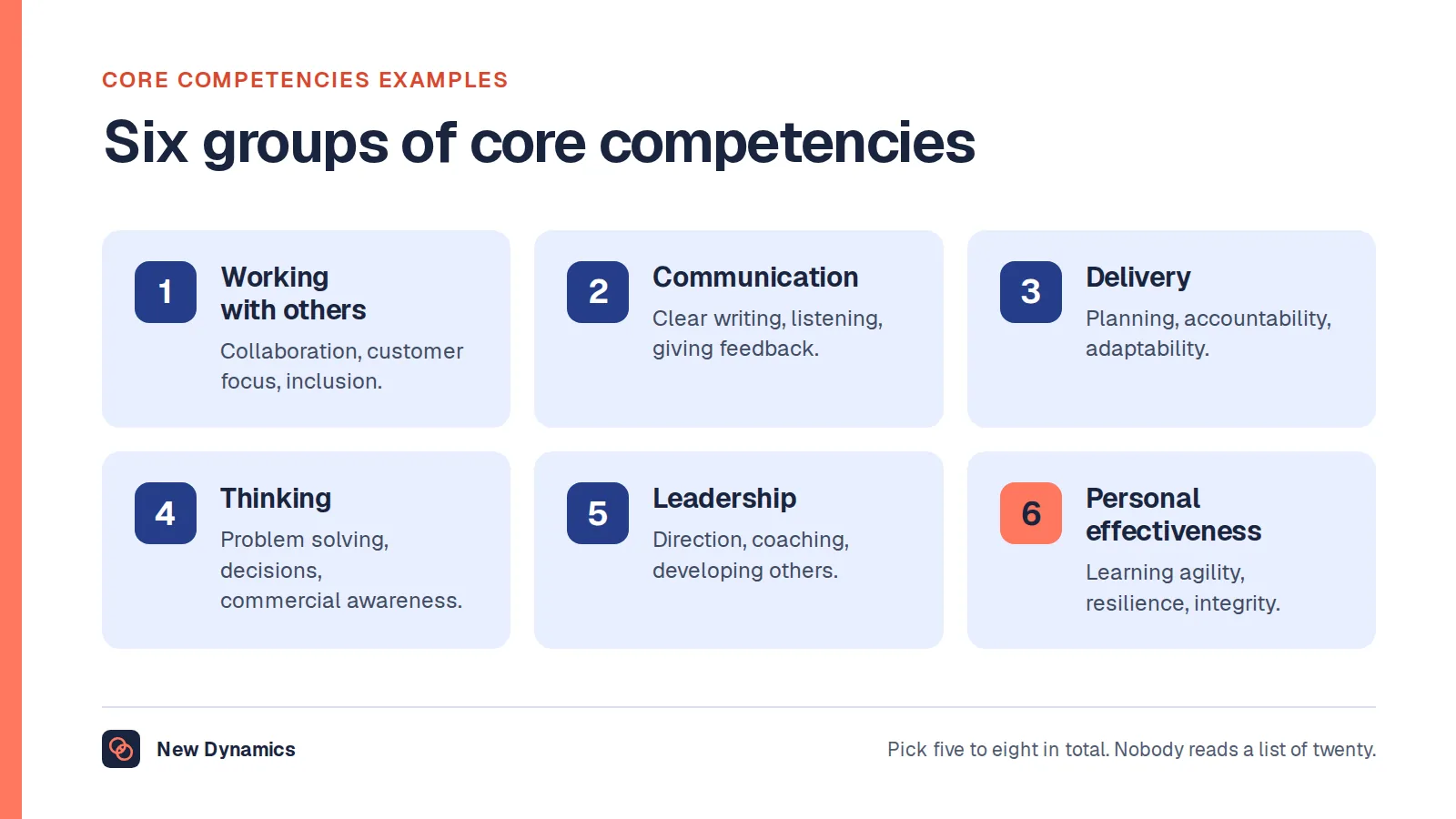
A competency names something the organisation values: collaboration, customer focus, judgement. An indicator describes what somebody does when they have it, in a sentence a third party could confirm or dispute.
Acas describes reviews as based partly on whether someone is "demonstrating the right behaviours in their work". The word doing the work there is "demonstrating". If the framework does not say what demonstrating looks like, every manager invents their own version, which is where inconsistency starts. Our post on core competencies covers choosing and defining the competencies themselves.
The four-part test

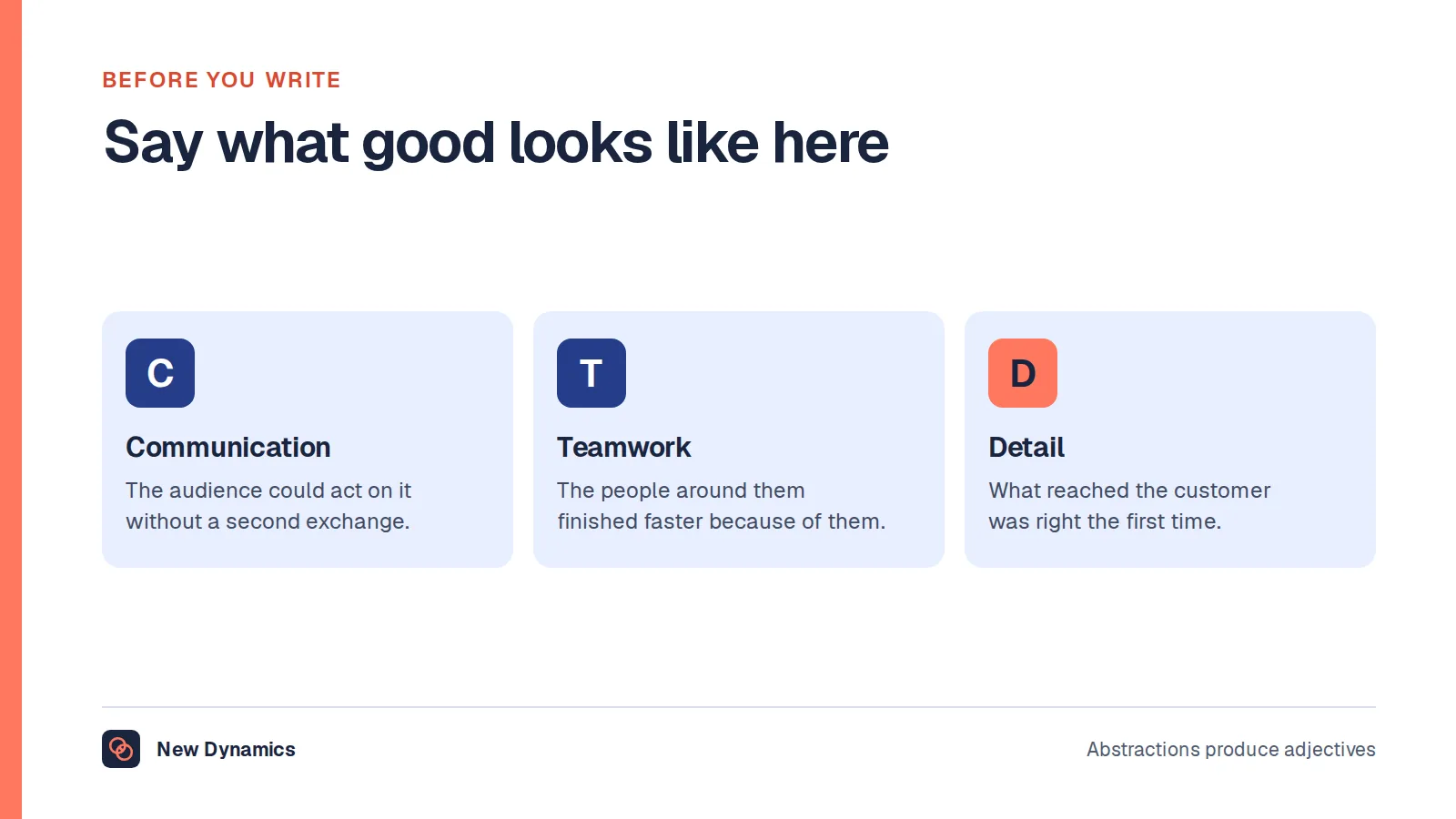
Observable. Could two people watching the same month agree on whether it happened? "Is approachable" fails. "Responds to questions from the team within a working day" passes.
Repeatable. It describes a pattern, not a single heroic incident. Indicators written from one memorable event produce reviews about that event forever.
Level-specific. The same sentence should not apply at every grade. If it does, the framework cannot support progression decisions, which our post on promotion readiness relies on.
Falsifiable. Somebody could look at the evidence and say "no, that did not happen". An indicator nobody could ever fail is decoration.
Three more rules of craft: present tense, one behaviour per sentence, and no adjectives. "Communicates clearly and effectively with a range of stakeholders" is three ideas and two adjectives, and it will mean something different to every reader.
A worked framework
Here is one competency written across four levels, which is the shape to copy.
Competency: working with others. How people make the work around them easier.
| Level | Behavioural indicators |
|---|---|
| Team member | Shares a draft before it is finished. Says when they are stuck within a day rather than at the deadline. Hands over work with the context the next person needs. |
| Senior professional | Offers help to colleagues outside their own objectives. Writes down what they learn so that others do not repeat it. Raises a disagreement with the person concerned before escalating it. |
| Manager | Resolves friction in the team within the week it appears. Puts their own team's capacity behind another team's deadline when the organisation needs it. Names the trade-off when they cannot. |
| Senior leader | Removes a structural cause of conflict between teams. Changes who decides what, rather than mediating the same dispute repeatedly. Makes cross-team help the normal way work gets done. |
Two more competencies, at one level each, to show the pattern holds:
Customer focus, team member. Confirms what the customer actually asked for before starting. Tells the customer about a delay before the customer asks. Records the reason for a complaint, not just the resolution.
Judgement, senior professional. Escalates with a recommendation rather than a question. Names the assumption their analysis rests on. Changes position when new evidence arrives, and says why.
Notice what is missing: no "excellent", no "proactive", no "strategic". Each line is something someone either did or did not do.
How many to have
Five to eight competencies, three to five indicators per level. Beyond that, nobody reads it and managers pick the three they remember, which is the same as having three but with more paperwork.
A practical test before you publish: hand the draft to a manager with a real person in mind and ask them to find evidence for five indicators in ten minutes. If they cannot, the indicators are either too abstract or describe work your organisation does not actually do.
Using them in a review
A competency-based review rates the competency, supported by indicator-level evidence. In practice:
- Gather evidence against two or three indicators per competency, not all of them. Completeness is not the goal; defensibility is.
- Write the example, not the judgement. Our post on competency feedback examples has wording for the three competencies managers find hardest.
- Where evidence is missing, say so rather than assuming either way. "No evidence this period" is a legitimate entry and a prompt for next year.
- Rate the behaviour, not the person. The indicator is the standard; the rating says how consistently it appeared.
- Keep the record. Acas says it is important to keep a written record of what is discussed and to share it with the employee.
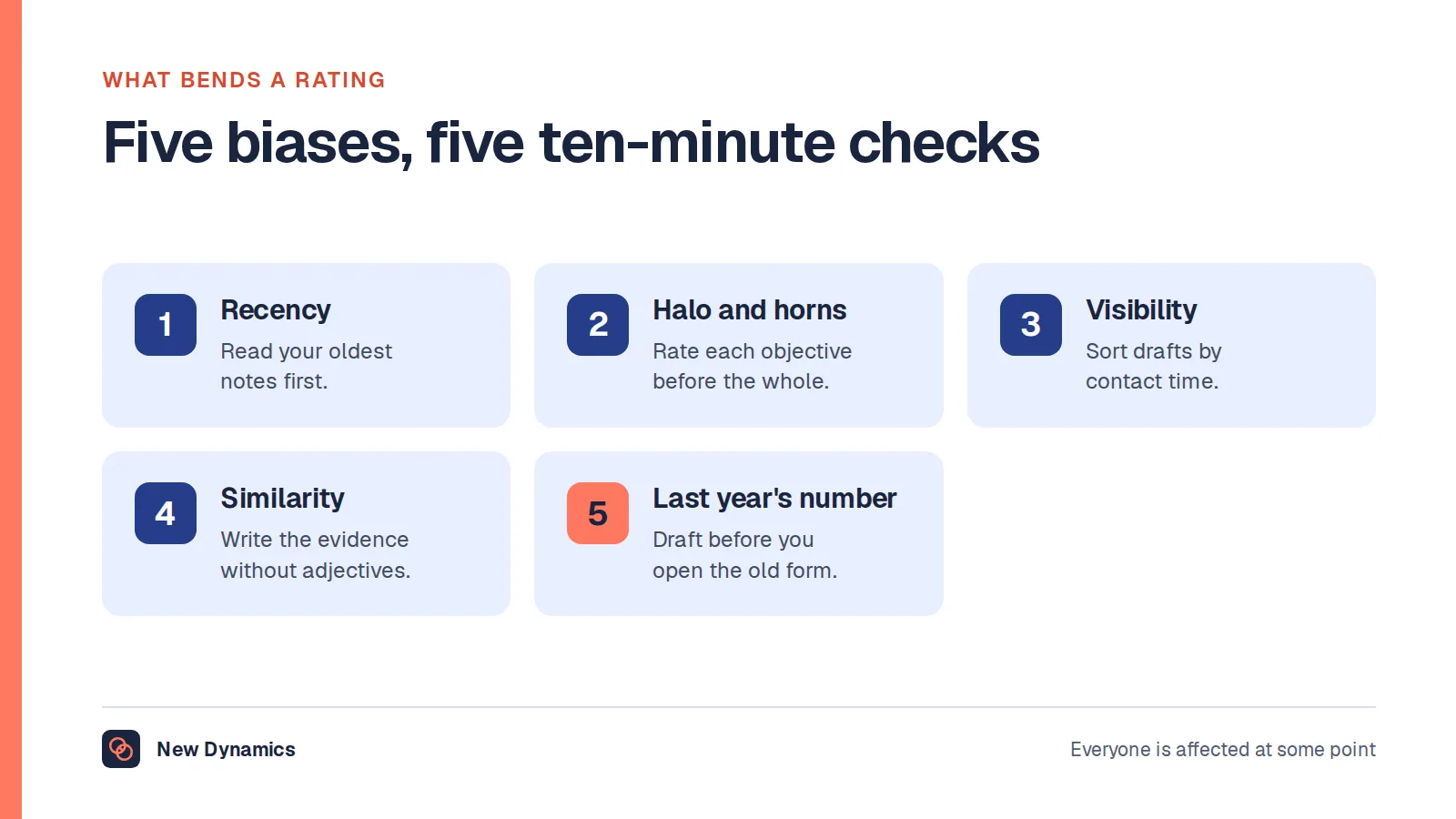
Then calibrate, because indicator wording does not eliminate interpretation, it narrows it. Our post on rating an employee fairly covers that conversation.
Five ways indicator sets go wrong

Aspiration instead of description. Indicators written as the organisation wishes it were. People notice within one cycle, and the framework loses authority.
Seniority smuggled in. "Influences senior stakeholders" is a description of access, not of behaviour. Someone with no exposure cannot demonstrate it however good they are.
Inflation. Every revision adds lines and none removes them. Set a maximum and keep to it.
Style over substance. This is the serious one. Indicators that reward speaking up in meetings, visible confidence or a particular way of communicating measure manner rather than contribution. Acas says less favourable treatment "can be anything that puts someone with a protected characteristic at a disadvantage" and that it "can still be discrimination even if the less favourable treatment was not intended". Write the result you want, which is usually "the team knew about the risk in time", not the manner you are imagining.
Written by one person. Acas's advice on countering unconscious bias includes having more than one person involved and "keeping a written record of why decisions were made". A framework drafted alone tends to describe its author.
Keeping it current
Review the set once a year against what actually changed: new work, new tools, a restructure. Delete anything no manager used, rather than explaining it harder. Date the version, say what changed, and tell people, because a framework that changes silently is one that nobody trusts to drive their rating.
Frequently asked questions
What is a behavioural indicator?
A sentence describing what someone does when they have a competency, specific enough that two people watching the same month could agree on whether it happened. "Shares a draft before it is finished" is an indicator; "is collaborative" is a label.
How do you write behavioural indicators?
Use four tests: is it observable, does it describe a repeated pattern rather than one event, is it specific to a level, and could somebody look at the evidence and say it did not happen. Write in the present tense, one behaviour per sentence, and remove every adjective.
How many behavioural indicators should a competency have?
Three to five per level, across five to eight competencies. Longer frameworks are not read, so managers fall back on the few they remember. Test a draft by asking a manager to find evidence for five indicators in ten minutes.
What is a competency-based review?
A review that rates agreed competencies using evidence against their indicators, alongside objectives. Gather evidence for two or three indicators per competency, write the examples rather than the judgements, record where evidence is missing, and calibrate the ratings across managers before they are final.
What is the difference between a competency and a behavioural indicator?
The competency is the heading and the indicator is the evidence standard underneath it. Competencies are chosen by the organisation and change rarely; indicators describe observable actions and differ by level, which is what makes progression decisions possible.
Can behavioural indicators be unfair?
They can, when they describe a communication style rather than a result. Indicators that reward visible confidence or speaking up in meetings measure manner, and Acas notes that treatment can disadvantage someone with a protected characteristic even when that was not intended. Write the outcome you need and let people reach it in their own way.
Your next step: rewrite three lines
- Open your framework and find three indicators containing an adjective. Rewrite them as actions.
- Check whether any indicator applies identically at every level. If so, it cannot support progression.
- Ask a manager to evidence five indicators for one person in ten minutes, and watch where they get stuck.
- Read the set for style bias, and replace anything that describes manner with the result you actually want.
For turning behaviours into feedback and development actions, read and download our competency-based feedback guide. The guide is free to read, and the PDF uses our short download form.
Want indicators with evidence attached rather than adjectives? Book a New Dynamics demo and bring your current framework. You can also email contact@new-dynamics.com.