TL;DR
- Benchmarking means comparing your performance, practices or costs with a reference point, such as your own past, another team, a competitor or a recognised standard, in order to learn and improve.
- There are four main types: internal, competitive, functional and against a standard. HR teams most often benchmark pay, turnover, absence, hiring, engagement and the ratio of HR staff to employees.
- A benchmark is useful only if it is valid and comparable. Define the measure precisely, check how the comparison data was collected and treat the gap as a question to investigate, never as a verdict.
Your staff turnover is 14%. Is that good? Nobody can say without a comparison: with last year, with the branch down the road, with your sector or with the target you set yourself. Benchmarking is the discipline of making that comparison carefully.
This article explains what benchmarking means, describes the four main types, shows what HR teams benchmark and where to find trustworthy data, and sets out six steps for a comparison that leads to action.
Before you compare yourself with anyone, you need clear measures of your own. See how New Dynamics Goals & OKRs keep targets and progress in one place.
What is benchmarking?
Benchmarking means comparing your own performance, practices or costs with a reference point, in order to understand where you stand and to improve. The reference point is the benchmark.
The UK government's Infrastructure and Projects Authority gives a useful definition in its guide, Best Practice in Benchmarking: “Benchmarking uses historical information to identify standards and best practice.” The guide is written for major projects, and its principles apply much more widely.
It also makes a point that is easy to forget: a benchmark does not have to be an average. In its words, “a benchmark could be any kind of reference point. It could be a type of average other than the mean, such as median or mode”. The question to ask is whether it is “an appropriate and useful reference point” for the thing you are comparing.
Benchmark, KPI and target
| Term | Meaning | Example |
|---|---|---|
| KPI | A measure you track because it matters | Staff turnover |
| Benchmark | A reference point for comparison | Median turnover for similar employers |
| Target | The level you have decided to aim for | Turnover below 12% by December |
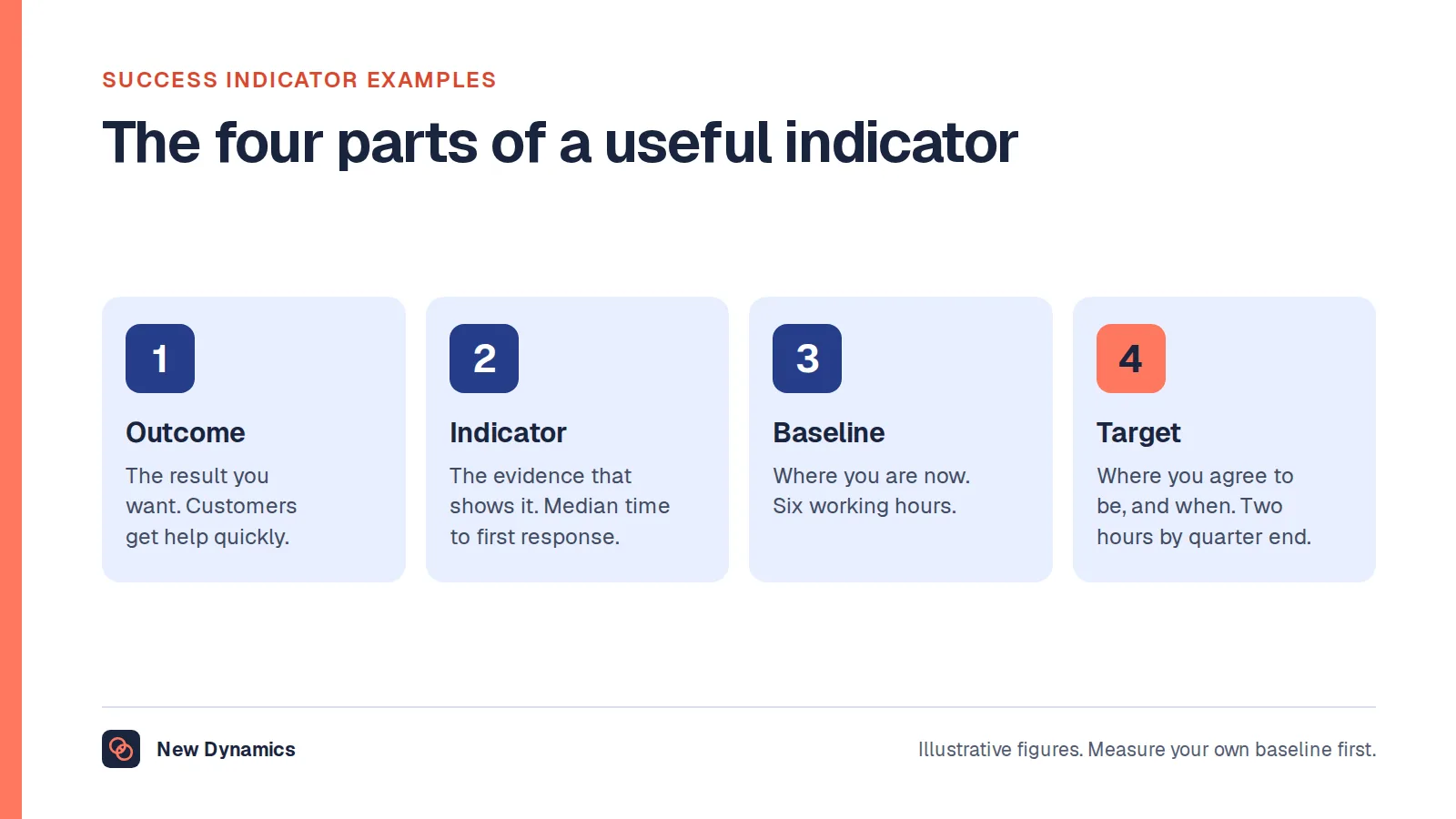
A benchmark informs a target. It should not automatically become one. The median for your sector may be too modest an aim, or an unrealistic one. Our success indicator examples explain how to choose measures in the first place.
The four main types of benchmarking
- Internal benchmarking. Compare teams, sites or periods within your own organisation. The data is comparable and available, and the best performer is down the corridor and willing to talk.
- Competitive benchmarking. Compare yourself with direct competitors. It is the most relevant comparison and the hardest to obtain. It usually relies on published figures and surveys.
- Functional benchmarking. Compare one function or process with organisations in other sectors that do it well. A hospital might learn about handovers from an airline. This is where the newest ideas tend to come from.
- Benchmarking against a standard. Compare yourself with a recognised framework, a regulatory requirement or a published national figure.
These are common working categories, and different authors divide them differently. A second distinction cuts across all four: performance benchmarking compares numbers, and practice benchmarking compares how things are done. The numbers tell you that there is a gap. The practices tell you why.

What HR teams benchmark
| Area | Typical measures |
|---|---|
| Pay and reward | Base pay by role and level, pay ranges, bonus levels, benefits |
| Retention | Turnover, voluntary turnover, turnover in the first year |
| Absence | Days lost per employee, long-term absence |
| Recruitment | Time to fill, cost per hire, offer acceptance |
| Engagement | Survey scores on standard items |
| Development | Training days or spend per employee, internal promotion rate |
| Inclusion | Representation by level, pay gaps |
| HR function | HR staff per hundred employees, HR cost per employee |
| Performance process | Review completion, frequency of one-to-ones, goal setting on time |
We have not given figures for any of these. Benchmarks vary widely by sector, size and country, and they go out of date quickly. Use a current source that fits your organisation.
Where to find trustworthy benchmark data
Official statistics. In the UK, the Office for National Statistics runs the Annual Survey of Hours and Earnings, which it describes as “the most comprehensive source of information about the wages and working hours of employees in the UK”. The ONS says that pay review bodies use it to compare public and private sector pay.
Published disclosures. GOV.UK's gender pay gap service lets you “find and compare” the pay gap data that employers in the UK report, including the average difference between men's and women's hourly and bonus pay.
Professional bodies and trade associations. Many publish member surveys on pay, turnover, absence and HR practice. Check the sample size and who took part.
Salary surveys. Commercial surveys can be detailed and current. Understand how jobs are matched, because job titles alone are unreliable. Our list of job titles by level shows how much titles vary.
Your own history. Last year's figures are the most comparable data you will ever have.
Peer networks. A confidential exchange between a few similar organisations can be more useful than a large survey. Take care: exchanging current or future pay intentions with competitors can raise competition law issues. Take legal advice before you set up such a group. This is general information, not legal advice.
How to benchmark in six steps
The Infrastructure and Projects Authority sets out a seven-step method for projects, which runs from confirming objectives and setting the metrics, through gathering, validating and re-basing data, to reviewing the result. The six steps below adapt the same logic for HR and management use. The adaptation is ours.
- Decide the question. What decision will this inform? “Are we paying enough to keep our engineers?” is a question. “Let's benchmark HR” is not.
- Define the measure precisely. Does turnover include retirements, fixed-term contracts ending and redundancies? Is absence measured in days or as a percentage of working time? Small differences in definition produce large differences in the figure.
- Choose the comparison group. Similar size, sector, location and workforce. A comparison with the wrong group is worse than none.
- Gather and check the data. Find out how it was collected, when and from whom. Adjust for differences where you can. The IPA calls this validating and re-basing.
- Analyse the gap, and ask why. Look at the spread as well as the average. Then go from the numbers to the practices: what do the better performers do differently?
- Act, and measure again. Set a target, change something and review. A benchmarking exercise that ends in a slide has wasted everyone's time.

A worked example
The organisation and the figures are illustrative.
A care provider with 600 staff has first-year turnover of 38%. The HR lead wants to know whether that is normal.
- Question: is our first-year turnover unusually high, and if so, why?
- Measure: leavers with under twelve months' service, divided by starters in the period, excluding fixed-term contracts that ended as planned.
- Comparison: internally, across its nine homes. Externally, a sector survey of similar providers.
- Data: internal rates run from 19% to 61% across the homes. The sector survey gives a median of 33%, though it includes planned fixed-term endings, so the true like-for-like figure is a little lower.
- Analysis: the organisation is somewhat above the sector. The more striking finding is the internal spread. The three homes with the lowest turnover all give new starters a named buddy and a review at week four. The homes with the highest turnover do neither.
- Action: introduce the buddy and the four-week review everywhere, set a target of 28% within a year and track the figure monthly by home.
The external benchmark said that there was a modest problem. The internal benchmark found the solution. Our 30-60-90 day plan and exit interview questions support that kind of fix.
Limits and pitfalls
Comparing unlike with unlike. The IPA guide warns that comparing figures against a benchmark “only works if the benchmark is a valid figure itself”.
Aiming for average. Matching the median means being as mediocre as everyone else. Decide where you need to be excellent.
Copying practices without the context. What works in a technology firm may fail in a hospital.
Old data. Pay surveys age quickly in a moving labour market.
One number. An average hides the spread. Two organisations with the same turnover can have very different problems.
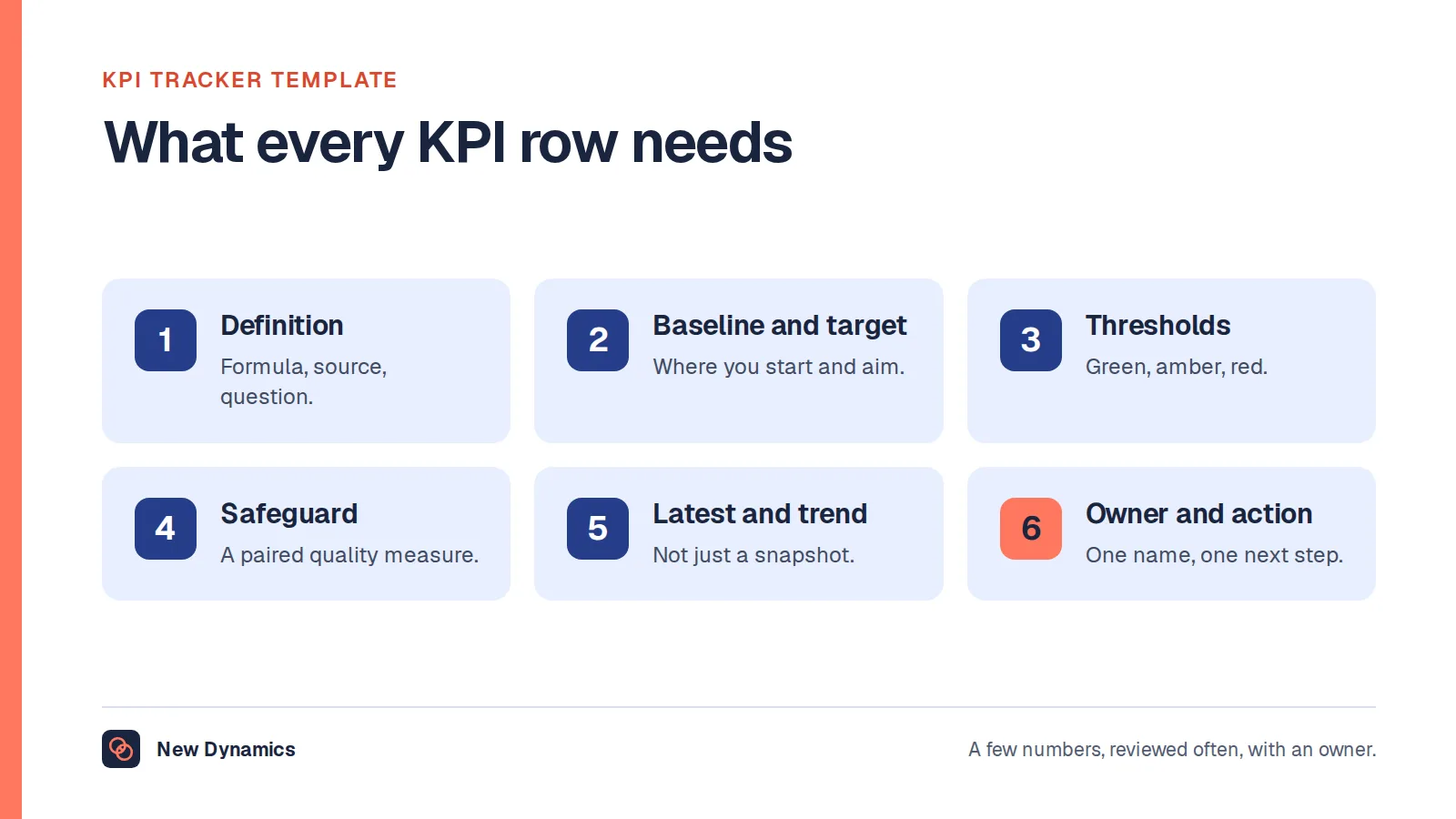
Gaming. Once a benchmark becomes a target with consequences, people find ways to hit the number. Pair each measure with a safeguard. See our KPI tracker guide.
Paralysis. You will never have perfect data. A rough, honest comparison that leads to action beats a perfect one that arrives too late.

Frequently asked questions
What is benchmarking?
Benchmarking means comparing your own performance, practices or costs with a reference point, such as your past results, another team, a competitor or a recognised standard, in order to understand where you stand and to improve.
What are the main types of benchmarking?
Four common types are internal benchmarking within your own organisation, competitive benchmarking against direct competitors, functional benchmarking against good practice in other sectors, and benchmarking against a recognised standard or published figure.
What is an example of benchmarking in HR?
An employer compares first-year staff turnover across its sites and with a sector survey. It finds that its best sites give every new starter a buddy and a four-week review, and introduces both everywhere, with a target and monthly tracking.
What is the difference between a benchmark and a KPI?
A KPI is a measure you track because it matters, such as staff turnover. A benchmark is a reference point for comparison, such as the median turnover for similar employers. A benchmark helps you to judge a KPI and to set a realistic target.
Where can I find HR benchmarking data?
Sources include official statistics, such as the UK's Annual Survey of Hours and Earnings, published disclosures such as gender pay gap reports, surveys by professional bodies, commercial salary surveys, confidential peer networks and your own historical data.
What are the risks of benchmarking?
The main risks are comparing figures that are defined differently, aiming for average, copying practices without their context, using out-of-date data, relying on a single number and turning a benchmark into a target that people then game.
Your next step: benchmark one measure internally
- Choose one people measure that matters, such as turnover or absence.
- Write down exactly how it is calculated.
- Compare it across your own teams or sites for the past year.
- Visit the best performer, and ask what they do differently.
For a wider framework for measuring the HR function, read and download our human resources management guide. The guide is free to read, and the PDF uses our short download form.
Want goals, progress and feedback in one place, so that your own numbers are ready to compare? Book a New Dynamics demo and bring your current measures. You can also email contact@new-dynamics.com.