TL;DR
- In ordinary reward language a bonus is decided after the period and an incentive is a formula agreed in advance. That split describes real behaviour, but neither word is defined in United Kingdom statute, and renaming a payment changes none of the duties attached to it.
- A cash payment of either kind is earnings. GOV.UK tells employers to add the bonus to the employee's other earnings and to deduct and pay PAYE tax and Class 1 National Insurance through payroll.
- Holiday pay is where it bites. Regulation 16(3ZA) of the Working Time Regulations 1998 requires payments intrinsically linked to contractual tasks, and other payments regularly paid in the preceding 52 weeks, to count in a week's pay for the four weeks of leave under regulation 13, even though GOV.UK says the normal rate 'does not usually include bonus payments'.
Someone in a pay meeting says the scheme should be called an incentive rather than a bonus, because incentives are earned and bonuses are gifts. Someone else says the name makes no difference. The second person is closer to right, and the first is pointing at something real.
This article separates the two: what people mean by each word, how much of that is convention rather than law, and the four things that genuinely change with the facts of a payment. Those are payroll treatment, holiday pay, whether a discretionary payment has quietly become contractual, and which minimum wage pay reference period it lands in. The United States position is named at the end. This is general information about the position in the United Kingdom and not legal advice.
An incentive only works if the measure behind it was written down before the period started. New Dynamics goals and OKRs is where that measure and the evidence against it live, so a payment decision can be read off a record rather than reconstructed.
The short answer, and why it is not a legal one
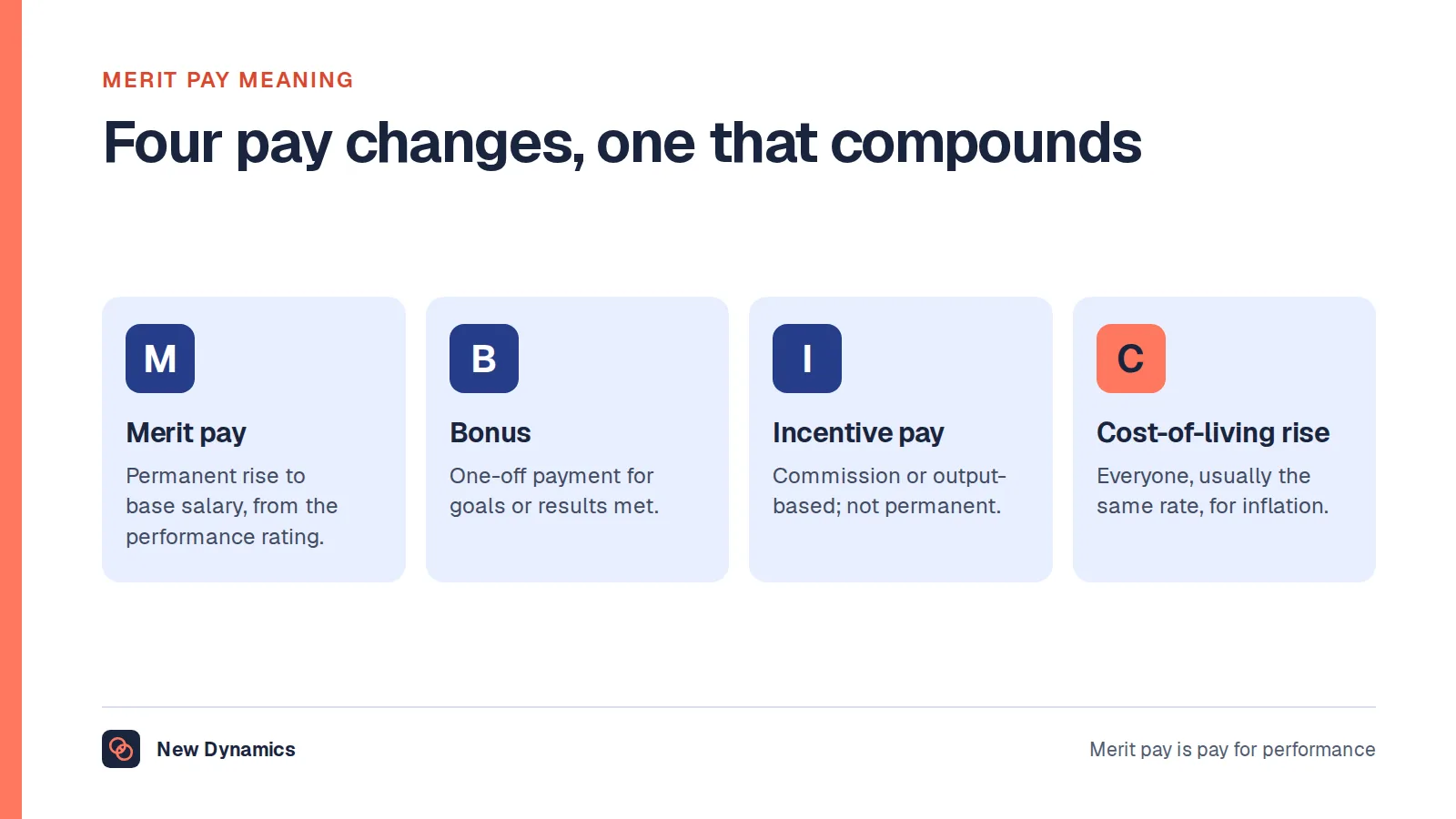
In everyday reward language, a bonus is backward-looking: the period ends, somebody looks at how it went, and a payment is decided. An incentive is forward-looking: a formula or threshold is published in advance, and the person can work out what they stand to earn.
The convention is useful, because a promise made in advance changes what people do and a payment decided afterwards does not. It is not a legal distinction in the United Kingdom. Neither word is defined in statute, and no provision applies to bonuses but not to incentives.
ACAS defines a bonus broadly, as "a payment an employer gives to staff in addition to their basic wages", and notes that "There is no legal requirement for an employer to provide a bonus". The split it does draw is not bonus against incentive but contractual against discretionary: contractual bonuses are "guaranteed in certain circumstances", discretionary ones are "not guaranteed" (Acas, bonuses).
So the question is never which word is on the scheme document. It is what the document says, how the payment has been handled in practice, and whether it is cash.
Where HMRC does draw a line, and it is not this one
HMRC publishes guidance under both words, and its line cuts across the convention.
On bonuses the position is short. "The bonus you've paid counts as earnings", so the employer must "add it to your employee's other earnings" and "deduct and pay Pay As You Earn (PAYE) tax and Class 1 National Insurance through payroll" (GOV.UK, expenses and benefits: bonuses). GOV.UK's running payroll guidance lists bonuses and commission among the "Other payments you may give your employee that you should record as normal pay" (GOV.UK, running payroll: payments).
HMRC's separate guidance on employee incentive awards says that if you give out incentive awards as part of a pay package, or your employees get awards from a third party, "you may need to pay PAYE tax and National Insurance contributions (NICs) on them". It lists incentive awards as cash, vouchers including ones exchangeable for cash, non-cash items like goods, prizes for employer-run competitions, and holidays you pay for. For cash the instruction is to "Include in the employee's gross pay when working out both PAYE tax and NICs" (GOV.UK, employee incentive awards).
Read together, the real dividing line is cash against non-cash, plus who makes the award. A cash payment of either kind is earnings and runs through payroll. A voucher, a holiday or a prize has its own treatment, and a cash award from a third party splits the obligation, with the other business deducting PAYE while the employer calculates and pays the National Insurance.

Holiday pay is where the word gets employers into trouble
This is the duty most often missed, and it is missed because two official pages read differently.
GOV.UK sets out two tiers for regular-hours workers. Employers must pay "at least 4 weeks of the worker's statutory entitlement at their 'normal' rate of pay" and "the remaining 1.6 weeks at a 'basic' rate of pay". It then defines the first tier: "'Normal' rate of pay includes commission, regular overtime payments, and any payments related to length of service or professional qualifications. It does not usually include bonus payments" (GOV.UK, holiday pay).
The regulation is more precise, and it governs. Regulation 16(3ZA) of the Working Time Regulations 1998, inserted on 1 January 2024 by the Employment Rights (Amendment, Revocation and Transitional Provision) Regulations 2023, says that for entitlement under regulations 13 and 15B these are to be included in a week's pay:
- "payments, including commission payments, which are intrinsically linked to the performance of tasks which a worker is obliged to carry out under the terms of their contract"
- "payments for professional or personal status relating to length of service, seniority or professional qualifications"
- "other payments, such as overtime payments, which have been regularly paid to a worker in the 52 weeks preceding the calculation date"
(The Working Time Regulations 1998, regulation 16). Regulation 13 is the four weeks' annual leave. Regulation 13A, the additional 1.6 weeks, is absent from that list, which is why the tiers are paid differently.
The word carrying the GOV.UK sentence is "usually". The regulation asks about the payment, not its name. A payment tied to the tasks the contract obliges the worker to do falls inside the first limb whatever it is called, and a quarterly payment everyone has received every quarter for a year falls inside the third. Only a genuine one-off, unconnected to contractual tasks and not regularly paid, is what "not usually" describes. Our post on on-target earnings covers the same problem where the variable element is the larger part of the package.
How a discretionary bonus becomes contractual
The other real risk sits between what the contract says and what the employer has done for years.
ACAS is clear that discretion has limits. "If a contract says a bonus is discretionary, the employer must still act fairly when deciding whether to pay it", and if they do not, the employee "might be able to make a legal claim" for breach of contract. It also warns that "If a discretionary bonus scheme has unclear terms or wording, it could be interpreted as being contractual."
Then there is custom and practice: "If there is no written agreement, the employee might be entitled to a bonus through 'custom and practice'." ACAS's guidance on that doctrine sets out what has to be shown. The term must be "'notorious' or generally well-known in the business or industry, usually over a long period of time", and also "reasonable" and "certain". The same page gives the countermeasure, using a bonus as its example: an employer who wants to pay a year-end bonus without creating a contractual term "should make sure the employment contract includes a written term saying that all bonuses are discretionary", because something "cannot become part of the contract through custom and practice if it contradicts a written term" (Acas, custom and practice, last updated 1 July 2026).
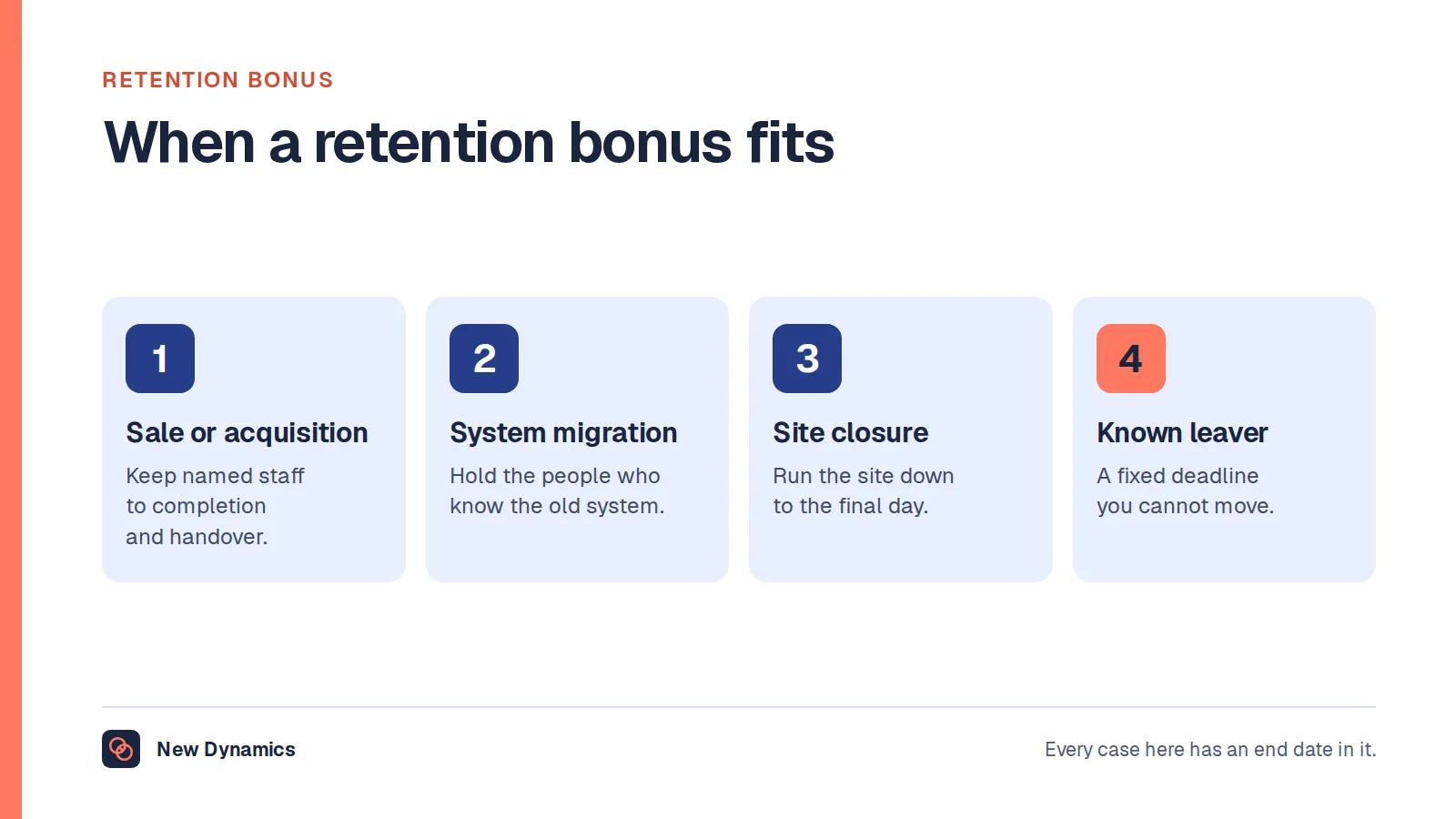
Whether a term has in fact been implied in any given case is for a tribunal on that case's evidence, so this is a risk to manage rather than a rule to apply. Managing it is straightforward: write down the discretion, write down what it covers, and record the reason for each decision. Our post on a retention bonus covers the same question where payment turns on a date.
The minimum wage, and which period the payment lands in
A bonus counts towards minimum wage pay, and the period it counts in is a rule in its own right.
GOV.UK says the pay allocated to a pay reference period is any pay either received during that period, unless it is pay for the previous period, or earned in that period but not received until the next one. Delay it further and the position changes: "if you delay payment by more than one pay reference period you can't usually count the amount towards the period in which the worker earned it. Instead it counts towards the period in which it is paid."
Annual payments get their own treatment. "Most of an annual bonus received in a pay reference period will count towards the minimum wage only in that period. However, a proportion of the bonus can count towards pay received in the previous pay reference period." GOV.UK's worked example, on 2025 to 2026 rates, takes a worker paid £1,831.50 a month for 150 hours, which is £12.21 an hour, and a £500 bonus paid in December. One twelfth of it, £41.67, can count towards November, lifting that month to £12.49 an hour. The rest counts in December (GOV.UK, calculating the minimum wage). The rule is the same whatever the payment is called, so a payment cannot be moved to a more convenient period by renaming it, and one large payment does not cover a shortfall in the months before it.

The United States, named briefly
Different system, same lesson. The Internal Revenue Service treats bonuses as supplemental wages, which carry their own withholding method. Publication 15 (2026), the Employer's Tax Guide, says that "Supplemental wages are wage payments to an employee that aren't regular wages" and that "They include, but aren't limited to, bonuses, commissions, overtime pay" and awards and prizes. Where they are paid separately and income tax was withheld from regular wages in the current or immediately preceding calendar year, one permitted method is to "Withhold a flat 22% (no other percentage allowed)" (IRS, Publication 15 (2026)).
Overtime is where the United States draws the distinction people expect, and draws it on substance. Under the Fair Labor Standards Act a discretionary bonus is excludable from the regular rate of pay only if the employer keeps sole discretion over whether to pay and how much until at or near the end of the period, and "The bonus payment is not made according to any prior contract, agreement, or promise causing an employee to expect such payments regularly". Non-discretionary bonuses, including "Bonuses based on a predetermined formula, such as individual or group production bonuses", attendance and safety bonuses, go into the regular rate. The Department of Labor then settles the naming argument: "The label assigned to the bonus and the reason for the bonus do not conclusively determine whether the bonus is discretionary" (US Department of Labor, Fact Sheet 56C). So the forward-looking, formula-based payment British reward teams call an incentive is, in American overtime law, a non-discretionary bonus that counts in the regular rate.
What to write down instead of arguing about the word
Five lines in the scheme document remove most of the ambiguity, whichever name sits at the top of the document.
- Contractual or discretionary, in those words, in the contract or written statement rather than only in a scheme note.
- What triggers payment: a formula, a threshold or a judgement, and who exercises any judgement.
- The period and the payment date, so payroll knows which pay reference period the amount falls into.
- Cash or something else, because that, not the name, decides the reporting route.
- Whether it has been paid before, and how often, because a repeated payment builds a holiday pay obligation and possibly a contractual one.
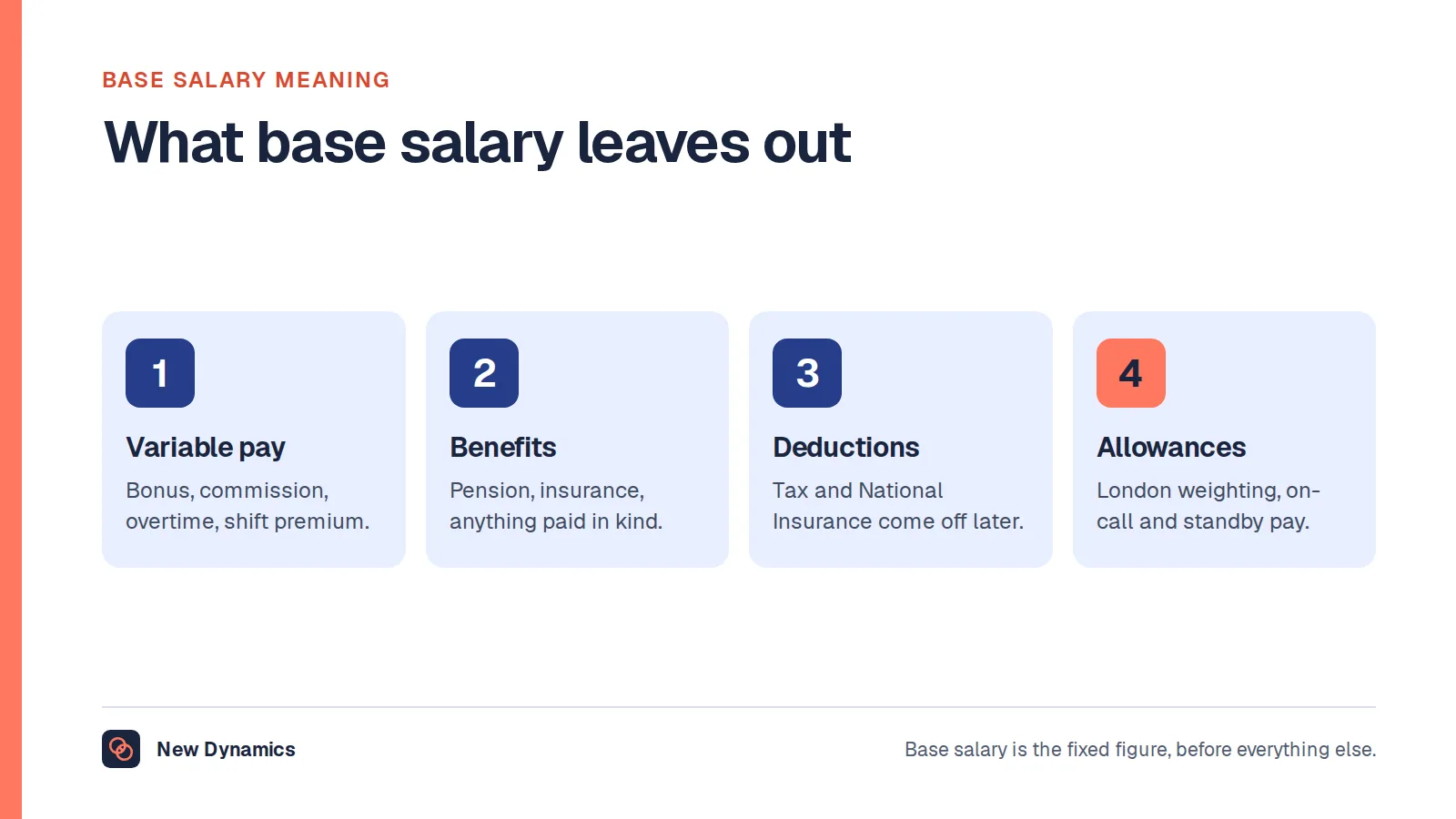
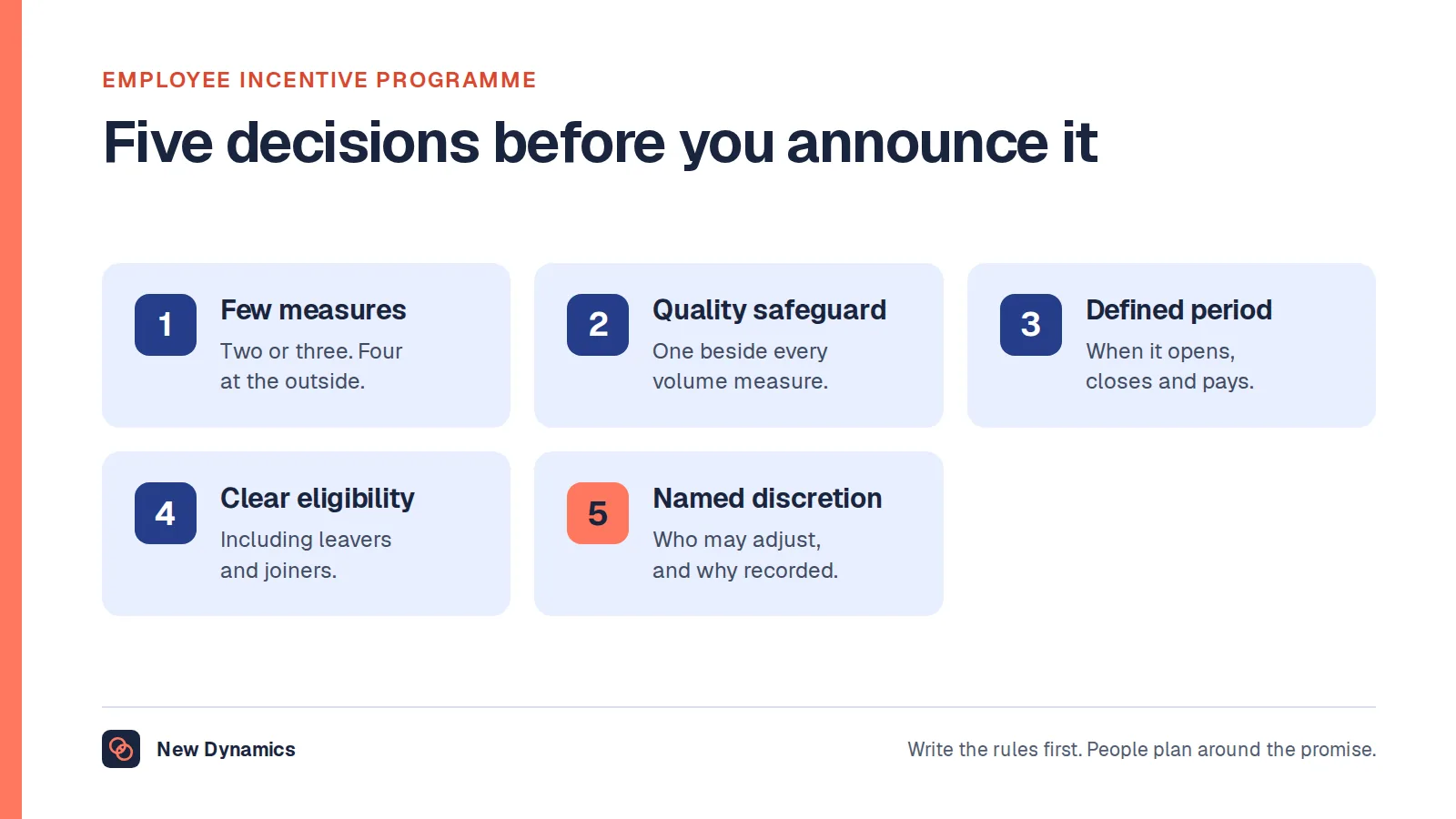
If a scheme has run for years without these written down, the useful exercise is not renaming it. It is reading what has actually been paid, to whom and how often, then writing down what that pattern commits you to. Our post on designing an employee incentive programme covers the measurement side once the terms are settled, and base salary covers what sits underneath both.
Frequently asked questions
What is the difference between a bonus and an incentive?
In normal reward language a bonus is decided after a period has ended and an incentive is promised in advance against a defined measure. Neither word has a statutory definition in the United Kingdom, so the difference describes how the payments behave rather than which rules apply. The rules follow the facts.
Is an incentive bonus the same as a bonus?
For payroll purposes, yes, where the payment is cash. GOV.UK says a bonus you have paid counts as earnings, and HMRC's guidance on employee incentive awards says a cash award is included in the employee's gross pay for both PAYE tax and National Insurance contributions. The treatment diverges for vouchers, goods, prizes and holidays.
Does a bonus have to be included in holiday pay?
It depends on the payment, not the name. Regulation 16(3ZA) of the Working Time Regulations 1998 requires payments intrinsically linked to contractual tasks, and other payments regularly paid in the preceding 52 weeks, to count in a week's pay for the four weeks of leave under regulation 13. GOV.UK says the normal rate "does not usually include bonus payments", which describes genuine one-offs.
Can a discretionary bonus become contractual?
It can. ACAS says that where an employer has regularly paid a bonus without a written agreement, the employee might be entitled to it through custom and practice, and that unclear scheme wording could itself be read as contractual. A term implied that way must be well known in the business over a long period, reasonable and certain, and cannot contradict a written term, which is why ACAS advises recording that all bonuses are discretionary.
Which pay reference period does a bonus count in for the minimum wage?
Normally the period it is paid in, or the period it was earned in if payment arrives in the next period. GOV.UK says that if payment is delayed by more than one pay reference period, it counts towards the period in which it is paid. For an annual bonus, most counts in the period of payment, with a proportion able to count towards the previous one.
How are bonuses taxed in the United States?
The IRS treats them as supplemental wages with their own withholding method. Publication 15 (2026) permits a flat 22 per cent on supplemental wages paid separately, subject to conditions. Separately, the Fair Labor Standards Act includes non-discretionary bonuses in the regular rate of pay for overtime.
Your next steps
- Find the scheme document and check whether it says contractual or discretionary in those words.
- List every payment made under it in the last 52 weeks, with dates and recipients.
- Decide, against regulation 16(3ZA), whether any of them is intrinsically linked to contractual tasks or has been regularly paid, and tell payroll if the four-week holiday pay rate must change.
- Check the minimum wage sums for the period each payment landed in, not the period it was earned for.
- Write down the trigger, the period, the payment date and the limits of any discretion, then stop debating the name.
For the pay principles, decision rights and review criteria a scheme has to sit inside, read and download our compensation policy guide. The guide is free to read, and the PDF uses our short download form.
Want the measure, the updates against it and the manager's evidence in one place, so a payment decision rests on a record? Book a New Dynamics demo and bring the scheme rules you run today. You can also email contact@new-dynamics.com.