TL;DR
- A retention bonus is a sum of money an employer promises an employee on condition that the employee is still employed on a stated future date. It is also called retention pay, a retention payment or a stay bonus. The three parts that matter are the amount, the trigger date and the service condition.
- In the United Kingdom a cash retention bonus is earnings. GOV.UK's guidance for employers says a cash bonus counts as earnings, so the employer adds it to the employee's other earnings and deducts and pays PAYE tax and Class 1 National Insurance through payroll. HMRC records that where a bonus is later clawed back, no relief or repayment of National Insurance is possible.
- The narrow legitimate use is holding named people through a dated event: a sale, a migration, a site closure. Outside that, a retention bonus buys the notice period rather than commitment, tells everybody who is considered valuable, and leaves the reason the person was leaving exactly where it was.
Somebody you cannot afford to lose has said they are going, and the date falls in the worst possible month. The migration goes live in March. One person understands the payroll build and nobody wrote it down. So the question arrives already half answered: what if we paid them to stay?
What is a retention bonus? It is a sum of money an employer promises an employee on condition that the employee is still employed on a stated future date. Nothing more complicated than that. The complications are in the conditions, the tax and what the payment teaches everybody who hears about it.
This article covers the meaning and the other names for it, when employers reach for one, how the agreement and the clawback are structured, what happens on redundancy and dismissal, the PAYE and National Insurance treatment in the United Kingdom, the equal pay and discrimination exposure, why these payments often fail and what to do instead. It is general information about the position in the United Kingdom, not legal advice, and clawback clauses in particular are contract law and can be unenforceable, so take advice on your own wording.
Most retention bonuses are paid because the employer found out too late. See how New Dynamics continuous feedback keeps one-to-ones and what was said in them in one place, so an intention to leave is not the first you hear of it.
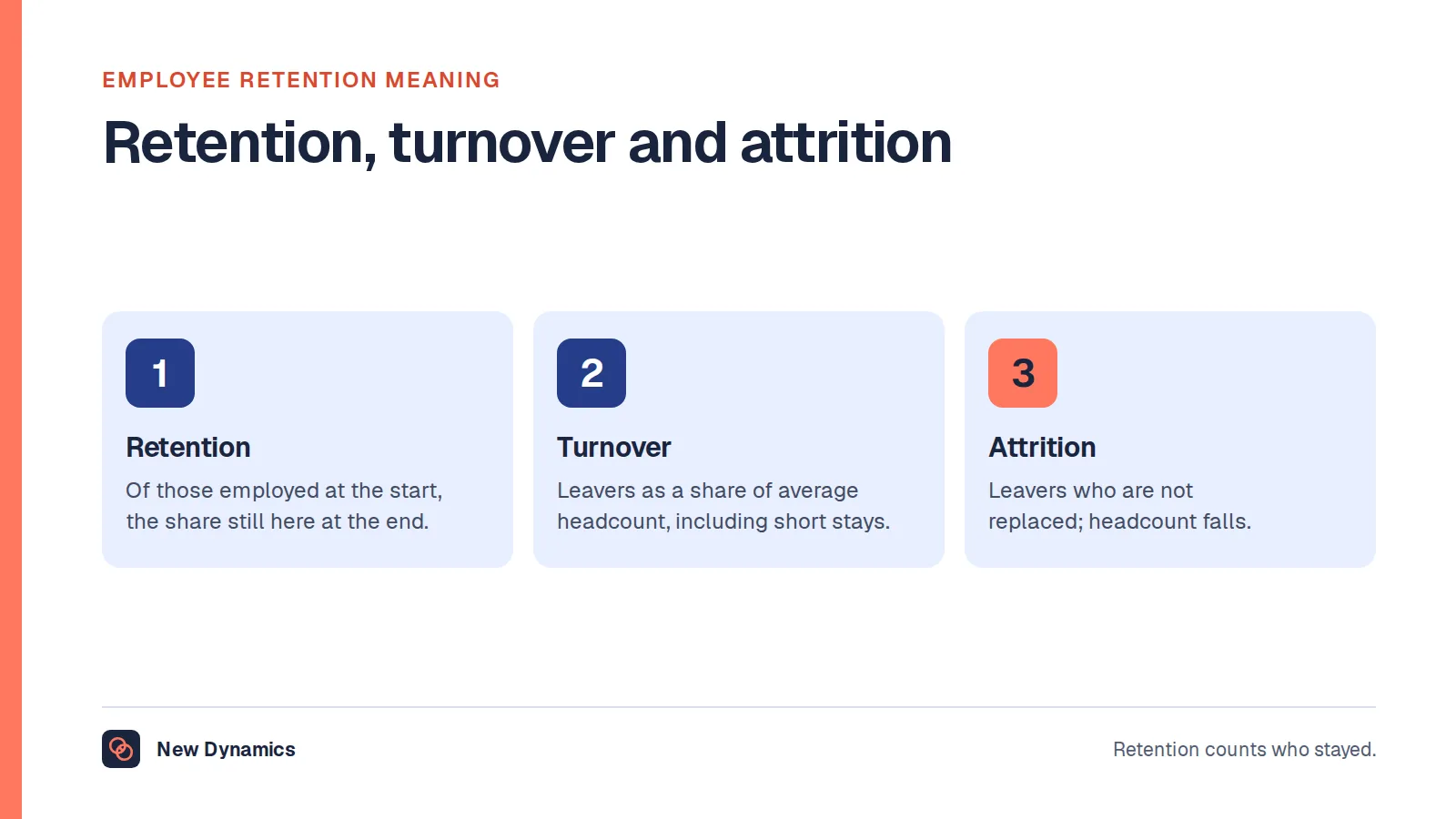
Two neighbouring questions sit elsewhere. For the concept and how the rate is calculated, see the meaning of employee retention. For diagnosing a high leaving rate, see high employee turnover.
Retention bonus meaning: three parts and nothing else
A retention bonus has three parts, and an agreement missing one of them will go wrong.
- An amount. Usually a lump sum, sometimes split into dated instalments.
- A trigger date. The date on which the condition is tested: completion of a sale, the end of a migration, the closure of a site.
- A service condition. The usual formulation is employed on that date, and not under notice given or received.
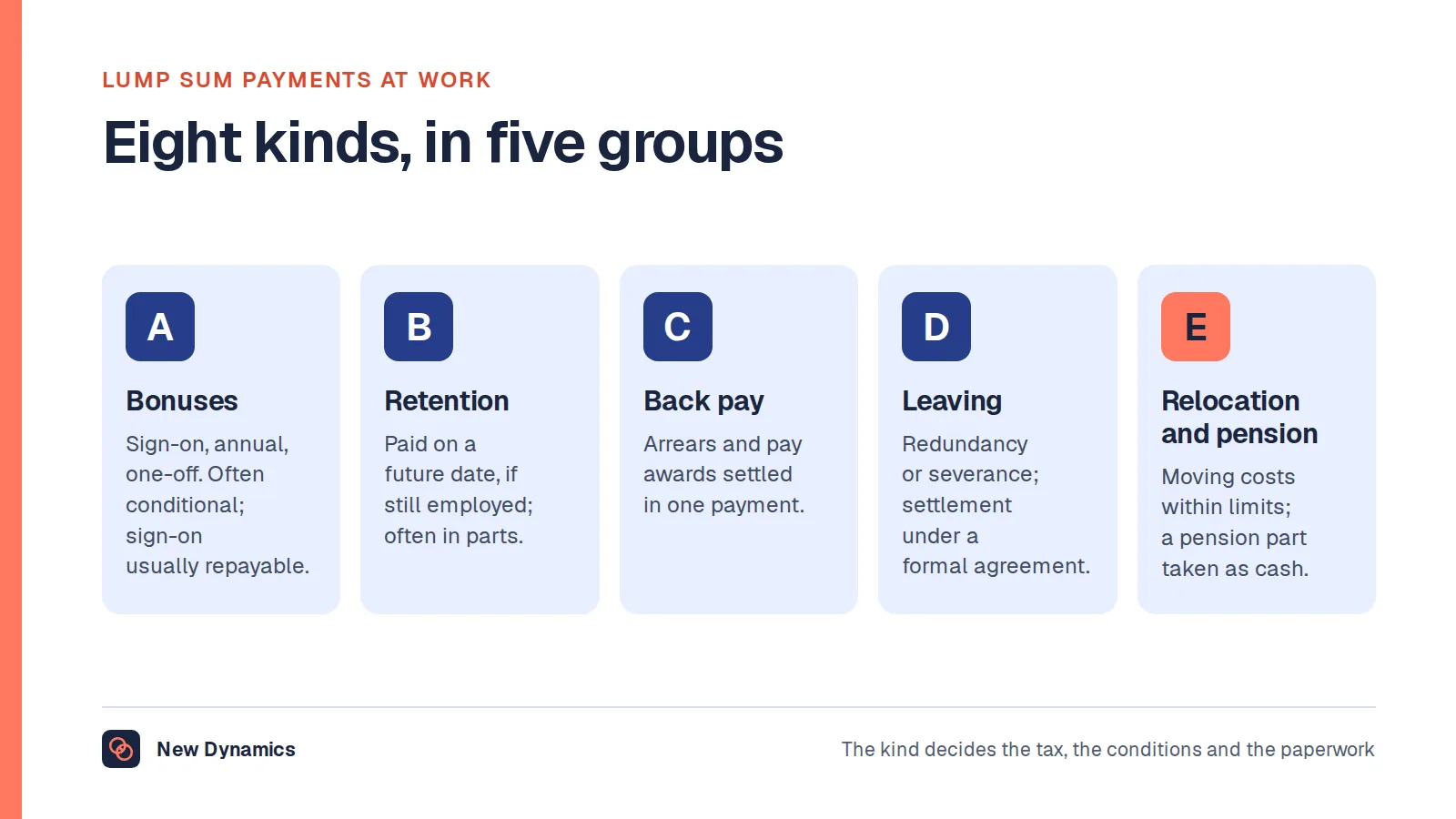
Our post on the lump sum payment sets a retention payment beside the other one-off payments employers make: on a payslip the money looks identical, while the reason for it is not.
What is retention pay? The same thing in different words. Retention payment, retention pay, stay bonus, stay-on bonus and loyalty bonus all describe a payment conditional on remaining employed for a period. Nothing turns on which you use, although "stay bonus" is heard most in a sale or a wind-down.
| Payment | Based on | Paid when |
|---|---|---|
| Retention bonus | Being employed on a date | On that date, or shortly after |
| Sign-on bonus | Accepting the job | On or just after joining |
| Merit increase | A performance rating | Permanently, in every payslip |
| Incentive scheme | Results, output or goals met | After the measurement period |
| Severance pay | Leaving, not staying | On termination |
| Pay rise | The market, grade or role | Permanently, and compounding |
The last distinction causes most trouble. A retention bonus is not a pay rise, and employers reach for it precisely because it is not: it costs once and does not reset the person's base for every future increase. That is a real advantage, and also why the person often takes the money and leaves anyway.
What are retention bonuses used for? Five situations
The defensible cases share one feature. There is an event with a date, specific people are needed up to it, and everybody knows the payment is buying time rather than loyalty.
A sale, acquisition or merger. The buyer or the seller wants named people in place to completion and handover. ACAS notes that "Workers might be protected by TUPE when an organisation is transferred from one employer to another", so who promises the bonus, and what happens to it on transfer, is a question for your advisers first.
A system or process migration. The people who understand the old system are the people you need until the new one is stable, and also the people whose skills are about to become obsolete in your organisation. That combination is the most common honest use of a retention payment.
A site closure or wind-down. Somebody has to run the site to the last day, knowing their job ends when they finish. ACAS lists the situations in which an employer "should only consider making redundancies", the first being that part or all of the organisation is "closing, or has already closed". A retention payment here pays people to stay for their own redundancy, which is worth saying plainly in the letter.
One irreplaceable person. A single individual holds knowledge nobody wrote down. The bonus buys time to remove the risk, and if it is not spent that way you will have the same conversation next year for more money. New Dynamics org charts make single points of dependency visible rather than assumed.
A known leaver you need through a deadline. Somebody has resigned, or has said they are looking, and there is a date you cannot move. The weakest of the five, because you are negotiating with somebody who has already decided.

Two questions before you commit. Does the need end on the date? And would you still want this person in post in eighteen months? If not, you are paying to postpone something.
How common are retention bonuses? Nobody official counts
No official United Kingdom source publishes what share of employers pay retention bonuses, or what a typical one is worth. The Office for National Statistics does not break out retention payments as a category, and neither GOV.UK nor ACAS publishes prevalence data. Any percentage circulating as the answer comes from a private survey panel you cannot inspect.
The nearest official material covers bonuses in general, and it is old. The ONS bulletin Average Weekly Earnings, bonus payments in Great Britain says "In the financial year ending 2017 (April 2016 to March 2017), the combined value of all bonuses paid in Great Britain was a record £46.4 billion, growing by 6.5% on the financial year ending 2016". That page carries a release date of 19 September 2017 and lists its next release as to be announced, so those figures describe the financial year ending 2017 and nothing since, and cover all bonuses rather than retention payments.
What is still published monthly is the split between regular and total pay. The ONS Labour market overview, UK of 20 October 2026 reports that "Annual growth in employees' average regular earnings (excluding bonuses) was 3.7% in June to August 2026" and that "Annual growth in total earnings (including bonuses) was 3.7% in June to August 2026": across the economy, bonuses added nothing to the rate at which pay was rising. More of the figures we can source sit on our HR statistics hub.
So price a retention bonus against what you are protecting: the migration slipping, rebuilding the knowledge, the sale being delayed.
How a retention bonus agreement is structured
Four things have to be written down, and the usual failure is that two were only discussed.
The trigger date, named as a date. Not "after the migration" and not "once things settle". A calendar date, or one defined by a single identifiable event such as legal completion. Vague triggers are where disputes start.
The service condition, in full. The common wording is that the employee must be employed on the trigger date and must not, on that date, be under notice of termination given by either party. That second limb matters: without it, somebody can resign a week before the date, work out their notice, collect the payment and leave. With it, you have made resignation more expensive rather than less likely.
What ends the entitlement. Resignation, dismissal for conduct or capability, redundancy, the end of a fixed term, death in service and long-term absence should each have an answer. Silence on any of them means a negotiation later, at the worst moment.

Writing, signed by both. A retention bonus changes the terms on which somebody is employed, so it is a variation of the contract. ACAS puts it plainly: on changing an employment contract, "Any changes must be agreed by both the worker and employer". So it is a letter the employee signs and returns, not an email saying it has been approved. Our post on the employment contract covers the written statement.
Decide too whether the payment is contractual or discretionary. A contractual entitlement is a liability you have created; a discretionary one is weaker as an incentive, because the person knows it can evaporate.
Redundancy, dismissal and resignation: what the agreement must say
Redundancy before the trigger date. If you are paying somebody to stay through a wind-down, the likeliest reason they will not be employed on the trigger date is that you dismissed them. ACAS describes redundancy as "a type of dismissal where a role is no longer needed" and notes that employers must consult workers. An agreement that pays nothing if the employer makes the person redundant a fortnight early is not a retention agreement; it is a reason to leave in month two. Say explicitly that the payment is made in full, or pro rata, where employment ends by reason of redundancy. Our post on the redundancy process covers the consultation around it.
Dismissal for conduct or capability. The usual position is no payment, which is defensible provided the dismissal was fair and followed a proper procedure. A retention bonus changes none of the usual obligations in a disciplinary process, and must never become a reason to delay one.
Resignation before the trigger date. No payment. That is the point of the mechanism. Say whether a resignation given before the date but taking effect after it forfeits the payment: under the "not under notice" wording it does, and the employee should know before signing.
Leave, hours and payroll timing. Decide now whether people on family leave, long-term sickness or a career break on the trigger date qualify, because a condition that excludes somebody on maternity leave is the kind that ends up at a tribunal. For part-time employees, ACAS states that "Part-time employees and workers are entitled to the same rates of pay as people who do the job full time", so pro-rate by hours. And say entitlement crystallises on the trigger date, so somebody who resigns the next day is still paid.
Tax and payroll treatment in the United Kingdom
A cash retention bonus is earnings: not a gift, not compensation, not outside payroll.
GOV.UK's guidance for employers states: "As an employer providing bonus payments to your employees, you have certain tax, National Insurance and reporting obligations". On a cash bonus the same guidance says that "The bonus you've paid counts as earnings", so the employer should "add it to your employee's other earnings" and "deduct and pay Pay As You Earn (PAYE) tax and Class 1 National Insurance through payroll".
So the mechanics are the ordinary payroll mechanics, on both sides: HMRC's Rates and thresholds for employers 2026 to 2027 says "You pay secondary contributions (employer's National Insurance) to HMRC as part of your PAYE bill". For the 2026 to 2027 tax year that page gives the employer secondary rate for category A as 15%, and the employee primary rate for category A as 8% above the primary threshold up to the upper earnings limit and 2% above it.
Two consequences budget holders miss.
The cost is higher than the offer. A gross retention bonus costs the employer that amount plus employer National Insurance, plus any pension contribution if the scheme treats bonuses as pensionable. Check the rules before you set the figure.
The employee receives much less than the headline. For a higher earner the combined deduction is substantial, which is why an offer that sounded generous in a meeting lands as an anticlimax on a payslip. Work out the net figure before you say the number, and document whether the figure in the letter is gross or net. Our post on payroll deductions covers what else comes off that payslip.
On timing, HMRC's manual is specific. Describing a signing bonus paid to tie an employee to a company for a further period of at least five years, it records that the employee's "right to receive the Signing Bonus was fully vested at the time he received it" and that "The employer had correctly operated PAYE and that income is taxable in full in the tax year in which it was received". So a retention payment is taxed in full when received, even though it buys a period that has not finished.
Clawback: contract law, deductions and the tax you cannot get back
Clawback is the clause saying the employee repays some or all of the bonus if they leave within a period after payment. It is common, often badly drafted, and worse in its consequences than people expect.
Start with the deduction. Section 13 of the Employment Rights Act 1996 provides that "An employer shall not make a deduction from wages of a worker employed by him" unless "the deduction is required or authorised to be made by virtue of a statutory provision or a relevant provision of the worker's contract", or "the worker has previously signified in writing his agreement or consent to the making of the deduction". If you intend to recover a retention bonus out of final pay, that written authority has to exist first.
The same section closes the obvious shortcut, providing that "a relevant provision of a worker's contract having effect by virtue of a variation of the contract does not operate to authorise the making of a deduction on account of any conduct of the worker, or any other event occurring, before the variation took effect". You cannot add the clause after the resignation and apply it to a payment already made.
Then the tax trap. HMRC's Employment Income Manual records: "The Martin case also established that when a payment or bonus is 'clawed back' and a payment of negative earnings is made from employee to employer, this does not change the position of NICs or PAYE deductions for the original payment. No relief or repayment of NICs is possible." The employee has to "contact HMRC directly to claim any tax relief due in the year the payment of negative earnings was made", and the National Insurance is simply gone.
The facts of that case show what this means in money. HMRC records that "The gross payment was £250,000 but Mr Martin received £147,500", and that when the clawback was triggered "The amount that he had to and did pay to his employer was calculated to be £162,500". He received £147,500 and repaid £162,500, because the formula ran on the gross figure, and whether that repayment counted as negative taxable earnings had to be litigated to the Upper Tribunal. HMRC adds that the outcome turned on that contract's wording, and that in any other case "careful consideration must be given to identifying all the relevant facts", because "not every payment made by an employee to an employer will constitute negative earnings".
Four rules follow.
- Draft on the net amount, or taper, so the employee never repays more than they received.
- Taper by time served. Repaying the whole sum on day 364 of a 365-day condition is the kind of term a tribunal looks at hard.
- Get written authority to deduct before you pay.
- Take advice on enforceability. Clawback clauses are contract law and can be challenged. This is general information about the position in the United Kingdom, not legal advice.
Equal pay and discrimination: the exposure of paying one person
A retention bonus is, by design, a payment to some people and not others. That is the point of it, and also the exposure, because the reason one person gets it is a judgement about how hard they would be to replace.
ACAS states the equal pay position: "By law, men and women must get equal pay for doing 'equal work'. This is work that equal pay law classes as the same, similar, equivalent or of equal value". Its list of the pay and contractual terms covered includes "performance-related pay, for example a bonus that's in the employment contract", and a contractual retention bonus is a contractual term.
The mechanism in the legislation is automatic. Section 66 of the Equality Act 2010 provides that "If the terms of A's work do not (by whatever means) include a sex equality clause, they are to be treated as including one", with the effect that "if A does not have a term which corresponds to a term of B's that benefits B, A's terms are modified so as to include such a term". A retention payment given to one person doing equal work, and not to a comparator of the other sex, can be read into that comparator's contract unless the employer can explain the difference by something other than sex.
ACAS does allow that a difference can sometimes be justified, for example where somebody is "better qualified, if their skills are crucial to the job and hard to recruit", while adding that "Getting paid more must have nothing to do with someone's sex". That is close to the honest reason for most retention payments, so write the reason down at the time.
The exposure is wider than pay. ACAS says that "Discrimination means treating someone 'less favourably' than someone else" because of age, disability, gender reassignment, marriage and civil partnership, pregnancy and maternity, race, religion or belief, sex or sexual orientation, and that "These are called 'protected characteristics'". Less favourable treatment might include "excluding someone from opportunities or benefits", and, for a decision made quickly under pressure, "It can still be discrimination even if the less favourable treatment was not intended".
Four safeguards.
- Write the criteria before the names: the knowledge held, the event it is needed for, the cost of its absence.
- Check the list against protected characteristics, and against part-time and fixed-term status, before anything is offered.
- Include people absent that week, then decide their position deliberately rather than by omission.
- Record the reason for each inclusion and exclusion. Our post on pay equity sets out the checks.
Assume the payments become known. ACAS good practice is to "be consistent when deciding people's pay and contractual terms and conditions, for example have one pay structure for the organisation". An ad hoc payment to some people is the opposite of one pay structure, which is a reason to keep retention payments rare and tied to a named event.
Why retention bonuses usually fail
A retention bonus is almost always a symptom. If you have to pay somebody to stay, something else is wrong and the payment does not touch it.
It buys the notice period, not commitment. The condition is presence on a date, so presence is what you get, and nothing in it asks for effort or goodwill.
The person leaves the day after the money lands. The most common outcome, and not bad faith. You asked them to stay until a date and they did. If you needed them permanently, a one-off payment was never the right instrument.
It tells everybody who is considered valuable. Retention payments do not stay secret, and what escapes is not only who was paid but who was not. In a team of nine where four were paid, you have told five people where they stand. It also teaches the route: once announcing an intention to leave produces money, that announcement becomes a tactic.
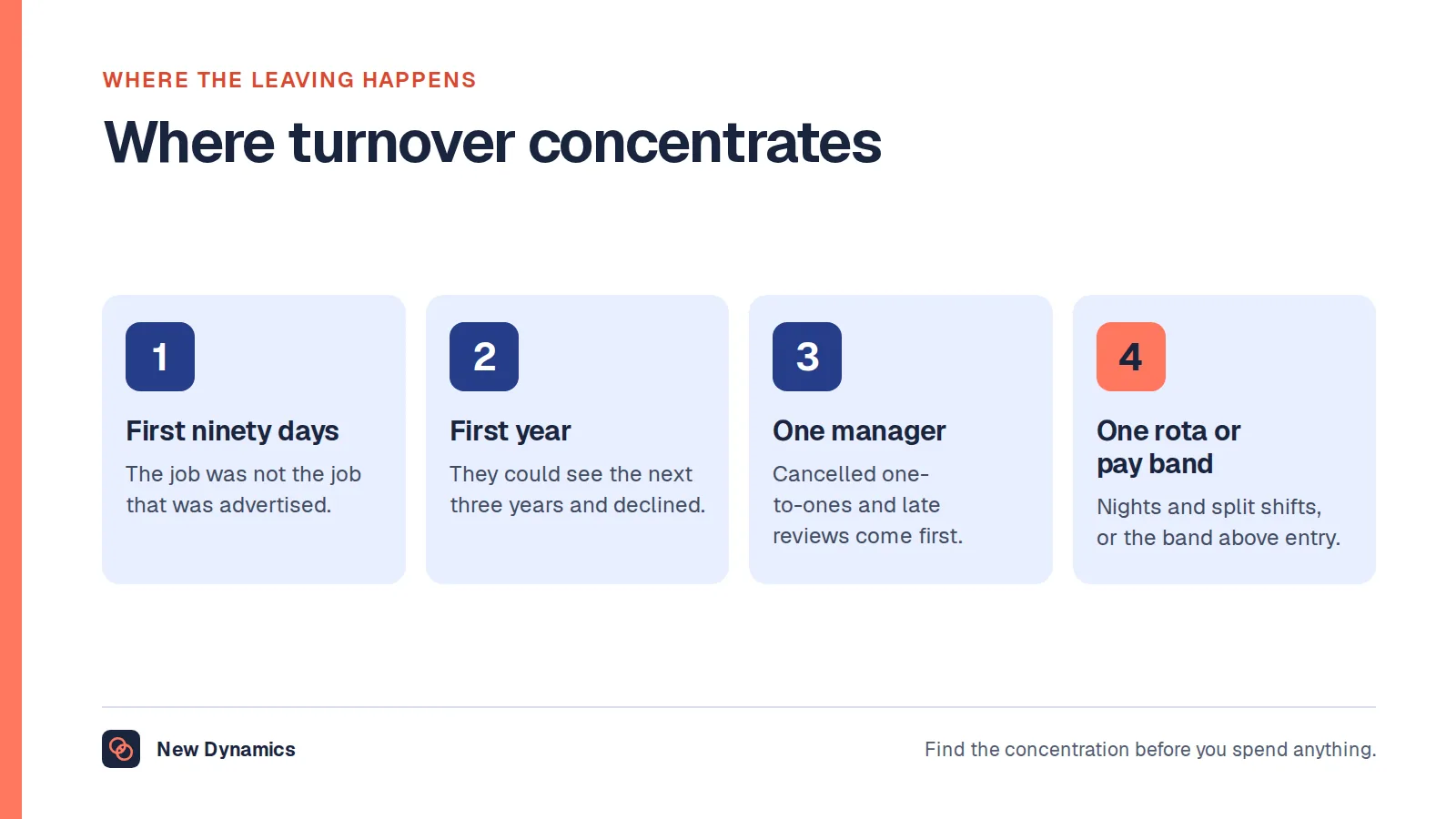
It does not treat the cause. People leave over the manager, the absence of a visible next step, pay that cannot be explained, and a workload or rota they cannot plan around. A retention bonus addresses none of them, and it is chosen because it is quicker than the conversation about the manager who cancels every one-to-one. Our post on high employee turnover makes the same point from the other side.
The narrow exception is the one above: holding named people through a dated event, where the need genuinely ends on the date. That is not a retention strategy. It is a purchase of time.
What to do instead
If the trigger was a resignation, some of this is too late for this person, and none of it is too late for the next one.
- Spend the time you bought. Attach the payment to a handover: the system documented, a second person trained, the decisions written down, with dates. Then the money buys an asset rather than a delay.
- Cost the dependency, not the person. What does it cost if this role is empty for three months? That figure tells you whether to pay, how much, and what else to fix.
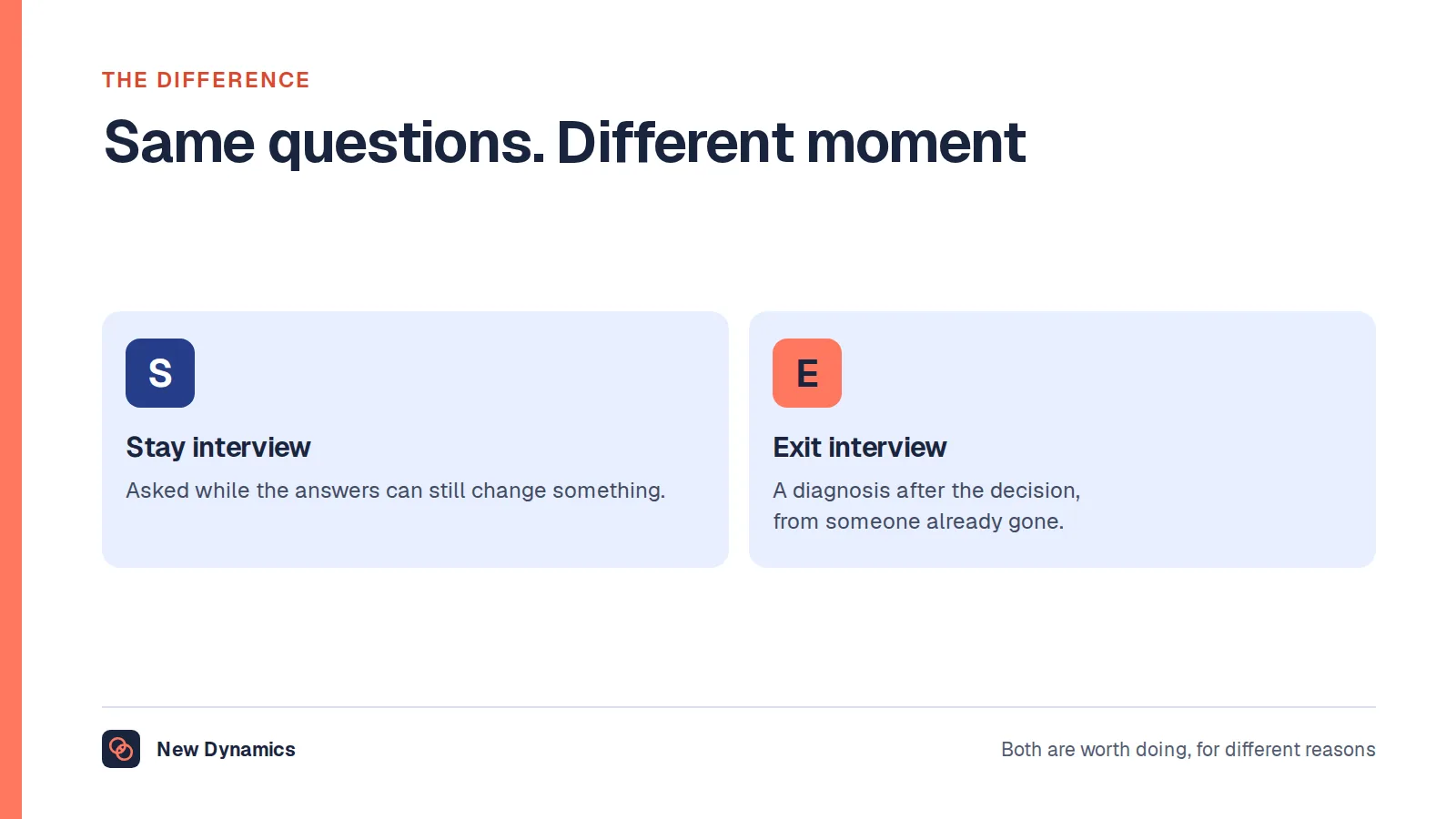
- Find out before they decide. Stay interviews ask why somebody stays while the answer can still change something. They cost nothing and are the highest-return item here.
- Fix the thing they named. If three people in one team raise the same problem, that problem is the retention plan. Our employee retention guide covers the practices in depth.
- Make the next step visible. People leave to get a promotion you could have given them. A published career progression framework is cheaper than a bonus and lasts longer.
- Reduce key-person risk as a habit. Two people able to run each critical process, and documentation somebody else can find.

How to word the retention bonus letter
Keep it short and specific, and have it signed. Eight elements, in this order.
- What the payment is. A retention payment, named as such, and the amount, stated as gross.
- Why it is being offered. The event, and why this person is needed to it. One sentence, and the line that protects you later.
- The trigger date. A calendar date, or legal completion of a named transaction.
- The service condition. Employed on that date and not under notice given by either party.
- When and how it is paid. The payroll run, and that PAYE tax and National Insurance are deducted as normal.
- What happens if employment ends first. Redundancy, dismissal, resignation and the end of a fixed term, each with its own answer.
- Clawback, if there is one. The period, the taper, whether it runs on the net or gross amount, and written consent to deduct any repayable sum from final pay.
- What the letter does not change. That the rest of the contract is unaffected, whether the payment is pensionable, and that it is not part of base salary.
A workable core reads something like this, as an example to adapt rather than copy: the organisation will pay you a retention payment of a stated gross amount, subject to PAYE tax and National Insurance deductions, in the payroll run following a stated date, provided that on that date you are employed and are not under notice of termination given by either party. If your employment ends before that date by reason of redundancy, the payment will be made in full.
Then do the three things most employers forget. Have the employee sign and return a copy. Tell the manager, who will be asked. And diarise the trigger date with a reminder a month before.
Frequently asked questions
What is a retention bonus?
A retention bonus is a sum of money an employer promises an employee on condition that the employee is still employed on a stated future date. Its three parts are the amount, the trigger date and the service condition, usually that the person is employed and not under notice. It is also called retention pay, a retention payment or a stay bonus.
What are retention bonuses used for?
Employers use them to hold specific people through a dated event: a sale or acquisition, a system migration, a site closure, a deadline that cannot move, or the time needed to transfer knowledge held by one person. The defensible cases all have an end date, and the payment buys time rather than commitment.
What is retention pay, and is a retention payment the same thing?
Yes. Retention pay, a retention payment, a stay bonus and a loyalty bonus all describe the same instrument: money conditional on remaining employed for a defined period. Nothing legal or tax related turns on the phrase. What matters is the trigger date and what happens if employment ends first.
Is a retention bonus taxable in the United Kingdom?
Yes, it is earnings. GOV.UK guidance for employers says a cash bonus counts as earnings, so the employer adds it to the employee's other earnings and deducts and pays PAYE tax and Class 1 National Insurance through payroll. Employer Class 1 National Insurance is due too, so the real cost is higher than the headline. This is general information, not tax advice.
Can an employer claw back a retention bonus?
Only if the agreement says so and the employee gave written authority first. Section 13 of the Employment Rights Act 1996 bars a deduction from wages unless a statutory provision, a relevant provision of the contract or the worker's prior written consent authorises it, and a later variation cannot authorise a deduction for an earlier event. HMRC also records that where a bonus is clawed back, no relief or repayment of National Insurance is possible. Clawback is contract law and can be unenforceable, so take advice.
Do retention bonuses work?
For holding named people to a date, often yes, which is their narrow legitimate use. As a way of keeping somebody who wants to leave, usually no. The condition is presence on a date, so presence is what it buys, and the common outcome is that the person leaves shortly after payment.
Your next step: price the dependency before you price the person
- Name the event, the date and the people genuinely needed to it. If you cannot name a date, do not write the letter.
- Cost three months of the role being empty, so the next conversation has a cash figure in it.
- Write the inclusion criteria before the names, then check the list against protected characteristics, part-time status and anybody absent that week.
- Attach a handover to any payment, with a review a month before the trigger date.
- Book three stay interviews in that team this month, whatever you decide about the money.
For the practices that make retention payments unnecessary, read and download our employee retention guide. The guide is free to read, and the PDF uses our short download form.
Want one-to-ones, development plans and reporting lines in one place, so an intention to leave is not the first you hear of it? Book a New Dynamics demo and bring the team you are worried about. You can also email contact@new-dynamics.com.