TL;DR
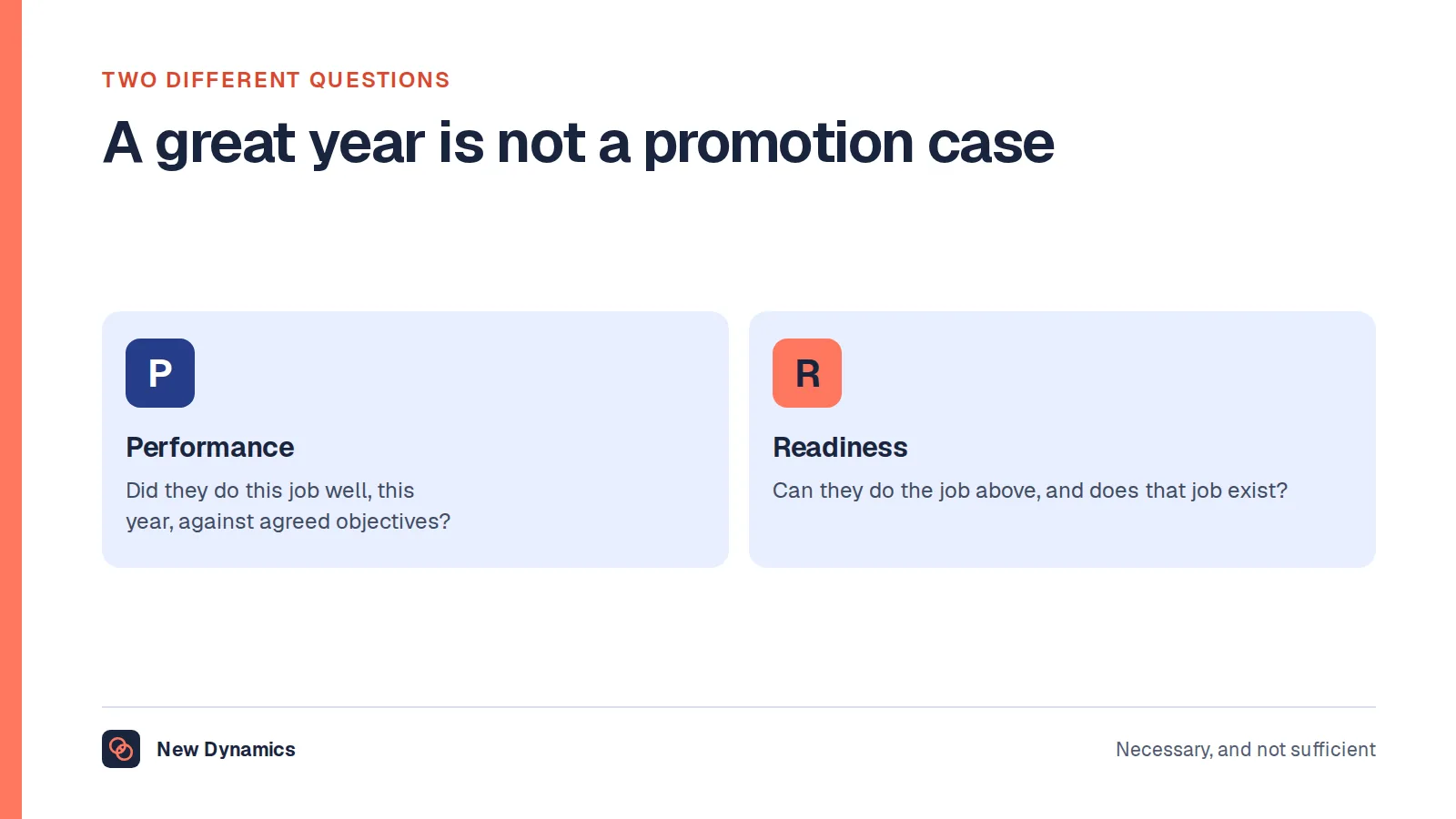
- There are two different plateaus and they need opposite answers. A structural plateau means there is no next rung, because the team is small or the level above needs a scope nobody has to give. A performance plateau means the rung exists and the evidence for it does not yet. Conflating them is why most of these conversations fail.
- A manager with no promotion to offer still has five concrete things: a lateral move, a scope change inside the same job, a restructured role through the statutory flexible working route, time off for study or training, and a secondment. Two of those are statutory routes an employee can start without the manager's agreement.
- Progression and pay are not the same plateau. Acas states there is no legal requirement to give a pay rise unless the employee earns the minimum wage and it increases, moves into the next minimum wage age bracket, or has a contractual right. The minimum wage changes every 1 April, so pay can rise for years while a level never does.
Four years in the same job. Good at it, trusted with the hard work, and going nowhere. The review says "keep doing what you are doing", which is the one sentence nobody wants to hear twice.
That is a career plateau, and it is where career advice usually collapses into encouragement. This article separates the two plateaus that get discussed as one, gives a test for telling them apart, and lists what a manager in the United Kingdom can actually put on the table when there is no promotion, including the two routes an employee can start alone. It covers pay honestly, because a plateau in progression is not a plateau in pay. It is general information about the position in the United Kingdom and not legal advice.
A plateau is usually noticed in a review, so that is the sensible place to handle it. See how New Dynamics performance reviews keep goals, feedback and the evidence behind a rating attached to the cycle, so "what has actually changed since last year" has an answer on the record.
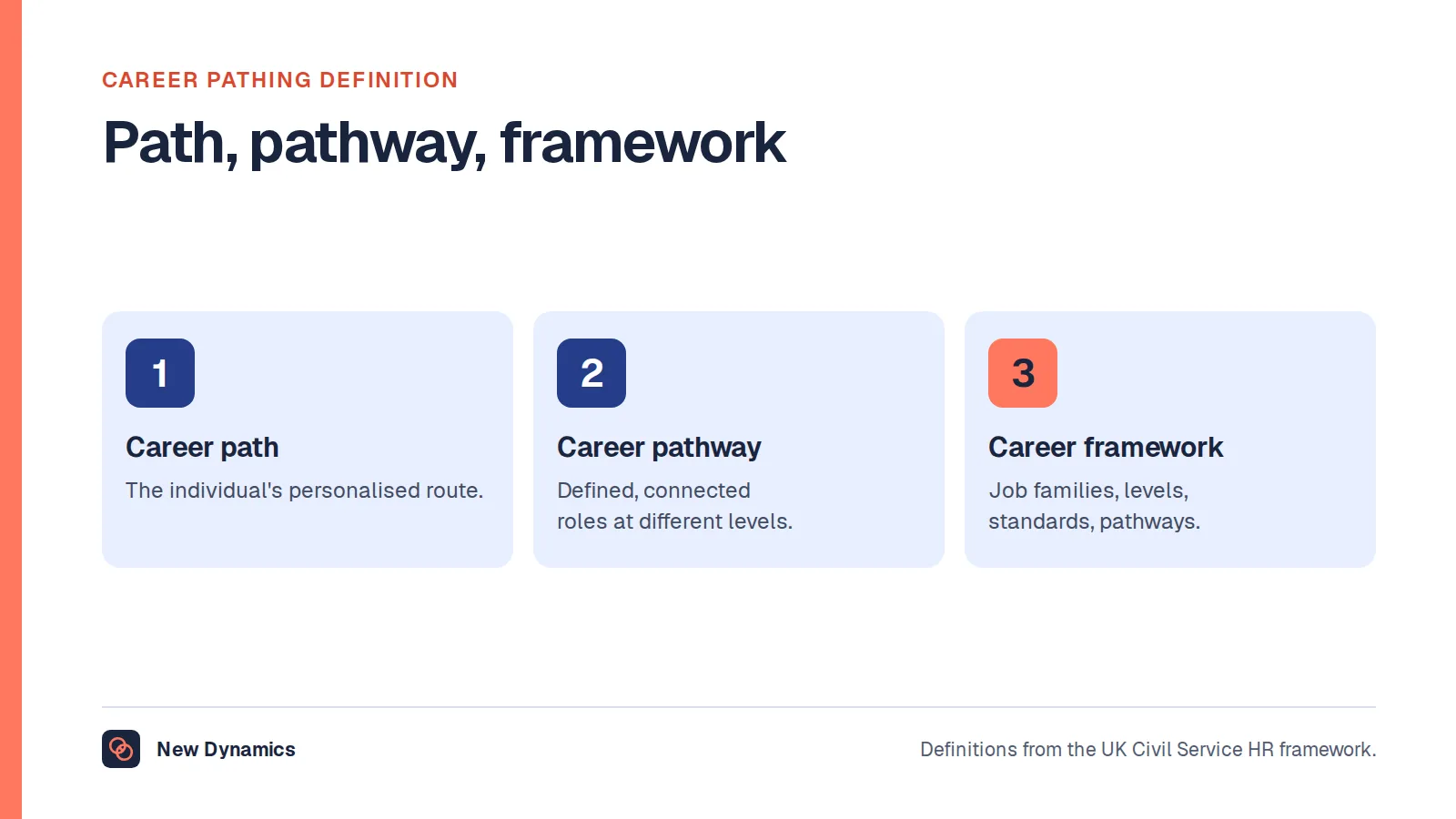
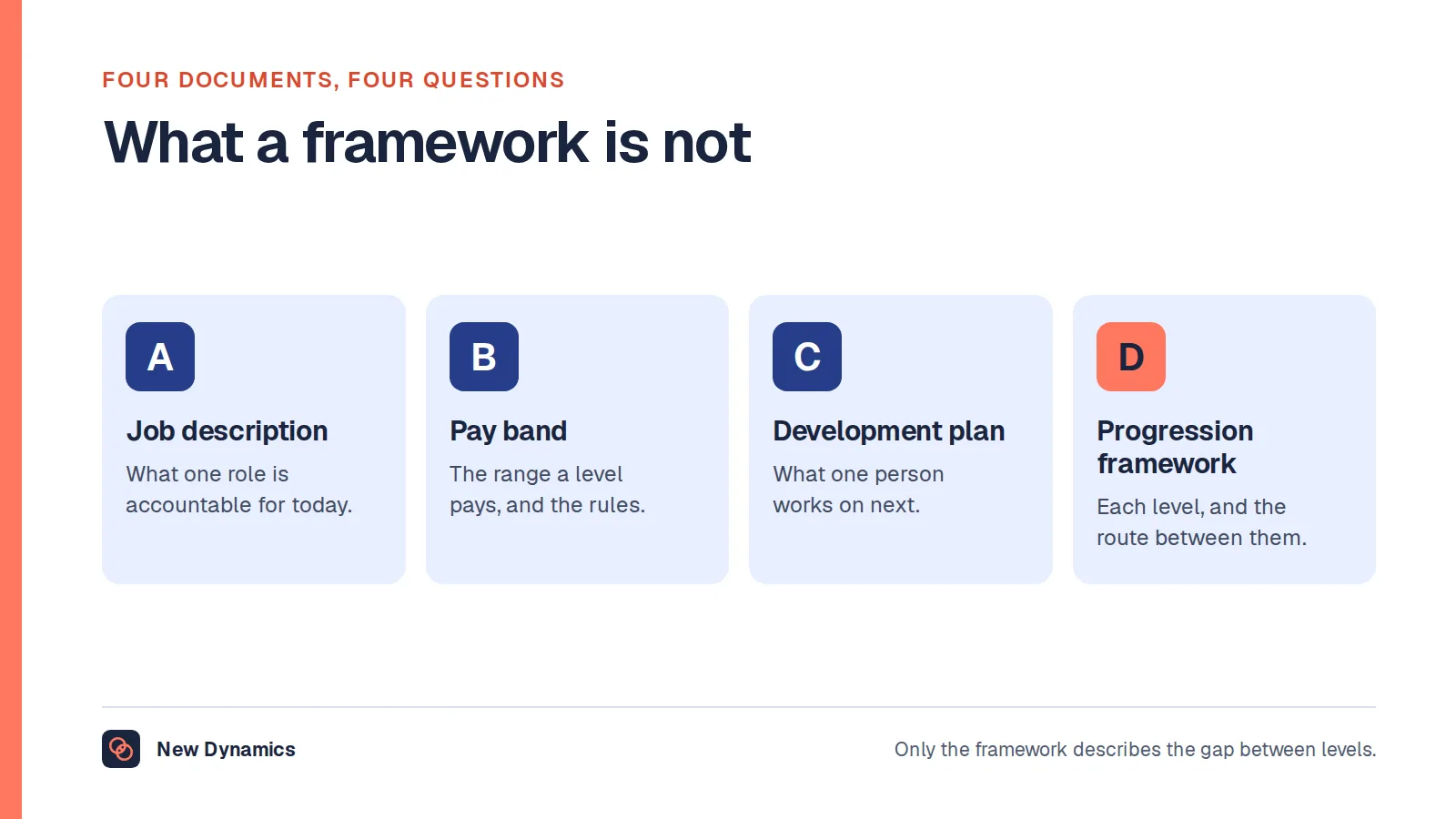
For the map of levels and moves this article assumes, read our post on career pathing. For how to word what each level requires, read the career progression framework.
What a career plateau means
A career plateau is a sustained period in which someone's level, scope and responsibility stop changing, whether or not their pay does. It is a description, not a legal term. No UK statute defines it and nothing follows automatically from being on one. What matters is the cause, because the causes point in opposite directions.
A structural plateau and a performance plateau are not the same problem
A structural plateau is a feature of the organisation, not the person. There is no next rung. The team has six people and one manager. The level above needs a span of work the organisation does not have. The postholder above is not going anywhere. Nothing the employee does this quarter changes any of that.
A performance plateau is a feature of the work. The rung exists and the evidence for it does not yet. Something specific is missing: a decision the person recommends rather than makes, a piece of work with more exposure, a habit that stops them being handed the next thing.
The two need opposite responses. Telling someone on a structural plateau to work on their gaps is unfair, because closing the gaps changes nothing. Telling someone on a performance plateau that the organisation is just flat avoids a hard sentence and costs them a year.

Four questions that tell you which one you are on
- Does the next role exist today? Not in the framework document. In the organisation, with a postholder or an open vacancy. If it does not exist, the plateau is structural and no amount of development dissolves it.
- Which expectations at the next level does the evidence already show? Go through them one at a time and name the proof. If most are met, the blocker is not readiness.
- What single thing would change the answer? If the honest answer is "a vacancy" or "a restructure", it is structural. If it is "owning the renewal conversations instead of preparing them", it is a performance plateau with a next step attached.
- Has this been said out loud before? A plateau nobody has ever named is often a third thing: the rung exists, the readiness exists, and the person is not being considered. That one has its own section below.
Our post on promotion readiness covers how question two is judged in practice, and what a "not yet" has to come with.

What a manager can offer when there is no promotion
This is the part that gets hand-waved. Five real options, described as they work in the UK.
A lateral move
A sideways move at the same level into another team or job family adds scope a vertical move cannot, and often unblocks the vertical move later. It is covered by discrimination law in its own right. Section 39(2)(b) of the Equality Act 2010 says an employer must not discriminate against an employee "in the way A affords B access, or by not affording B access, to opportunities for promotion, transfer or training or for receiving any other benefit, facility or service". Transfers sit in the same clause as promotions, so sideways is not a consolation prize in the eyes of the Act. Our post on the talent marketplace covers making internal moves visible when they come up.
A scope change inside the same job
The title stays and the work does not. Final say on a technical area. The largest account. Deputising when the manager is away. Owning a decision rather than drafting it. This is the fastest option available and the easiest to do badly, because unpaid extra responsibility described as development gets noticed.
A restructured role through a flexible working request
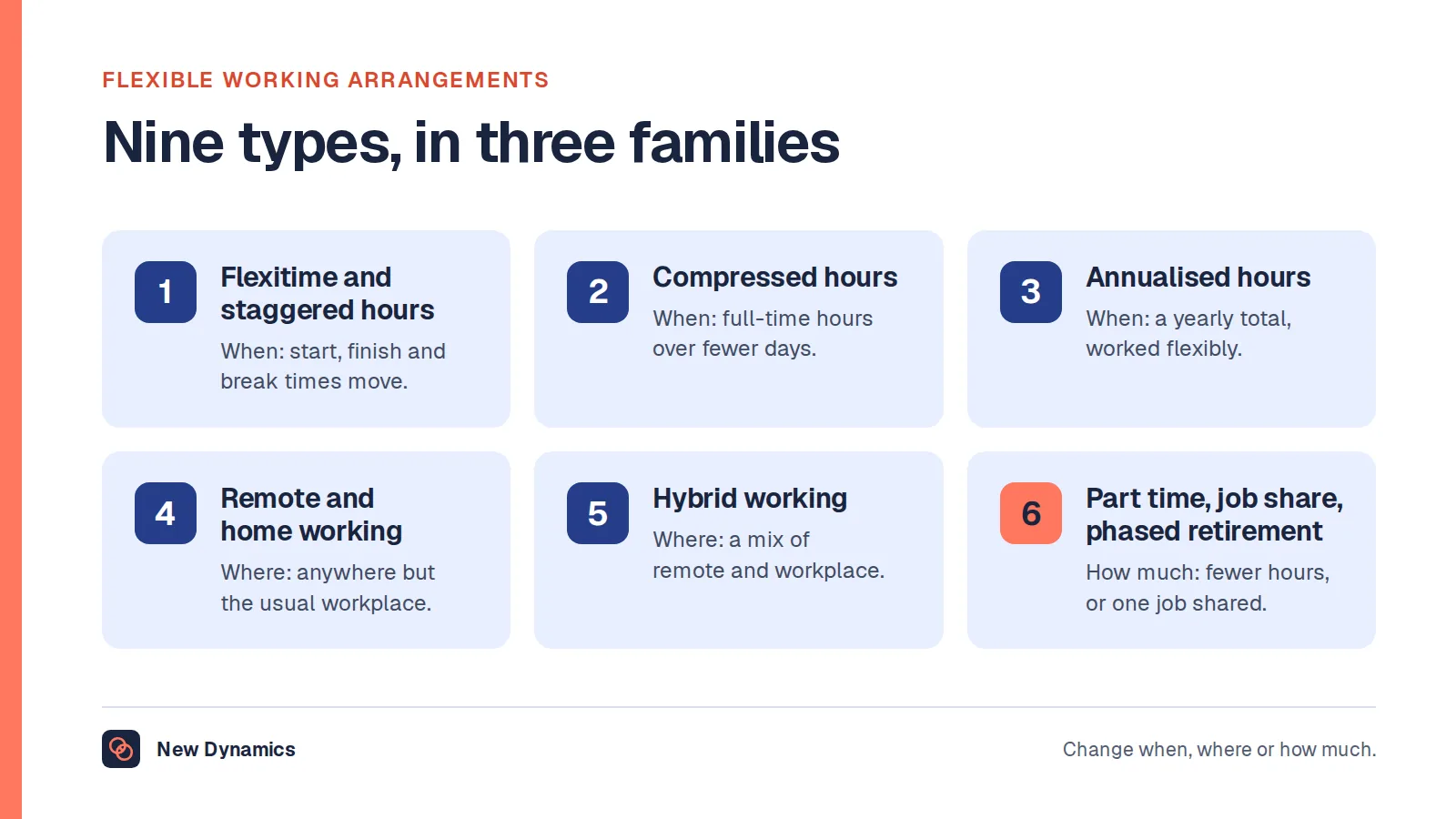
Flexible working is usually discussed as a parenting matter. It is also a way to change the shape of a role that cannot change level, and it is a statutory right rather than a favour.
GOV.UK's guidance on flexible working states that "All employees have the legal right to request flexible working", covering the number of hours they work, when they start or finish, the days they work and where they work. It adds: "Employees can make a request for flexible working from their first day in a job." The rules differ in Northern Ireland.
The handling rules are specific. GOV.UK's page on applying for flexible working says the employer "discusses the employee's request with them and makes a decision on it within 2 months - or longer if agreed with the employee", that if the employer agrees "they must change the terms and conditions in the employee's contract", and that "The employer must discuss the employee's request with them before refusing their application." Employees can make 2 applications in any 12-month period.
The standard is set on the overview page: "Employers must deal with requests in a 'reasonable manner'", with examples including "assessing the advantages and disadvantages of the application", "discussing possible alternatives to the request" and "offering an appeal process". Mishandling can go to an employment tribunal. An employer can still refuse "if they have a good business reason for doing so."
That last line matters here. It is a right to ask and to be dealt with properly, not a right to the answer you want. Our post on flexible working arrangements covers the shapes a request can take.
Time off for study or training, where the right applies
There is a separate statutory request route and it is narrower than most people assume. Section 63D of the Employment Rights Act 1996 creates a "Statutory right to make request in relation to study or training", and requires the study or training to have the purpose of improving "(a) the employee's effectiveness in the employer's business, and (b) the performance of the employer's business".
GOV.UK's guidance on time off for training or study lists the conditions: "staff must be classed as an employee", "they must have worked for their employer for at least 26 weeks", "training must help staff do their job better", and "at least 250 people must work in the organisation". It states that "Time off is usually unpaid unless the employer agrees to pay it", and excludes agency workers and several categories of young person.
On timings, GOV.UK's page on the employer's decision and responsibilities says the employer has 28 days to accept the request or hold a meeting, and if a meeting is held "they must make a decision within 14 days of it, unless the employee agrees in writing to extend this time". Refusal grounds are a listed set, including that "the training would not benefit their business". Employees can make only 1 request a year, and "The employer does not have to pay for the training or study."
So in an organisation with fewer than 250 people this route does not exist at all, and training has to be negotiated rather than requested. Say that plainly rather than implying a right that is not there.
A secondment
A secondment is a temporary move to other work, inside or outside the organisation, with a return to the substantive role at the end. No UK statute defines one or gives anyone a right to one. What governs it is the written agreement, which needs to say who remains the employer, who directs the work, what the return arrangements are, and what happens if the role has changed by then.
What a secondment is not free from is discrimination law. The Equality and Human Rights Commission's Employment Statutory Code of Practice uses one as a worked example, in the passage at paragraph 17.71 on selecting workers for training: an employer offering managers a six-month secondment at a new overseas office who select none of the female managers with children who applied, on an assumption about their families, is "likely to amount to direct discrimination because of sex".

Pay: a plateau in progression is not a plateau in pay
These two get merged and should not be. Someone can stand still on level for years while their pay rises every April. Someone else can be promoted into a band that overlaps the old one and see almost nothing.
Acas, the public body that advises on employment matters, sets the baseline on its guidance about pay rises, last updated 1 October 2026: "There is no legal requirement for an employer to give a pay rise to an employee unless: they earn the minimum wage and it increases, they earn the minimum wage and move into the next age bracket, their contract states they are entitled to one." Acas separates discretionary rises, which "are not guaranteed each year", from contractual ones, which must be paid if the agreed criteria are met, and notes a regular unwritten practice can become an entitlement through custom and practice.
The minimum wage case proves the point. GOV.UK's National Minimum Wage and National Living Wage rates page states that "The rates change on 1 April every year", and publishes the hourly rate for workers aged 21 and over as £12.71 from April 2026 and £13.21 from April 2027. A worker on that rate gets an increase every year without one thing about their role changing.
Two consequences for a manager. Pay progression inside a band is a real option when a level change is not, and saying so beats silence. And do not use a pay rise to settle a progression conversation, because it answers a question nobody asked and the original one returns next year. For the wider figures a pay discussion reaches for, see our HR statistics hub. Mapping levels to pay also carries equal pay implications, which our career progression framework post covers.
When the plateau is concentrated in one group
If the people who stop progressing share a characteristic, that is a finding to investigate, not a coincidence to explain away.
Section 19 of the Equality Act 2010 makes a "provision, criterion or practice" discriminatory where it "puts, or would put, persons with whom B shares the characteristic at a particular disadvantage when compared with persons with whom B does not share it" and the employer "cannot show it to be a proportionate means of achieving a legitimate aim". A promotion criterion nobody thought about twice, such as continuous recent service or availability for travel, can meet that description.
The EHRC code is the source to read on spotting it. At paragraph 18.23 it says "Equality monitoring enables an employer to find out whether their equality policy is working", and gives examples of what monitoring may reveal, including that "applicants with a particular religion or belief are not selected for promotion", that "women are concentrated in certain jobs or departments", and that "older workers are not selected for training and development opportunities". Those are plateau patterns, written down as warning signs.
The code also says where to look. Paragraph 18.28 lists the key areas to monitor "including: recruitment and promotion, pay and remuneration, training, appraisals, grievances, disciplinary action, dismissals and other reasons for leaving". On appraisals, paragraph 17.81 recommends employers "monitor performance assessment results to ensure that any significant disparities in scores apparently linked to a protected characteristic are investigated, and steps taken to deal with possible causes". Paragraph 18.25 adds that "For employers in the private sector, equality monitoring is not mandatory. However, it is recommended that all employers carry out equality monitoring."
Note the code's status. At paragraph 1.12 it explains "It is a statutory Code. This means it has been approved by the Secretary of State and laid before Parliament." At 1.13: "The Code does not impose legal obligations. Nor is it an authoritative statement of the law; only the tribunals and the courts can provide such authority. However, the Code can be used in evidence in legal proceedings brought under the Act." The edition quoted here is the Commission's 2011 code.
What the employee can do
- Ask which plateau it is, and ask for the answer in writing. Does the role I want exist here, and if it does, what is missing. A written answer is harder to repeat vaguely next year.
- Make the ask specific. "More responsibility" is not actionable. "I want to run the Q3 migration and present it at the board review" is.
- Use the statutory routes if the informal ask stalls. A flexible working request forces a decision within two months and a discussion before any refusal. A study or training request, where the 250-employee and 26-week conditions are met, forces a response within 28 days. Neither needs the manager's agreement to start.
- Set your own deadline. Decide, before the conversation, what you will do if nothing has changed in six months. A structural plateau the organisation will not restructure is real information about whether to stay.
Our post on career conversations gives the questions for the discussion itself.
How long does a career plateau last, and how common is it?
No official UK source publishes either figure. There is no government statistic for the typical duration of a career plateau and none for how many employees are on one, because a plateau is a description people apply to their own situation rather than a measured state. We are not going to put a vendor survey number here and dress it up as evidence.
What you can measure is your own organisation: time at current level by team and job family, internal move rate, the share of promotions going to internal candidates, and those same figures broken down by protected characteristic as the EHRC code advises. Those numbers are specific to you, which is exactly why they beat a national average.
Frequently asked questions
What is a career plateau?
A career plateau is a sustained period in which someone's level, scope and responsibility stop changing. It is a description rather than a legal term, and no UK statute defines it. The useful question is not whether you are on one but what is causing it, because a plateau caused by the shape of the organisation and one caused by missing evidence of readiness need opposite responses.
What is the difference between a structural and a performance plateau?
A structural plateau means there is no next rung: the team is small, the organisation is flat, or the level above needs a scope that does not exist. Nothing the employee does changes it. A performance plateau means the next rung exists and the evidence for it does not yet, so there is a specific next step. Treating a structural plateau as a development problem wastes the employee's year.
How long does a career plateau usually last?
No official UK source publishes a typical duration, and none publishes how common plateaus are. Instead of a borrowed figure, measure time at current level in your own organisation, by team and job family, and look at how often internal moves actually happen.
What can a manager offer when there is no promotion available?
Five things. A lateral move into another team at the same level. A scope change inside the same job, such as ownership of a technical area or a decision. A restructured role through the statutory flexible working route. Time off for study or training where that right applies. A secondment. Pay progression inside the existing band is a sixth, and is not a substitute for answering the progression question.
Can I ask to change my role if there is nothing to be promoted into?
Yes. GOV.UK states that all employees have the legal right to request flexible working from their first day in a job, covering the hours worked, start and finish times, the days worked and where the work happens. The employer must deal with it in a reasonable manner, decide within 2 months unless a longer period is agreed, and discuss it before refusing. They can still refuse for a good business reason.
Do I have a right to time off for training if my career has stalled?
Only in some workplaces. Under section 63D of the Employment Rights Act 1996, GOV.UK's conditions are that you are an employee, have worked for the employer for at least 26 weeks, the training must help you do your job better, and at least 250 people must work in the organisation. Time off is usually unpaid, the employer does not have to pay fees, and you can make only 1 request a year.
Is a career plateau the same as a pay freeze?
No. Acas states there is no legal requirement to give a pay rise unless the employee earns the minimum wage and it increases, moves into the next minimum wage age bracket, or has a contractual right to one. Because the minimum wage changes every 1 April, pay can rise for years while a level never does. Answer the two questions separately.
Your next step: name the plateau in one conversation
- Pick the person who has been at the same level longest in your team.
- Check whether the role above theirs exists today, with a postholder or a vacancy. Write the answer down before the meeting.
- If it does not exist, say so in that sentence, then choose two of the five options above and name dates for both.
- If it does exist, go through the next level's expectations and name the one thing that would change the answer.
- Pull time at level for the whole organisation, broken down the way the EHRC code advises. If one group stands out, that is the next piece of work.
For the wider picture on growing careers inside an organisation, read and download our career development guide. The guide is free to read, and the PDF uses our short download form.
Want time at level, development plans and review evidence in one place instead of three spreadsheets? Book a New Dynamics demo and bring your current levels. You can also email contact@new-dynamics.com.