TL;DR
- Write down the cycle you actually run before you look at anything. Software enforces whatever process you give it, so a system chosen before the process is agreed will decide the process for you.
- Cycles break on the awkward cases: someone who changed manager in March, a part-year starter, a person on leave, a leaver mid-cycle, and calibration. Give every supplier the same three scenarios from your own last round.
- The data questions matter as much as the features. Access control, retention and deletion, export, and whether you can answer a subject access request from the system are the ones that are expensive to discover later.
Every performance system demos well. A manager writes a review, an employee sees it, a chart appears. The problems start in month seven, with the person who changed manager in March, the part-time starter who joined in September and the calibration meeting that the tool has no concept of.
This article covers whether you need a system at all, the requirements a real cycle breaks on, the data questions to ask every supplier, and the warning signs. We sell software in this category, so there are no product names here and nothing below is a claim about ours. It describes the position in the UK and Great Britain and is general information, not legal advice.
If you want to see how one system handles the cycle, New Dynamics performance reviews is ours, and the rest of this article is about how to judge any of them.
First, do you need one?
Three signs you probably do: reviews live in documents nobody can find, nobody can answer how many were completed without a spreadsheet exercise, and evidence is reconstructed from memory every year.
Two signs the problem is the process rather than the tooling: managers do not know what the ratings mean, or the cycle is widely ignored. Software makes an agreed process cheaper to run; it does not create agreement. Our post on the performance management policy covers settling that first.
Write the cycle down before you look
One page: who is in scope, what happens and when, what gets recorded, who sees what, what happens with the awkward cases. A system will enforce whatever you give it, which is useful when the process is agreed and painful when it is not.
Take that page into every demo. If a supplier's product can only run a different process, that is useful information early and an expensive surprise later.
The five requirements a cycle breaks on

1. The awkward cases. Someone who changed manager mid-cycle, a part-year starter, a person on family or sick leave, a leaver, someone with two managers. Ask to see each one. Our posts on reviewing an employee who changed manager and part-time, shift and seasonal staff describe what the process has to do, and a tool that cannot record which period a review covers will produce unfair reviews every year.
2. Evidence through the year. Can notes, feedback and objective progress be captured as they happen and surfaced when the review is written? If the answer is a text box in November, the system is a form, not a record.
3. Calibration. Can two managers' ratings be compared before they are final, with the evidence attached, and can a change be recorded with its reason? This is the feature most often missing and the one that decides whether ratings are consistent.
4. Records and access. Who can see what, for how long, and who can delete it. The ICO expects employment records to be accessible only to those authorised, with "managers only have access to the information they need to meet their obligations", and expects a retention schedule. Ask how deletion actually works.
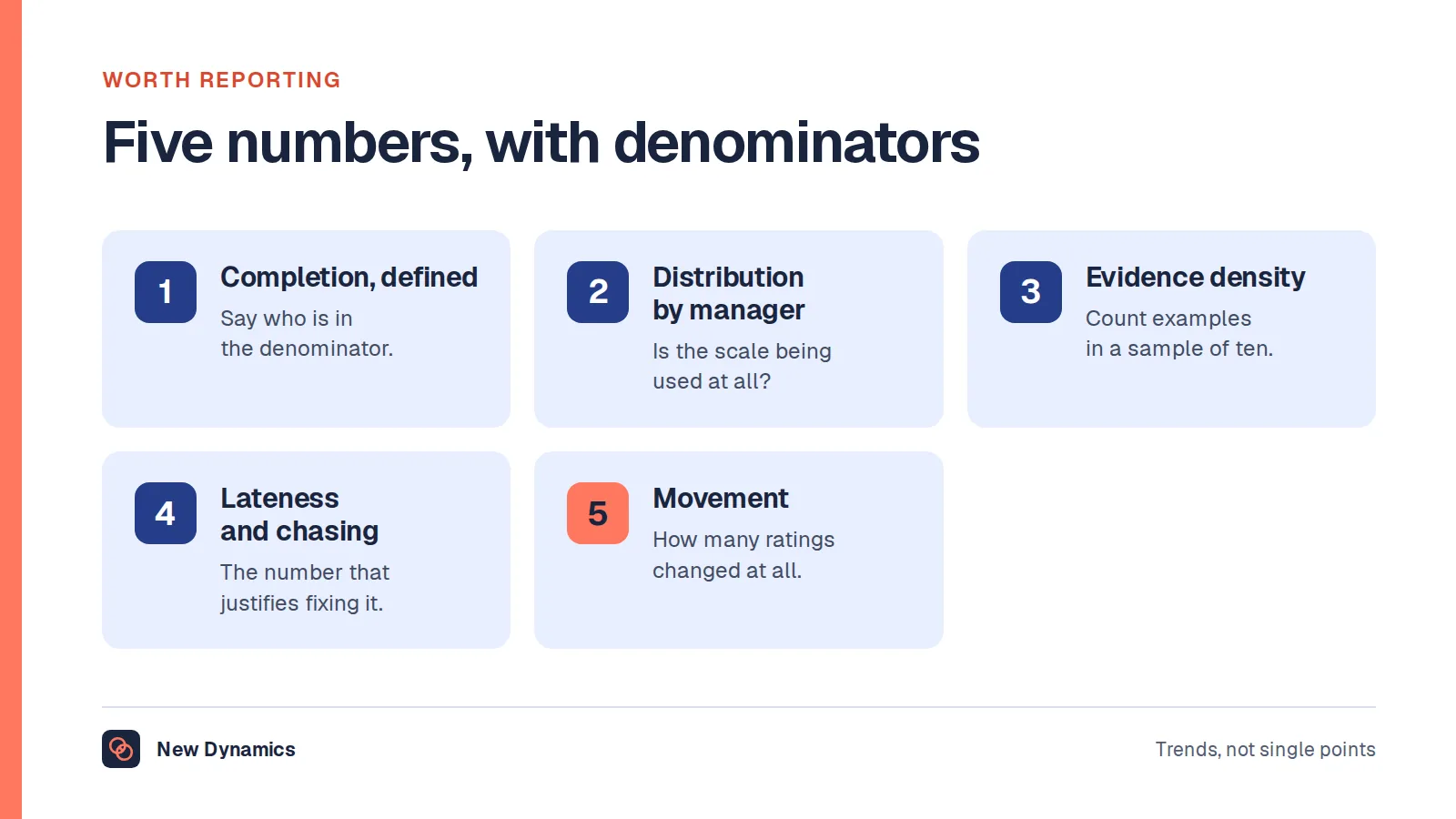
5. Reporting you can defend. Completion with a definition you control, distribution by manager, and raw export. Our post on performance data for HR reporting covers what to report; a dashboard you cannot export from is a dashboard you cannot check.
Lower down the list, and still worth asking: integration with your HR system of record, single sign-on, mobile and accessibility, and what the administrator's job looks like during a cycle.
Five data questions for every supplier

- Where is the data stored, and who can reach it? Including the supplier's own staff, and under what controls.
- What are the retention and deletion options? The ICO says you should set a schedule listing what you hold, what you use it for and how long you keep it. A system that cannot delete on a schedule cannot support one.
- Can we answer a subject access request from it? People can ask for the personal information held about them and must be answered "without delay and within one month". Find out what that involves in practice.
- What happens to our data if we leave? Full export, in what format, including historic reviews and the audit trail. Ask before you sign, not in year three.
- What does the audit trail record? Who changed a rating, when, and why. Acas treats the written record as part of performance management, and a record that can be edited silently is worth less than one that cannot.
Run the demos properly
Send every supplier the same script, taken from your own last cycle. Three scenarios is enough: a straightforward review, an awkward case, and a calibration conversation. Ask them to do it live in a sandbox rather than showing slides.
Then give the system to two managers and twenty employees for one real cycle before committing everybody. A pilot surfaces the administrator's workload, which is the cost nobody estimates.
Our HRIS selection guide has a scorecard for the wider process, and the performance management software RFP template structures the supplier questions.
Count the whole cost
Licences are the visible part. Add implementation, data migration, integration work, the administrator's time during each cycle, manager training, and the cost of exit. A cheaper licence with twice the administration is not cheaper.
Red flags and good signs

Treat these as warnings: a scoring or ranking feature whose basis cannot be explained, a forced distribution baked into the product, no raw export, basics priced as add-ons, and an inability to show the awkward cases live.
Be reassured by: a clear access model, deletion and retention you control, an audit trail you cannot quietly edit, an export that includes history, and a supplier willing to say what their product does not do.
One more, because it matters for fairness: you should be able to analyse outcomes yourself. Acas notes that "it can still be discrimination even if the less favourable treatment was not intended", and checking a pattern requires getting the data out rather than trusting a supplied chart.
Frequently asked questions
How do you choose a performance management system?
Write down the cycle you actually run, then test every option against the awkward cases rather than the standard one: changed managers, part-year starters, people on leave, leavers and calibration. Ask the data questions about access, retention, export and audit trail, run a real pilot, and count the administration cost as well as the licence.
What features matter most in performance review software?
The ability to handle part-year and changed-manager cases, evidence capture through the year, calibration with the evidence attached, a records model with access control and retention, and reporting you can export and define yourself.
Do we need performance management software at all?
Not if the problem is that nobody agrees what the ratings mean or the cycle is ignored. Software makes an agreed process cheaper to run and an unclear one more visible. Settle the policy and the rating definitions first, then decide.
What should you ask a supplier about data protection?
Where the data is stored and who can access it including their staff, what retention and deletion you control, how a subject access request is answered from the system, what a full export looks like on exit, and what the audit trail records when a rating changes.
How long should a pilot run?
One full cycle with a couple of managers and a small group of employees, including the awkward cases if you have them. A two-week trial shows the interface; a cycle shows the administration, which is where the real cost sits.
What are the warning signs when buying performance software?
Scoring or ranking whose basis cannot be explained, a forced rating distribution built into the product, no raw data export, core functions priced as add-ons, and a supplier who will not demonstrate the awkward cases live in a sandbox.
Your next step: write the one page
- Write your cycle on one page, including what happens for the five awkward cases.
- Turn the five data questions into a section of your RFP.
- Script three scenarios from last cycle and give the same script to every supplier.
- Budget the administrator's time per cycle before you compare licence prices.
For a scorecard and a structured selection process, read and download our HRIS selection guide. The guide is free to read, and the PDF uses our short download form.
Want to put one of those scenarios in front of us? Book a New Dynamics demo and bring your awkward cases. You can also email contact@new-dynamics.com.