TL;DR
- A policy is a description of what your organisation actually does, not an aspiration. Every sentence that promises something is a commitment people will hold you to, which is why most policies are longer than they should be and less accurate than they look.
- Ten sections cover it, and six of them carry the weight: scope, the cycle, objectives, the rating approach, records and access, and what happens when performance falls short.
- The British specifics matter. Acas expects support before any formal procedure, says a separate capability procedure must still follow the Acas Code, and treats the written record as part of the process.
Most performance policies are written after an incident. Somebody asks whether an employee was treated according to the policy, and the answer is that the policy says an appraisal happens annually, which it did not, and nothing else relevant.
This article sets out what belongs in the policy, the decisions each section forces, what not to promise, and the British specifics that a generic template misses. It describes the position in Great Britain and the UK and is general information, not legal advice. Have the final version checked before you publish it.
A policy is only as good as the process underneath it. See how New Dynamics performance reviews keep the cycle, the evidence and the records in one place.
Ten sections

1. Purpose and principles. Three sentences on what performance management is for here. Resist the temptation to write a paragraph about excellence.
2. Scope. Who it applies to: employees, and whether workers, agency staff or people on probation are included. Acas says employers "should conduct regular performance reviews for anyone with the legal status of employee" and that it is a good idea to do them at least once a year, and notes that employers might choose to run them for workers too.
3. The cycle. What happens and when: objective setting, check-ins, any mid-year review, the end-of-period review. State the frequency you will actually deliver.
4. Objectives. How they are set and agreed, how many, and the standard they should meet. Acas's test is that objectives should be specific, measurable, achievable, relevant and time-bound, and "fair and reflect the employee's usual tasks and workload". Our post on the goal-setting conversation covers the practice.
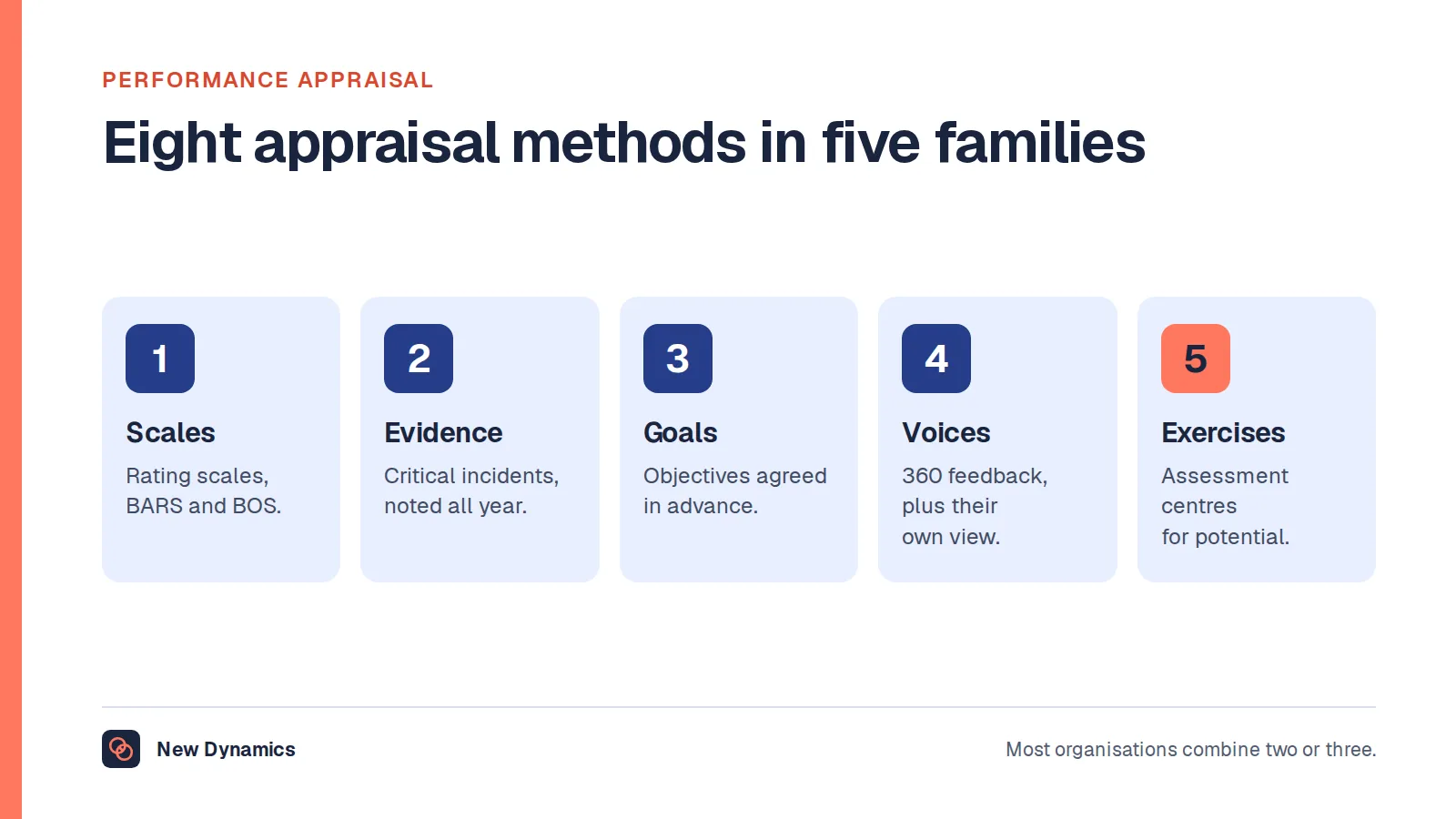
5. The rating approach. Whether you use ratings, what the levels mean, and how calibration works. If ratings connect to pay, say so here rather than leaving it to rumour, as our post on performance reviews and pay argues.
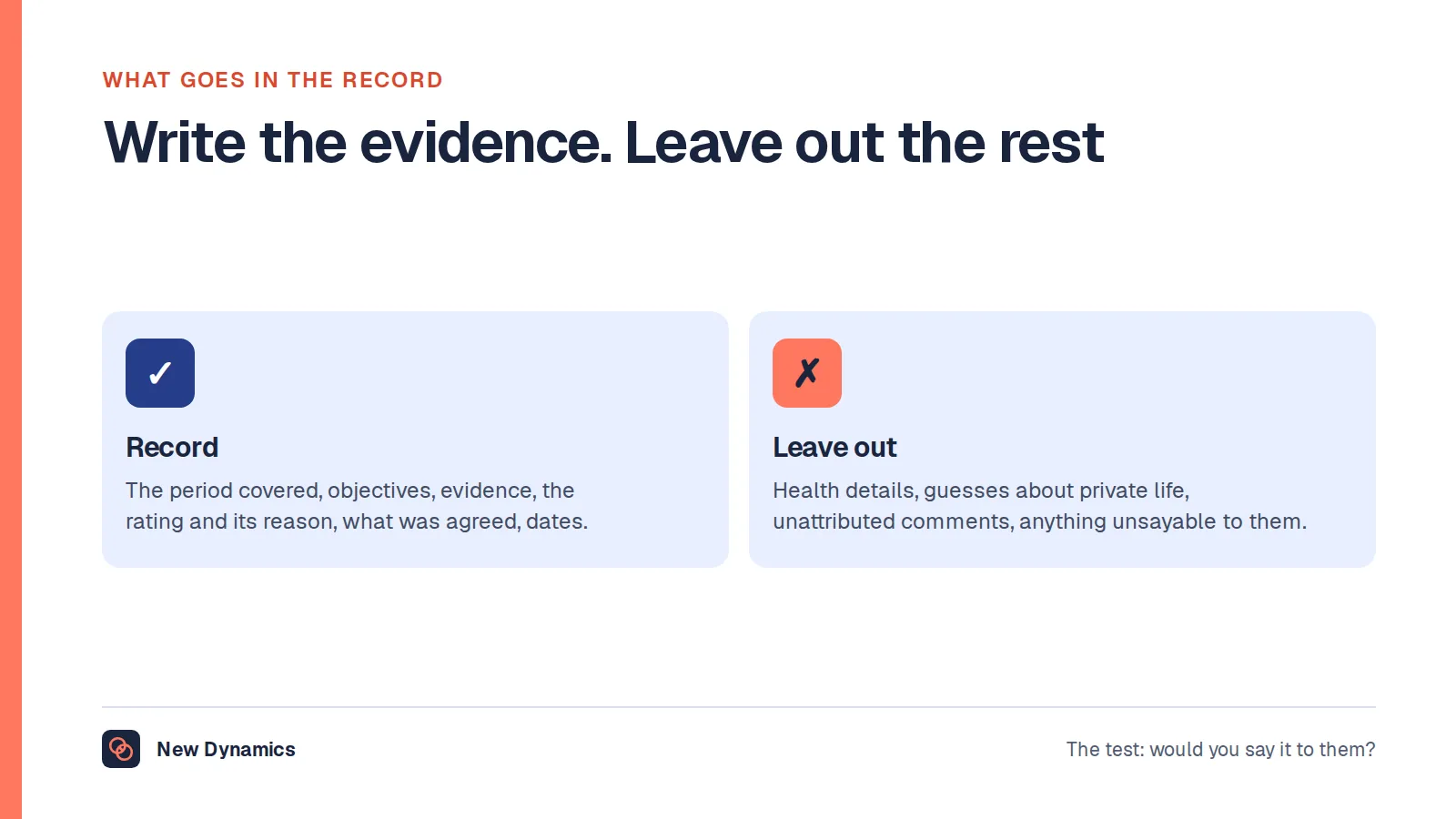
6. Records and access. What is kept, who can see it and how long it is held. The ICO says you "should set up a retention policy or schedule" listing what you hold, what you use it for and how long you keep it, and expects access to be limited to those authorised.
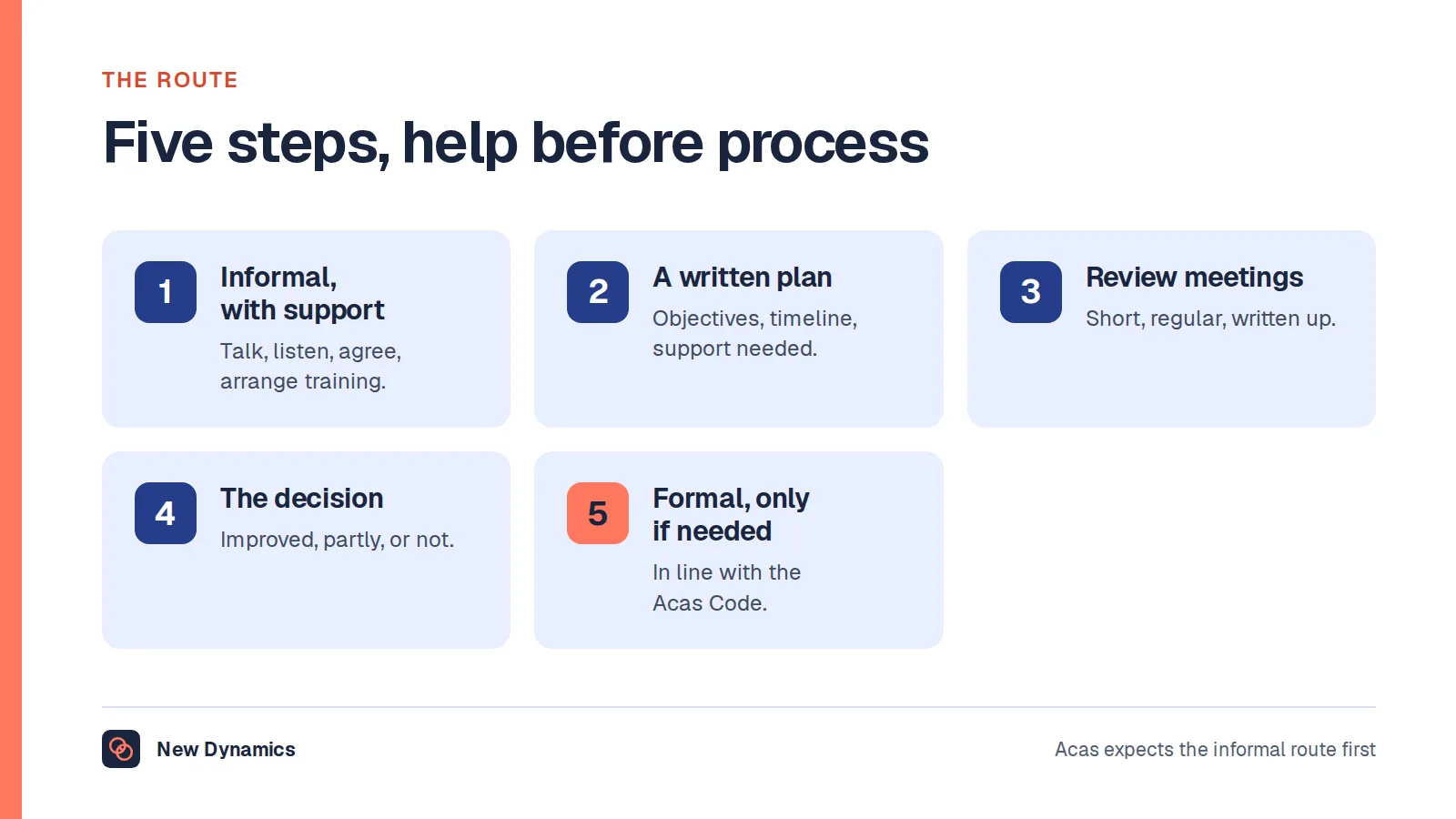
7. Where performance falls short. The route from an informal conversation through support to any formal stage, and who to involve. Our post on the capability procedure sets it out in full.
8. Disagreement. How somebody records a different view, and the route if that does not resolve it.
9. Roles. What the manager does, what the employee does, what HR does. Three bullets each is enough.
10. Review of the policy itself. Who owns it, when it is next looked at, and the version date.
The decisions a template hides

A downloadable template fills these in with something plausible. Each is a decision your organisation has to make.
- Frequency. Annual, twice a year, or continuous with a light annual summary. Write what you will actually do.
- Ratings or not, and if yes, how many levels and what they mean. Our post on removing ratings covers the trade-off.
- The pay link. Direct, loosely connected through a moderated recommendation, or none.
- Who is in scope, including probation, part-time staff, people on long-term leave and leavers mid-cycle.
- Retention. How long reviews are kept, with a reason for the period.
- Calibration. Whether it happens, who is in the room, and what can change in it.
What a policy should not promise

An appraisal for everyone every year, if you will not deliver it. A policy is a commitment. If completion runs at seventy per cent, a promise of universal annual reviews is a documented failure every cycle.
A specific pay outcome for a rating. Unless the scheme genuinely works that way and the budget is guaranteed. Describe the mechanism, not the result.
A fixed distribution of ratings. Curves cause more problems than they solve, and writing one into policy makes every unfair outcome a policy outcome.
That performance management is separate from discipline in all circumstances. It usually is, and sometimes a capability process becomes formal. Acas notes that where an employer uses "a separate 'capability procedure' instead of a disciplinary procedure", it "must still be in line with the Acas Code of Practice on disciplinary and grievance procedures".
The British specifics
Three things a generic template leaves out.
Support before process. Acas says employers "should take steps to try and help someone to improve, before starting a formal disciplinary procedure", and that any improvement plan should set out specific objectives, a reasonable timeline and the support or training needed. The policy should say that, because it shapes what managers do.
Where the terms live. Acas, writing about probation, says terms and conditions must be set out in the written statement of employment particulars or the contract, and that where they sit in a policy "employers must make this clear in either the written statement or the contract". The same logic applies to anything contractual in your performance policy, which is a good reason to keep it non-contractual and say so.
Consistency as a protection. Acas notes that applying a process consistently helps explain how decisions are made, "this reduces the risk of discrimination". That is the honest argument for a policy: not that it covers you, but that it makes decisions explicable.
Keep it short and current
Four pages is plenty. A policy nobody reads protects nobody, and the longer it is, the more promises it contains.
Two habits keep it alive. Date every version and say what changed, and review it after each cycle against what actually happened: if the policy says one thing and the cycle did another, one of them is wrong and you now know which. Our post on performance review record keeping covers the records half, and the employee handbook guide covers where it all sits.
Frequently asked questions
What should a performance management policy include?
Ten sections: purpose, scope, the cycle, objectives, the rating approach, records and access, what happens when performance falls short, how disagreement is handled, the roles of manager, employee and HR, and who owns the policy with its review date.
Is an appraisal policy a legal requirement in the UK?
There is no specific legal requirement to have one. Acas says employers should conduct regular performance reviews for employees and that doing them at least once a year is a good idea, and a written policy is how consistency is achieved, which Acas links to reducing the risk of discrimination. This is general information, not legal advice.
Should a performance policy be contractual?
Usually not, and the policy should say so clearly. Where terms are contractual they belong in the contract or the written statement of employment particulars, and Acas says that where terms sit in a policy, employers must make that clear in one of those documents.
How long should a performance management policy be?
Around four pages. Longer policies contain more promises and get read less, and every promise is something people can hold the organisation to. Describe what you actually do rather than what you aspire to.
What should a policy say about poor performance?
That support comes first: an informal conversation, agreed improvements and any training needed, before a formal stage. Acas expects employers to try to help someone improve before starting a formal procedure, and says any separate capability procedure must still follow the Acas Code.
How often should the policy be reviewed?
After each full cycle, and at least annually. Compare what the policy says with what actually happened, date each version, and record what changed. A policy that drifts from practice is worse than no policy, because it documents the gap.
Your next step: check the policy against the cycle
- Read your current policy and mark every sentence that is a promise.
- Check each promise against what last cycle actually did.
- Fix whichever is wrong, the policy or the practice, and date the new version.
- Make sure the records, retention and access section matches what your system actually does.
For where the policy sits alongside everything else people need to find, read and download our employee handbook guide. The guide is free to read, and the PDF uses our short download form.
Want the cycle to match the policy without chasing? Book a New Dynamics demo and bring your current document. You can also email contact@new-dynamics.com.