TL;DR
- The document HMRC requires is the payment and deduction statement. A contractor must give one to every subcontractor it deducts from within 14 days of the end of each tax month, which means by the 19th.
- The percentage is not applied to the invoice total. VAT, consumable stores, fuel other than fuel for travelling, plant hire, prefabrication and materials the subcontractor paid for directly all come out first.
- Failing to issue statements carries its own penalty, separate from the return. CIS 340 says HMRC may charge up to £3,000 where a contractor fails to give statements to subcontractors registered for payment under deduction.
A subcontractor rings in March and asks for nine months of statements at once, because their accountant will not file without them. That call is where most contractors find out the paperwork is not optional, and that the deduction figures in their accounting system were never written up in the form the scheme requires.
This article sets out the CIS deduction statement: who issues one, what it must contain, when it is due, what the deduction is applied to, and how it connects to the monthly return. It covers the United Kingdom and is general information, not tax advice. Filing happens in HMRC's service or in commercial CIS software, but everything upstream of it is a monthly process with owners and dates: see how New Dynamics workflows let you shape the stages, participants and rules around how your organisation works, so a monthly obligation has a named owner instead of a habit.
What a CIS deduction statement is, and what HMRC calls it
HMRC's name for it is the payment and deduction statement, and there is a one page form of that name on GOV.UK, published on 1 September 2008. Its Details section leaves no discretion: "You must give a written statement to every subcontractor you make a deduction from, each time you pay them for the CIS. You have to do this within 14 days of the end of each tax month."
It matters because the scheme runs in the opposite direction from ordinary invoicing. GOV.UK's overview of the Construction Industry Scheme explains that "contractors deduct money from a subcontractor's payments and pass it to HM Revenue and Customs (HMRC)", and that "the deductions count as advance payments towards the subcontractor's tax and National Insurance". The statement is the subcontractor's only proof that those advance payments were made in their name.
Who has to issue one, including businesses outside construction
The obvious route in is a construction business. GOV.UK: "If your business is construction and you pay subcontractors for construction work, you're a 'mainstream' contractor", which covers a builder, a labour agency, a gangmaster or gang leader, and a property developer. On the other side you "register as a subcontractor if you do construction work for a contractor", and a business doing both registers twice.
The second route catches employers who do not think of themselves as construction businesses at all. GOV.UK: "You count as a 'deemed' contractor if your business does not do construction work but you have spent more than £3 million on construction in the 12 months since you made your first payment." It names housing associations and arm's length management organisations, local authorities and government departments, and adds a duty that is easy to miss: "You must monitor your construction spend if you are likely to become a deemed contractor." HMRC's detailed guide, CIS 340, updated on 27 August 2026, puts the threshold as a continuing test: section 2.2 says it bites where spend "exceeds £3 million in any rolling one year period". Monitor against that wording, because a rolling test has to be rechecked and a single window does not.
Verification, and the three deduction rates
You do not choose the rate. HMRC gives it to you when you verify the subcontractor, and GOV.UK's page on making deductions and paying subcontractors lists the Construction Industry Scheme deduction rates as:
- 20% for registered subcontractors
- 30% for unregistered subcontractors
- 0% if the subcontractor has gross payment status, "for example they do not have deductions made"
Those are the rates published on GOV.UK in the tax year running from 6 April 2026 to 5 April 2027. CIS 340's worked examples hedge, calling 20% "the rate in force at the time of writing this guide", which is another reason to take the rate from the verification response rather than from memory.
Verification is a standing duty too. GOV.UK says "You must also verify subcontractors you've used before if you have not included them on a CIS return in the current or last 2 tax years". Gross payment status is applied for separately, on tests covering a clean payment history, construction work in the UK, a business bank account and turnover ignoring VAT and materials of "at least £30,000 if you're a sole trader".

What the deduction is applied to, and what comes out first
This is the commonest error in the scheme. The percentage is not applied to the invoice total. GOV.UK says to "start with the total (gross) amount of the subcontractor's invoice", then take away the amount the subcontractor has paid for:
- VAT
- equipment which is now unusable ("consumable stores")
- fuel used, except for travelling
- equipment hired for this job ("plant hire")
- manufacturing or prefabricating materials
- materials (only if they paid for them directly)
"Finally, deduct the CIS percentage rate (as given to you by HMRC) from the amount left."
CIS 340 sharpens that list. Only the subcontractor who bought the materials may claim them, because section 3.13 says "it is only where a subcontractor directly pays for the materials purchased to fulfil a particular construction contract, that the cost in question may be deducted". Travel is not excluded, since section 3.11 requires travelling expenses and subsistence to be "included in the gross amount of payment and the amount from which the deduction is made". And plant counts as materials only where it was genuinely hired from a third party: where the subcontractor owns it, section 3.14 says "no notional deduction for plant hire may be made".
The contractor, not the subcontractor, carries the risk of an inflated materials figure. Section 3.13: "If the materials element looks to be excessive we may seek to recover any under deduction from the contractor." Ask for receipts, and where there are none, GOV.UK says to "estimate the cost of the materials".
What a CIS deduction statement must contain
Contractors can design their own statement. CIS 340 section 3.15 says "Contractors can choose the style of the statements but they must include the" following, and this is the list to check your template against:
- the contractor's own name and employer tax reference
- the end date of the tax month in which the payment was made, "such as 'tax month ending 5 May 2016'", or the date of payment for a single payment
- the subcontractor's name and Unique Taxpayer Reference
- the subcontractor's "personal verification number if the subcontractor could not be verified and a deduction at the higher rate has been made"
- the gross amount of the payments made to the subcontractor
- "cost of any materials that has reduced the amount against which the deduction has been applied"
- the amount of the deduction

Everything else is optional. A statement may be sent electronically where both sides agree and it is "in a form that allows the subcontractor to store and print it", it may cover a tax month or a single payment, and a replacement for a lost one "must be clearly marked 'Duplicate'". Where a payment was made gross, there is no obligation to issue one.
The monthly return, the nil return and the penalties
The return is a separate duty falling on the same date. GOV.UK: "Send your monthly returns to HMRC by the 19th of every month following the last tax month." A tax month runs from the sixth of one month to the fifth of the next, so both duties land 14 days after it ends. GOV.UK's example covers both: for the tax month 6 May to 5 June, the return must reach HMRC by 19 June, and the statement must be given by 19 June.
A month with no payments still needs an action. GOV.UK says to either "file a return showing your payments were 0 (known as a 'nil return')" or "tell HMRC that you've temporarily stopped using subcontractors (known as making an 'inactivity request')". CIS 340 draws a line the short page does not. Section 4.5 says mainstream contractors who paid nobody "must let us know by either filing a nil return or notifying us of a period of inactivity by the 19th of the month", while deemed contractors "are not legally required to file a nil return", but if they do not tell HMRC either way "we will issue a penalty", which HMRC cancels once told no subcontractors were paid. Section 4.18 adds that "From 6 April 2026 the obligation to file a nil return will be reinstated for mainstream contractors." Both point the same way in practice: tell HMRC something by the 19th.
Late returns run up a published scale: £100 at one day late, £200 at two months, then at six months and again at twelve months "£300 or 5% of the CIS deductions on the return, whichever is higher", and beyond that "an additional penalty of up to £3,000 or 100% of the CIS deductions on the return, whichever is higher".
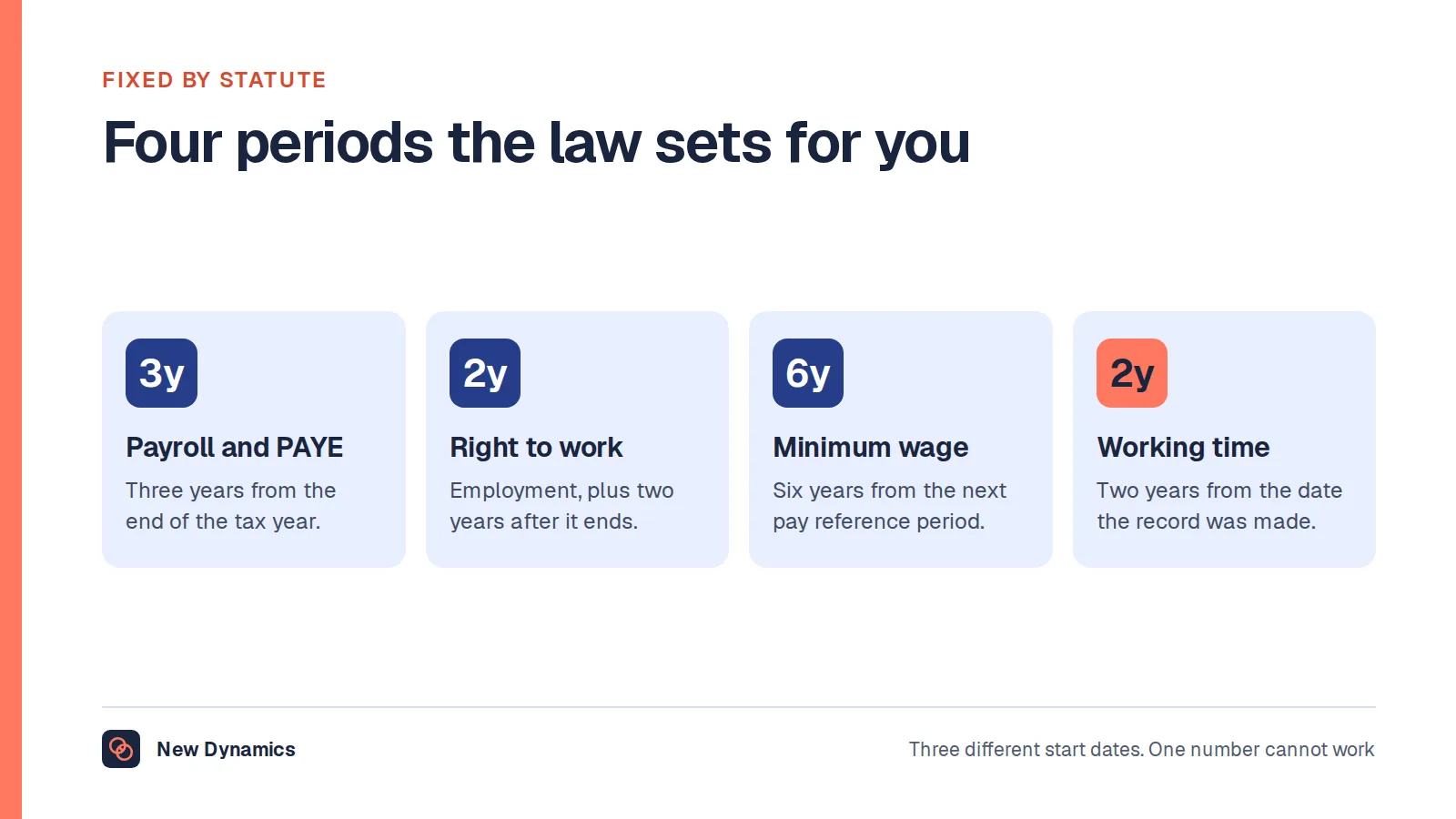
Three more penalties attach to the declarations and the records, and a contractor with tidy accounts but no statement template meets them first. GOV.UK requires you to "declare that the subcontractors listed are not employees" and warns of "a penalty of up to £3,000 if you give the wrong employment status for a subcontractor on your monthly return". CIS 340 section 4.20 allows up to £3,000 where a contractor fails "to give statements to subcontractors registered for payment under deduction, recording their payments and deductions". And records of gross payments, deductions and materials must be kept "for at least 3 years after the end of the tax year they relate to", with a fine of "up to £3,000 if you cannot show your CIS records when asked by HMRC".

Why the subcontractor cannot reclaim without it
For the subcontractor the statement is the evidence behind a figure on their own return. GOV.UK: "You'll need the monthly payment and deduction statements your contractor has given you." A sole trader or partner records total pay before deductions as income and "the total deductions contractors have taken, as 'CIS deductions'" on the Self Assessment return. A limited company goes through payroll instead, with the usual Full Payment Submission plus an Employer Payment Summary showing "the total CIS deductions for the year to date", and not through the Corporation Tax return, which GOV.UK says "you may get a penalty" for using. Either way HMRC can ask for proof, and if the subcontractor does not answer in time, HMRC decides the claim on what it has and "You will not be able to make any more claims in that tax year". The cost of a missing statement lands on the subcontractor, not on the contractor who failed to send it.
CIS is not an employment status decision
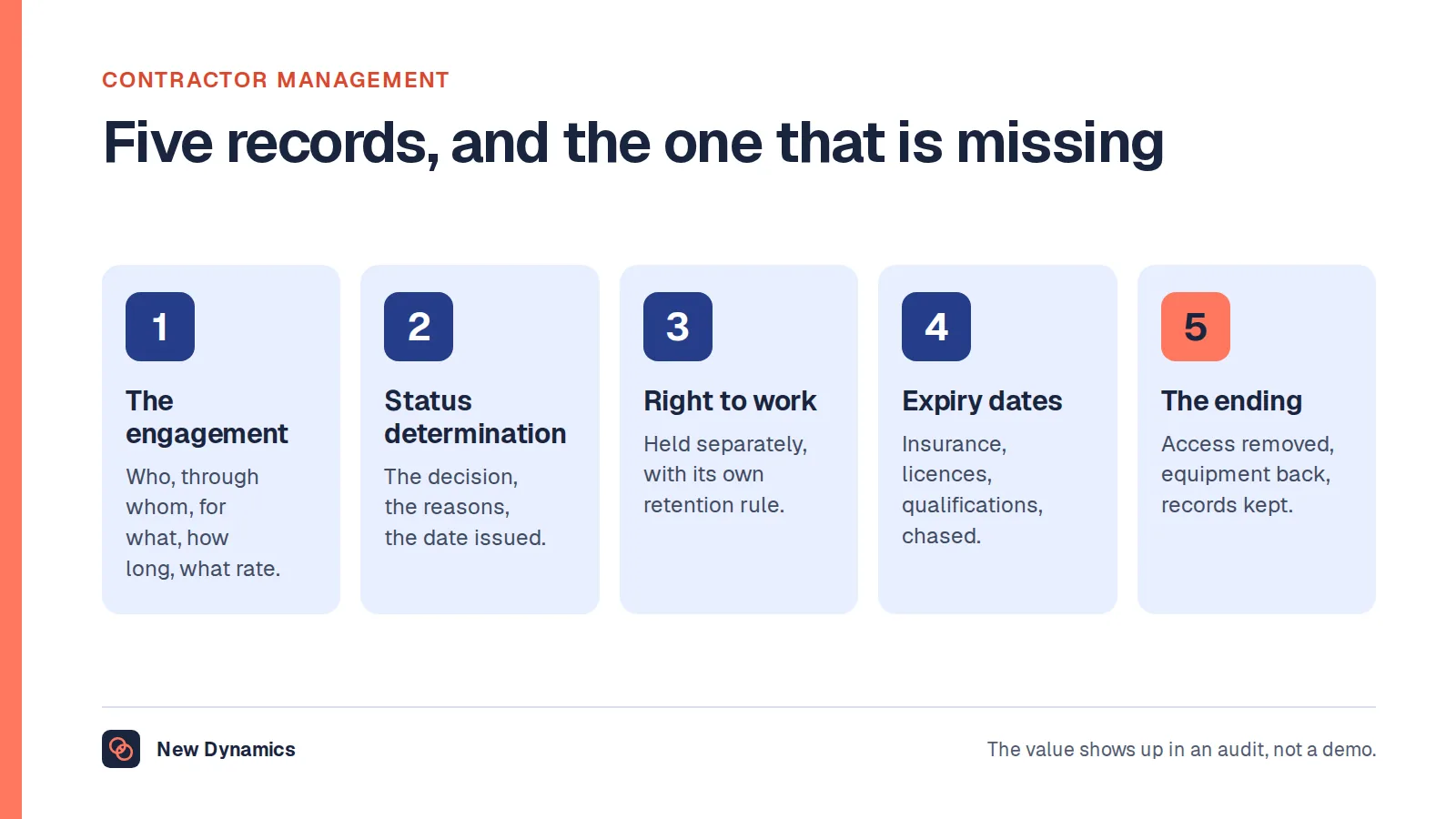
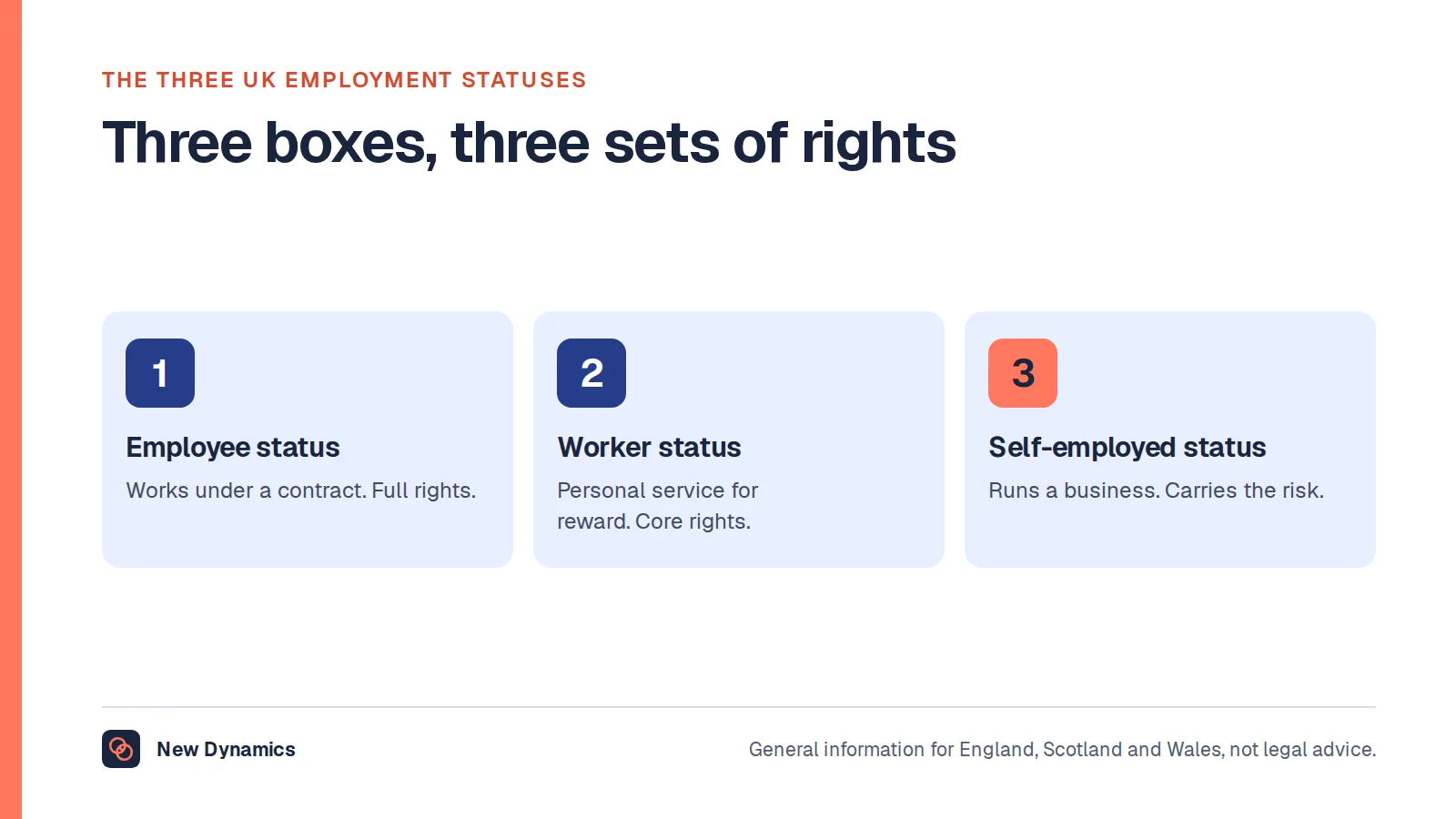
Operating the scheme correctly says nothing about whether the person should have been an employee. CIS 340 section 1.8 is explicit: "For a contract to be within the scheme, it must not be 'a contract of employment'", and "Employment status is determined in accordance with common law and it's for the contractor to consider the individual's employment status when the subcontractor is first engaged."
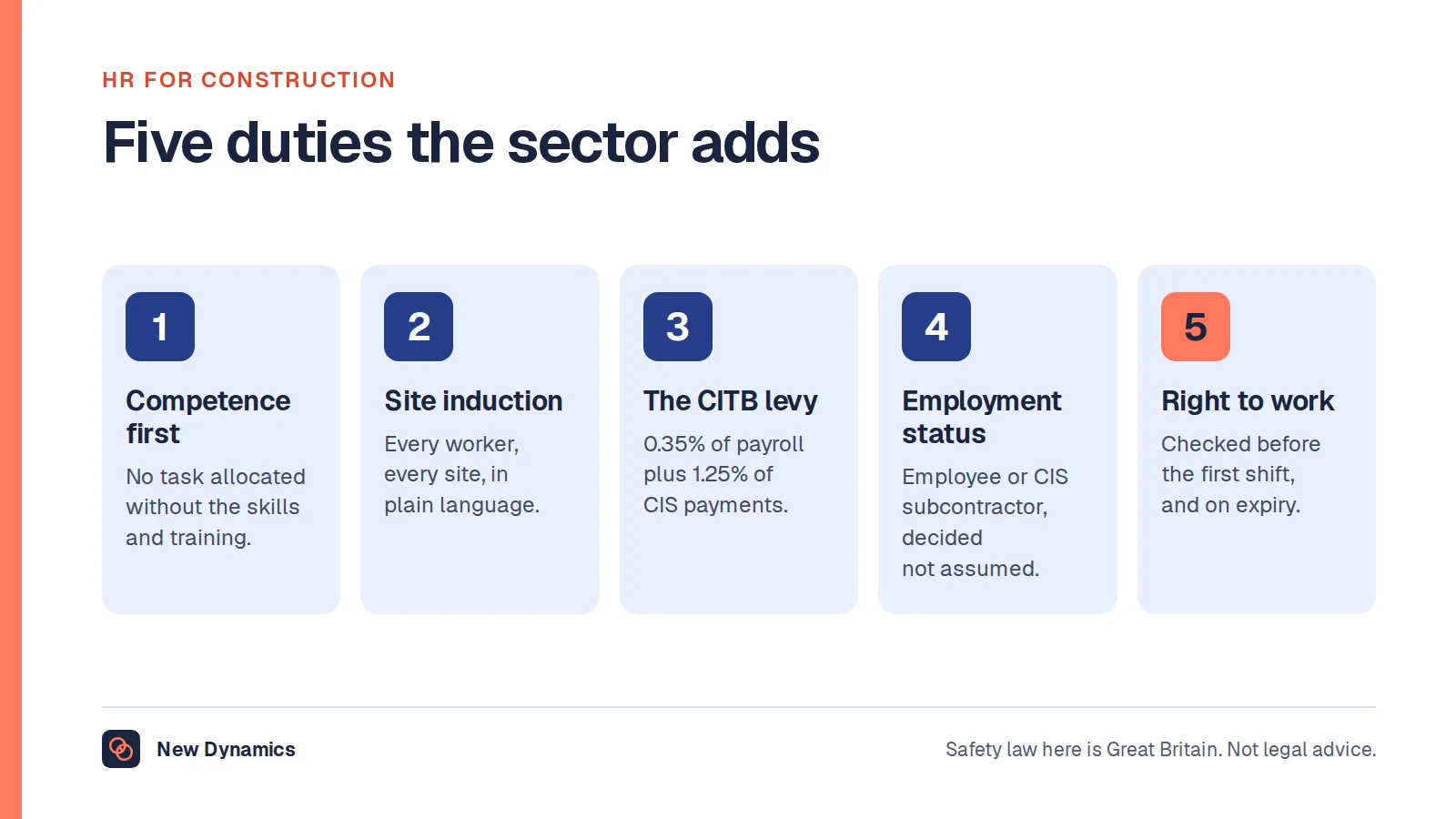
So there are two risks, and a clean set of statements answers only one. GOV.UK puts the other in a sentence: "You must check if you should employ the person instead of subcontracting the work. You may get a penalty if they should be an employee instead." A worker treated as self employed who is not is an unpaid PAYE and National Insurance liability with no statement to offset it. Our post on employment status sets out the three United Kingdom categories and the tests behind them, and the sector picture sits in HR for construction. No official source publishes how many CIS deduction statements are issued or missed each year, so we quote no figure for either; for the published people figures we do use, see the HR statistics hub.
Frequently asked questions
What is a CIS deduction statement?
It is the written statement a contractor must give a subcontractor whenever a Construction Industry Scheme deduction is made from their payment. HMRC calls it a payment and deduction statement, and the subcontractor uses it as evidence of tax already paid on their behalf.
When must a CIS deduction statement be given to a subcontractor?
Within 14 days of the end of each tax month. A tax month runs from the sixth of one month to the fifth of the next, so the deadline is the 19th. GOV.UK's example is that for the tax month 6 May to 5 June, the statement must be given by 19 June, the same date as the monthly CIS return.
What must a CIS deduction statement contain?
CIS 340 lets contractors choose the style but requires the contractor's name and employer tax reference, the tax month end date or payment date, the subcontractor's name and Unique Taxpayer Reference, the verification number where a higher rate deduction was made, the gross amount paid, the materials cost that reduced the amount deducted from, and the amount of the deduction.
Is the CIS deduction taken from the whole invoice?
No, and this is the most common mistake. Start with the gross invoice, then take off VAT, consumable stores, fuel other than fuel used for travelling, plant hire, the cost of manufacturing or prefabricating materials, and materials the subcontractor paid for directly. The percentage applies to what is left. Travel and subsistence stay in.
What happens if a contractor does not issue CIS deduction statements?
CIS 340 says HMRC may charge penalties of up to £3,000 where a contractor fails to give statements to subcontractors registered for payment under deduction. Regular failure can also be weighed when HMRC considers whether that contractor should keep its own gross payment status as a subcontractor.
Does a business outside construction have to register as a CIS contractor?
It can. GOV.UK says registration is required if "your business does not do construction work but you have spent more than £3 million on construction in the 12 months since you made your first payment", and CIS 340 frames that as a rolling one year test. Housing associations, local authorities and government departments are its examples.
Your next step: check the template, then the calendar
- Check last month's statement against the CIS 340 list. The fields most often missing are the employer tax reference and the materials cost that reduced the amount deducted from.
- Check the calculation starts from the gross invoice and strips out VAT, consumable stores, fuel other than travel fuel, plant hire, prefabrication and directly purchased materials first.
- Put one date in the calendar, not two. Statements and the return share the 19th, and a month with no payments still needs a nil return or an inactivity notification.
- Make the status decision separately and record it. A clean statement does not make a subcontractor self employed.
For the records and retention side of this, read and download our employee data protection guide. The guide is free to read, and the PDF uses our short download form.
If the real problem is that a monthly obligation lives in one person's memory, Book a New Dynamics demo and bring the process you run today. You can also email contact@new-dynamics.com.