TL;DR
- A company value is a stated preference that costs something when it is honoured. If nobody in your market would publicly claim the opposite, you have written a description of competence, not a value.
- Values only reach a review conversation safely once they are written as observable behaviour. Acas says a performance review covers what someone is doing well and any areas for improvement, and that it is important to keep a written record of what is discussed.
- Assessing someone against values fit is where bias enters performance management. Acas says less favourable treatment can be anything that puts someone with a protected characteristic at a disadvantage, and that it can still be discrimination even if it was not intended.
Most sets of company values are a list of things no reasonable person is against. Integrity, teamwork, excellence, innovation. Nobody argues with them, which is exactly the problem: a statement nobody would argue with cannot settle an argument, and settling arguments is the only job values have.
This article covers what a value actually is, how to write a set that holds, how to turn each one into behaviour a manager can discuss without judging someone's personality, and the fairness risk that comes with the phrase "values fit" in a performance review.
Values become real at the moment somebody is thanked for acting on one, in public, by name. See how New Dynamics recognition ties a thank you to the behaviour it was for, so values show up in the record of the year rather than on a wall.
If you came looking for published sets you can read in full, our post on corporate values quotes two of them. This article is about writing your own.
What a company value actually is
A value is a stated preference that costs something when it is honoured.
That is the whole definition, and the second half is the part that gets dropped. A preference with no cost attached is a description of competence. Every organisation prefers to be good at things. What distinguishes one organisation from another is what it is willing to give up, and when.
So a usable company value has three properties.
Somebody could reasonably hold the opposite. Not a villain. A competent competitor with a different theory of the business. If the opposite of your value is only held by people who are incompetent or dishonest, you have written a hygiene standard.
Honouring it costs something you can name. Money, speed, a deal, a hire, a client, an argument with somebody senior. If you cannot finish the sentence "we do this even when it costs us ...", the value has not been written yet.
It settles a decision that is genuinely close. Values are tie-breakers. They earn their place in the fortnight when two sensible courses of action point in different directions and somebody has to choose.

The test most published values fail
Take each of your values and write its opposite as a plain sentence, as though a rival were putting it on their own website. Then ask whether anyone would actually say it.
"We are against integrity." Nobody. "We do not value our customers." Nobody. "We prefer to work alone rather than in teams." Actually, somebody might, and there are businesses built on deep individual craft where that is close to true, which is why teamwork occasionally survives this test and usually does not.
The test is not a word game. It tells you whether a value carries information. A value that fails it still has uses, because it can sit in a code of conduct as a minimum standard, and minimum standards matter. It just cannot guide a decision, because nothing in the organisation is pulling the other way.
The other failure is harder to spot. A value can pass the opposite test and still be dead, because nothing in the business has ever been given up for it. Written values and operating values diverge quietly: the operating values are whatever behaviour actually gets rewarded, promoted and forgiven. If the two sets disagree, people follow the operating set and stop reading the other one, and you have taught everybody that published statements are decoration.
How to write company values

- Start from decisions you have already made, not from adjectives. Go back through the last two years and find five hard calls: the client you resigned, the hire you turned down, the deadline you missed on purpose, the refund you gave that you did not owe, the feature you refused to build. Each one was a preference acted on under cost. The values are already in there.
- Name the trade-off in the sentence. A value should read as a choice, not a quality. "We would rather be clear than clever." "We finish before we start." The grammar of a choice forces a comparison, and a comparison is what makes it usable.
- Use plain words. If a value needs a glossary, it will not be quoted by anyone. Short Anglo-Saxon words survive translation into daily speech, which is where values either live or die. Avoid anything you would not say out loud in a corridor.
- Keep them few. Three to five. A list of nine is a list nobody can recall under pressure, and recall under pressure is the entire use case. Anything that is a legal or safety requirement belongs in a policy, not in the values, because it is not optional and therefore not a choice.
- Test each one against a real case. Take a decision currently sitting unresolved and ask whether the draft value points at an answer. If every value is compatible with both options, none of them is doing work.
- Write what each value is not. A sentence of the form "this does not mean ..." prevents the most common abuse, where a value gets stretched to justify whatever somebody already wanted to do.
Four value statements of our own
These four are ours, written as examples for this article rather than borrowed from anybody else, and they are written the hard way so the shape is visible. Each one has a cost in the open.
"We say the number we believe, not the number that wins the meeting"
The cost: slower buy-in, and the occasional forecast that makes a quarter look worse than a more generous reading would. The reasonable opposite: optimism is a management tool, and a team that believes it can hit a stretch number sometimes does.
"We finish what we have started before we start what is interesting"
The cost: ideas with real merit get delayed, and some of them go stale and die. The reasonable opposite: move resource to the best available opportunity whenever it appears, because sunk cost is not a reason to continue.
"We write it down, even when a conversation would be quicker"
The cost: real time, today, on something whose benefit lands months later with somebody who has not joined yet. The reasonable opposite: documentation ages badly and a short conversation is cheaper than a wrong document.
"We tell the customer the thing they will not like, early"
The cost: uncomfortable calls, and sometimes a renewal. The reasonable opposite: wait until you have a solution to offer alongside the problem, because bad news without a remedy only creates alarm.
Notice what these have in common. In each case a competent, honest person could run a business the other way. That is what makes them values rather than compliments.
From value to observable behaviour
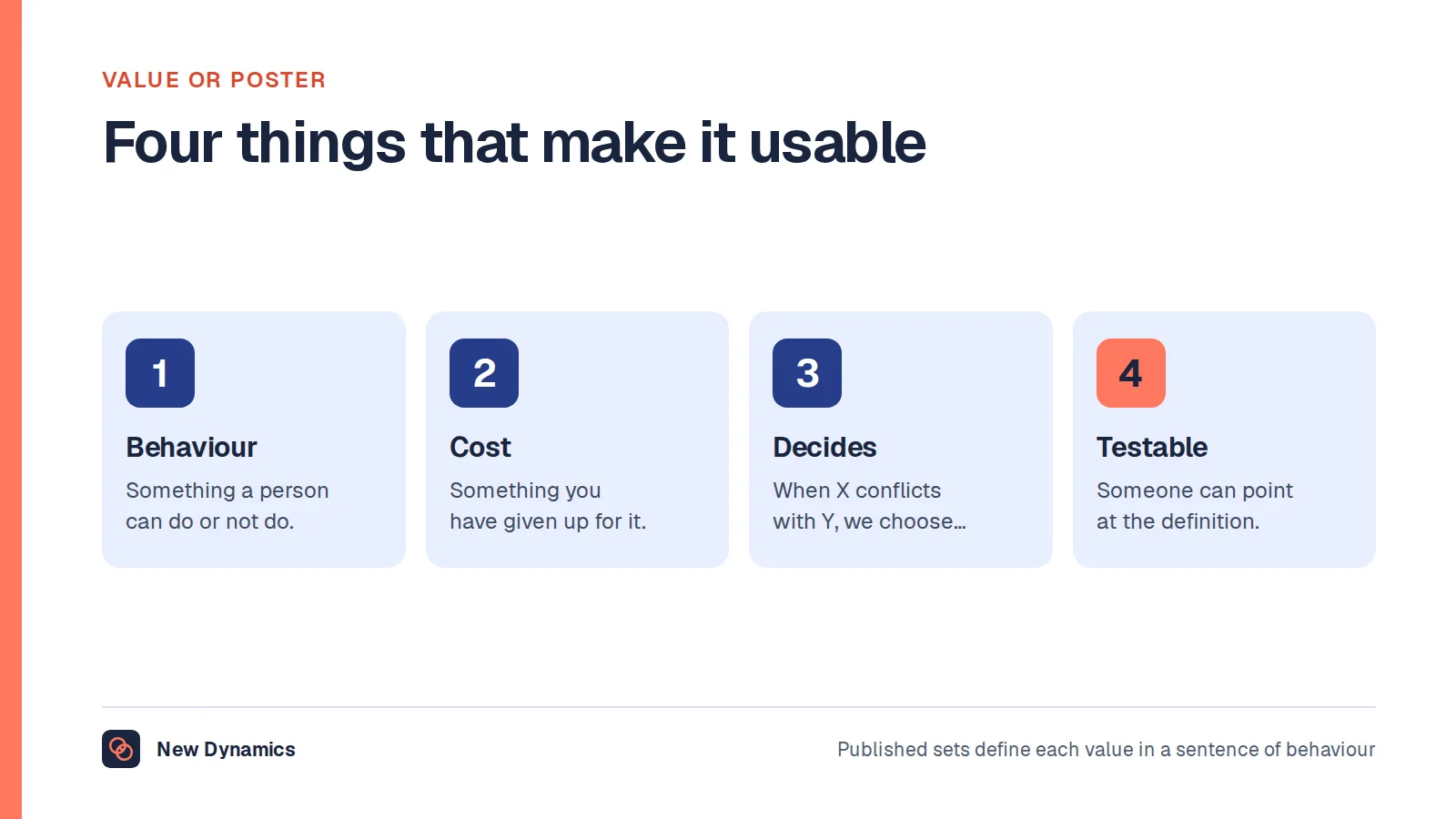
A value is an abstraction, and you cannot assess somebody against an abstraction without assessing their personality. That is the mechanism by which values exercises turn into character judgements, and it is avoidable. For each value, write two or three behaviours that can be seen, with the version that fails next to it.
| Value | What it looks like | What it is not |
|---|---|---|
| Say the number you believe | Flagged a slipping date in the week it slipped, with a revised estimate | Being gloomy in meetings, or refusing to commit to anything |
| Finish before you start | Closed out the previous piece of work, or handed it over in writing | Refusing all new work, or hoarding a task past its usefulness |
| Write it down | Left a decision record the next person could act on without asking | Long documents nobody reads, or minutes used to allocate blame |
| Tell the customer early | Raised a problem with the client before they found it themselves | Passing every internal worry straight to the customer |
The right-hand column matters as much as the middle one. Every value has a failure mode that looks like enthusiasm for it, and naming that failure mode is what stops the value being used as a weapon.
Behaviour written this way survives a review conversation. Acas describes performance reviews as "a chance to discuss someone's work, including: what they are doing well, any areas for improvement, whether they need more support or training, their career and any development objectives", and says that "it's important to keep a written record of what is discussed" and that this "should be shared with the employee afterwards". A record saying somebody "does not live our values" is unusable. A record saying a date slipped three times without being flagged, with the dates, is a conversation anybody can have. Our competency feedback examples show the same move applied to competency frameworks.
Values and culture: which one comes first
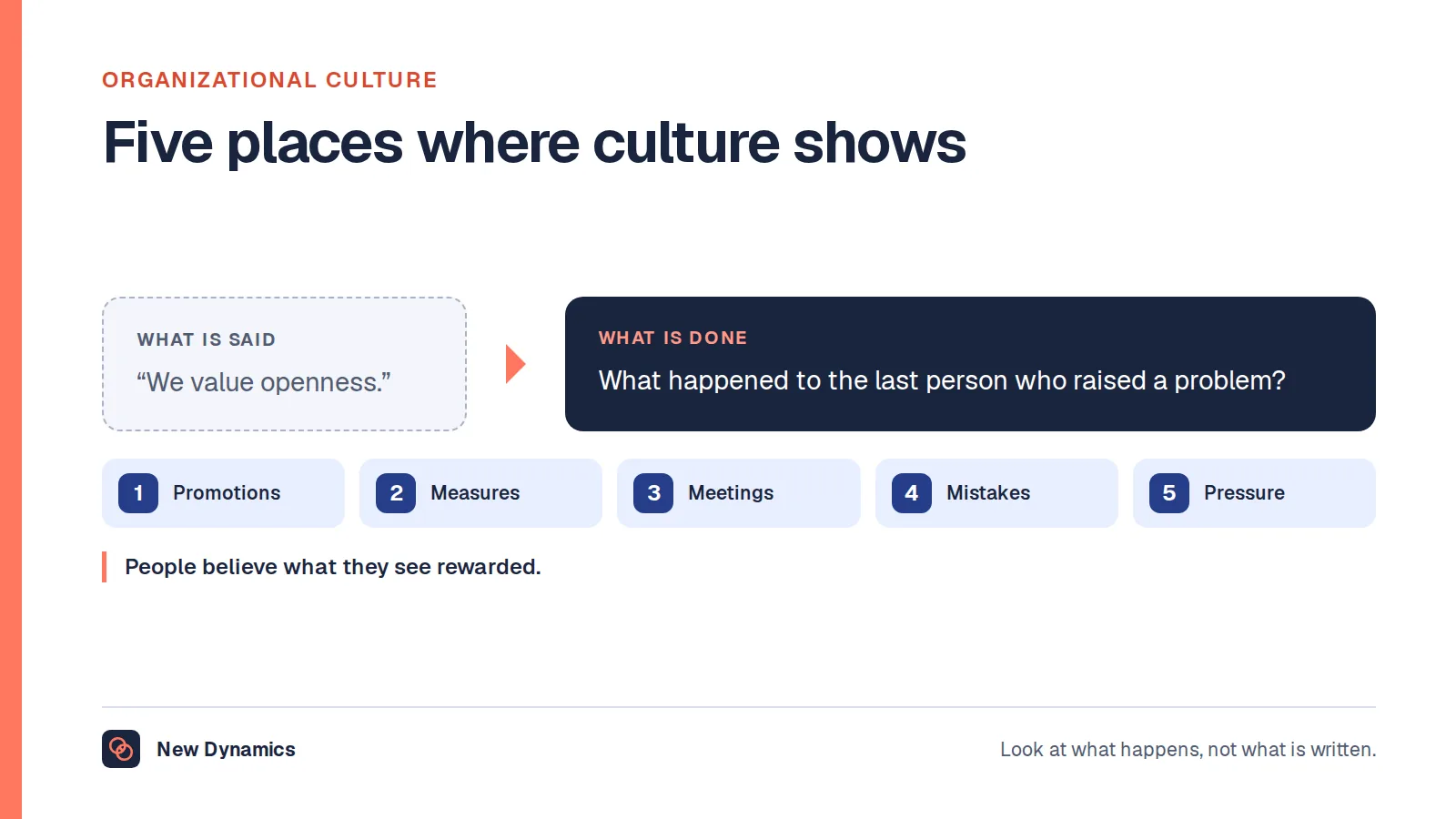
Values are what you say you prefer. Culture is what people here actually do when no process tells them what to do. The two are related, but the direction of travel runs from behaviour to values far more often than the other way round, which is why defining company culture by publishing a values poster rarely changes anything.
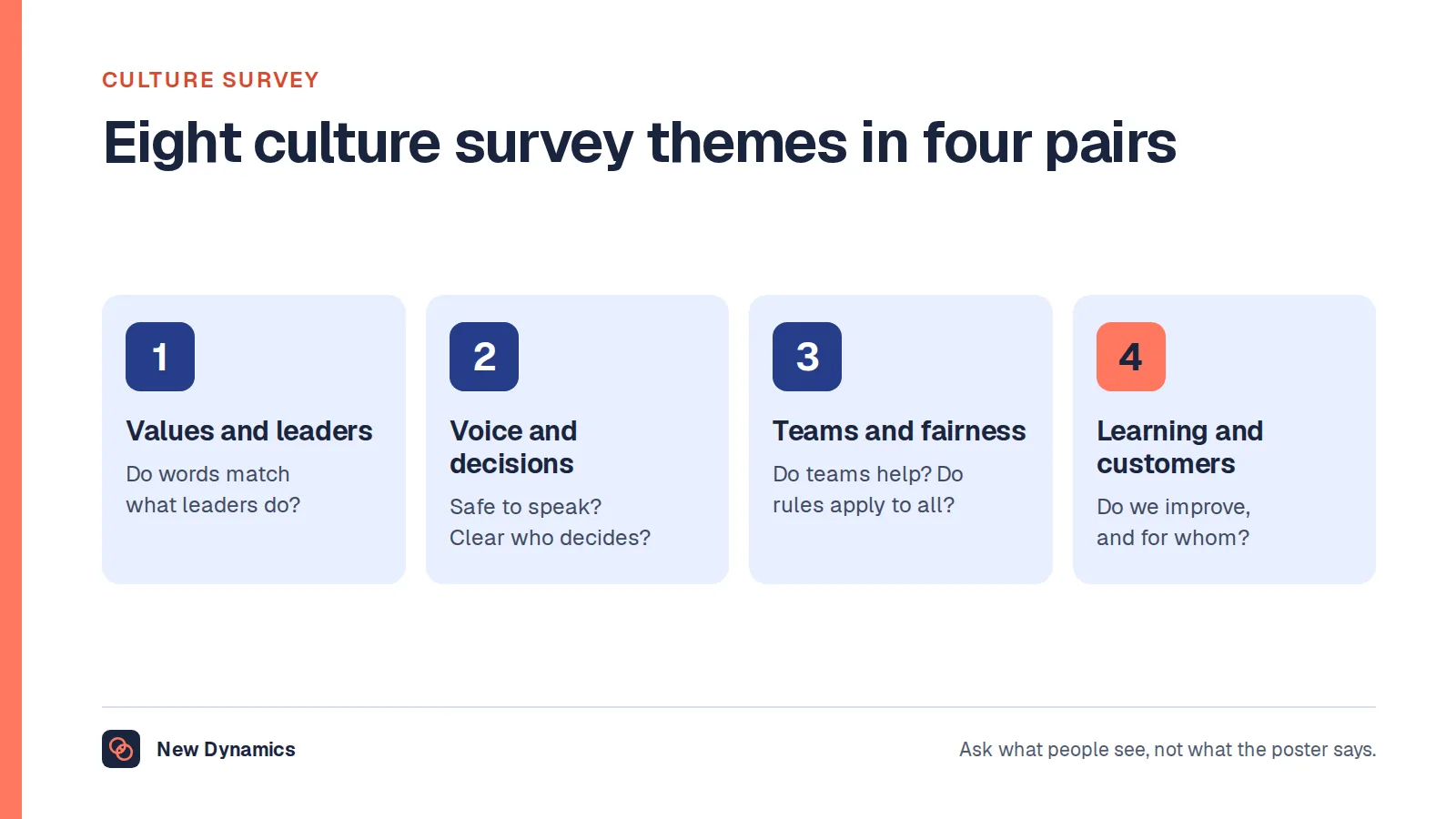
The practical version: culture is the sum of what gets rewarded, what gets tolerated and what gets punished. If you want to know your operating values, do not read the statement. Look at the last three promotions, the last person who left in frustration, and the last time somebody senior was wrong in public. Our post on organisational culture covers the wider frame, and our culture survey questions are a way of finding the gap between the stated set and the operating one without guessing.
The fairness risk when values reach a review
This section describes the position in the United Kingdom and is general information rather than legal advice. Take advice on your own circumstances.
"Values fit" is where bias enters performance management. The phrase is attractive precisely because it is vague, and vagueness lets an assessor reach for whatever impression they already had. Judgements about fit track things that have nothing to do with the work: how fluently somebody speaks in a meeting, whether they socialise after work, whether they remind the assessor of themselves, whether their working pattern makes them visible at the times senior people are looking.
The legal exposure is straightforward. Acas says discrimination "means treating someone 'less favourably' than someone else, because of" a protected characteristic, and that "less favourable treatment can be anything that puts someone with a protected characteristic at a disadvantage, compared to someone who does not have that characteristic". It lists examples including "excluding someone from opportunities or benefits" and "making it harder for someone to do their job", and makes the point that matters most here: "it can still be discrimination even if the less favourable treatment was not intended". A values rating that quietly gates promotion, development funding or interesting work is exactly that kind of opportunity.
Four safeguards, all cheap.
- Assess behaviour, never traits. The question is what the person did and when, not what sort of person they are.
- Require evidence for a values judgement, especially a negative one. No example means no rating. Acas also says objectives "should be fair and reflect the employee's usual tasks and workload", and a fairness standard that applies to objectives applies at least as strongly to a judgement about character.
- Never let a values rating override delivered work without a written reason. If somebody delivered and still scored badly on values, the reason has to be a specific incident that was raised with them at the time.
- Read the distribution. Count values ratings by sex, ethnicity, age, disability, working pattern and part-time status wherever the numbers are large enough to protect anonymity, and count them by manager too. A pattern is a finding.
For the wider process, our performance review guide sets out how to keep a cycle anchored in evidence.
Where values show up: recognition, hiring and hard decisions
Recognition. This is the cheapest and most honest test of whether values are real. If you cannot name somebody thanked in the last month for acting on a specific value, at a specific cost, the set is inert. Recognition that names the behaviour teaches the behaviour; recognition for general brilliance teaches nothing.
Hiring. Values belong in the question, not in the scorecard adjective. Ask candidates for a time they chose the harder of two defensible options and what it cost. Score the answer against the behaviour table, with the same questions for every candidate. "Culture fit" as a free-text box at the end of an interview is a bias collection device.
Hard decisions. A value proves itself in public when it is expensive: the client you resign, the launch you delay, the commission you do not pay because the deal was mis-sold. Those moments are worth writing up internally, because a single explained decision does more for a set of values than a year of reminders.
Values statements: what a statement of values is for
A values statement is the published artefact: the short document that names each value, explains the trade-off and gives the behaviour. It is not a mission statement, which says what you are for, and it is not a code of conduct, which sets the minimum standards that are not optional.
Keep the statement to one page. Each value gets its plain sentence, a line on what it costs, two or three observable behaviours and one sentence on what it does not mean. Date it, and say who agreed it. A statement that cannot be read in two minutes will be summarised by somebody else, and their summary becomes the real one. Our code of conduct guide covers the companion document, including which obligations belong there rather than in the values.
What goes wrong

Values written by committee. Every round of consultation sands off the edges, because the edges are the bits somebody objects to, and the edges were the value. Consultation is useful for testing whether a draft is recognisable and whether it can be lived with. It is a poor way to generate the draft. A small group with decision-making authority writes a better set than a workshop of thirty, provided they then publish it and let people argue.
Values nobody can breach. If no behaviour in the organisation would count as breaking a value, the value is not operative. The useful question for every draft is: what would somebody have to do for us to say that was a breach, and would we actually say so if the person were senior and successful?
Values used to punish dissent. This is the serious one. A value like "we assume positive intent" or "we commit and move forward" can be turned into a rule against raising problems, and then disagreement becomes a values breach rather than a contribution. Watch for values cited in response to a challenge rather than in response to a decision. Where the concern involves wrongdoing, legal protection applies: GOV.UK says "you're a whistleblower if you're a worker and you report certain types of wrongdoing", that the disclosure "must be in the public interest", and that "as a whistleblower you're protected by law - you should not be treated unfairly or lose your job because you 'blow the whistle'". A values framework that makes speaking up costly is a risk to the organisation, not a feature of its culture.
The gap between stated and operating values. The most common failure and the easiest to detect, because everybody already knows about it. Ask people what it actually takes to get promoted here. Compare the answers with the published list. The distance between the two is your real culture problem, and no amount of rewriting the statement closes it. Changing what gets rewarded does.
Too many values. A list long enough to cover every virtue cannot be prioritised, so in any real conflict people pick whichever item supports the decision they already favour.
Frequently asked questions
What are company values?
Company values are the stated preferences an organisation uses to settle decisions when two reasonable courses of action conflict. A working value has a cost attached: you can name what the organisation gives up when it honours the value. A preference with no cost is a description of competence rather than a value.
How many core values should a company have?
Three to five. The purpose of values is recall under pressure, and a list of nine cannot be recalled or prioritised, so in any genuine conflict people select whichever item supports the decision they had already reached. Anything that is a legal or safety requirement belongs in a policy, because it is not a choice.
What is the difference between values and culture?
Values are what an organisation says it prefers. Culture is what people actually do when no process tells them what to do. Culture is built from what gets rewarded, tolerated and punished, so publishing a values statement does not change it on its own. Changing what gets rewarded does.
Can you assess someone against company values in a performance review?
You can assess behaviour, and you should not assess personality. Write two or three observable behaviours for each value, require a specific example with a rough date for any rating, and never let a values judgement override delivered work without a written reason that was raised with the person at the time.
Is values fit a fair basis for performance or promotion decisions?
Treat it as a risk. Acas says less favourable treatment can be anything that puts someone with a protected characteristic at a disadvantage, lists excluding someone from opportunities or benefits as an example, and notes it can still be discrimination even if it was not intended. Anchor every judgement in behaviour and evidence, and read the distribution of ratings by group and by manager. Take advice on your own circumstances.
What should a statement of values include?
One page. Each value as a plain sentence written as a choice, a line naming what honouring it costs, two or three behaviours somebody could observe, and one sentence on what the value does not mean. Date it and say who agreed it, so it can be revisited rather than quietly outgrown.
Your next steps
- Write the opposite of each of your current values as a plain sentence. Delete or rewrite any value whose opposite nobody would claim.
- For each surviving value, finish the sentence "we do this even when it costs us ...". If you cannot, it is not a value yet.
- Write two or three observable behaviours per value, with the failure mode that looks like enthusiasm for it in the next column.
- Find one decision from the last year where a value was honoured at real cost, and write it up internally. One explained decision outperforms a year of reminders.
- Count last cycle's values ratings by manager and by group, with a threshold that protects anonymity, and look at what the pattern tells you.
For the review process these judgements sit inside, read and download our performance review guide. The guide is free to read, and the PDF uses our short download form.
Want values to appear in the record of the year rather than on a wall? Book a New Dynamics demo and bring your current values statement and your review form. You can also email contact@new-dynamics.com.