TL;DR
- A competency is a described behaviour that can be observed and evidenced. A skill, a value and a personality trait are three other things entirely, and confusing them is the root of most unusable frameworks.
- Build one from the work your organisation actually does, keep it to five to eight competencies, write each at two or three levels, and test every descriptor by asking whether two assessors reading the same evidence would reach the same answer.
- The strongest argument for a framework is fairness. It turns "they are not quite ready" into something a person can act on, and it makes a promotion or a rating reviewable afterwards.
Somebody has just been told they are not quite ready for the next role. They ask what would make them ready, and the honest answer is that nobody wrote it down. That conversation is the reason competency frameworks exist, and it is the test of whether yours is any good.
This article covers what a competency is and what it is not, how to build a framework that managers will use, a sample competency written out at three levels, the fairness case for having one, and how to keep it from turning a review into a scoring exercise. It describes the position in Great Britain and is general information rather than legal advice.
A framework only works if the evidence sits with the behaviour all year rather than being reconstructed in April. See how New Dynamics performance reviews keep competencies, examples and comments on the same record.
What a competency actually is

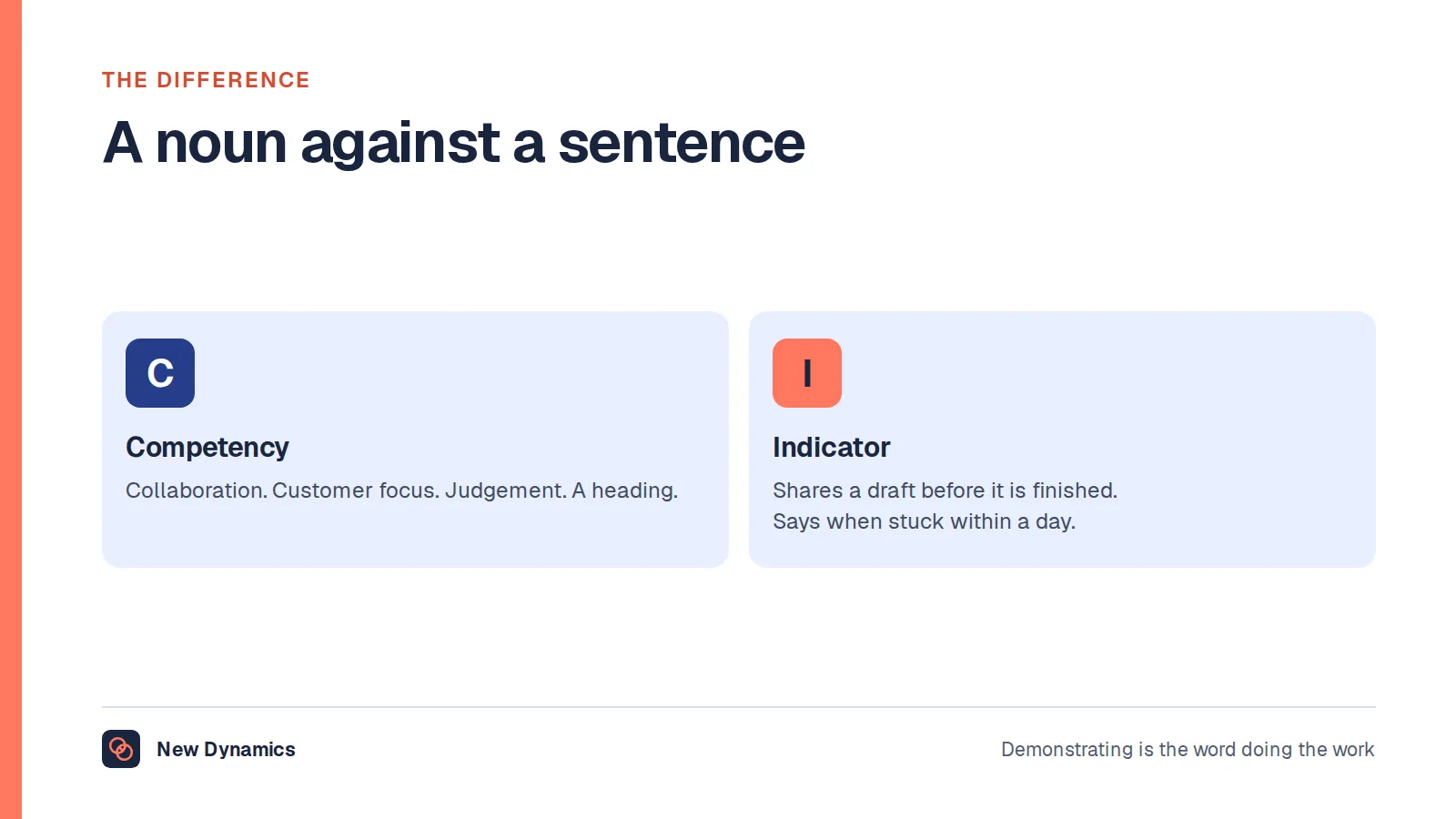
A competency is a described behaviour: something a person does, written plainly enough that it can be observed at the time and evidenced afterwards. "Says when a deadline will be missed before the deadline arrives" is a competency statement. It happened or it did not.
Three other things get written into frameworks in its place, and each one causes a different failure.
A skill is a capability, not a behaviour. Someone can hold a skill and never use it, which means a skill cannot be rated from a review cycle, only inferred. Skills belong in a skills inventory and in training plans. Write "builds a forecast model" as a skill and you will spend the review arguing about whether the person could have done it rather than what they did.
A value is what the organisation says it cares about. Integrity, ambition, respect. Values are useful as a frame and useless as an assessment standard, because the gap between the word and the evidence is wide enough for any manager to fill with their own impression. A value becomes assessable only when you write out the behaviour that would show it, at which point it has become a competency.
A personality trait is a disposition. Extraversion, agreeableness, resilience as a temperament. Rating a trait is rating who somebody is, which is both unfair and unfixable. It is also the point at which a framework starts measuring similarity to the assessor. Our post on behavioural indicators goes deeper into writing the sentence underneath each heading, and our post on core competencies covers choosing the headings themselves.
The practical consequence is this. A behavioural competency describes an action with an outcome attached. If you cannot say where you would look for evidence of it, you have written a value or a trait and labelled it a competency.
A published example: Civil Service Success Profiles
If you want to see a competency framework in live use rather than in a textbook, the UK Civil Service publishes one. Success Profiles, published by the Cabinet Office on 18 June 2018, states that "Success Profiles are the recruitment framework used within the Civil Service."
What makes it worth reading is that it does not treat behaviours as the whole picture. It names five performance elements and defines each one separately:
- Behaviours, which it defines as "the actions and activities that people do which result in effective performance in a job".
- Strengths, "the things we do regularly, do well and that motivate us".
- Ability, "the aptitude or potential to perform to the required standard".
- Experience, "the knowledge or mastery of an activity or subject gained through involvement in or exposure to it".
- Technical, "the demonstration of specific professional skills, knowledge or qualifications".
Read those five definitions next to each other and the distinction this article opened with is already made for you, by a published framework, in its own words. Behaviours are the actions people take. Technical skills are a separate element. Potential is a third thing again. A framework that collapses all of them into one list of twelve adjectives is not being comprehensive, it is losing information.
You do not have to adopt all five elements. The useful habit is to be explicit about which element each line of your framework is assessing, and to stop mixing them inside a single rating.
How to build one

Start from the work
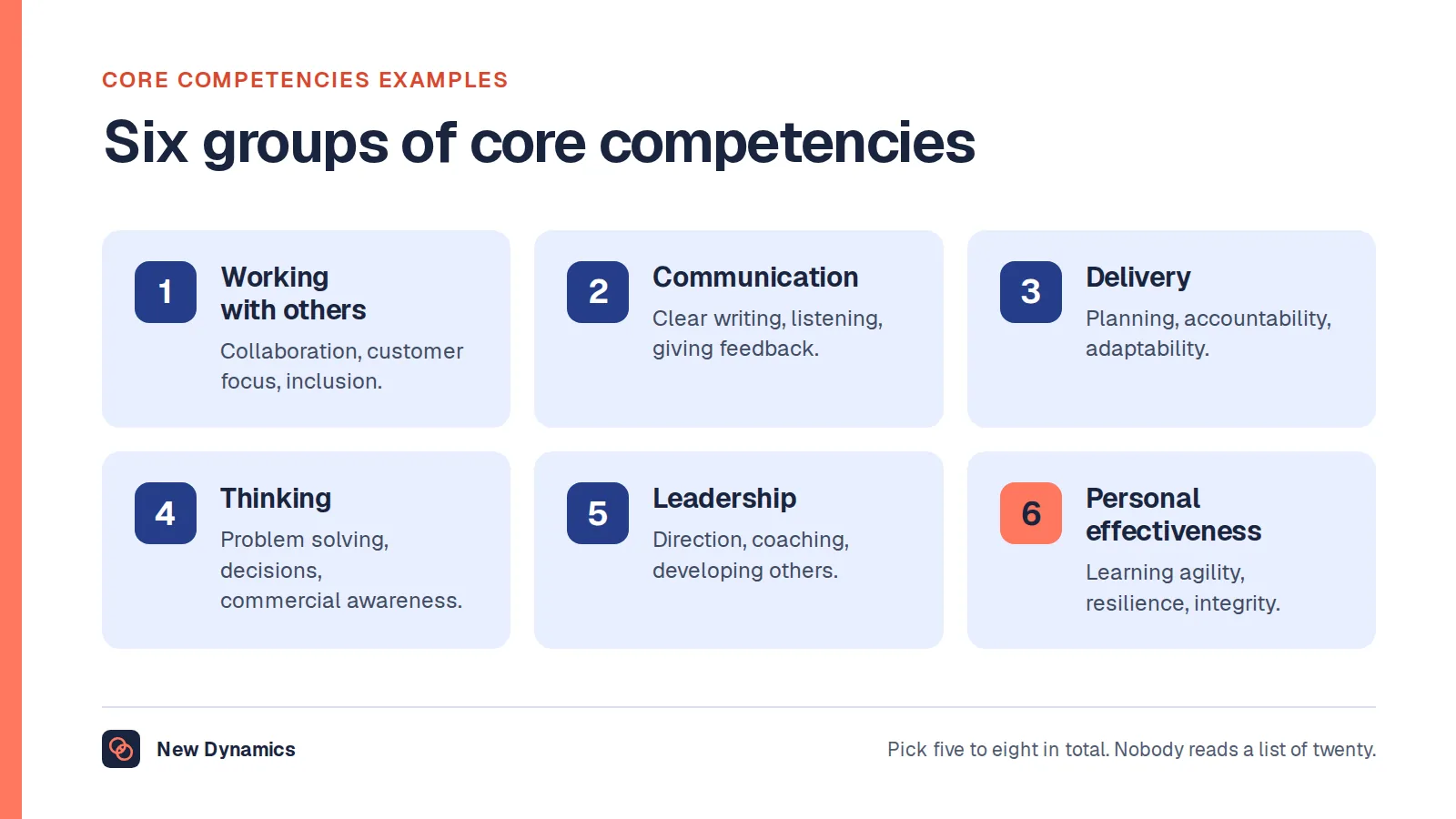
Do not start from a list you found. Start by asking what the people who are visibly good at the work here do differently from the people who are struggling, and write the answers as sentences about actions. You will get fifteen or twenty. Group them, and the headings that emerge are your competencies, named in your organisation's own language rather than in generic framework vocabulary.
Test each candidate against the work. If a competency would read identically for a software firm, a construction business and a hospital, it is probably too abstract to assess.
Keep the list short
Five to eight competencies, applying to everyone. The instinct to add one more is always reasonable in isolation and always wrong in aggregate, because a manager with forty competencies in front of them uses the three they remember, which is the same as having three with far more paperwork.
Write each competency at two or three levels
Two levels if your structure is flat, three if you have a genuine step between doing the work, leading the work and shaping how the work is done. More than three and the levels stop being distinguishable in practice.
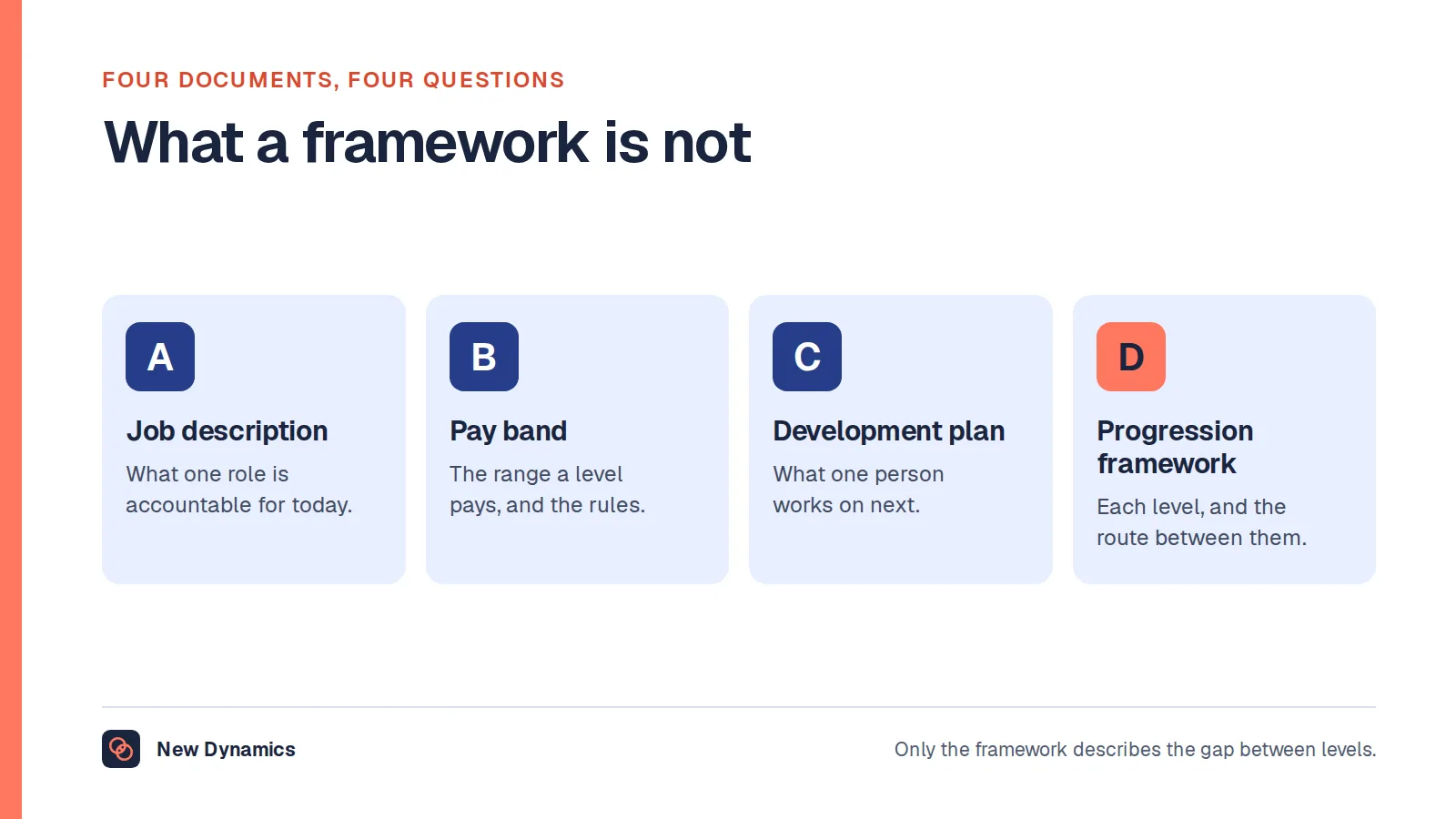
Each level must name a different behaviour, not the same behaviour with a stronger adverb. "Communicates clearly" at level one and "communicates very clearly" at level two is one level pretending to be two. If you need help describing the levels themselves rather than the behaviours inside them, our post on the career progression framework covers how many levels to run and how they relate to pay and job titles.
Write descriptors two assessors would agree on
This is the only quality test that matters. Take a real piece of evidence, give it to two managers with the descriptor, and ask each to say which level it shows. If they disagree, the descriptor is the problem, not the managers. Rewrite it until they agree, which almost always means removing an adjective and adding a named action, an audience or a timeframe.
A sample competency written at three levels
Here is one competency written out in full, as a shape to copy. The competency is deliberately narrow, because narrow competencies are the ones managers can evidence.
Competency: raising problems early. How someone handles work that is going wrong, from noticing it to telling the people who need to know in time to act.
| Level | Described behaviour | Where the evidence comes from |
|---|---|---|
| 1. Own work | Says a task will miss its date before the date, not after it. Brings the problem together with what they have already tried. Tells the one person most affected, in a form that person can act on. | Project and ticket histories, one-to-one notes, the messages that flagged the slip. |
| 2. A team or a project | Notices a slip in somebody else's work and raises it with that person first. Offers the people affected two options rather than only the bad news. Records the decision taken, so the same question is not reopened a month later. | Project and risk logs, meeting notes, what colleagues say in feedback. |
| 3. Across teams | Changes how the work is planned so the same category of slip stops recurring. Reports a risk to a senior forum when doing so makes their own area look worse. Responds to early warnings without blame, so people keep giving them. | Process or planning changes they made, minutes of the forum, whether others escalate up. |
Three things to notice. Every line is an action with a timeframe or an audience attached. The levels describe different work, not the same work rated more generously. And the evidence column exists, which is what stops the competency becoming a vibe.
The anti-pattern, for contrast, is the version most frameworks ship: "Level 1: communicates risk. Level 2: communicates risk effectively. Level 3: communicates risk strategically." Nobody can evidence that, and nobody can act on it.
Our post on competency feedback examples has review wording for three competencies managers get stuck on, if you want to see the next step from descriptor to written comment.
The fairness argument, which is the strongest one
The usual case for a framework is consistency. The better case is fairness, and it has two parts.
First, a framework converts an impression into an action. "They are not quite ready" is not reviewable, not improvable and not arguable. "At level 2 we would expect you to raise a slip in a colleague's work with that colleague directly, and in the last two quarters that went to me instead" is all three. Acas puts the same obligation on the development objective that follows: objectives should be "specific", "measurable", "achievable", "relevant" and "time-bound", and Acas adds that "objectives should be fair and reflect the employee's usual tasks and workload". A named behaviour makes that possible. An adjective does not.
Second, a framework makes a decision reviewable after the fact. Acas describes a performance review as a chance to discuss "what they are doing well, any areas for improvement, whether they need more support or training", and says that reviews may assess whether someone is "demonstrating the right behaviours in their work". It also says "it's important to keep a written record of what is discussed" and that this "should be shared with the employee afterwards". A framework gives that record a shared vocabulary, so a promotion or a rating can be explained to the person, to a second manager and, if it ever comes to it, to somebody outside the organisation.
That second point is where the law touches this. Acas states that "discrimination means treating someone 'less favourably' than someone else, because of" a protected characteristic, and lists those characteristics as "age, disability, gender reassignment, marriage and civil partnership, pregnancy and maternity, race, religion or belief, sex, sexual orientation". It describes indirect discrimination as "when everyone's treated the same but people with a protected characteristic are put at a disadvantage".
That last definition is the one competency frameworks need to be careful about, because a framework applies the same words to everybody by design. Behaviour descriptions must not become a proxy for personality, confidence or cultural similarity. A descriptor such as "speaks up in meetings" or "has presence with senior stakeholders" sounds like behaviour and is actually manner, and it will systematically favour people who are extraverted, who are not managing a disability, who share the assessor's background or who have been given exposure to senior people in the first place. Write the result you need, which is usually "the risk was known in time to act on it", and let people reach it in their own way. This is general information rather than legal advice, and anything consequential deserves advice on your own facts.
There is no official statistic on how many UK employers run a competency framework. Neither Acas nor the Office for National Statistics publishes that figure, so treat any percentage you are quoted without a named source with suspicion. Our HR statistics page collects the workforce figures that are actually published.
How it appears in a review without becoming a scoring exercise
The failure mode of a good framework is that the review becomes an audit of the framework. Four habits prevent that.
Evidence two or three descriptors per competency, not all of them. Completeness is not the goal. A defensible example and a clear next step is the goal.
Let the person bring their own evidence first. They were there for all of it and the manager was there for some of it. The framework then becomes a shared reference rather than a verdict handed down.
Spend the conversation on the gap, not the score. The score is a byproduct. The sentence worth twenty minutes is the one about what would be different at the next level.
Record "no evidence this period" where that is true. It is an honest entry, it is better than a guess in either direction, and it is a prompt for the next cycle.
Calibrate afterwards rather than during. Wording narrows interpretation, it does not eliminate it, so a short conversation between managers about where a level boundary actually sits is worth more than another revision of the descriptor.
Keeping it from bloating
Every framework gains weight. Each addition is defensible and the total is unusable, so set the rules before the pressure arrives.
- Fix a maximum number of competencies and descriptors, and treat it as a budget. A new competency enters only when an old one leaves.
- Review once a year, and delete. Look at which descriptors were cited in actual reviews. Anything no manager used in twelve months is either badly written or not real work. Remove it instead of explaining it harder.
- Resist the role-specific annexe. The moment each team gets its own version, cross-team comparison and calibration stop working. Keep the framework common, and put role-specific requirements in the job description and the objectives.
- Date the version and say what changed. A framework that moves silently is one nobody trusts to drive a rating.
Where competency frameworks go wrong

Forty competencies. The commonest failure and the easiest to diagnose. Ask three managers to name the framework's competencies without looking. If they cannot, the length has already defeated it.
Descriptors written as adjectives. "Strong communicator", "proactive", "highly effective". These are the author's conclusion with the reasoning removed. They cannot be evidenced, cannot be disputed and cannot be improved, so every rating comes down to the manager's general feeling about the person.
Levels that repeat. The same sentence at each level with the adverb turned up. If level 3 does not describe different work from level 1, the framework cannot support a promotion decision and will instead be used to justify one already made.
A framework that is never used in a decision. The quietest failure. It is published, it is on the intranet, it appears in the review form, and no promotion, rating, pay decision or development plan has ever turned on it. At that point it is documentation of an intention rather than a framework, and people treat it accordingly. The honest fix is to use it in one real decision and show your working.
Written by one person. A framework drafted alone describes its author's strengths. Draft it with a group that includes people doing the work, not only the people managing it, and test the descriptors on real evidence before publishing.
Frequently asked questions
What is a competency framework?
A short, agreed set of described behaviours, usually five to eight, each written at two or three levels, used to assess and develop people consistently. The behaviours must be specific enough to observe at the time and evidence afterwards, which is what separates a framework from a list of values.
What is the difference between a competency and a skill?
A competency is a behaviour someone demonstrated. A skill is a capability they hold, which may or may not have been used. Skills belong in a skills inventory and in training plans. Rating a skill from a review cycle means inferring it from behaviour anyway, so write the behaviour.
How many competencies should a framework have?
Five to eight for the whole organisation, with three to five described behaviours at each level. Beyond that managers use the handful they remember, so a longer framework produces the same assessment with more administration and less consistency.
What are behavioural competencies?
Competencies written as actions with an outcome attached, rather than as adjectives or traits. "Tells the people affected about a delay before they ask" is a behavioural competency. "Good communicator" is a label. The test is whether two people watching the same quarter would agree on whether it happened.
Can a competency framework be discriminatory?
It can, if descriptors describe manner rather than contribution. Acas describes indirect discrimination as everyone being treated the same while people with a protected characteristic are put at a disadvantage, which is what a descriptor rewarding visible confidence or senior exposure does. Write the outcome you need and let people reach it their own way. This is general information rather than legal advice.
Where can I see a real competency framework?
The UK Civil Service publishes Success Profiles, which names behaviours as one of five elements alongside strengths, ability, experience and technical skills, with a published definition for each. It is a useful model because it keeps those elements separate instead of merging them into a single rating.
Your next step: fix three descriptors
- Open your framework and count the competencies. If there are more than eight, pick the eight that managers actually cite and park the rest.
- Find three descriptors built on an adjective and rewrite each as an action with an audience or a timeframe.
- Take one real piece of evidence to two managers and ask which level it shows. Rewrite until they agree.
- Read the whole set for manner, and replace anything about confidence, presence or style with the result you need.
- Name one real decision in the next cycle that the framework will drive, and show your working when you make it.
For turning those descriptors into feedback and development actions, read and download our competency-based feedback guide. The guide is free to read, and the PDF uses our short download form.
Want your competencies and the evidence behind them on the same record all year? Book a New Dynamics demo and bring the framework you use today. You can also email contact@new-dynamics.com.