TL;DR
- A disciplinary procedure runs in a set order: establish the facts, decide whether there is a case to answer, write to the employee, hold a hearing at which they can be accompanied, decide, confirm in writing, and offer an appeal heard by someone not previously involved.
- The Acas Code of Practice on disciplinary and grievance procedures is the spine of the process. A failure to follow it is not unlawful in itself, but a tribunal takes it into account and can adjust an award by up to 25 per cent for an unreasonable failure to comply.
- Dismissal without notice is possible for gross misconduct, but it still needs a fair procedure. Suspension should not be automatic and should be as brief as possible, and written records of the case should be kept.
Most employers know roughly what a disciplinary procedure contains. Far fewer run it in the right order, with the right people, at the right pace. That gap is expensive, because tribunals rarely ask whether the conduct happened. They ask how the employer found out, what the employee was told, and who decided.
This article sets out the disciplinary procedure end to end, from the first investigation to the appeal, and then answers the questions that come up inside it: what disciplinary action actually means, what insubordination is in a UK context, whether instant dismissal is a real thing, when suspension is appropriate and how long to keep the paperwork. It describes the position in Great Britain in general terms and is general information rather than legal advice.
A surprising number of formal cases start with a standard nobody ever stated out loud. See how New Dynamics continuous feedback keeps expectations and concerns recorded through the year, so the hearing is never the first conversation on the subject.
The Acas Code is the spine of the procedure
Acas publishes a statutory Code of Practice on disciplinary and grievance procedures. In Acas's own words on its step-by-step guide to following a fair procedure, “The Acas Code of Practice on disciplinary and grievance procedures is the minimum an organisation should follow”, and “Although the Acas Code is not the law, if a disciplinary case reaches an employment tribunal, judges will take into consideration whether the employer has followed the Acas Code in a fair way.”
The Code itself puts the same point in statutory terms: “A failure to follow the Code does not, in itself, make a person or organisation liable to proceedings.” Then comes the sentence that concentrates most employers' attention: “Tribunals will also be able to adjust any awards made in relevant cases by up to 25 per cent for unreasonable failure to comply with any provision of the Code.” The Code explains what that means in practice: “if the tribunal feels that an employer has unreasonably failed to follow the guidance set out in the Code they can increase any award they have made by up to 25 per cent.”
GOV.UK repeats it for employers in its guide to taking disciplinary action. Employers should “have written disciplinary rules and procedures to deal with employee performance and conduct and you must tell your staff about them”, those rules “should follow the Acas Code of Practice on disciplinary and grievance procedures”, and “if someone wins an employment tribunal against you and you did not follow the code, then their award could be up to 25% more”.
Two short requirements in the Code underpin everything that follows. “Employers and employees should raise and deal with issues promptly and should not unreasonably delay meetings, decisions or confirmation of those decisions.” And: “Employers and employees should act consistently.” Delay and inconsistency are the two failures that do the most damage to an otherwise sound case.

The disciplinary procedure, stage by stage
1. Establish the facts through a proportionate investigation
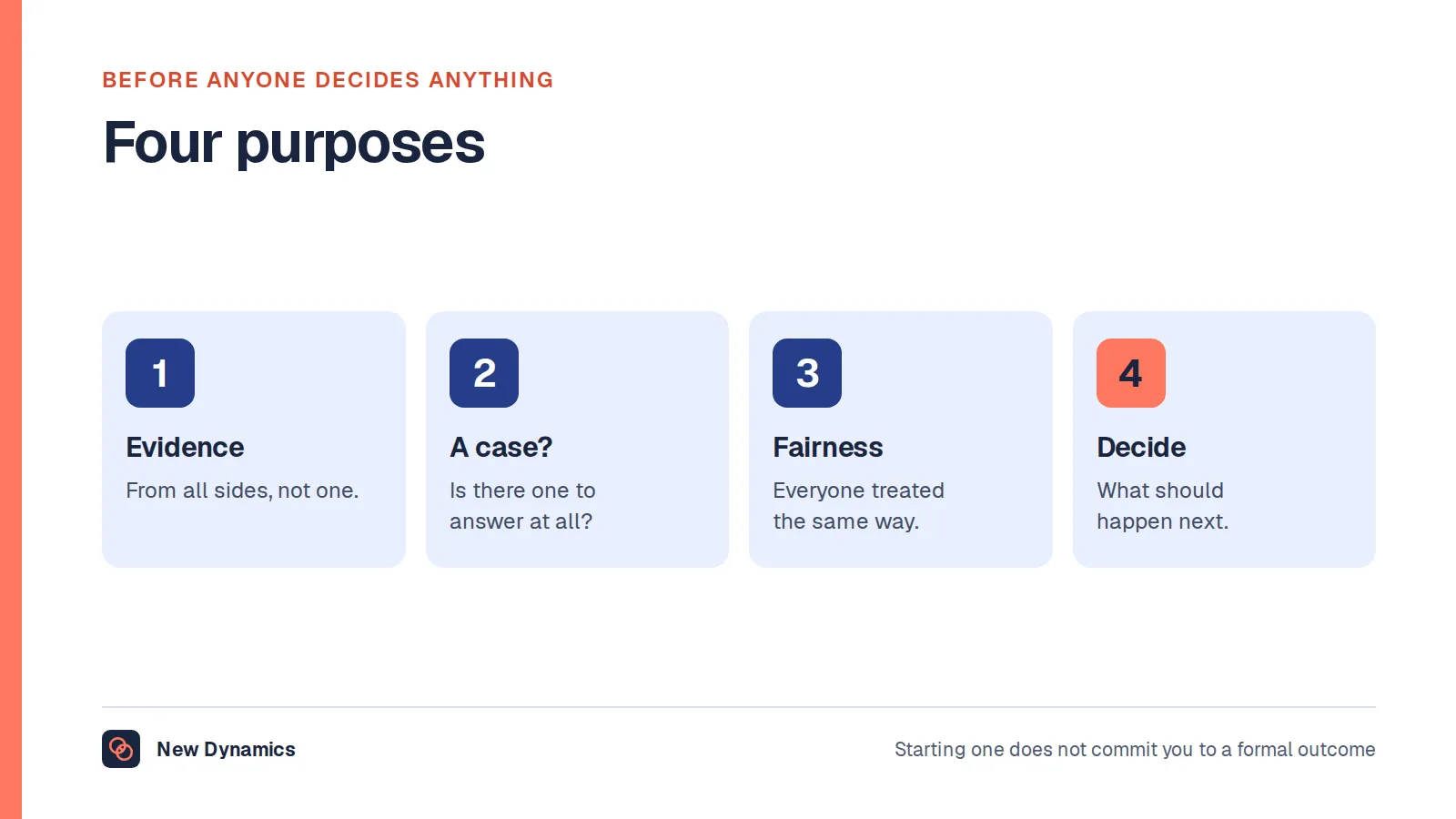
The Code is direct about the starting point: “It is important to carry out necessary investigations of potential disciplinary matters without unreasonable delay to establish the facts of the case.”
Proportionate means proportionate. A single late arrival needs a conversation and a note, not a fortnight of statement taking. An allegation of theft needs documents, witness accounts and a record of what was asked and answered. Where the organisation is big enough to allow it, the Code asks for a split of roles: “In misconduct cases, where practicable, different people should carry out the investigation and disciplinary hearing.” One person investigating, deciding and then hearing the appeal is the single most common structural defect in a small employer's process.
Our guide to workplace investigations covers the investigation itself in more detail, including scope, witnesses and the investigation report.
2. Decide whether there is a case to answer
An investigation can and should be able to end the matter. If the facts do not support the allegation, the procedure stops there, and the employee is told so clearly. Moving automatically from investigation to hearing, whatever the findings, turns the investigation into a formality and invites the conclusion that the outcome was decided in advance.
3. Write to the employee setting out the allegation
Once there is a case to answer, the Code requires written notification: “If it is decided that there is a disciplinary case to answer, the employee should be notified of this in writing.” It also says what the letter must contain. “This notification should contain sufficient information about the alleged misconduct or poor performance and its possible consequences to enable the employee to prepare to answer the case at a disciplinary meeting.”
In practice that means naming the allegation specifically rather than referring to “conduct issues”, enclosing or listing the evidence the employer will rely on, stating the possible outcomes including dismissal where that is genuinely in prospect, and giving the date, time and place of the hearing with the right to be accompanied spelled out.
4. Hold the hearing, with the right to be accompanied
Timing matters in both directions. The Code says: “The meeting should be held without unreasonable delay whilst allowing the employee reasonable time to prepare their case.”
The right to be accompanied is statutory, not a courtesy. “Workers have a statutory right to be accompanied by a companion where the disciplinary meeting could result in: a formal warning being issued; or the taking of some other disciplinary action”. The companion has a defined role too: “The companion should be allowed to address the hearing to put and sum up the worker's case, respond on behalf of the worker to any views expressed at the meeting and confer with the worker during the hearing.”
Run the hearing as a hearing. Put the allegation and the evidence, let the employee respond and raise anything in mitigation, and adjourn before deciding rather than announcing an outcome in the room.
5. Decide, and tell the employee in writing
The Code sets the duty plainly: “After the meeting decide whether or not disciplinary or any other action is justified and inform the employee accordingly in writing.”
The decision should rest on the findings, on what is reasonable in the circumstances, and on how the organisation has treated comparable cases. The written outcome should state what was decided, the reasons, what has to change and by when, how long any warning lasts, and the right of appeal.
6. Offer an appeal, heard by someone not previously involved
Appeals are part of the procedure, not an optional extra. The Code says: “Where an employee feels that disciplinary action taken against them is wrong or unjust they should appeal against the decision.” It also says how the appeal must be run: “The appeal should be dealt with impartially and, wherever possible, by a manager who has not previously been involved in the case.”
A rehearing by the person who made the original decision is not an appeal. In small organisations that can be difficult, which is a reason to plan who hears appeals before a case arrives, not after.

What disciplinary action actually means
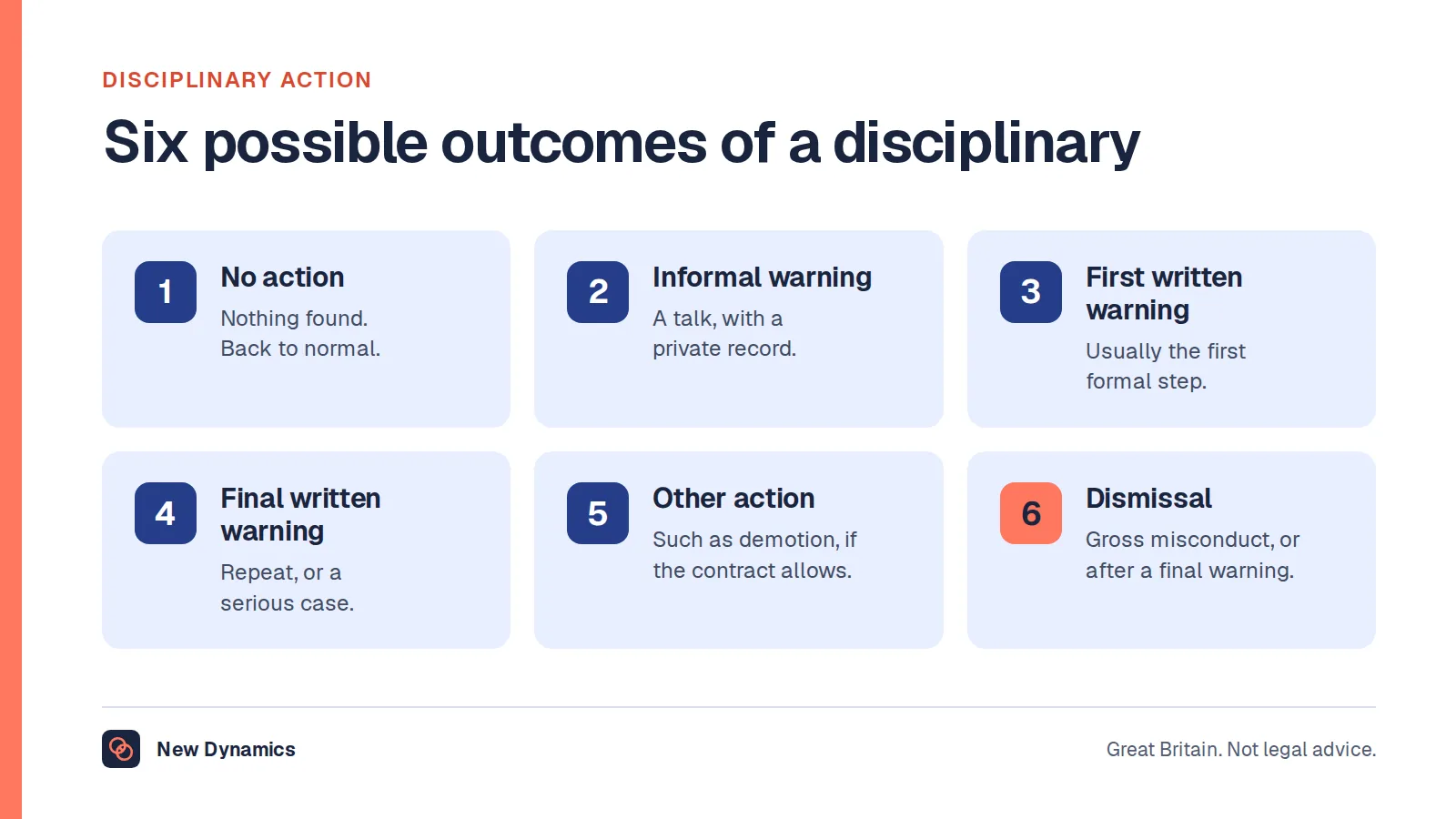
“Disciplinary action” is used in two ways: the formal process itself, and the outcome of that process. The usual range of outcomes runs from no action at all, through an informal or recorded verbal warning, a first written warning and a final written warning, to other action such as demotion where the contract allows it, and finally dismissal. Our fuller post on disciplinary action sets out all six outcomes and what a written warning should say.
Two points are worth stating here. A procedure that always produces a sanction is not a procedure. And a warning that does not say what has to change, by when, and for how long the warning stands is a threat rather than a plan.
Insubordination at work: what it means in the UK
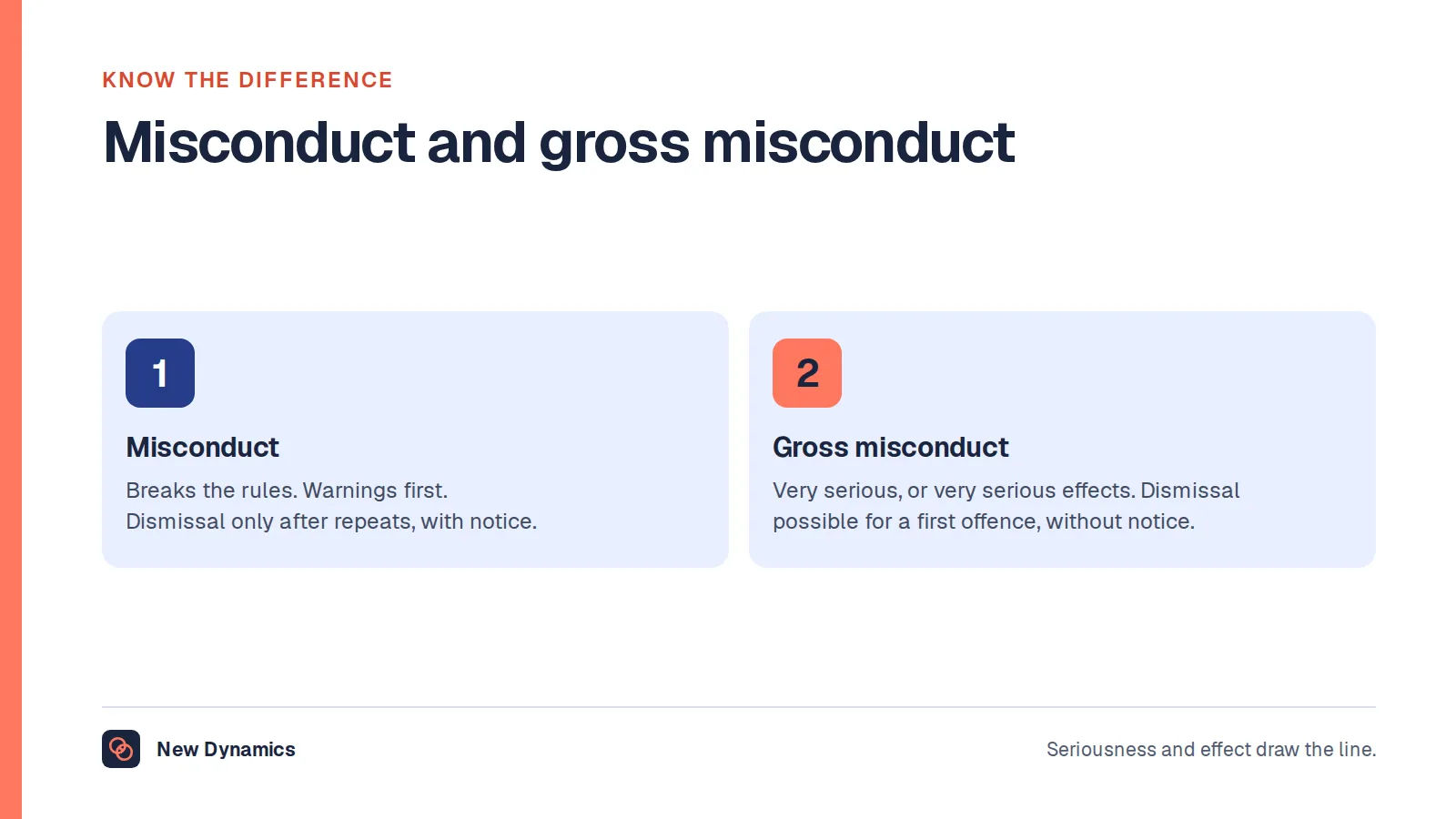
Insubordination is not a legal term of art in UK employment law. There is no statutory definition, no separate test, and nothing in the Employment Rights Act 1996 that treats it as a category of its own. It is a descriptive word used in policies and disciplinary letters.
What it usually describes is a refusal to follow a reasonable and lawful management instruction, or behaviour that openly undermines a manager's authority. Acas's own examples of misconduct include insubordination in the sense of refusing to do work, and among its examples of gross misconduct it gives serious insubordination, described as refusing to follow policies or take reasonable orders from a supervisor.
Three cautions matter, and American HR writing tends to miss all three.
- It is the facts that decide, not the label. Calling conduct “gross insubordination” in a letter does not make dismissal fair. What was the instruction, was it reasonable and lawful, was it understood, and what did the employee actually do or refuse?
- Refusing an unlawful or unsafe instruction is not misconduct. An employee who declines to do something dangerous or illegal is not being insubordinate in any sense that supports a sanction.
- The process still applies in full. Whether insubordination justifies a warning or a dismissal depends on the seriousness of the conduct, the context, any mitigation, consistency with past cases, and whether the procedure above was followed.
Instant dismissal and “sackable offences”
“Instant dismissal” is a phrase from conversation, not from statute. What exists in law is summary dismissal: dismissal without notice or pay in lieu of notice, which an employer can use where the conduct amounts to gross misconduct.
GOV.UK's guide to dismissal confirms that immediate dismissal is possible: “There are some situations where you can be dismissed immediately - for example, for violence.” What it does not do is remove the procedure. On unfair and constructive dismissal, GOV.UK says a dismissal could be unfair if the employer does not “have a good reason for dismissing you” or does not “follow the company's formal disciplinary or dismissal process (or the statutory minimum dismissal procedure in Northern Ireland)”.
That is the whole point. Without notice is lawful in the right case. Without process is how employers lose tribunals even where the conduct was real and serious. An employee escorted out of the building on the day, with no investigation, no written allegation and no hearing, may well have done exactly what the employer believes, and the dismissal can still be found unfair on procedure alone.
There is no official list of “sackable offences”. Each organisation's policy should give examples of what it treats as gross misconduct, and those examples should be genuinely serious: a policy that labels minor lateness gross misconduct devalues the term and will not persuade anyone that dismissal was reasonable.

Suspension should not be automatic
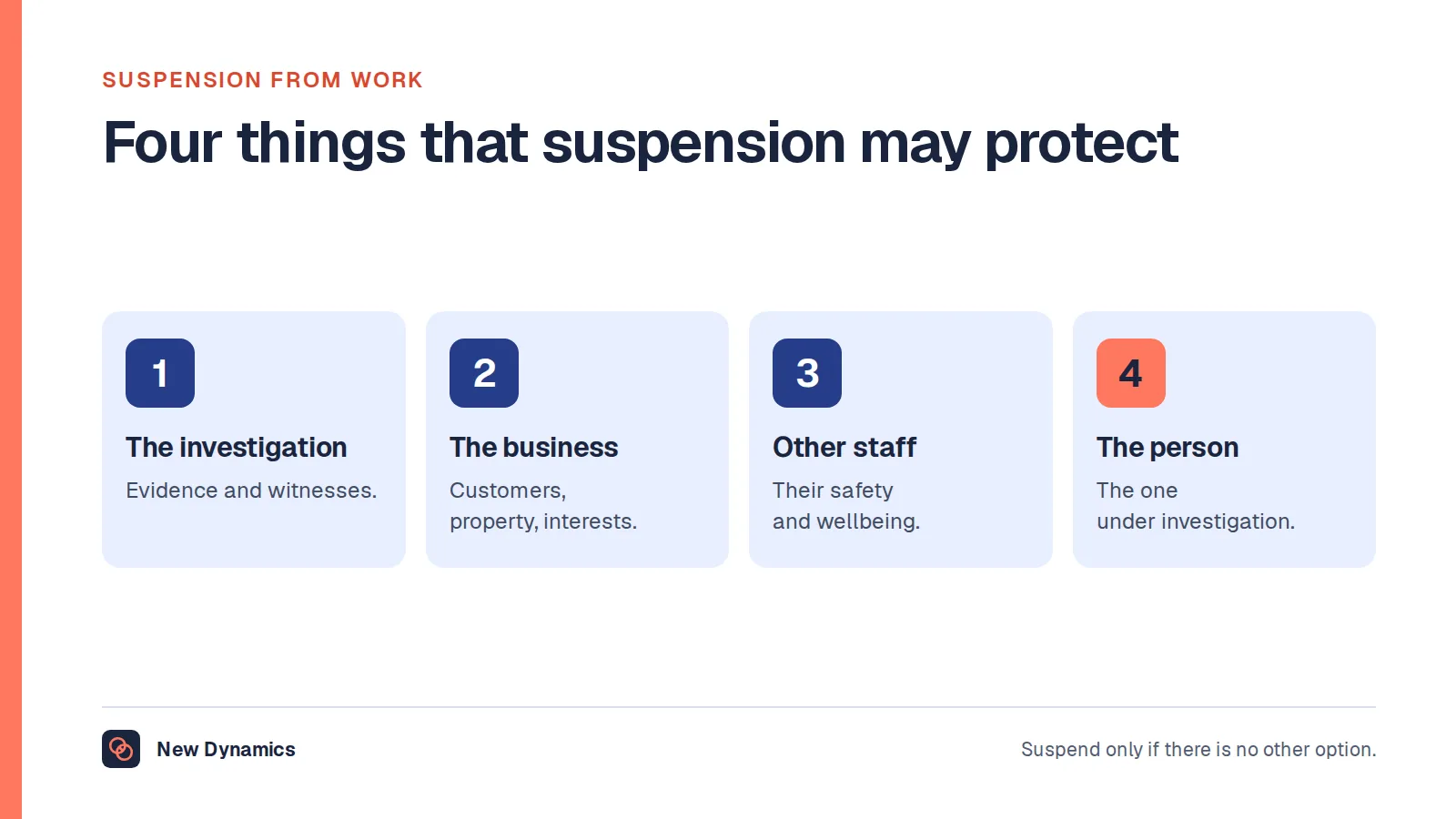
Suspension has become a reflex in some organisations, and the Code is pointed about it: “In cases where a period of suspension with pay is considered necessary, this period should be as brief as possible, should be kept under review and it should be made clear that this suspension is not considered a disciplinary action.”
Read that as three obligations. Consider whether suspension is necessary at all, or whether a temporary change of duties, reporting line or site would protect the investigation just as well. Keep it under active review rather than letting it run until the hearing. And say in writing that it is not a sanction and not a finding. Our post on suspension from work covers pay, duration and what an employee should be told.
Records, and how long to keep them
The Code's advice is short: “Employers would be well advised to keep a written record of any disciplinary or grievances cases they deal with.” In practice that means the investigation notes and evidence, the invitation letter, the hearing notes, the decision letter and the appeal outcome.
How long to keep them is a data protection question. The ICO's guidance on collecting and keeping employment records is explicit that there is no fixed answer: “Data protection law does not set specific time limits for how long you can keep your workers' personal information. This is up to you, and will depend on how long you need the information for your particular purposes.”
The ICO asks employers to set up a retention policy or schedule listing “the types of record or information you hold”, “what you use it for” and “how long you intend to keep it”, and to act on it: “Once you no longer need the information, you should erase it or, if possible, anonymise it, for example, after the employment relationship and all your legal obligations to retain the information have ended.” Different categories of record need different periods, so avoid a single blanket rule for everything.
Two practical consequences. A warning that has expired under the policy should not be relied on in a later case. And a disciplinary file kept indefinitely “just in case” is a retention problem rather than a safeguard.
The unfair dismissal qualifying period is changing
As things stand, an employee normally needs two years' continuous service before they can bring an ordinary unfair dismissal claim. GOV.UK's summary of stakeholder roundtables on unfair dismissal changes describes the Employment Rights Act 2025 as legislation that “reduces the qualifying period for the right to claim unfair dismissal from 2 years to 6 months”, and records that the government “set out in Parliament its intention to implement these changes from 1 January 2027”.
GOV.UK's timeline update lists the same measure as a future step: “reduction of unfair dismissal qualifying period to 6 months, for dismissals from 1 January 2027, and uncapping compensatory awards”.
So the shorter period is legislated but not yet commenced. Check the current position on GOV.UK before relying on either figure, and do not treat a commencement date as though it has already arrived. Note too that some dismissals have never needed any qualifying service, including those for automatically unfair reasons such as trade union membership, whistleblowing or asserting a statutory right.
The practical lesson for process design is the same either way. An employer whose procedure only becomes careful once someone passes a service threshold has built the wrong procedure.
Where employers lose a case they should have won
- Deciding first and holding the hearing afterwards. The outcome letter written before the meeting is the clearest evidence of a sham process.
- A vague allegation. “Concerns about your conduct” does not let anyone prepare an answer.
- No companion. Refusing or failing to mention the statutory right to be accompanied.
- One person doing everything. Investigator, decision maker and appeal officer in one.
- Inconsistency. Dismissing for what someone else was warned for, without an explicable reason.
- Drift. Weeks of silence, an open-ended suspension, a decision that never arrives in writing.
- No appeal, or a token one. An appeal heard by the original decision maker is not impartial.
Frequently asked questions
What are the steps in a disciplinary procedure?
Establish the facts through a proportionate investigation without unreasonable delay, decide whether there is a case to answer, notify the employee in writing with enough detail about the allegation and its possible consequences to let them prepare, hold a hearing at which they have a statutory right to be accompanied, decide, inform them in writing, and offer an appeal.
Does the Acas Code of Practice have legal force?
The Code says that “A failure to follow the Code does not, in itself, make a person or organisation liable to proceedings”. But an employment tribunal takes the Code into account, and it can adjust any award in a relevant case by up to 25 per cent for an unreasonable failure to comply with any of its provisions.
Is insubordination misconduct?
It can be. Insubordination is not a UK legal term of art; it is a descriptive word for refusing a reasonable and lawful instruction or openly undermining a manager's authority. Acas treats refusing to do work as misconduct and serious insubordination as a possible example of gross misconduct. Whether it justifies a warning or dismissal depends on the facts and the procedure followed.
Can an employer dismiss someone instantly?
Summary dismissal without notice is possible where the conduct amounts to gross misconduct, and GOV.UK confirms that immediate dismissal happens in some situations, giving violence as an example. It still requires a fair procedure: an investigation, a written allegation, a hearing and an appeal. Skipping those steps is how employers lose tribunals even when the conduct was real.
Should an employee be suspended during a disciplinary investigation?
Not automatically. The Acas Code says that where suspension with pay is considered necessary, the period “should be as brief as possible, should be kept under review and it should be made clear that this suspension is not considered a disciplinary action”. Consider alternatives first, such as a temporary change of duties or location.
How long should disciplinary records be kept?
The Code advises keeping a written record of any disciplinary or grievance case. The ICO says data protection law sets no specific time limits, so the employer decides based on how long the information is needed, and should write that into a retention policy or schedule and then erase or anonymise records once they are no longer needed.
Your next step: test your own procedure against the Code
- Read your written disciplinary procedure and check that every employee can find it.
- Walk one real past case through the six stages above and note where it skipped one.
- Name, in advance, who investigates, who decides and who hears appeals.
- Check your retention schedule covers disciplinary files, and that expired warnings are not being relied on.
To get the written rules and procedures that a fair process depends on into one place, read and download our employee handbook guide. The guide is free to read, and the PDF uses our short download form.
Want concerns recorded in regular conversations long before a formal procedure starts? Book a New Dynamics demo and bring your current approach. You can also email contact@new-dynamics.com.