TL;DR
- EAP stands for employee assistance programme. It is confidential help, paid for by the employer, for personal or work problems that might affect an employee's work, usually through short-term counselling, information and referral.
- Typical services are counselling, financial and legal information, help with caring responsibilities, workplace conflict support, referral for substance use and support after a crisis. An EAP can be run in-house, by an outside provider or both.
- An EAP works only if people trust it and know about it. Managers should signpost, never diagnose, and an EAP does not replace the employer's own duty to deal with workload and other causes of stress.
Many employees first meet the letters EAP on a poster in the kitchen or on the last page of an induction pack, next to a free phone number. Few are told what it is, who answers the phone or whether their manager will find out that they called.
This article explains the meaning of EAP, what an employee assistance programme usually offers, three ways of running one, what confidentiality covers, how a manager should point someone towards it and how an employer can tell whether it is working.
An EAP supports people in hard times. Everyday conversations help to notice those times early. See how New Dynamics continuous feedback supports check-ins between managers and their teams.
What does EAP mean?
EAP stands for employee assistance programme, spelled employee assistance program in American English. It is a service, paid for by the employer, that gives employees confidential help with personal or work problems.
The Cambridge Business English Dictionary defines an employee assistance programme as “help that a company offers employees with personal problems that might affect their work”. Its example sentence describes a programme that provides counselling, information and referral for employees in some form of personal distress.
Those three words describe most EAPs well.
- Counselling: a small number of sessions with a qualified counsellor, by phone, by video or in person.
- Information: practical guidance on matters such as debt, housing, caring or a legal question.
- Referral: a route to longer-term or specialist help when the problem needs more than the EAP can give.
The letters have other meanings elsewhere. In universities, EAP often means English for academic purposes. In safety planning, it can mean emergency action plan. In HR, it almost always means employee assistance programme.
What does an EAP offer? Six core services
Services vary between providers and contracts. A useful public list comes from the US Office of Personnel Management (OPM), which sets out the services that should be standard in a federal employee assistance program.
- Mental health counselling. OPM describes this as “the opportunity to speak to a licensed clinician or counselor” about professional or personal topics that affect wellbeing, with referral for long-term help.
- Financial and legal services. Information and help with matters such as family budgeting, housing and wills, with referral for complex cases.
- Dependent care services. Help with finding care for children, elders and other dependants, and support for working parents.
- Workplace conflict resolution. Help for employees and managers with tense working relationships, including mediation.
- Substance use treatment services. Referral and education for people whose use of alcohol or drugs is causing harm.
- Crisis intervention. Immediate, short-term support after a sudden traumatic event, for individuals and for teams.
Your own programme may offer more or fewer of these. Read the contract summary, and tell employees plainly what is included.

Three ways to run an EAP
OPM describes three delivery models.
- Internal. The organisation employs the professionals who deliver the service. OPM notes that in-house providers may have “a greater internal knowledge and understanding of the agency” and the pressures within it.
- External. The employer contracts with an outside provider. OPM observes that because support sits outside the organisation, external models may be seen as “fostering greater employee trust in EAP providers' confidentiality and objectivity”.
- Hybrid. Both in-house professionals and outside providers deliver services, which can give a wider range of support.
Smaller employers often use an external provider, sometimes as part of an insurance or benefits package. Whichever model you choose, the question that matters to employees is the same: can I trust it?

Is an EAP confidential?
Confidentiality is the foundation of the service. OPM advises leaders to remind employees regularly that “private, confidential support is always available”.
In a typical external EAP, the employer receives only anonymous usage reports, such as the number of calls and the broad themes. It does not learn who called or what was said. There are usually narrow limits, for example where someone is at serious risk of harm, and a good provider explains them at the start of a call.
Do not take this on trust. Ask your provider three questions, and publish the answers to staff.
- What information does the employer receive, and how is it kept anonymous in small teams?
- What are the limits of confidentiality?
- What happens to records, and for how long are they kept?
The handling of health information is regulated, and the rules differ between countries. Our employee data protection guide covers the principles.
Who pays, and is it taxed?
The employer pays. Employees use the service free of charge, and in some programmes close family members can use it too. Check your own contract.
In the UK, GOV.UK's guidance on counselling for employees says that an employer has no tax, National Insurance or reporting obligations for welfare counselling services, provided that the service is “available to all your employees” and is for welfare issues. It gives examples: “bereavement, ill health or stress, problems at work, sexual abuse or personal relationship difficulties”.
The same guidance lists what the counselling service cannot offer under the exemption, including tax advice, legal advice and financial advice on anything other than debt problems. It adds that counselling provided through a salary sacrifice arrangement is not exempt.
This is a summary of UK government guidance at the time of writing. It is general information, not tax or legal advice, and the rules differ in other countries.
Where an EAP fits in a wellbeing approach
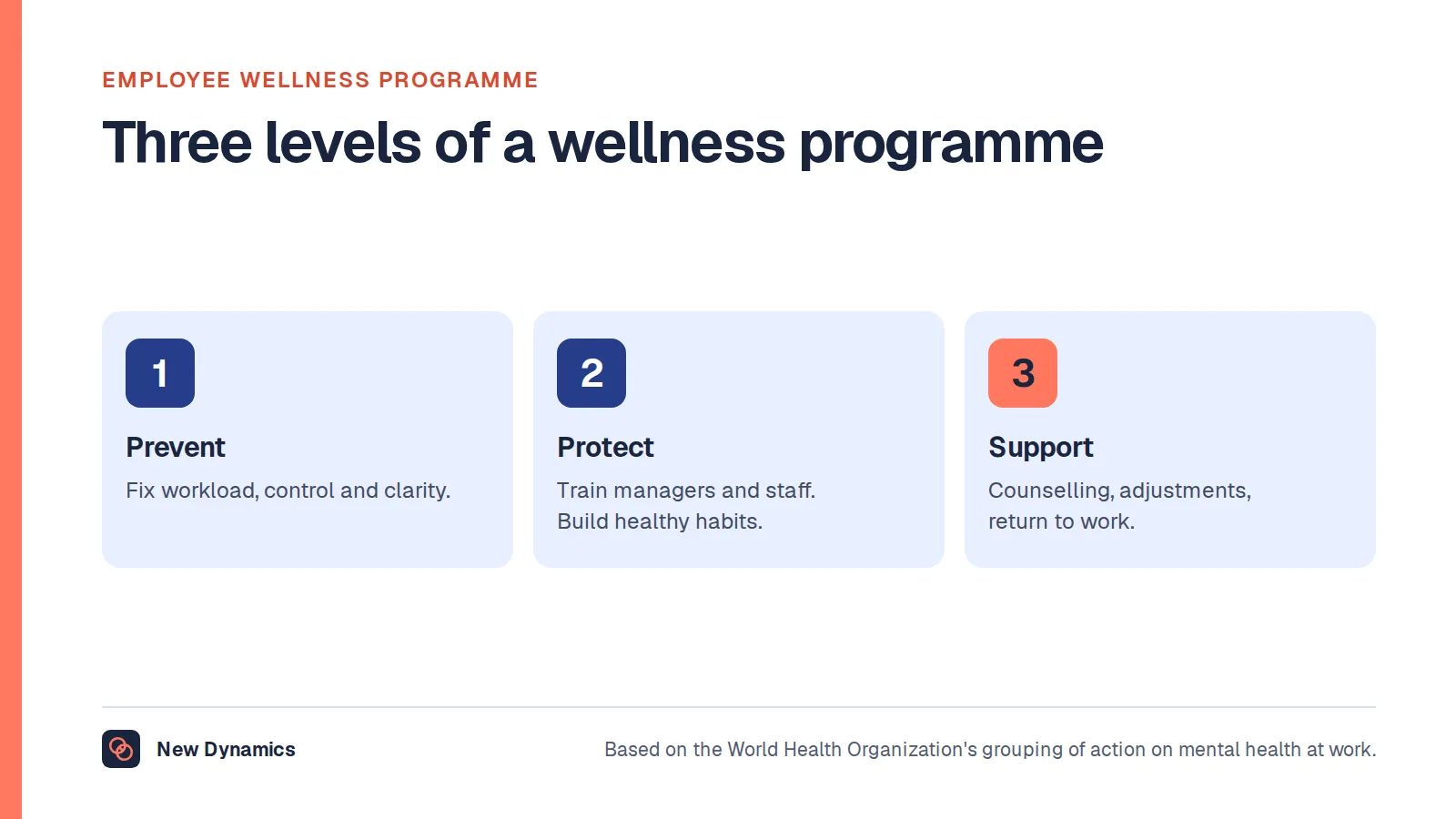
An EAP is one part of a wider approach. The CIPD's factsheet on wellbeing at work says that employers should offer sources of help such as “counselling, an employee assistance programme (EAP) and occupational health (OH) services where possible”. It also calls for a prevention-based approach that addresses the work-related risks to health.
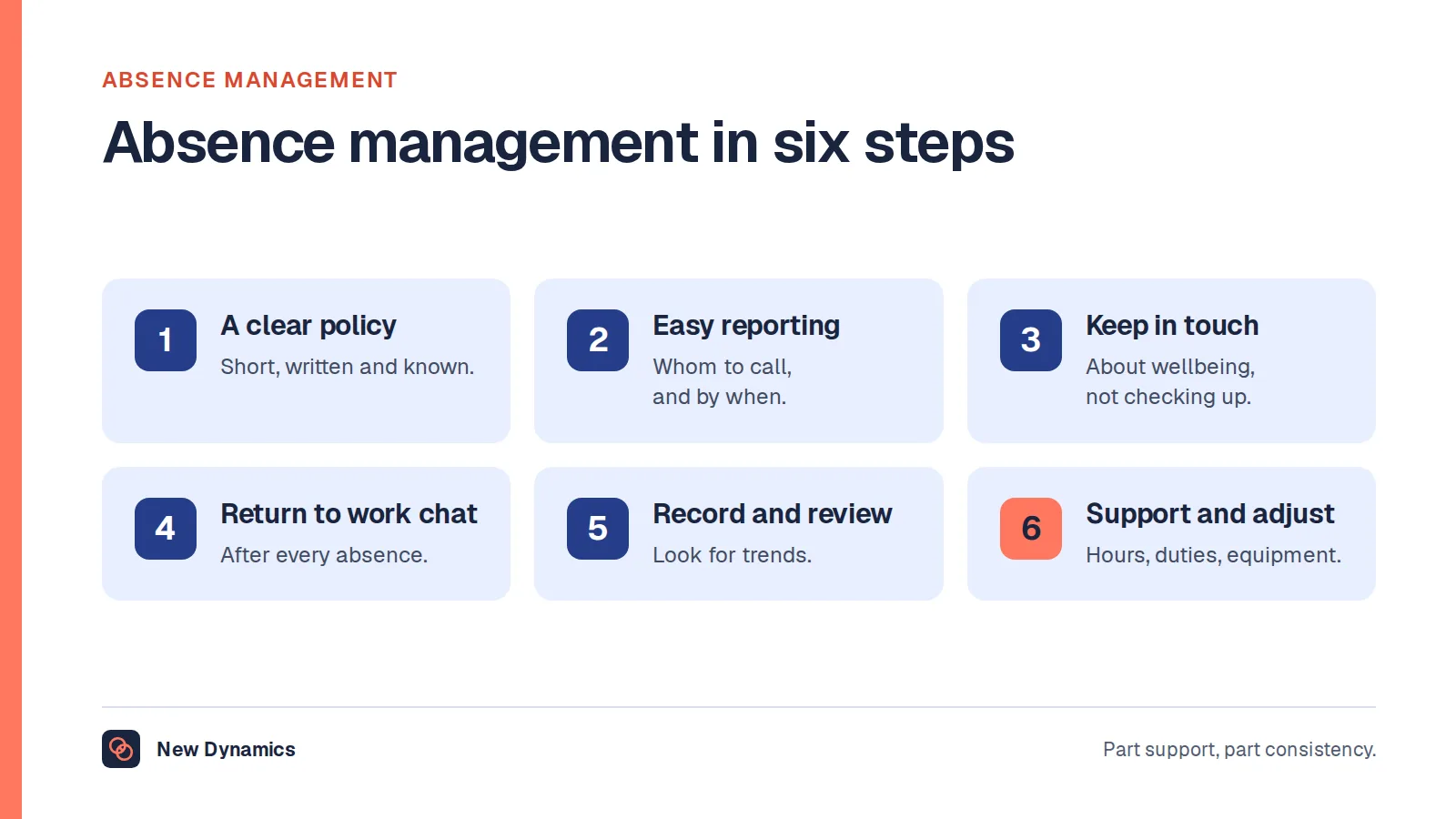
That second point matters. An EAP helps a person to cope. It does not reduce an impossible workload, fix a bullying manager or clarify a confused role. Those are the employer's job. Our guide to building an employee wellness program sets out the wider picture, and our guide to absence management explains how support and attendance fit together.
An EAP also differs from two services with which it is often confused.
| Service | What it is for |
|---|---|
| EAP | Confidential, short-term help with personal or work problems, chosen by the employee |
| Occupational health | Clinical advice to the employer and employee about health and fitness for work |
| Coaching | Development of skills and performance at work, not treatment of distress |
For the third, see our article on the meaning of coaching.
How managers should refer someone to the EAP
Most people use an EAP by choice, after hearing about it from a colleague or a manager. A manager's job is to make that easy.
- Notice. Changes in mood, attendance, concentration or work quality are reasons to ask, not evidence of anything.
- Ask privately. “You have not seemed yourself lately. How are things?” Use a regular one-to-one meeting or make time for a separate conversation.
- Listen. You do not need to solve the problem, and you should not ask for medical or personal details.
- Signpost. Say what the EAP is, that it is free and confidential, and give the number or link. Offer time in the working day to make the call.
- Follow up. Ask later how the person is doing, not whether they called. Agree any changes to work that would help.
Do not diagnose, and do not make use of the EAP a condition of anything. Where performance is also a concern, keep the two conversations honest and separate: support is offered, and expectations are still explained.

How to tell whether your EAP is working
- Awareness. Ask in a survey whether people know that the EAP exists and how to reach it. Low awareness is a common weakness.
- Usage. Look at the anonymous usage rate over time. Very low usage may point to low awareness or low trust, not to a workforce without problems.
- Themes. If the provider's anonymous reports show that work problems dominate, look at the work.
- Access. Check waiting times, opening hours, languages and whether shift workers and remote staff can use it.
- Feedback. Ask the provider for user satisfaction figures, gathered anonymously.
- Links. Review it alongside absence figures and survey results, without trying to match individuals.
Common mistakes
Launching it once and never mentioning it again. People need reminding when they need help, which is rarely in induction week.
Treating it as the whole wellbeing strategy. A phone line does not make up for poor management.
Vague promises about confidentiality. State precisely what the employer sees.
Managers who use it to avoid a conversation. “Have you tried the EAP?” is a poor substitute for listening.
Forgetting managers' own needs. Managers carry other people's troubles, and they can use the service too.
Buying on price alone. Ask about counsellor qualifications, the number of sessions and what happens when someone needs more.
Frequently asked questions
What does EAP stand for?
In HR, EAP stands for employee assistance programme, or employee assistance program in American spelling. It is confidential help, paid for by the employer, for personal or work problems that might affect an employee's work.
What is an EAP used for?
People use an EAP for short-term counselling and for practical information on matters such as stress, bereavement, relationships, debt, caring responsibilities, conflict at work and alcohol or drug use. The EAP refers people on when they need longer-term or specialist help.
Is an EAP really confidential?
In a typical programme the employer receives only anonymous usage reports and does not learn who used the service or what was said. There are usually narrow limits, for example where someone is at serious risk of harm. Ask your provider to explain them.
Who pays for an EAP?
The employer pays, and employees use it free of charge. Some programmes also cover close family members. In the UK, GOV.UK says that welfare counselling available to all employees carries no tax, National Insurance or reporting obligations for the employer.
Can my manager make me use the EAP?
An EAP is normally voluntary. A manager can tell you about it, encourage you and give you time to call, but the choice is yours. A manager should not ask what you discussed with a counsellor.
What is the difference between an EAP and occupational health?
An EAP gives an employee confidential, short-term help with personal or work problems. Occupational health gives clinical advice to the employer and the employee about health and fitness for work, usually after a referral by the employer.
Your next step: check three things this week
- Find your EAP's phone number and web link. If it takes you more than a minute, it will take your staff longer.
- Ask the provider what the employer sees, and write the answer in plain words for staff.
- Remind every manager of the five steps: notice, ask privately, listen, signpost and follow up.
Good referrals begin with regular conversations. Read and download our manager one-to-one guide. The guide is free to read, and the PDF uses our short download form.
Want regular check-ins in which problems surface early? Book a New Dynamics demo and bring your current approach. You can also email contact@new-dynamics.com.