TL;DR
- The company tests changed on 6 April 2026. HMRC's manual states that from that date EMI options can be granted by independent trading companies with "gross assets not exceeding £120 million or £30 million", "less than 500 or 250 employees" and "unexercised qualifying options not exceeding £6 million or £3 million". The lower figure in each pair applies to a specified Northern Ireland company.
- The individual cap did not move. Schedule 5 to ITEPA 2003 still bars an employee from holding unexercised qualifying options over shares with a total value of more than £250,000, and unexercised CSOP options count towards it.
- The notification deadline changed for options granted on or after 6 April 2024, from 92 days after the grant to 6 July following the end of the tax year of grant. Miss it and the option is not a qualifying option at all.
Enterprise Management Incentives is the most used of the four tax advantaged share schemes in the United Kingdom, and the one most often got wrong. HMRC's Employee Share Scheme statistics, published on 3 July 2026, report that "the vast majority, 90%, of ESS companies operate an EMI scheme". Several of the figures changed on 6 April 2026, and the deadline for telling HMRC about a grant changed in 2024. A grant that fails any one condition is not a qualifying option, and the tax advantage goes with it.
An EMI option is a right to buy shares at a price fixed when the option is granted. This article covers which companies and which employees qualify, the two monetary limits, the tax at grant, exercise and sale, the notification deadline and what a disqualifying event does. Every figure comes from the statute or HMRC's own guidance, with the date it took effect. It is general information about the position in the United Kingdom, not tax, legal or financial advice. Setting up an EMI scheme needs professional advice from someone who can look at your company's own facts.
A grant is a reward decision, and it is easier to defend when the evidence behind it already exists. See how New Dynamics performance reviews keep the year's goals, feedback and ratings attached to the cycle, so a decision about who gets a grant is read off a record.
Where the rules live, and why notification is not paperwork
The scheme sits in Schedule 5 to the Income Tax (Earnings and Pensions) Act 2003, which defines a qualifying option as a share option "in relation to which the requirements of this Schedule are met at the time when the option is granted, and which is notified to an officer of Revenue and Customs in accordance with Part 7". So the conditions are tested at grant, not later, and notification is part of the definition.
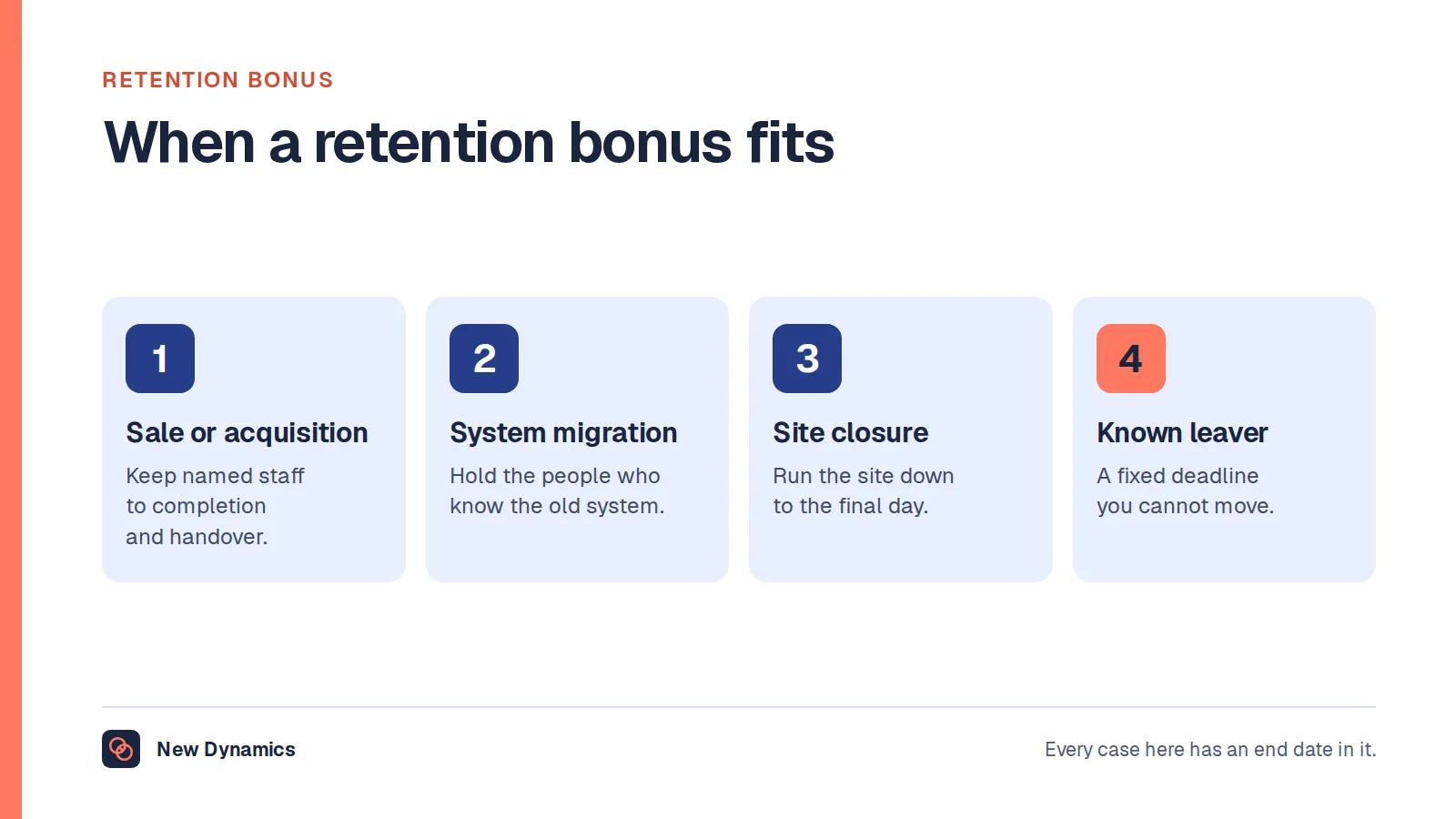
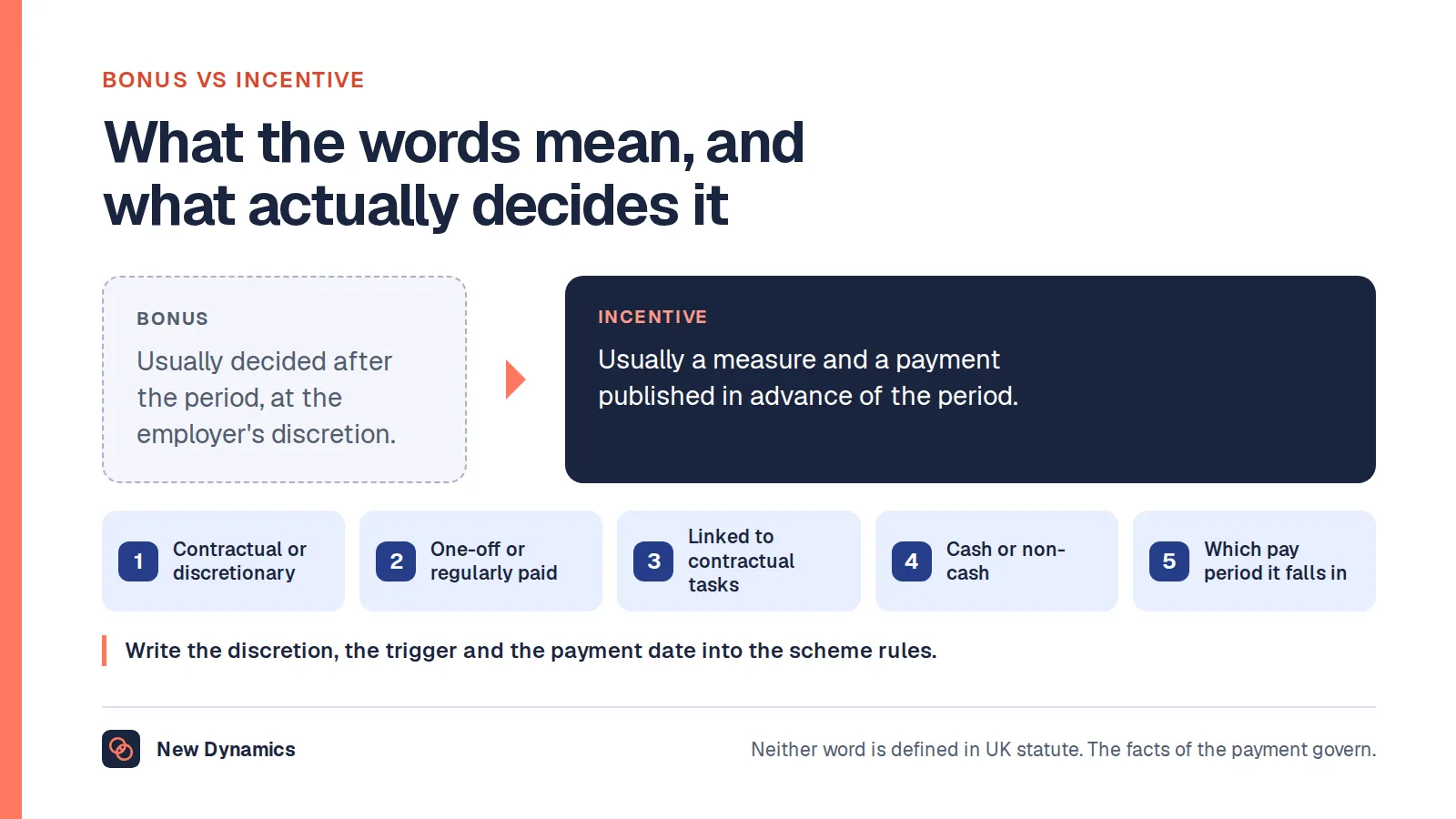
There is no approval process. HMRC's manual at ETASSUM50100 states: "There is no approval process or clearance mechanism for EMI, however there is a requirement on companies to notify HMRC when an option is granted." A company can ask for advance assurance that it meets the conditions. For cash alternatives, see our posts on retention bonuses and the difference between a bonus and an incentive.
Which companies qualify, and the figures that changed in April 2026
Independence. Paragraph 9 requires that the company is not "a 51% subsidiary of another company", nor under the control of another company without being a 51% subsidiary, and that no arrangements exist by which it could become either.
Gross assets. Paragraph 12 caps a single company's gross assets at "(a) £120 million, or (b) where the company is a specified Northern Ireland company, £30 million". Both figures were inserted with effect from 6 April 2026 by section 13 of the Finance Act 2026. For a parent company the test applies to the group assets.
Number of employees. Paragraph 12A requires the full-time equivalent employee number to be less than "(a) 500, or (b) where the company is a specified Northern Ireland company, 250", also from 6 April 2026. The count adds full-time employees, then adds for each part-timer "such fraction as is just and reasonable". Directors count; employees on maternity, paternity, shared parental, parental bereavement or neonatal care leave do not.
A qualifying trade. Paragraph 15 requires a trade "conducted on a commercial basis and with a view to the realisation of profits" that does not consist, wholly or substantially, in excluded activities. Paragraph 16 lists those: dealing in land, commodities, futures, shares or securities; dealing in goods outside an ordinary wholesale or retail trade; banking, insurance, money lending, debt factoring, hire purchase financing or other financial activities; leasing; receiving royalties or licence fees; legal or accountancy services; property development; farming or market gardening; forestry and timber; shipbuilding; producing coal or steel; running hotels or comparable establishments; and running nursing or residential care homes. Paragraph 14A adds a UK permanent establishment requirement.

A "specified Northern Ireland company" is defined by the new paragraph 57F as one with its registered office in Northern Ireland carrying on a trade in goods, or in the generation, transmission, distribution, supply, wholesale trade or cross-border exchange of electricity. If that is your company, the old £30 million, 250 and £3 million figures still apply.
The two monetary limits
£250,000 per employee. Paragraph 5 says an employee "may not hold unexercised qualifying options which are in respect of shares with a total value of more than £250,000" granted by reason of employment with one company or group. The figure has stood since 16 June 2012, when the Income Tax (Limits for Enterprise Management Incentives) Order 2012 substituted it. Unexercised Schedule 4 CSOP options count towards it, value means the market value of issued shares of the same class at the time of grant, and restricted shares are valued "as if they were not" restricted. Under paragraph 6, once £250,000 has been granted, any further option within three years of the last grant cannot qualify, whether or not the earlier ones were exercised.
£6 million per company. Paragraph 7 caps the total value of shares subject to unexercised qualifying options at "(a) £6 million, or (b) where the employer company is a specified Northern Ireland company, £3 million", from 6 April 2026. A grant that crosses the line cannot qualify so far as it relates to the excess. For scale, HMRC reports that in the tax year ending 2025 "the average value of options per grant was £13,930 for EMI". More figures are in our HR statistics hub.
Which employees qualify
Employment. Paragraph 25: an employee of the company, or of the company or a qualifying subsidiary where it is a parent.
Working time. Paragraph 26 is the test people trip over. The average amount per week of the employee's committed time must equal or exceed the statutory threshold, which is "25 hours a week, or if less, 75% of the employee's working time". Committed time is time the employee is required to spend on the business of the company or group, and it includes time that would have been spent but for injury, ill health or disability, pregnancy, childbirth, or maternity, paternity or shared parental leave. A non-executive director or a part-time adviser will often fail this.
No material interest. Paragraph 28 excludes anyone with a material interest in the company or, for a group, in any member of it. Paragraph 29 defines that as beneficial ownership of, or the ability to control directly or indirectly, "more than 30% of the ordinary share capital of the company", with a parallel test on the assets of a close company. Associates count towards the 30%, so a founder's family holding can be what disqualifies them.
The tax at grant, at exercise and on a discount
Grant. ETASSUM57010 states that "There is no income tax or National Insurance contributions charged on the grant of a qualifying EMI option." The general rule for employment related securities options is section 475 of ITEPA 2003: "No liability to income tax arises in respect of the acquisition of an employment-related securities option."
Exercise at market value. Section 530 applies where the option is to acquire shares at not less than their market value at the time of grant, and then "no liability to income tax arises by virtue of section 476 in respect of the exercise of the option". ETASSUM57010 adds the timing: from 6 April 2026 the option must be exercised within 15 years of grant, or 10 years where the employer is a specified Northern Ireland company. Before that date the limit was 10 years for everyone, and the Finance Act 2026 inserted the new period into paragraph 36 of Schedule 5.
Exercise at a discount. Section 531 covers an option to acquire shares at less than market value at grant, or at nil cost. The charge is not removed, it is limited. The taxable gain is the chargeable market value, less any consideration for the grant, less the amount paid for the shares, where the chargeable market value is the lower of the market value at grant and at exercise. So the discount built in at grant is taxed as employment income on exercise, and growth after grant is not.

Capital gains tax, and Business Asset Disposal Relief
Selling the shares is a capital gains event. ETASSUM57190 sets out the computation: the gain is the sale price less the amount paid for the shares and the costs of disposal, and anything paid for the grant, plus any amount charged to income tax on exercise, forms part of the cost. For the 2026 to 2027 tax year, GOV.UK's guidance on Capital Gains Tax rates gives the tax-free allowance as £3,000, with gains in the basic rate band taxed at 18% and gains above it at 24% from 6 April 2026.
Business Asset Disposal Relief can apply, and the EMI version is looser. Section 169I of the Taxation of Chargeable Gains Act 1992 carries a condition written for EMI shares, requiring that "the option grant date is, or is before, the first date of the period of 2 years ending with the date of the disposal", and that throughout those two years the company is a trading company or the holding company of a trading group and the individual is an officer or employee. ETASSUM57190 states the consequences: "it is not necessary for the employee's shareholding to be at least 5% (in terms of voting power and nominal share capital), and the period between grant of the EMI option and disposal of the relevant shares must be no less than two years."
The first point is the real advantage, because for ordinary shares relief needs a "personal company", defined in section 169S as at least 5% of the ordinary share capital and at least 5% of the voting rights. An EMI holder with a fraction of a percent can still claim. The second point cuts both ways: the two years run from grant, not exercise. ETASSUM57190 also warns that relief "is not available where shares are acquired on exercise of an EMI option more than 90 days after a disqualifying event, nor where the period between the date of grant of the option and the disqualifying event is less than one year".
Two official pages disagree on the rate. ETASSUM57190 says "capital gains tax is charged at a rate of 14% on the gain". GOV.UK's guidance on Business Asset Disposal Relief lists "18% on all gains on qualifying assets disposed of from 6 April 2026", 14% between 6 April 2025 and 5 April 2026 and 10% on or before 5 April 2025, against a £1 million lifetime limit. The statute governs and agrees with the public page: section 169N(3) of TCGA 1992 now reads "The rate of capital gains tax in respect of that gain is 18%", substituted by section 8(4) of the Finance Act 2025 for disposals on or after 6 April 2026. The manual page appears not to have caught up.
The notification deadline, and when it changed
Paragraph 44(1) requires notice of the option to be given to an officer of Revenue and Customs "on or before 6 July following the end of the tax year in which the option was granted". The notice comes from the employer company, must be given electronically, and must carry a declaration by a director or the secretary that the requirements of Schedule 5 are met and the information is correct and complete.
That wording replaced "within 92 days after the date of the grant of the option". Section 13 of the Finance Act 2024 made the change, and subsection (4) fixes the start: "The amendments made by this section have effect in relation to share options granted on or after 6 April 2024." ETASSUM50100 says the same from the other side: "Prior to 6 April 2024 the options granted must be notified within 92 days of the grant."
An option granted on 1 May 2026 therefore falls in the tax year ending 5 April 2027 and must be notified by 6 July 2027. A separate annual return is also due. HMRC publishes a reasonable excuse process for a late notification, but lateness is a real problem rather than a formality.
Disqualifying events, and the 90 day window
A disqualifying event does not cancel the option. It starts a clock. ETASSUM57050 puts it in a line: "If the EMI option is exercised within 90 days of the disqualifying event, the tax advantages are preserved." Section 532 produces the charge where the option is exercised "later than 90 days after the day on which the event occurred", measured against the value of the shares immediately before the event, so growth after the event escapes the income tax charge and the earlier value does not.
Sections 534 to 536 list the events. On the company side: becoming a 51% subsidiary, coming under the control of another company, or ceasing to meet the trading activities requirement. On the employee side: ceasing to meet the employment requirement or the working time requirement, plus a deemed event at the end of any tax year in which average weekly reckonable time fell below the threshold. Then variations that raise the market value of the shares or would breach Schedule 5, certain alterations of share capital, share conversions, and a Schedule 4 CSOP grant that takes the holder over £250,000.
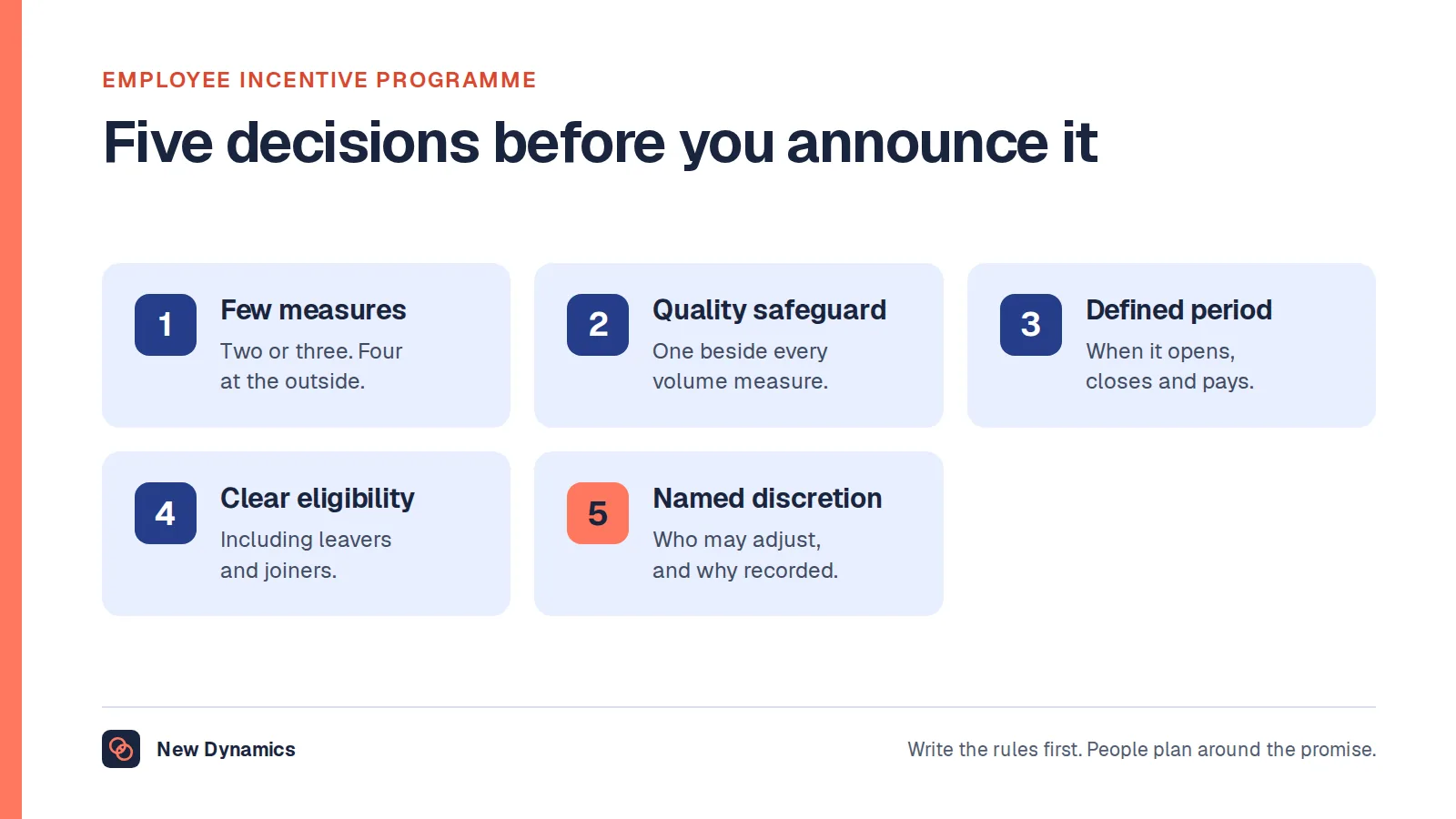
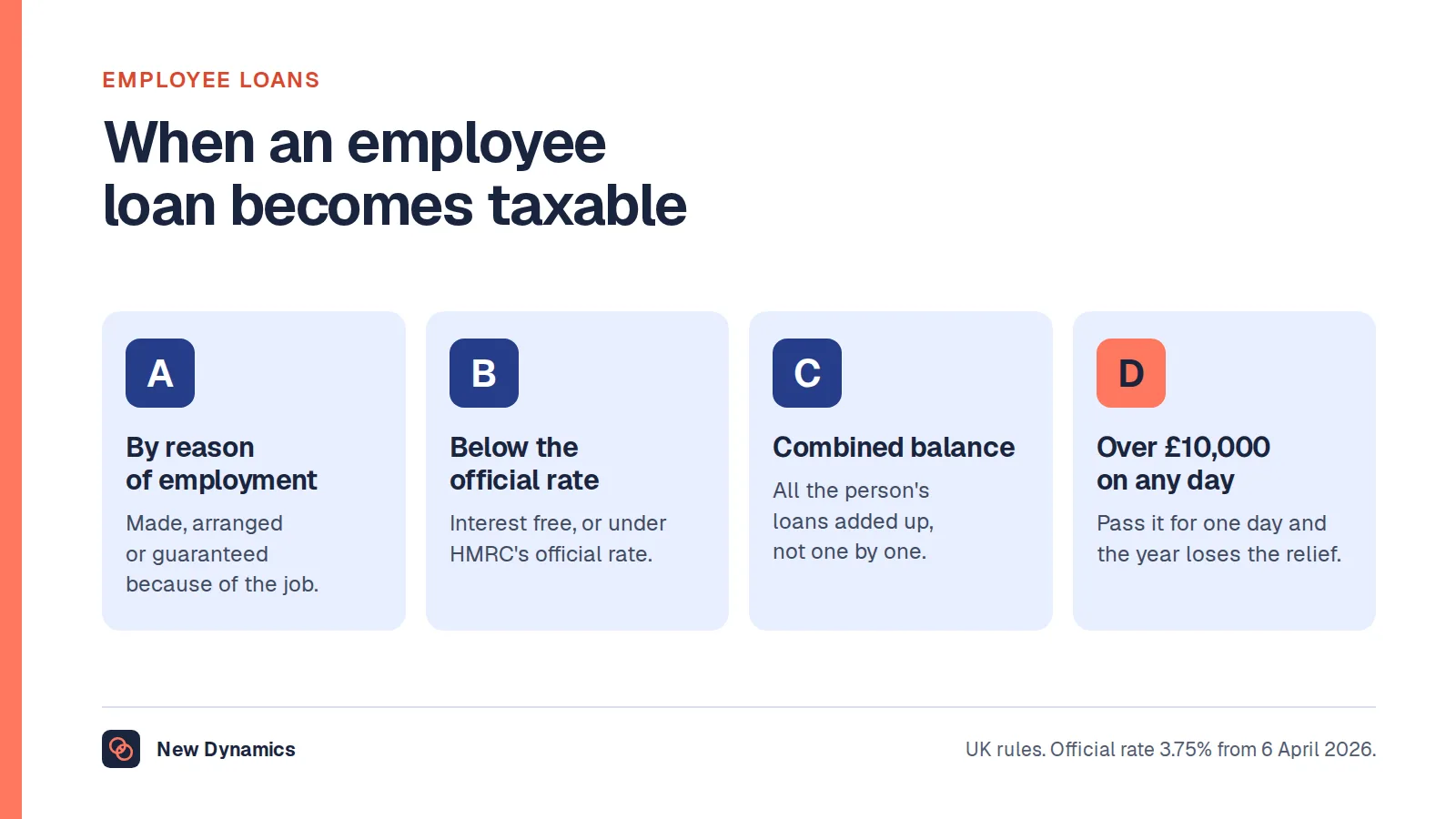
An acquisition and a change in someone's hours are both on that list, and both are foreseeable. Holders need to know about the 90 days before the event, not after. For the cash side of a package, see our posts on employee incentive programmes, salary sacrifice and employee loans.
Frequently asked questions
Do you pay income tax on EMI share options?
Not on the grant. HMRC's manual states there is no income tax or National Insurance charged on the grant of a qualifying EMI option. There is normally none on exercise either, provided the exercise price is at least the market value of the shares at the date of grant and the option is exercised in time. A discount built in at grant is taxed as employment income on exercise.
What are the EMI qualifying company conditions?
The company must be independent, carry on a qualifying trade and have a UK permanent establishment. From 6 April 2026 its gross assets must not exceed £120 million and its full-time equivalent employee number must be fewer than 500. A specified Northern Ireland company keeps the earlier £30 million and 250 figures. Excluded activities include financial trades, property development, legal and accountancy services, and running hotels or care homes.
What is the EMI £250,000 limit?
Paragraph 5 of Schedule 5 to ITEPA 2003 bars an employee from holding unexercised qualifying options over shares worth more than £250,000, measured at the market value of the shares when each option was granted. Unexercised CSOP options count towards it. Once £250,000 has been granted, further options within three years of the last grant cannot qualify.
How many hours must an employee work to qualify for EMI?
The working time requirement in paragraph 26 is an average of at least 25 hours a week, or if less, 75% of the employee's working time. Committed time includes time that would have been worked but for injury, ill health, disability, pregnancy, childbirth, or maternity, paternity or shared parental leave. Falling below the threshold is itself a disqualifying event.
When must an EMI option be notified to HMRC?
For options granted on or after 6 April 2024, the employer company must notify HMRC on or before 6 July following the end of the tax year in which the option was granted. Before that date the deadline was 92 days after the grant. Section 13 of the Finance Act 2024 made the change. Notification is a condition of the option being a qualifying option.
Can you claim Business Asset Disposal Relief on EMI shares?
Yes, where the conditions are met. The 5% shareholding condition that applies to ordinary shares does not apply to EMI shares, and the two year period runs from the grant of the option rather than from exercise. Relief is lost where the shares are acquired more than 90 days after a disqualifying event, or where less than a year passed between grant and that event.
Your next step: check one grant against the conditions
- Write down the company's gross assets, its full-time equivalent employee number and the value of unexercised qualifying options outstanding, and compare each with the limit that applies to your company from 6 April 2026.
- Confirm the trade is not substantially an excluded activity, and that the company is not a 51% subsidiary or subject to arrangements that could make it one.
- For each proposed holder, record the average committed time per week and what share of their working time that is, and check their holding with their associates' against the 30% bar.
- Add up the holder's unexercised qualifying and CSOP options at grant date values, check the headroom under £250,000 and the three year rule, and diary notification for 6 July following the end of the tax year of grant.
- Take professional advice on the valuation and the documents before anything is signed. None of the above replaces it.
For the policy around a reward decision, read and download our compensation policy guide. The guide is free to read, and the PDF uses our short download form.
Want reward decisions to rest on evidence that already exists rather than being reconstructed in the meeting? Book a New Dynamics demo and bring your current review form. You can also email contact@new-dynamics.com.