TL;DR
- HMRC exempts loans "with a combined outstanding value to an employee of less than £10,000 throughout the whole tax year". The test is on the total across all loans, not on each one.
- Two official pages word the same threshold differently. Section 180(2) ITEPA 2003 and HMRC's own manual both say the threshold is not exceeded where the aggregate "does not exceed £10,000", so exactly £10,000 is still inside the exemption.
- The official rate of interest is 3.75% from 6 April 2026. HMRC's average official rate table, last updated 6 March 2026, shows 3.75% for 2025 to 2026 and has no entry yet for 2026 to 2027.
An employee asks for help buying an annual rail season ticket. Finance lends the money and recovers it over ten months. Nobody files anything. A year later the question arrives: should that have gone on a P11D?
Usually not, and one threshold is the reason. But it is measured in a way employers often guess wrong, the rate used to value the benefit moves, and two official pages word the same test differently. This article sets out the United Kingdom position on employee loans: when a loan is taxable, how it is valued, what is reported, which loans sit outside the charge, and what a write-off costs. It is general information and not tax, financial or legal advice.
Lending is a two minute decision with a twelve month tail. See how New Dynamics workflows give each step after that decision an owner and a date.
What counts as an employee loan
GOV.UK's guide on loans provided to employees sets out different rules for three things: "providing 'beneficial loans', which are interest-free, or at a rate below HMRC's official interest rate", "providing loans you write off", and "charging a director's personal bills to their loan account within the company".
The reach is wider than a signed agreement. HMRC's booklet 480 on beneficial loan arrangements says at paragraph 17.6 that "Loan means more than lending money. It includes any form of credit. It follows that any kind of advance made by reason of the employment is covered." It also catches loans you only "arranged, facilitated, guaranteed or taken over from someone else", and loans from a company or person connected with the business.

The £10,000 test, and the aggregate that catches people out
Most employer lending is exempt. GOV.UK's what's exempt page lists loans "with a combined outstanding value to an employee of less than £10,000 throughout the whole tax year (£5,000 for 2013 to 2014)".
Two words there do the work. Combined means the test is on the total of everything the person owes you, not on each loan on its own. Throughout makes it a high water mark rather than a year end snapshot: pass the figure for a single day and the exemption is gone for the whole year. HMRC's manual at EIM26140 concedes that "in strictness" this means tracking the total "on a day-to-day basis", and notes that accrued interest joins the balance only when it "falls due for payment".
The boundary itself is worded two ways. GOV.UK says "less than £10,000". Booklet 480 at 17.16 and EIM26140 both say the total "does not exceed £10,000". The statute sides with the manual: section 180(2) of the Income Tax (Earnings and Pensions) Act 2003 provides that the threshold "is not exceeded if at all times in the year the amount outstanding on the loan (or ... the aggregate of the amount outstanding on them) does not exceed £10,000". The Act governs, so a total of exactly £10,000 is still inside the exemption. Near the line, work from section 180 rather than the summary page.
Section 180(3) applies the same figure to non-qualifying loans alone, so one large qualifying loan does not drag the small ones into charge. In booklet 480's example a £50,000 qualifying loan sits alongside non-qualifying loans of £6,000 and £4,000: the £60,000 total fails the first test, but the £10,000 of non-qualifying loans stays exempt.
The official rate, and the two ways to value the benefit
The taxable amount is the interest forgone: the difference between interest at "the appropriate 'official rate' (or rates) for the tax year concerned" and the interest actually paid (480, 17.4).
HMRC publishes two tables of official rates, last updated 6 March 2026. The actual rates table gives 3.75% from 6 April 2026 with no closing date, and 3.75% for 6 April 2025 to 5 April 2026. The average rates table, used where the loan ran all year and "you are using the normal averaging method of calculation", shows 3.75% for 2025 to 2026 and 2.25% for each of the two years before. As at 7 November 2026 it has no entry for 2026 to 2027, so the only published figure for the current year is the actual rate of 3.75%. No official source yet gives an average official rate for 2026 to 2027.
There are two calculation methods, and the choice is not the employer's. Booklet 480 at 17.28 says the normal averaging method "applies automatically unless: the director or employee elects for the other (the 'alternative precise method'), or HMRC gives notice that it intends to use the 'alternative precise method'".

- Averaging uses the average of the loan's "maximum opening and closing balances at the beginning and end of the tax year" and the average official rate (480, 17.29). EIM26225 says it "gives a reasonably fair result" where the loan is repaid in regular sums or stays fairly constant, and "would produce an unfair result if the loan fluctuated widely during the tax year".
- The precise method takes each day the loan is outstanding, "dividing the official rate for that day ... by 365" and applying that to the maximum balance for the day, per EIM26230. Interest actually paid is then deducted.
EIM26240 is explicit on the election: "Either the employee or the Inspector can elect for the alternative precise method ... An election made by the Inspector must be made in writing." It covers all of that employee's beneficial loans for the year, and each side has until 12 months from the 31 January following the tax year. EIM26225 explains why the second method exists: averaging "could ... be manipulated by an artificial bed and breakfast transaction where the loan is repaid on 4 April and redrawn on 6 April".
What to report, and where
For a beneficial loan, GOV.UK's what to report and pay page says you must "report it on form P11D" and "pay Class 1A National Insurance on the value of the benefit". There is no PAYE tax on the benefit itself. The Class 1A rate "on expenses and benefits for 2026 to 2027 is 15%", per HMRC's rates and thresholds for employers.
The deadlines page sets 6 July after the tax year end to report the benefits, give employees a copy and declare the Class 1A owed, with payment by "22 July (19 July if paying by cheque)". A late P11D(b) draws "a penalty of £100 per 50 employees for each month or part month". To do the arithmetic, HMRC offers PAYE Online, payroll software or "P11D working sheet 4", which does not get sent in.
Loans will stay a year end item for some time. HMRC's interim guidance on mandatory payrolling, updated 23 September 2026, phases mandatory payrolling in from 6 April 2027 for cars, car fuel, vans, van fuel and medical benefits, then from April 2028 for "most other BiKs ... This excludes loans and accommodation which will remain voluntary."
Which loans are outside the charge
GOV.UK's exempt list covers loans provided:
- "in the normal course of a domestic or family relationship as an individual (not as a company you control, even if you are the sole owner and employee)";
- with a combined outstanding value under the £10,000 threshold above;
- "to an employee for a fixed and invariable period, and at a fixed and invariable rate that was equal to or higher than HMRC's official interest rate when the loan was taken out";
- "under identical terms and conditions to the general public as well (this mostly applies to commercial lenders)";
- "that are 'qualifying loans', meaning all of the interest qualifies for tax relief";
- "using a director's loan account as long as it's not overdrawn at any time during the tax year".
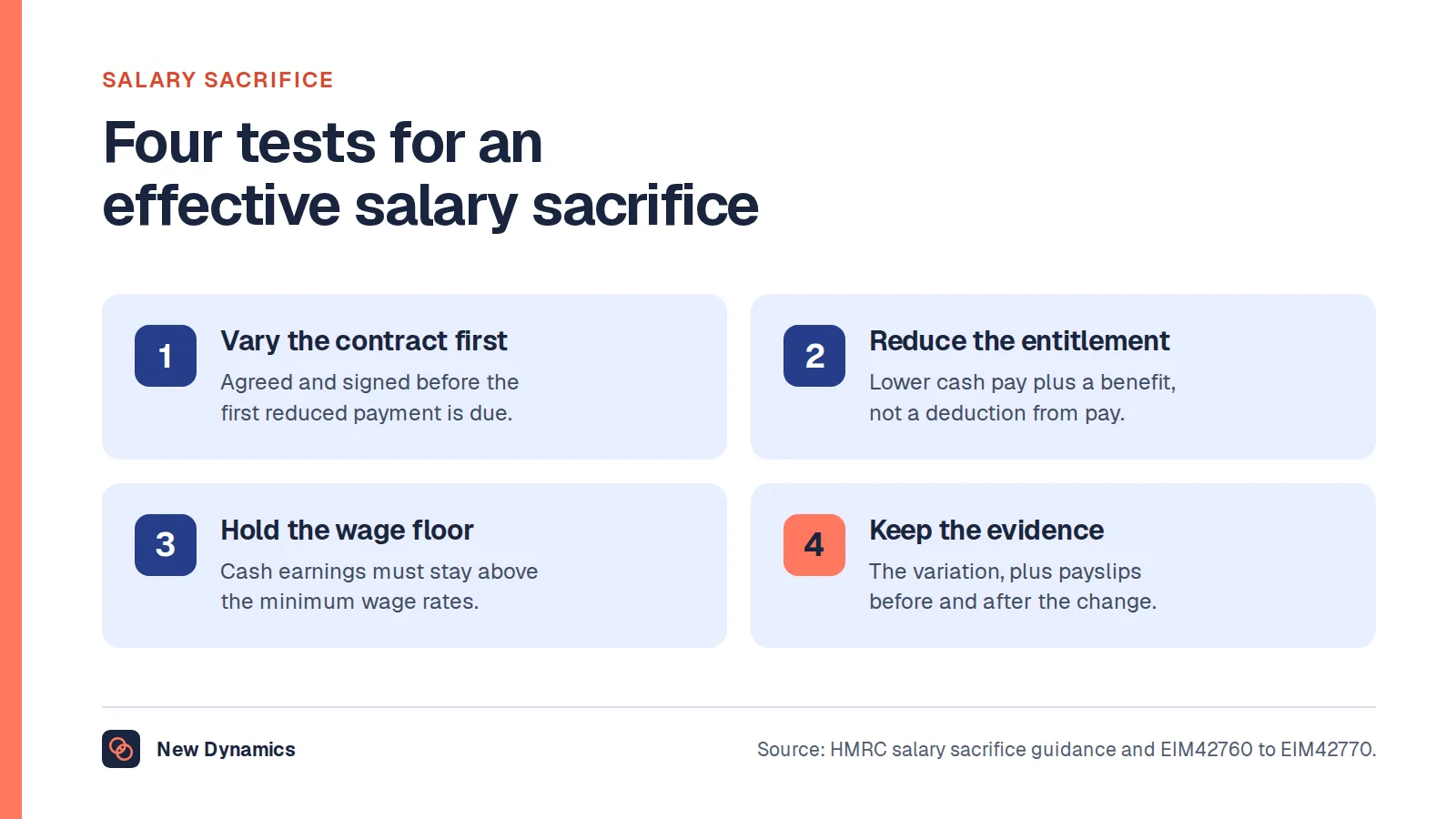
Salary sacrifice breaks the exemptions: GOV.UK says "You do have to report loans to your employees or their relatives if they're made as part of a salary sacrifice arrangement", and booklet 480 confirms the small loans exemption "does not apply where the loan is given through optional remuneration arrangements". Our post on salary sacrifice covers those arrangements.
Expense float is handled separately. EIM26155 accepts that advances for necessary expenses "are strictly loans", but not taxed as such in practice where the maximum advanced at once "does not exceed £1,000", the advances "are spent within six months" and the employee accounts for the spend regularly.
Four cases employers actually meet
A season ticket loan
GOV.UK's guide on public transport lists "loans made to employees to buy season tickets" and gives one line of instruction: "You should treat this as you would any other loan made to an employee." No special rule, so the £10,000 aggregate test decides it. The contrast on the same page is worth noting: reimbursing an employee's own season ticket "counts as earnings", with PAYE tax and Class 1 National Insurance through payroll.
A salary advance
An advance of pay already earned is pay brought forward, not credit. HMRC's consultation on salary advances treats them as relevant payments which, under the law as it then stood, "must be reported on or before the date they are paid". That was eased: regulation 67BD of the PAYE Regulations, in force from 6 April 2024, lets the advance and "the reduced regular relevant payment" be treated "as if they were a single relevant payment", where the advance "does not exceed the amount that ... reasonably represents completed service". It does not apply where the normal pay interval is shorter than a week or longer than a month.
So an ordinary advance of earned pay, recovered from the next payslip, is taxed as pay and reported through RTI. Go beyond earned pay, or let the balance roll on, and booklet 480's "any kind of advance" brings the loan rules back.
A loan to cover professional fees
Lending the money for a practising certificate or a professional subscription is a non-qualifying loan, so it counts towards the £10,000 total alongside anything else the person owes you. Paying the fee can be simpler: GOV.UK's guide on subscriptions and professional fees says nothing need be reported where you pay the body directly or reimburse the employee, "the organisation is on 'list 3', HMRC's list of approved professional bodies", and you have exemptions covering the fees.
A director's loan
The employment tax side follows the same rules. GOV.UK's director's loans guidance says that where a shareholder and director owes the company more than £10,000 "at any time in the year", the company must "treat the loan as a 'benefit in kind'" and "deduct Class 1 National Insurance", and the director "must report the loan on a personal Self Assessment tax return".
Beyond that, a director's loan carries company law duties and a separate corporation tax charge on an overdrawn loan account, reported on form CT600A. Those consequences are a different subject and out of scope here. Take them with your accountant.
If a loan is written off
Writing the debt off creates its own charge, whatever the loan looked like before. Booklet 480 at 17.3 says a tax charge "will arise irrespective of the terms of the loan which has been released or written off".
GOV.UK is equally firm: "You always have to report and pay on loans to employees that you write off, whether or not they are classed as beneficial loans." The treatment also differs from the interest benefit. You must "report it on form P11D" and "deduct and pay Class 1 National Insurance (but not PAYE tax) on the value of the benefit", so this one runs through payroll for National Insurance. For a shareholder director, GOV.UK adds that Income Tax on the amount is paid "through a Self Assessment tax return". A write-off is not a tidy way to close a stale balance.
Recovering a loan through payroll, and the minimum wage
Most employee loans come back through the payslip, which puts them inside the deduction rules. The lawful grounds, the written agreement you need first and the retail cap are covered in our post on payroll deductions, and that is where to start before the first instalment comes off.
The minimum wage point belongs here. Regulation 12 of the National Minimum Wage Regulations 2015 treats deductions for the employer's own use and benefit as reductions in minimum wage pay, then exempts a short list including "deductions, or payments, on account of an advance under an agreement for a loan or an advance of wages". A loan repayment therefore does not reduce minimum wage pay. That is a narrow permission: it does not make the deduction lawful under the contract, and it does not cover anything else you recover in the same run. For wider pay and reward figures, see our HR statistics hub.
Frequently asked questions
Are employee loans taxable in the UK?
Only where they are beneficial loans and no exemption applies. A loan that is interest free, or charges less than HMRC's official rate of interest, creates a benefit in kind. Most employer lending is exempt in practice because the combined balance stays under the £10,000 threshold all year.
What is the £10,000 threshold for employee loans?
It is the small loans exemption. GOV.UK exempts loans with a combined outstanding value to an employee of less than £10,000 throughout the whole tax year, and section 180(2) ITEPA 2003 says the threshold is not exceeded where the aggregate does not exceed £10,000 at all times in the year. The test is on the total of all the person's loans, measured at its highest point.
What is the official rate of interest for 2026 to 2027?
HMRC's actual official rates table gives 3.75% from 6 April 2026, with no closing date. The average official rates table, last updated 6 March 2026, shows 3.75% for 2025 to 2026 and does not yet list 2026 to 2027.
Is a season ticket loan taxable?
GOV.UK says to treat a loan to buy a season ticket as you would any other loan made to an employee, so the £10,000 aggregate test decides it. Reimbursing the cost instead counts as earnings, with PAYE tax and Class 1 National Insurance through payroll.
Is a salary advance an employee loan?
An advance of pay the employee has already earned, recovered from the next regular payment, is treated as pay, and regulation 67BD of the PAYE Regulations lets the two be reported as a single payment. An advance that goes beyond earned pay, or is left outstanding, falls within the beneficial loan rules.
What happens if an employee loan is written off?
It must be reported on form P11D whether or not the loan was a beneficial loan, with Class 1 National Insurance deducted and paid on the value of the benefit, but no PAYE tax. For a shareholder director, Income Tax on the amount is paid through Self Assessment.
Your next step: price one loan before you agree the next
- Add up everything the person already owes you, and find the highest combined balance in the year.
- If that figure can reach £10,000, check it against section 180 rather than the summary guidance.
- Value the benefit at the official rate for the year, 3.75% from 6 April 2026.
- Diary the P11D and P11D(b) for 6 July and the Class 1A payment for 22 July.
- Confirm the written agreement for the payroll deduction before the first instalment.
For pay rules you can explain to the people they apply to, read and download our compensation policy guide. The guide is free to read, and the PDF uses our short download form.
Want the steps after a lending decision to have an owner and a date? Book a New Dynamics demo and bring your current process. You can also email contact@new-dynamics.com.