TL;DR
- A salary sacrifice is a variation of the employment contract, not a payroll setting. HMRC states that an employer sets one up "by changing the terms of your employee's employment contract", that the employee "needs to agree to this change", and that each opt in or out means altering the contract again.
- The 2017 optional remuneration arrangement rules withdrew most of the advantage, but thirteen exemptions survive as "excluded exemptions" in section 228A ITEPA 2003, including pension contributions, cycles and safety equipment, employer-provided childcare, statutory redundancy pay, outplacement counselling and retraining courses.
- The £2,000 cap on National Insurance relief for pension sacrifice is law but not yet in effect. The National Insurance Contributions (Employer Pensions Contributions) Act 2026 received Royal Assent on 29 April 2026 and has effect "for the tax year 2029-30 and subsequent tax years".
Most arrangements that go wrong go wrong the same way. Somebody adds a line to the payroll system, the gross figure on the payslip stays where it was, and the sacrificed amount appears underneath it as a deduction. Nothing in the contract changed. On HMRC's analysis the employee is still entitled to the higher salary and still taxable on it, whatever the payroll run did.
This article covers what a salary sacrifice is in United Kingdom law, the conditions that make one effective, which arrangements the 2017 optional remuneration rules caught and which they left alone, the minimum wage floor, what a reduced gross figure does to statutory payments, and the exact status of the pension change announced at Autumn Budget 2025. It is general information about the position in the United Kingdom and it is not tax or legal advice.
A variation of terms is a decision with a record behind it, not an email. See how New Dynamics workflows hold the stages, approvals and evidence for a change of terms, so the paperwork exists when it is needed rather than being reconstructed later.
What salary sacrifice is
HMRC's guidance on salary sacrifice for employers, last updated on 6 April 2026, defines it in one sentence: "A salary sacrifice arrangement is an agreement to reduce an employee's entitlement to cash pay, usually in return for a non-cash benefit."
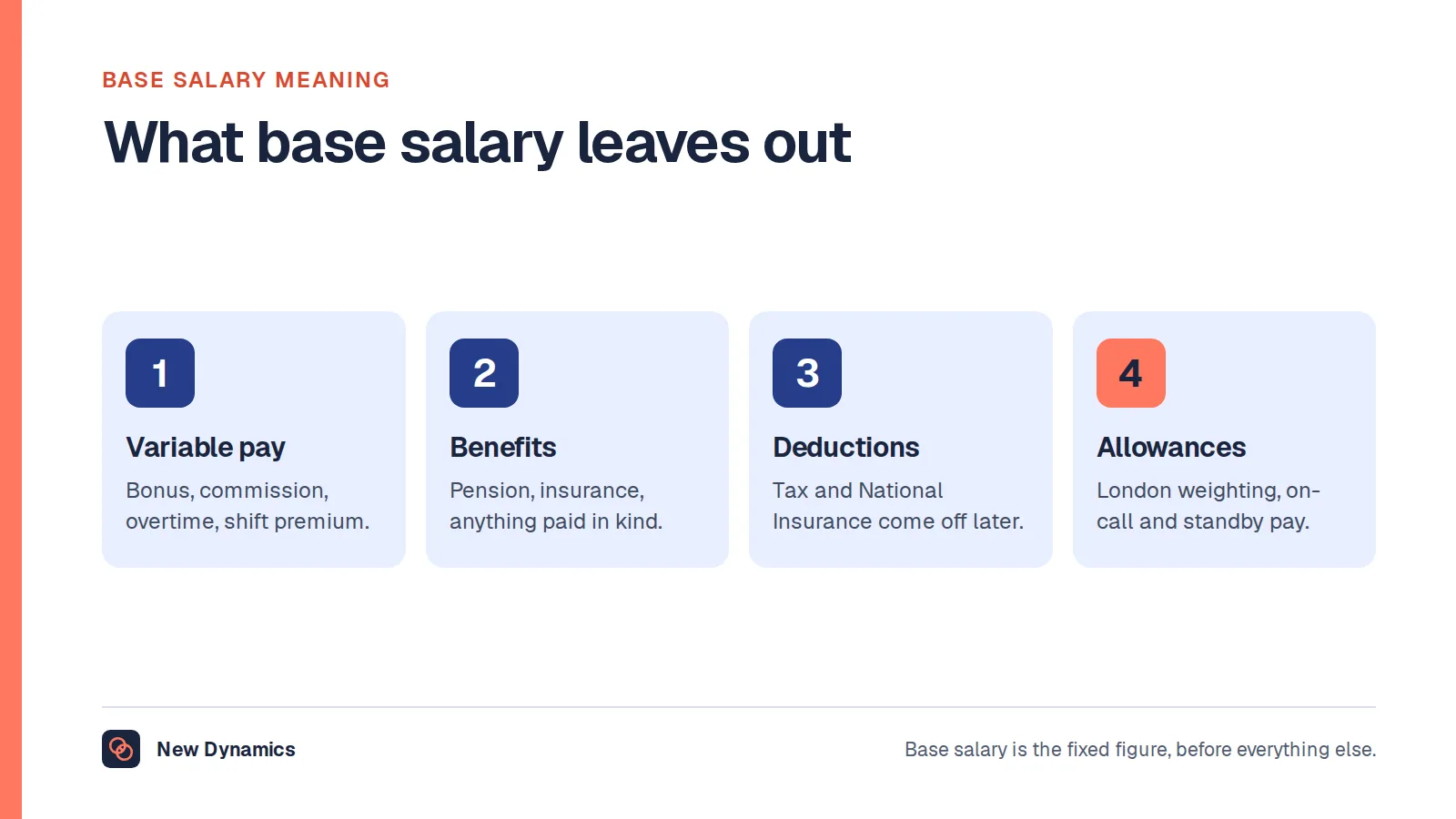
The word doing the work is entitlement. Nothing is taken from the employee. The amount they are owed under the contract becomes smaller, so there is less pay for Income Tax and National Insurance to apply to. Employment Income Manual 42750 puts it in contractual terms: a sacrifice happens when an employee "gives up the right to part of the cash remuneration due under his or her contract of employment", and "The sacrifice is achieved by varying the employee's terms and conditions of employment relating to remuneration." A one-off item such as a bonus can be sacrificed the same way.
That is why the guidance treats every election as a contract event. An employer sets one up "by changing the terms of your employee's employment contract", the employee "needs to agree to this change", and "If your employee wants to opt in or out of a salary sacrifice arrangement, you must alter their contract with each change." The contract "must be clear on what their cash and non-cash entitlements are at any given time". Our post on payroll deductions covers the separate question of what an employer may lawfully take from pay once the entitlement is settled.
The conditions for an effective sacrifice
EIM42760 sets two conditions. The contract "must be effectively varied before the changes are implemented", and "the true construction of the revised contractual arrangement between employer and employee must be that the employee is entitled to lower cash remuneration and a benefit".
Timing is the one that bites. EIM42765 states that "Entitlement to future remuneration must be given up before it is treated as received for employment income purposes", and that if the change is not complete by the first payment date, "The employee is still entitled to receive, and is therefore taxable on, the previous higher salary, even though the smaller, post-sacrifice amount is paid." Retrospective paperwork does not rescue a payroll change that ran first.
HMRC will not pre-approve an arrangement. The guidance says it "will not comment on a proposed salary sacrifice arrangement before it has been put in place", and that to be satisfied the change took effect at the right time it would need to see "evidence of the variation of terms and conditions (if there is a written contract)" and "payslips before and after the variation".
A payslip that still shows the pre-sacrifice gross figure is not fatal on its own. EIM42770 records that where the contract has been effectively varied, "the format of the payslip will not be used to challenge the effectiveness of the arrangement", but adds that where the contract has not been changed, the payslip format "is one piece of evidence that we would use as a basis on which to form a view". Keeping a notional or reference salary is allowed: EIM42771 says using the pre-sacrifice figure to set a pay rise, calculate overtime, work out holiday or sick pay, or answer a mortgage lender "does not invalidate the salary sacrifice".

The 2017 optional remuneration arrangement rules
From 6 April 2017 the advantage was largely removed. EIM44010 describes the legislation, section 69A ITEPA 2003, as covering two shapes. A type A arrangement is one where the employee "gives up the right, or the future right, to receive an amount of earnings". A type B arrangement is one where the employee "agrees to be provided with a benefit rather than an amount of earnings". The manual is explicit that this reaches beyond a classic sacrifice: "salary sacrifice includes benefits in kind with a cash allowance option and flexible benefits packages with a cash option".
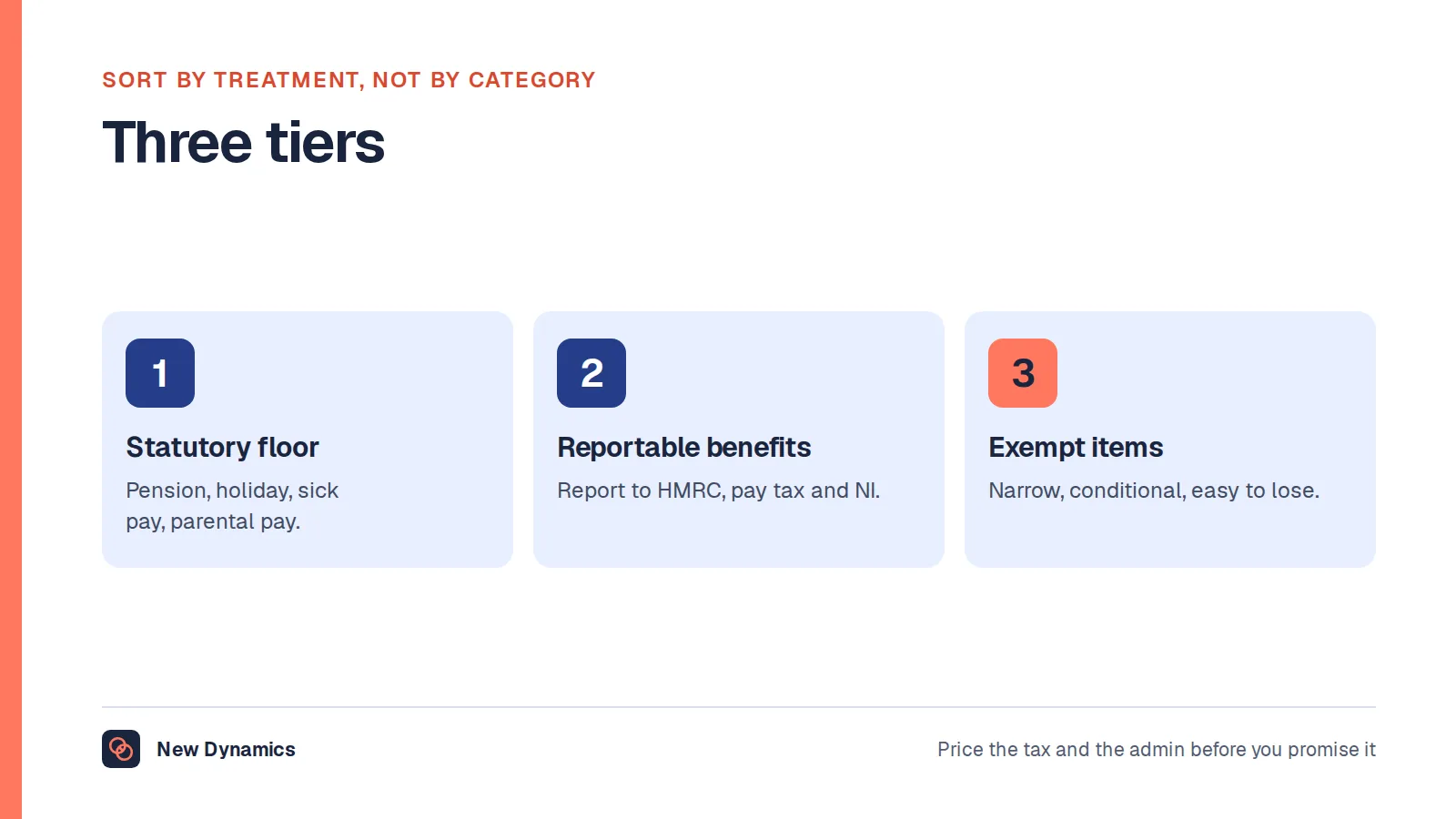
Where the rules apply, the taxable amount is "the greater of the amount of cash pay given up and the taxable value of the benefit under the normal benefit in kind rules". EIM44130 gives the consequence employers miss: where the benefit would have been exempt, the value to compare with the amount given up "is deemed to be nil. Therefore, the taxable value of the benefit is the amount foregone." Its example is a £360 a year mobile phone sacrifice, otherwise exempt under section 319 ITEPA 2003, on which £360 is taxable.
Two things sit outside the definition altogether. EIM44010 says the rules do not include "arrangements under which the employee reduces their working hours or becomes entitled to additional unpaid leave", nor a pay reduction that follows a change of working pattern, "for example, where an employee loses their shift allowance because they no longer work shifts".
The exemptions that survive, named precisely
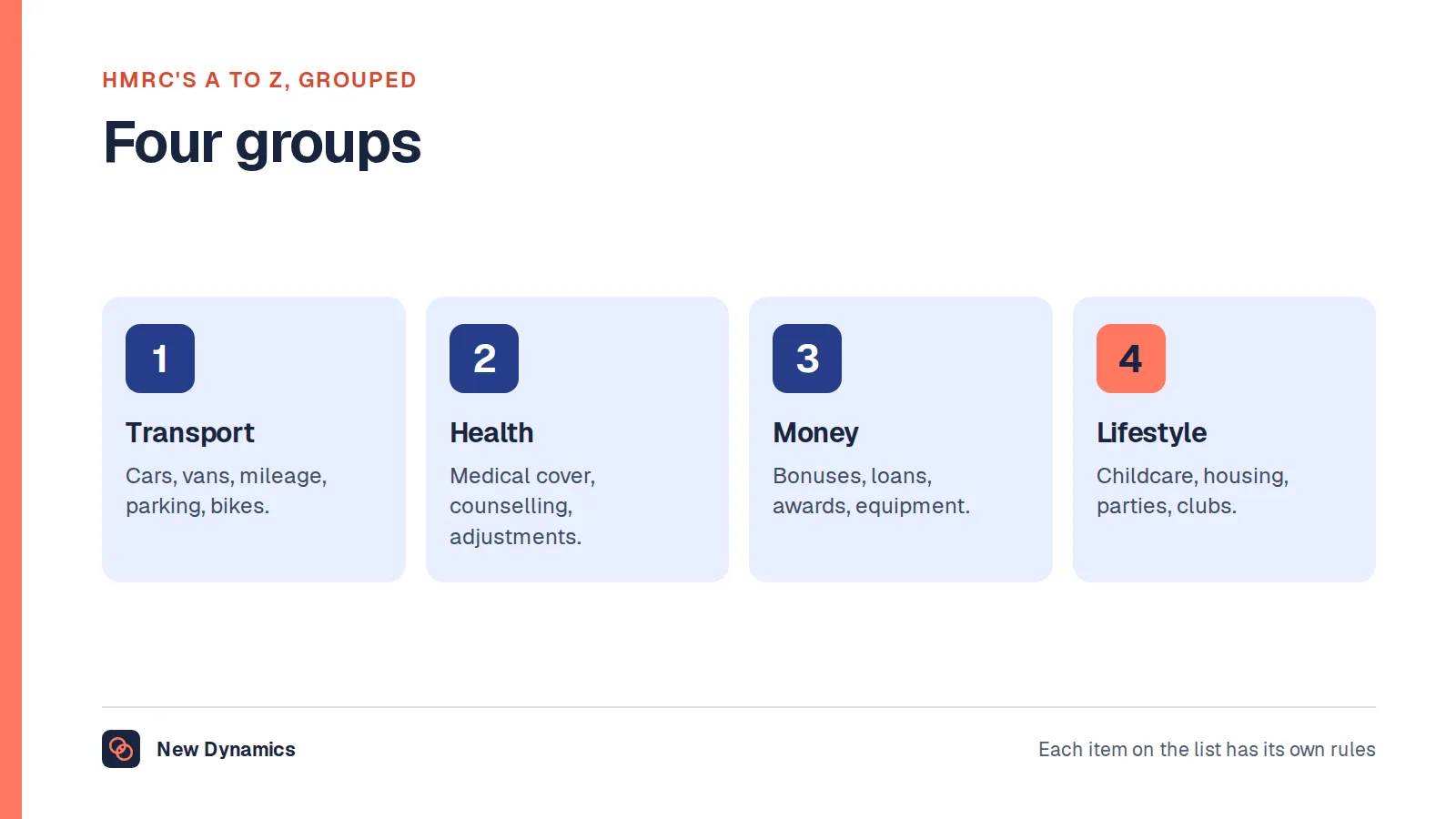
This is the part employers get wrong, so it is worth naming by section. EIM44131 lists the "excluded exemptions" under section 228A ITEPA 2003, which "are not affected by the changes" and stay exempt even under an optional remuneration arrangement, provided the qualifying conditions are met:
- Section 239, payments and benefits connected with taxable cars, vans and heavy goods vehicles.
- Section 244, cycles and cyclist's safety equipment, with section 266(2)(c) for non-cash vouchers used alongside it.
- Section 270A, qualifying childcare vouchers; section 318, employer-provided childcare; section 318A, other childcare provisions.
- Section 307, but "only in as far as the exemption applies to the provision of retirement benefits". HMRC spells out the trap: where the employee gets death benefits instead, for example employer-funded death in service cover, "the exemption does not apply when provided under optional remuneration arrangements".
- Sections 308, 308A and 308C, contributions to registered pension schemes, contributions to overseas pension schemes, and the provision of pensions advice.
- Section 309, statutory redundancy payments; section 310, counselling and other outplacement services; section 311, retraining courses.
The employer guidance says the same thing from the reporting side: "Exemptions on benefits in kind do not apply to salary sacrifice schemes", and the only benefits an employer need not value or report are pension scheme payments, employer provided pensions advice, workplace nurseries, childcare vouchers and directly contracted childcare "that started on or before 4 October 2018", and bicycles and cycling safety equipment.

The pension change: legislated, dated, not yet in effect
Pension sacrifice is the survivor of 2017, and it is the change employers are asking about. Three things need keeping apart.
Announced. HM Treasury published Changes to salary sacrifice for pensions from April 2029 on 26 November 2025: "As announced at Autumn Budget 2025, the government is changing how salary sacrifice for pension contributions works. From April 2029, the amount that is exempt from National Insurance contributions (NICs) will be capped at £2,000 a year for employee contributions made via salary sacrifice."
Legislated. HMRC's tax information and impact note of 4 December 2025 said primary legislation "will be introduced". It since was. The National Insurance Contributions (Employer Pensions Contributions) Act 2026, chapter 15, received Royal Assent on 29 April 2026 and came into force that day under section 3(2). It inserts a regulation-making power into section 4 of the Social Security Contributions and Benefits Act 1992 and its Northern Ireland equivalent, and section 1(4) requires that "The first regulations made under subsection (6A) ... must specify the contributions limit as £2,000 for a tax year".
Not yet in effect. Section 1(3) is the line that matters for this tax year: "The amendments made by this section have effect for the tax year 2029-30 and subsequent tax years." Nothing changes for 2026 to 2027. The regulations that will set out how the cap operates, including an equivalent limit for employees paid weekly, are not yet made. The impact note said the design "will be set out in secondary legislation in due course, following stakeholder engagement", and we found no such regulations published on legislation.gov.uk at the time of writing.
What the measure does, in the words of the impact note, is remove "the OpRA excluded exemption for employer pension contributions for Class 1 National Insurance contributions only, where salary sacrifice arrangements exceed the £2,000 contribution limit". Income Tax relief is untouched, and so is National Insurance relief on ordinary employer contributions made outside a sacrifice. HMRC's estimate is that "an estimated 7.7 million employees currently use salary sacrifice to make pension contributions. Of these, 3.3 million sacrifice more than £2,000 of salary or bonuses", and that 290,000 employers will have to account for and report the amounts. For wider workforce figures, see our HR statistics hub.

The minimum wage floor
The floor is absolute and it is in the employer guidance: "A salary sacrifice arrangement must not reduce an employee's cash earnings below the National Minimum Wage (NMW) rates. Employers must put procedures in place to cap salary sacrifice deduction and ensure NMW rates are maintained."
The rates on GOV.UK's National Minimum Wage page change on 1 April each year. From April 2026 they are £12.71 an hour for workers aged 21 and over, £10.85 for 18 to 20 year olds, £8 for under 18s and £8 on the apprentice rate. The same page already publishes April 2027 figures of £13.21, £11.27, £8.31 and £8.31.
Capping is not a one-off check. A sacrifice is usually a fixed monthly amount while hours and the hourly floor both move, so headroom can disappear without anybody touching the arrangement. The Department for Transport's cycle to work guidance sets out the two usual answers where a sacrifice would breach the floor: "offer the employee a lower value package and/or a longer than usual hire period", or "hire a cycle to the employee without a salary sacrifice arrangement". The same logic works for any benefit.
What it does to statutory payments and pensions
A smaller gross entitlement is a smaller base for anything calculated on gross pay. HMRC is blunt: "Salary sacrifice can affect the amount of statutory pay an employee receives. It can cause some employees to lose their entitlement altogether", and "If a salary sacrifice arrangement reduces an employee's average weekly earnings below the lower earnings limit, you don't have to make any statutory payments to them."
Check that against each scheme rather than applying it as a blanket statement, because they differ. For Statutory Maternity Pay, GOV.UK's employer guide requires the employee to "earn at least £125 a week (gross) in an 8-week 'relevant period'", so a sacrifice that drops average weekly earnings below that line removes entitlement. For Statutory Sick Pay the current GOV.UK employer guide lists no earnings floor at all among the qualifying conditions, and the published 2026 to 2027 rate is "£123.25 or 80% of the employee's average weekly earnings, whichever is lower". Where the general salary sacrifice page and a scheme page differ, the scheme page describes the test for that payment, and a reduced gross figure still shrinks an earnings-related amount even where it does not remove entitlement. The lower earnings limit itself, on rates and thresholds for employers 2026 to 2027, is £129 a week, £559 a month or £6,708 a year.
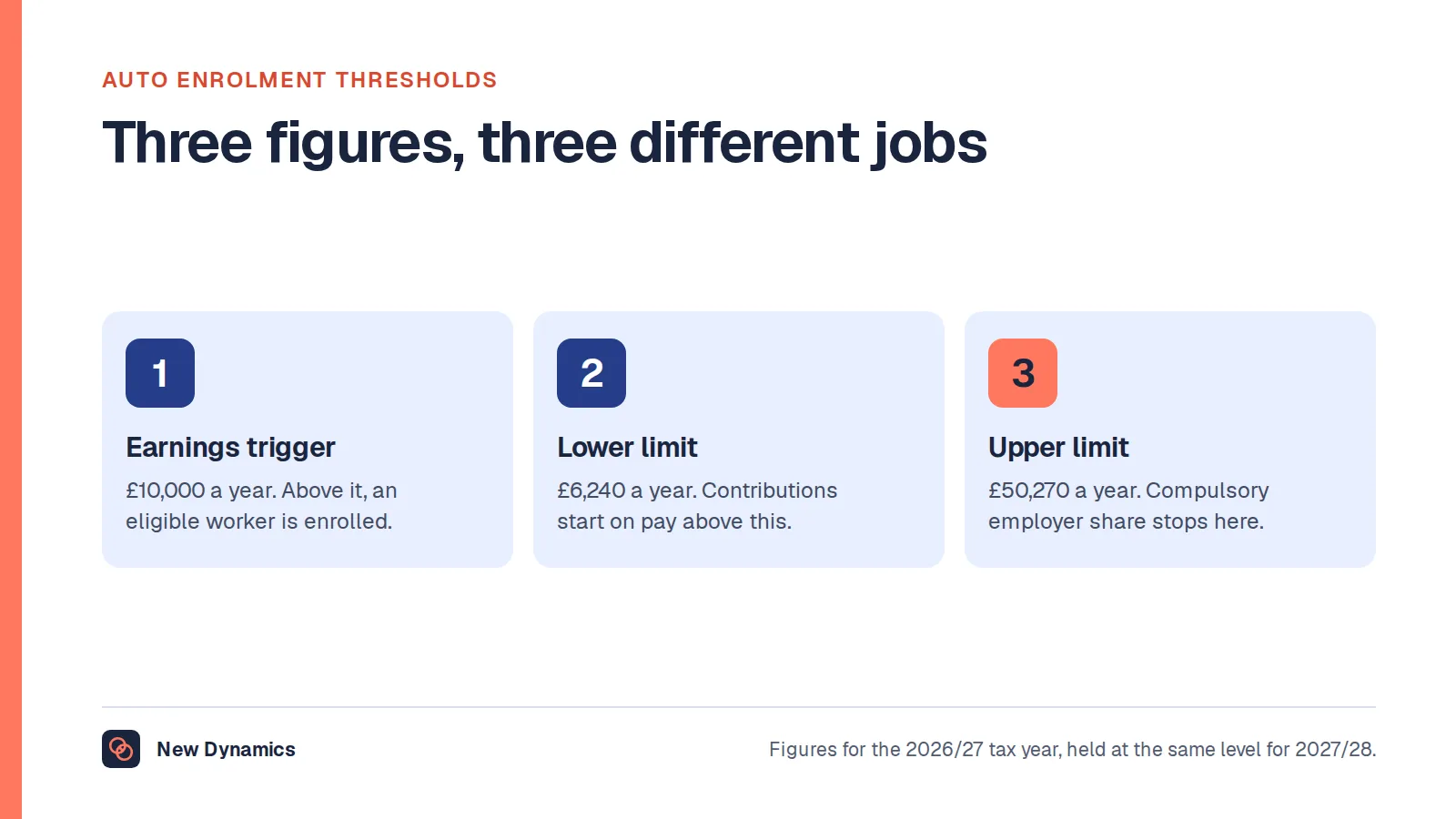
Pension and other earnings-related pay are a design choice, not an automatic consequence. HMRC says earnings-related payments such as occupational pension contributions, overtime rates and pay rises "can be based on the notional salary or the new reduced cash salary, but this must be made clear to the employee", and that employers "often" use a notional level of pay "so that employees who participate in salary sacrifice arrangements are not put at a disadvantage". Two warnings attach: check with the scheme provider that the approach is allowable, and if somebody opts out of the pension having already taken reduced pay, a payment making the shortfall good "should be made subject to tax and National Insurance contributions". Our post on auto enrolment thresholds covers the figures the contribution sits inside.
Sacrifice also reduces the cash earnings National Insurance is charged on, which HMRC notes may affect contribution-based entitlements such as State Pension, and earnings-related ones such as Maternity Allowance and Additional State Pension, where "The amount they receive may be less than the full standard rate, or they may lose the entitlement altogether."
Cycle to work, as a worked example
Cycles are one of the surviving exemptions, so the scheme shows a sacrifice that still works end to end. The Department for Transport's cycle to work scheme implementation guidance for employers, last updated on 13 June 2019, sets the conditions: "An employee must not, at any point during the hire period, own the cycle", "At least 50% of the cycle's use must be for 'qualifying journeys', i.e. commuting to work purposes", and the offer "must be made available across the whole workforce, with no groups of employees being excluded". For tax and National Insurance "there is no limit on the value of the cycle and safety equipment you can provide".
Two points sit outside tax law and are the ones most often missed.
Consumer credit. Because the employee hires the bike, the guidance says the agreement "is likely to be a regulated consumer hire agreement under the Consumer Credit Act 1974", with pre-contractual information, form and content requirements and post-contractual duties, and "If the hire agreement lasts for more than 18 months, the employee will have a statutory right to terminate under section 101 of the CCA." The owner may also need Financial Conduct Authority authorisation. There is a narrow exemption "where the owner is the employer and the total value of the goods being hired does not exceed £1,000", under the Financial Services and Markets Act 2000 (Exemption) Order 2001. It does not apply above £1,000, "irrespective of the value of the salary sacrifice arrangement", nor where the agreement is with a third party, and schemes above £1,000 "are acceptable provided the requisite FCA authorisation is obtained".
Ownership. At the end of the hire the employee may extend, return the equipment, or buy it "under a separate agreement entered into at the time". Then the line: "There must be no option, whether express or implied, as part of, or alongside the initial hire agreement for the employee to purchase the cycle or equipment at the end of the hire agreement." If there is, it is likely to be a hire purchase agreement, different regulatory requirements apply, and "it would no longer be eligible for the tax exemption". Scheme rules "should not refer to ownership as an option", any sale must be discretionary at the time, and any payment "must be out of post-tax pay". Giving the bike away instead creates a taxable benefit in kind to report.
One warning on that document. It was last updated in June 2019 and says an employer saves secondary Class 1 National Insurance "at 13.8%". The current employer rate on GOV.UK's rates and thresholds page for 2026 to 2027 is 15% on category A earnings above the secondary threshold of £96 a week. Use the rates page for the arithmetic and the DfT guidance for the scheme conditions.
Frequently asked questions
Is salary sacrifice a deduction from pay?
No. It reduces the pay the employee is entitled to under the contract, which is why HMRC calls it "an agreement to reduce an employee's entitlement to cash pay". A deduction comes out of pay the employee is still owed. That distinction decides the tax treatment and the paperwork.
Can an employer set up salary sacrifice without changing the contract?
No. HMRC's guidance says an employer sets one up "by changing the terms of your employee's employment contract" and that the employee "needs to agree to this change". If the variation is not effective before the first reduced payment, EIM42765 says the employee remains taxable on the previous higher salary.
Can an employee opt out whenever they want?
Not freely. Each opt in or out means altering the contract again. HMRC's general rule is that if an employee "swaps between cash earnings and a non-cash benefit whenever they like, any expected tax and National Insurance contributions advantages ... will not apply". Arrangements may allow changes on a lifestyle event, and the guidance names marriage, divorce, and a partner becoming redundant or pregnant.
Which benefits still give an advantage through salary sacrifice?
Those covered by an excluded exemption in section 228A ITEPA 2003. The list in EIM44131 includes registered and overseas pension contributions, pensions advice, cycles and cyclist's safety equipment, childcare provisions, benefits connected with taxable cars and vans, statutory redundancy pay, outplacement counselling and retraining courses.
Is the £2,000 pension cap in force now?
No. The National Insurance Contributions (Employer Pensions Contributions) Act 2026 is in force, but section 1(3) says its amendments "have effect for the tax year 2029-30 and subsequent tax years", and the regulations setting out how the limit works are not yet made. Treat 2026 to 2027 payroll as unchanged and the cap as a planning date.
Does salary sacrifice reduce holiday pay and overtime?
Only if the employer decides it should. HMRC says such payments "can be based on the notional salary or the new reduced cash salary, but this must be made clear to the employee", and that using a reference salary for pay rises, overtime, holiday pay or a mortgage reference "does not invalidate the salary sacrifice".
Your next step: audit the arrangements you already run
- Pull the signed variation for every live arrangement and check its date against the first reduced payment. A missing or late document is the failure HMRC looks for first.
- List each benefit you offer by sacrifice against the section numbers in EIM44131. Anything not on that list is taxable on the greater of the salary given up and the benefit in kind value.
- Rerun the minimum wage headroom calculation at each April uprating and after any change to hours, not only when somebody joins a scheme.
- Write down, for each earnings-related payment, whether you use notional or reduced salary, and confirm the pension scheme provider accepts it.
- Diary the 2029 pension cap, and watch for the regulations that will define how the £2,000 limit applies to weekly and monthly payrolls.
For the policy that holds all of this together, read and download our compensation policy guide. The guide is free to read, and the PDF uses our short download form.
Want variations of terms, approvals and the evidence behind them in one record rather than four inboxes? Book a New Dynamics demo and bring one live arrangement with you. You can also email contact@new-dynamics.com.