TL;DR
- Recognition and reward are two different mechanisms. Recognition is free, frequent, specific and given by anyone. Reward costs money, needs an approval limit and has tax consequences. Programmes fail when the two are merged into one points balance.
- In the UK, the trivial benefits exemption does not apply to a reward for work or performance, which is exactly what most schemes give. Decide with payroll before launch whether awards go through payroll, a P11D or a PAYE Settlement Agreement.
- Measure reach rather than volume: the share of people who received anything at all, and whether recognition is getting to shift and frontline staff who have no work email. Total messages sent tells you nothing useful.
Most reward and recognition programmes are bought before they are designed. A platform arrives, a points budget is loaded, a launch email goes out, and a year later the same four people are winning things, half the workforce has never been mentioned, and payroll is asking why vouchers appeared on a payslip untaxed.
This article is the design work rather than the shopping list: what the programme is meant to reinforce, who can give what, the approval limits, the UK tax treatment that catches employers out, how to check that recognition is reaching everybody, and what is honestly worth measuring. It describes the position in the UK and is general information, not tax or legal advice.
The free half has to work before the paid half is worth anything. See how New Dynamics recognition lets colleagues thank each other for specific work, in the flow of goals and feedback rather than in a separate catalogue.
If you want things to give rather than a structure to run, our 50 employee recognition ideas is the list. This post is the programme that sits around it.
Recognition and reward are not the same mechanism
This is the distinction almost every failed scheme has blurred.
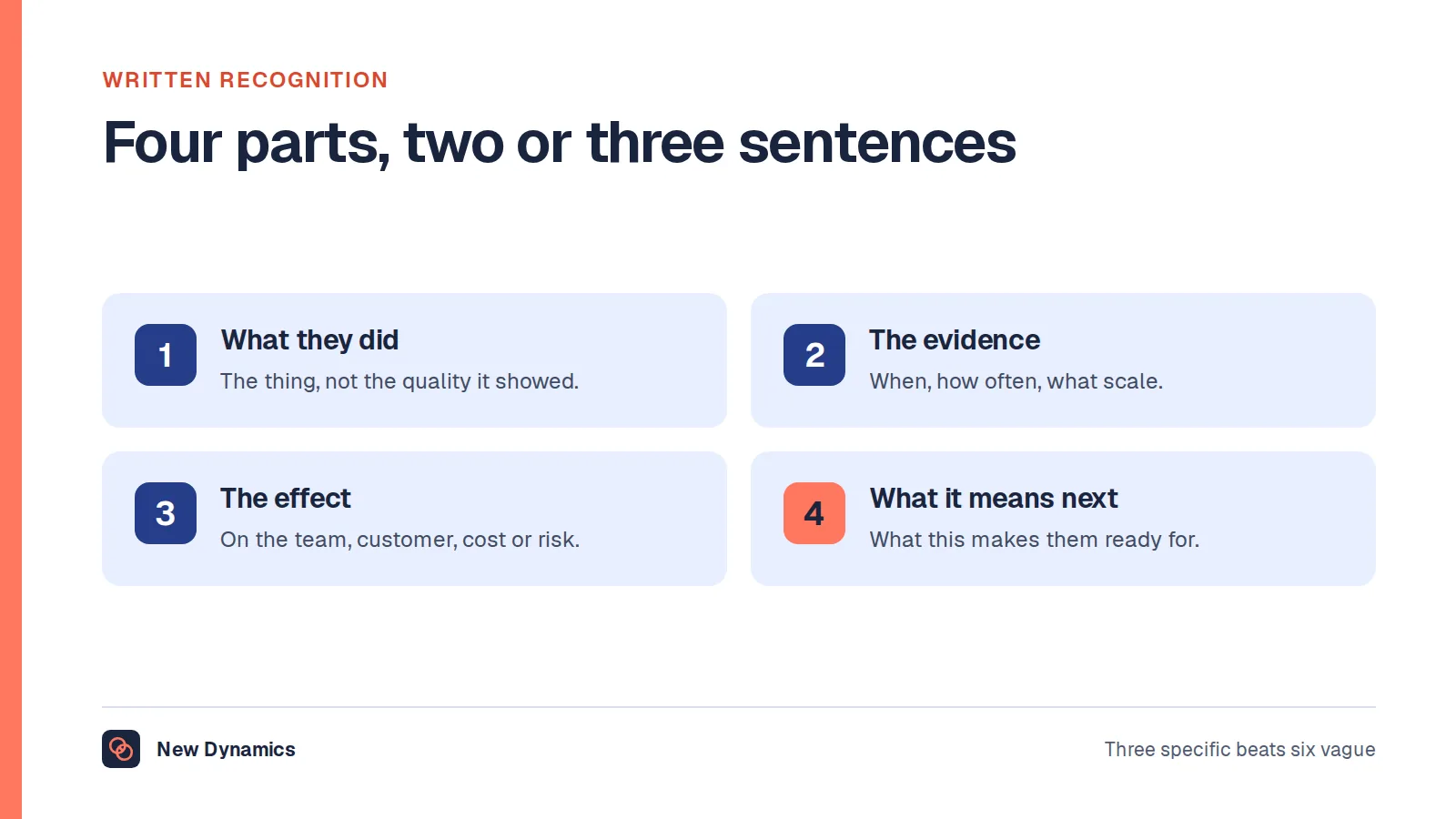
Recognition is attention. It is free, it can happen several times a week, it is specific about what somebody did, and anyone can give it to anyone: peer to peer, manager to report, report to manager, team to team. It needs no approval, no budget code and no tax treatment, because nothing of value changes hands.
Reward is money or something money bought. It is occasional, it comes out of a budget, somebody has to approve it, somebody has to record it, and it has a tax consequence that depends on what it is and why it was given.
Merge the two and you get a predictable set of problems. Thanks acquires a price, so people stop saying it for free. Managers ration appreciation because it draws down a budget. Employees start comparing the cash value of the words they received. And the scheme quietly becomes a small, badly run bonus system with no governance.
Keep them separate and each does its own job. Recognition carries the frequency and the specificity. Reward marks the handful of contributions each year that deserve more than words, under rules you can explain to anybody who asks.

Decide what the programme is meant to reinforce
Write down, in one page, the behaviour you want more of. Not "engagement". Behaviour.
A programme that reinforces nothing in particular reinforces visibility, because visible work is the easiest to notice. That is how recognition drifts towards sales, towards the office, towards the people who present at the monthly meeting, and away from the night shift, the second line support desk and the person who quietly stopped a problem from happening.
Three questions settle most of the design:
- What do we want noticed that is currently invisible? Prevention, handovers, mentoring, cover at short notice, patient or customer care that nobody logged.
- What are we already paying for? Hitting a quota is paid through pay and commission. Recognising it again in a reward scheme pays twice for the same thing and tells everyone else the scheme is not for them.
- Which of our values is this meant to make real? If a value cannot be recognised with a concrete example, it is a poster, not a value. Our post on corporate values covers that gap.
Then write the criteria in the words your people use. "Went above and beyond" is unusable, because every nomination claims it and no two managers read it the same way.
Who can give what, how often, and the approval limit
This is the part worth drafting before you look at any software. A permission grid removes the two arguments that kill schemes: "why did they get that and I did not", and "who signed this off".
A structure that works for most organisations:
- Anyone, any time, no limit: written recognition with no monetary value. Visible to the team, logged against the person, not approved by anybody. This is the volume of the programme.
- Any manager, within a team budget: a non-cash item at the low end, for a specific contribution, recorded at the point of giving and reported to payroll monthly. No pre-approval, because approval queues kill timeliness, but a clear cap and a monthly total that the manager's own manager can see.
- Head of function, above that cap: a larger award for something exceptional, approved in advance, with a written reason held with the record.
- Executive sponsor or HR, anything unusual: a one-off outside the rules. Rare, documented, and reviewed at the end of the year to decide whether the rules need changing.
Add two things people forget. A frequency rule, so the same person cannot be rewarded three times in a quarter while a neighbouring team gets nothing, and a lead time, because an award that arrives eleven weeks after the work has lost most of its meaning.
Then set the budget as a standing annual cost per head, reviewed with pay. A programme funded out of an underspend in its first year, with nothing allocated in its second, is worse than no programme, because it teaches people that appreciation here is a passing initiative.
The tax part, which is where employers get caught
This is the section most articles skip, and it is the one that produces the awkward conversation with payroll. The following describes the UK position, quotes the published guidance, and is general information rather than tax advice. Confirm your own treatment with payroll or your accountant before you promise anything.
The trivial benefits exemption, and why a performance reward usually fails it
GOV.UK's guidance on trivial benefits says you do not have to pay tax on a benefit for an employee if all of these apply: "it cost you £50 or less to provide", "it's not cash or a cash voucher", "it's not a reward for their work or performance" and "it's not in the terms of their contract".
Read the third condition again. A reward given for work or performance does not meet the definition of a trivial benefit, whatever it cost. That rules out most of what a reward and recognition scheme is designed to do. A £40 hamper for a birthday can sit inside the exemption. The same £40 hamper awarded for a good quarter generally cannot.
The same guidance notes a further restriction for owner-managed businesses: "You cannot receive trivial benefits worth more than £300 in a tax year if you're the director of a 'close' company", described there as "a limited company that's run by 5 or fewer shareholders".
If it does not qualify, it is reportable
Where the conditions are not met, the benefit is taxable and has to be reported, which GOV.UK's trivial benefits guidance handles through form P11D. The wider guidance on expenses and benefits for employers states the baseline duty plainly: if you provide expenses or benefits to employees or directors you must usually "report them to HM Revenue and Customs (HMRC)" and "pay tax and National Insurance on them".
Cash is simpler and more expensive. GOV.UK's guidance on bonus payments says a cash bonus "counts as earnings", so you "add it to your employee's other earnings" and "deduct and pay Pay As You Earn (PAYE) tax and Class 1 National Insurance through payroll". For non-cash bonuses it warns that "in certain cases you'll have to use PAYE when giving non-cash bonuses, for example, if you give your employee something they can easily convert to cash". A gift card is the obvious example, and it is the thing most schemes hand out.
PAYE Settlement Agreements, the mechanism built for this
Where a scheme produces lots of small awards, a PAYE Settlement Agreement is often the practical route. GOV.UK says a PAYE Settlement Agreement "allows you to make one annual payment to cover all the tax and National Insurance due on" expenses or benefits for employees, and that with one in place you do not put those items through payroll or on a P11D, paying Class 1B National Insurance as part of the agreement instead.
The guidance on what can be included is unusually useful for scheme design. Items have to be minor, irregular or impracticable, and its examples of minor benefits include "incentive awards, for example for long-service" and "small gifts and vouchers". It is equally clear about the limits: you cannot include "wages, high-value benefits like company cars, or cash payments such as employee bonuses, round sum allowances, beneficial loans in a PSA".
So a scheme built on modest non-cash awards can usually be settled centrally. A scheme that pays cash cannot, and the tax lands on the individual through payroll.
Long service is its own exemption
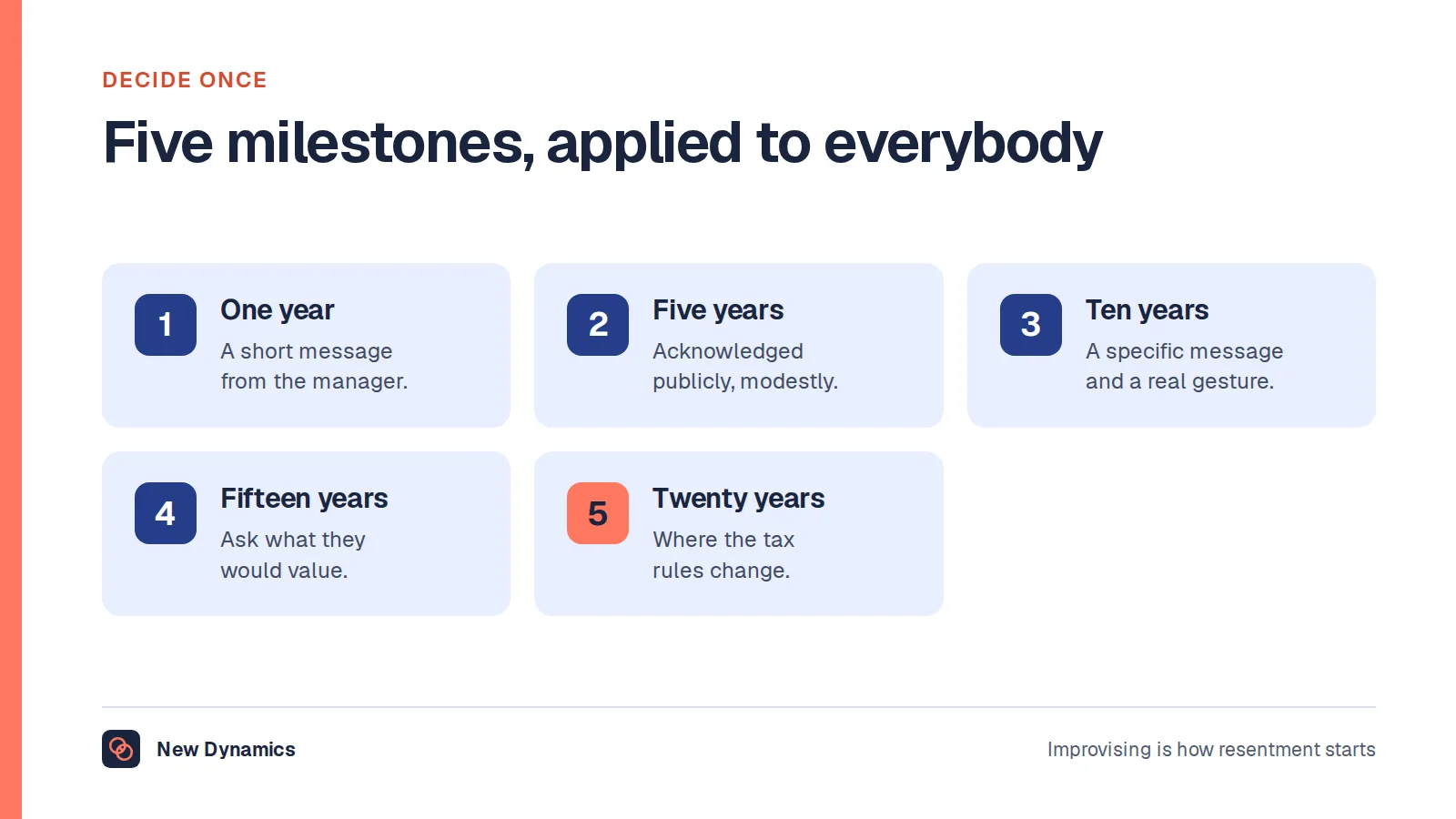
Service awards are a separate regime with tight conditions. GOV.UK's guidance on long-service awards sets the exemption at "a non-cash award to an employee" where "they've worked for you for at least 20 years", "the award is worth less than £50 per year of service" and "you have not given them a long-service award in the last 10 years". Anything you give at five or ten years sits outside it. Our post on long service recognition works through the milestones.
Three questions to put to payroll before launch
- Which awards in our grid are non-cash, and which are cash or convertible to cash?
- Do we want a PAYE Settlement Agreement, or will these go through payroll and the P11D process?
- Who tells payroll, in what format, and by when each month?
Get written answers. The common failure is not a wrong answer, it is that nobody asked, and the first anybody hears of it is a deduction on a payslip that the employee did not expect.

Fairness: who gets recognised, and who never does
Every recognition scheme has a distribution, and almost nobody looks at it.
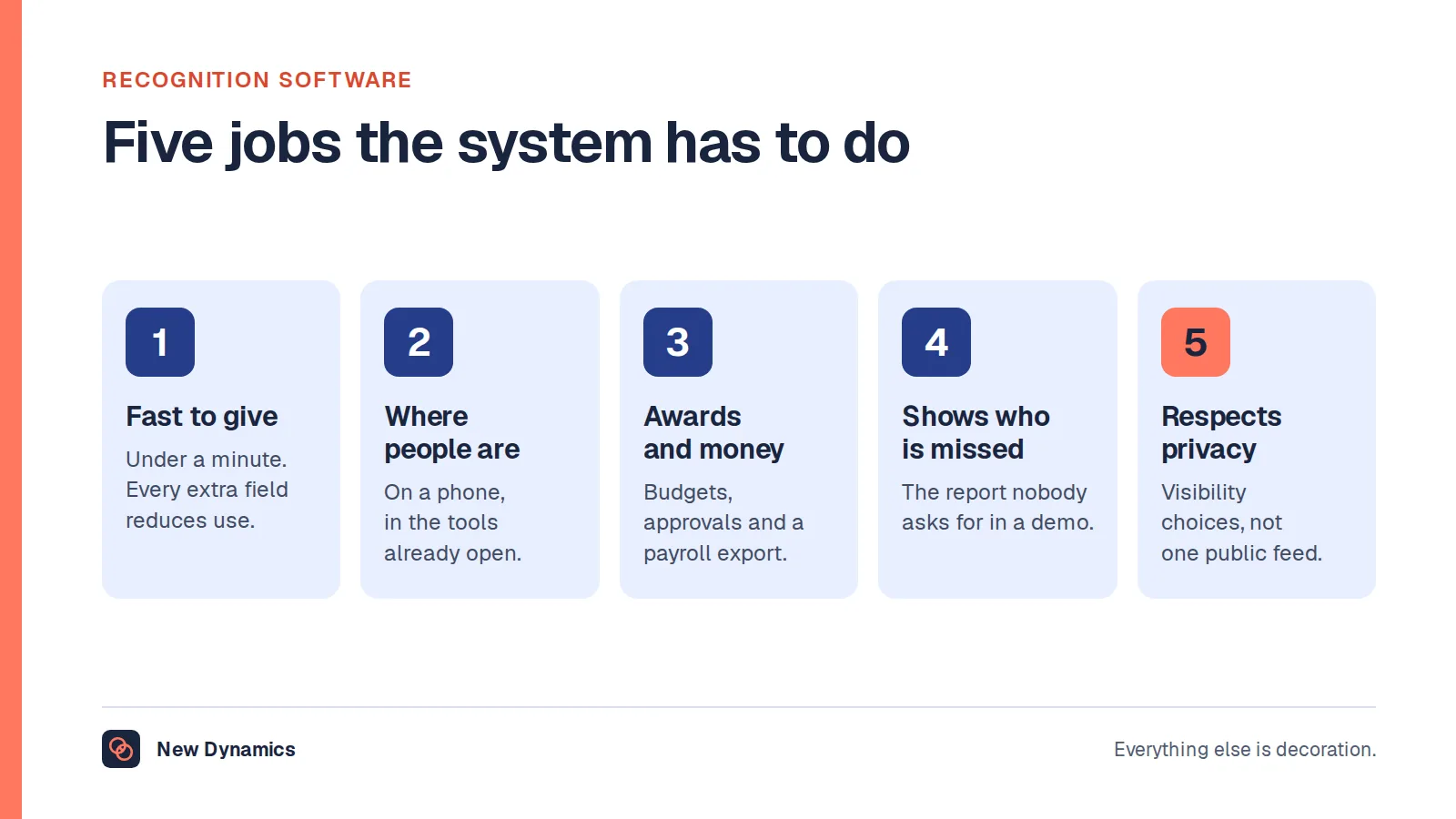
The structural problem is visibility. Recognition flows to work that is seen, and seeing is easier in head office, on day shift, in a role with a laptop and a calendar. If your programme lives behind a corporate login, the warehouse, the ward, the shop floor, the depot and the kitchen are effectively excluded, because many of those colleagues have no work email address and no reason to open an intranet in their own time. Access on a personal phone without a company account, a printed nomination route, a supervisor who can submit on somebody's behalf and a screen in the break area are not nice extras. They decide whether half your workforce is in the scheme at all.
Acas's guidance on equality, diversity and inclusion frames the employer's job as making sure "what's expected under discrimination law is actually happening in your workplace", which is a reasonable test to apply to a reward scheme as well as to a policy.
So check the distribution, quarterly, not annually:
- Recognition given and received by team, site and shift.
- Part-time compared with full-time, and people on family leave during the period.
- Office-based compared with frontline and remote colleagues.
- Protected characteristics in aggregate, where you lawfully hold that data and the groups are large enough to report without identifying anybody.
Then act on what you find. A team with no recognition at all usually has a manager who does not know the scheme exists, not a team doing nothing worth noticing. And keep recognition out of the performance rating. The moment a count of thank-you messages influences a rating, people start farming them, and the data stops meaning anything. Our post on recognising good performance covers that boundary.
Measure reach, not volume
The metric every platform offers is the number of recognitions sent. It is the least useful number available, because it rises when a handful of enthusiasts become more active and tells you nothing about the people the programme is missing.
Four measures that are worth reporting:
- Reach. The share of employees who received at least one piece of recognition in the quarter. This is the headline number.
- Breadth of giving. The share of employees, not just managers, who gave recognition. A programme where most recognition comes from managers is a manager communication tool, not a peer programme.
- Distribution. The gap between your best covered and least covered team or site. Narrowing that gap is a real result.
- Reward spend against the grid. How many awards at each tier, and whether the approval limits are being respected.
Two honest limits. No official UK body publishes a benchmark for recognition participation, so there is no number to compare yourself against. Measure your own baseline in the first quarter and track the direction after that. Where you want the wider picture on UK workforce data, our HR statistics hub collects what is actually published.
And a programme cannot carry more weight than it has. Recognition does not fix pay that has fallen behind the market, a workload nobody can meet, or a manager people are leaving. If an engagement survey says the problem is one of those, a reward scheme is a distraction from the fix, and launching one will be read as exactly that.

What goes wrong, and the design choice that prevents it
Points become a second currency. Once everything is priced in points, people convert words into value, compare balances, and treat a thank you as a small payment. Prevent it by keeping the free recognition stream genuinely free, with no points attached to a message, and the reward tiers separate and approved.
Manager-only recognition. If only managers can give anything, the programme reproduces the hierarchy and misses most of what colleagues see. Let anyone recognise anyone, in any direction, and look at the share of recognition that comes from peers.
The annual awards that recognise the same people. Where nominations are open and unweighted, the winners are the best known candidates, which is why the same names return. Set written criteria per category, require a specific example, rotate the panel, and publish the distribution of nominations by team.
Nobody budgets to sustain it. Fund it per head, every year, in the same cycle as pay. A scheme with no owner and no money after year one dies slowly and loudly.
No owner at all. Name one person accountable for the scheme document, the register of awards, the monthly payroll handover and the quarterly distribution review. If that is nobody's job, it will be done by nobody.
Frequently asked questions
What is a reward and recognition programme?
It is the structure that decides how an employer notices and repays good work. The recognition part is free, frequent and open to everybody. The reward part spends money against defined tiers and approval limits, and carries tax and reporting duties. A programme is the design, the budget, the governance and the measurement, rather than a platform or a catalogue.
What is the difference between reward and recognition?
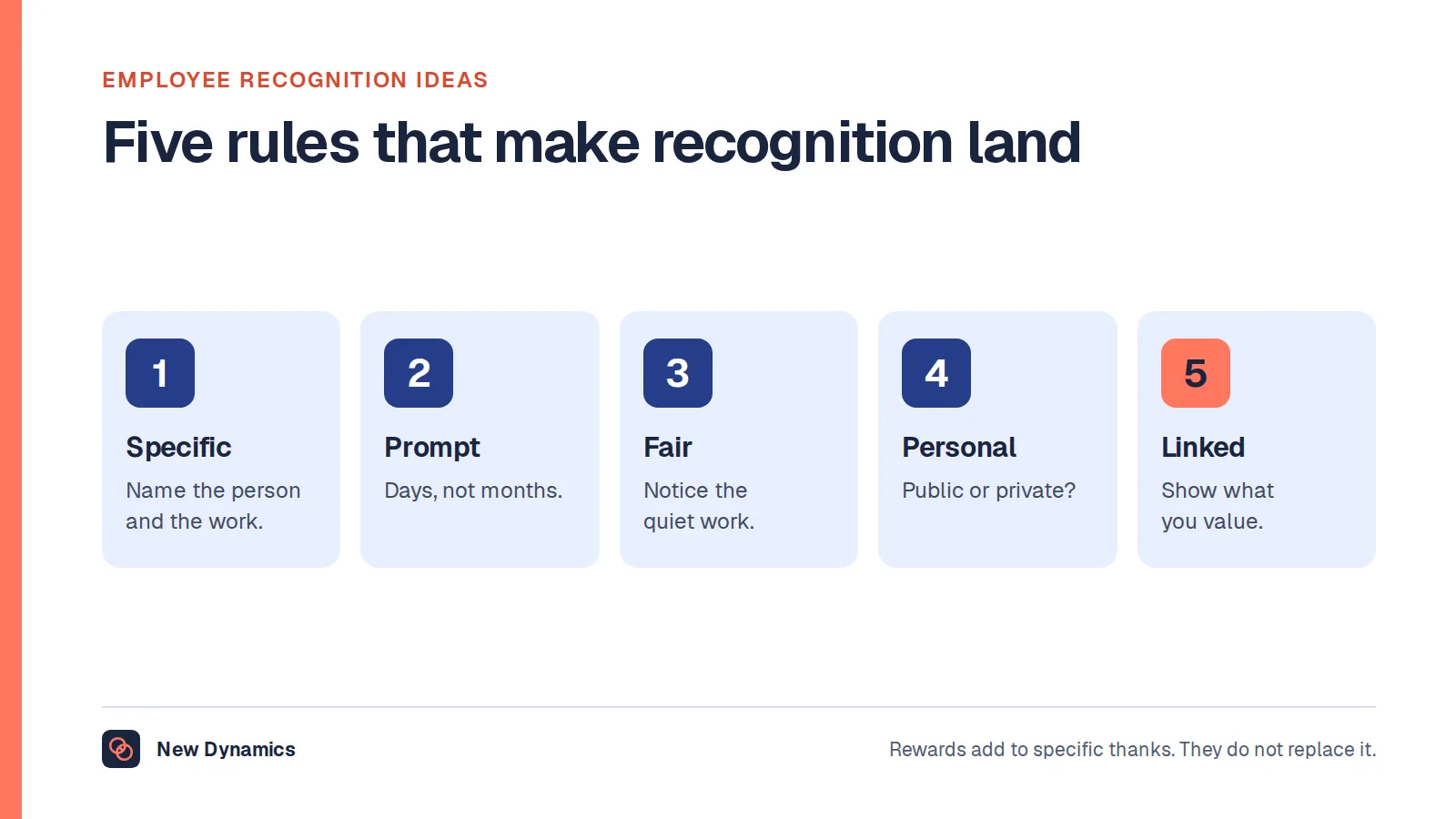
Recognition is attention: specific, prompt, given by anyone to anyone, and it costs nothing. Reward is a thing of value, so it needs a budget, an approval limit, a record and a tax decision. Recognition should happen weekly, reward occasionally. Schemes that merge the two end up paying for thanks and governing neither properly.
Is a staff recognition scheme taxable in the UK?
Usually, yes, in some form. GOV.UK's trivial benefits exemption requires a benefit to cost £50 or less, not be cash or a cash voucher, not be in the contract and not be a reward for work or performance. That last condition excludes most scheme awards, so they are reportable. Many employers settle small non-cash awards through a PAYE Settlement Agreement instead. Confirm your position with payroll.
How much should an employee reward system cost?
Set it as an annual amount per head in the pay cycle, and size it from your own payroll rather than from a benchmark. The useful discipline is the grid: how many awards at each tier you expect in a year, multiplied by the cap for that tier, plus the tax you will settle. Free recognition carries the frequency, so the budget only has to cover the exceptional cases.
How do you include shift and frontline staff who have no work email?
Give them a route that does not need a corporate login: sign-in on a personal phone without a company email address, a supervisor who can submit on a colleague's behalf, a printed nomination in the break area, and a screen where recognition is visible on site. Then check the numbers by site and shift, because exclusion shows up as a team with no recognition at all.
What should you measure in a rewards and recognition programme?
Measure the share of employees who received anything in the quarter, the share who gave something, the gap between your best and least covered teams, and reward spend against each approval tier. Avoid total messages sent. Be clear about the limits too: a programme will not repair uncompetitive pay, an unmanageable workload or a poor manager.
Your next steps
- Write the one-page distinction: what recognition is for here, and what reward is for.
- Draft the permission grid, with the cap, the approval route and the frequency rule at each tier.
- Put the three questions to payroll, and get the answers in writing before launch.
- Set the annual budget per head, in the pay cycle, for more than one year.
- Run the first distribution check a quarter after launch, by team, site and shift.
For the full approach to making appreciation specific, timely and fair, read and download our employee recognition guide. The guide is free to read, and the PDF uses our short download form.
If you want recognition to live alongside goals, feedback and reviews rather than in a separate tool, book a New Dynamics demo and bring your current scheme document. You can also email contact@new-dynamics.com.