TL;DR
- Constructive discharge is the American term. The EEOC Compliance Manual says it occurs where an employee resigns because they are being subjected to unlawful employment practices, and that the employer is responsible for it in the same way as an outright discriminatory discharge.
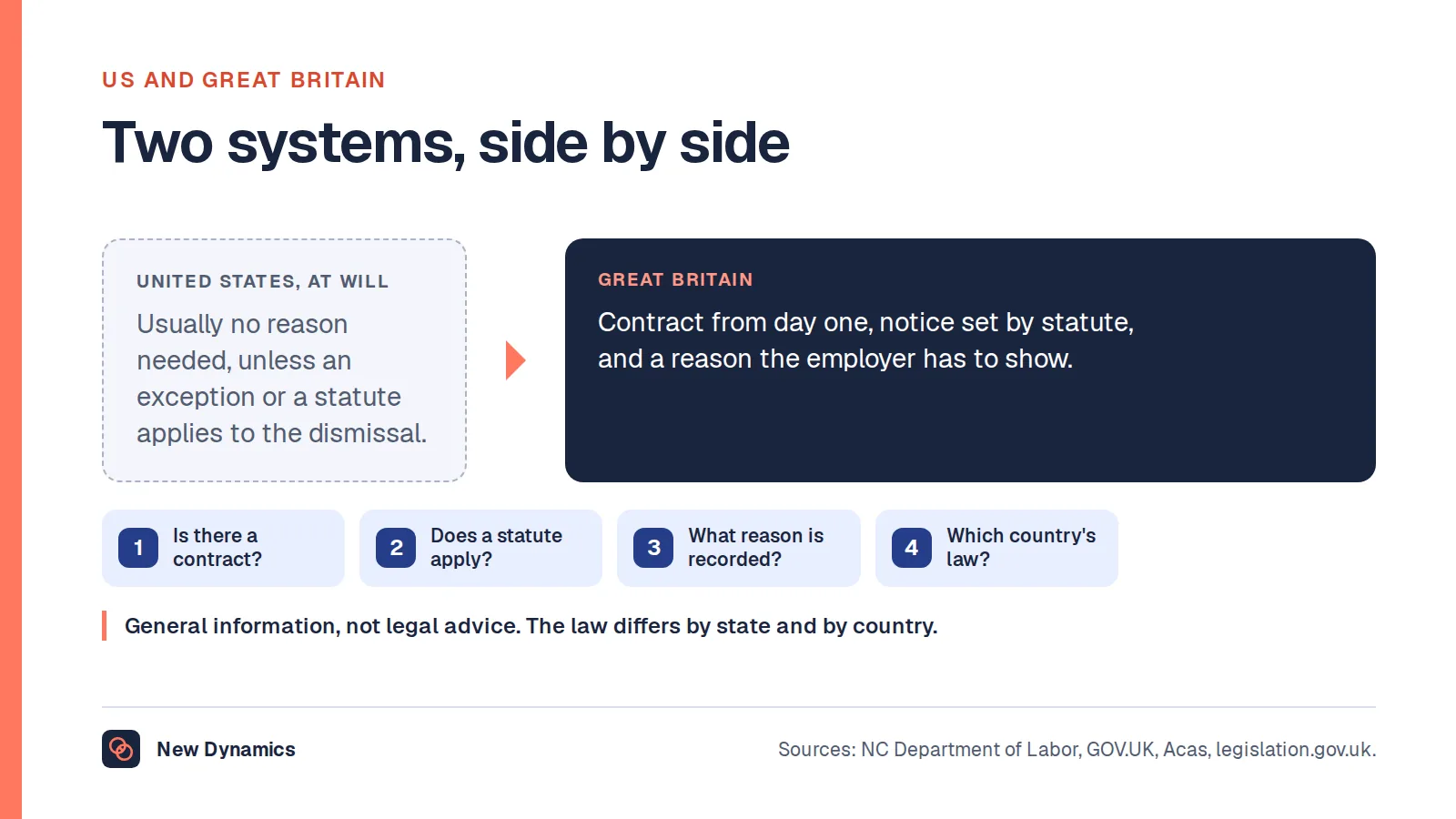
- Constructive dismissal is the British term, and it is a statutory route. Section 95(1)(c) of the Employment Rights Act 1996 treats an employee as dismissed where they end the contract in circumstances entitling them to do so without notice because of the employer's conduct. Acas warns that a claim "can be difficult to win at an employment tribunal".
- The clocks differ and one has just moved. The EEOC gives 180 or 300 calendar days to file a charge; section 111 of the Employment Rights Act 1996 now reads six months, substituted with effect from 1 October 2026. In neither country does an internal grievance pause the deadline.
Somebody resigns. The letter is short and polite, or four pages and furious, and either way it says the job became impossible. Weeks later a form arrives naming that resignation a dismissal, and the organisation is defending a decision it never knowingly made.
That is a constructive discharge in the United States and a constructive dismissal in the United Kingdom. The ideas overlap, the words do not travel, and the machinery differs. This article covers both and names the jurisdiction in every section, because the costly mistake is applying the right test from the wrong country.
It is general information and not legal advice. If you are thinking about resigning, get advice first: from Acas, a trade union or a solicitor in the United Kingdom, or from a lawyer licensed in your state in the United States.
Both systems end up asking the employer the same two questions: what did you know, and when. See how New Dynamics workflows hold a complaint, its owner, each approval and the date it was signed off in one place, not in one manager's inbox.
What constructive discharge means, and which country the term belongs to
Jurisdiction: both. General information, not legal advice.
The common idea is a resignation the law refuses to treat as voluntary, because the employer's conduct produced it. After that the systems diverge, starting with the vocabulary.
Constructive discharge is the American phrase, sometimes written loosely as constructive termination. It is not a free-standing claim. In almost every case it is an argument attached to another claim, usually discrimination or retaliation, and its job is to convert a resignation into the kind of adverse action that statute reaches.
Constructive dismissal is the British phrase, and Acas is specific that the formal term is longer. Its guidance on constructive dismissal, last updated 27 October 2026, says: "The legal term is 'constructive unfair dismissal'." That is where it sits: a route into the statutory unfair dismissal regime, not a separate wrong with its own name.
So if an American handbook uses constructive dismissal, or a British policy uses constructive discharge, the document has crossed the Atlantic without being read. Each word carries a different test and a different deadline.

Constructive discharge in the United States: the doctrine and the test
Jurisdiction: United States, federal law. State law adds more. General information, not legal advice.
Start with the baseline, because it explains why the doctrine exists. The Department of Labor's page on termination sets the limit of federal reach: absent discrimination, whistleblower status or a complaint under a law the Department enforces, "then the termination is subject only to any private contract between the employer and employee or a labor contract". Our article on at-will employment sets out that default.
So there is no general federal claim for being treated badly at work, and constructive discharge matters because it carries a resignation into a statute that does apply. The EEOC's Compliance Manual states the doctrine twice. Section 612 on discharge and discipline defines discharge and then widens it: in some cases "the employee's resignation is not voluntary, but is a constructive discharge, because the resignation was based on action or inaction by the employer which made it impossible for the employee to continue working".
Note "action or inaction": doing nothing about a complaint sits on the same footing as doing something wrong. The section returns to the term: "A constructive discharge occurs when an employee resigns from his/her employment because (s)he is being subjected to unlawful employment practices." It adds the causal test, that where the resignation "is directly related to the respondent's unlawful employment practices, it is a foreseeable consequence of those practices", and then the consequence employers underrate: "Respondent is responsible for a constructive discharge in the same manner that it is responsible for the outright discriminatory discharge of a charging party."
The standard people search for as intolerable working conditions appears in the harassment material. Section 615 on harassment, working through an age discrimination example, puts the test as whether "a reasonable person would have found the working conditions created by the harassment intolerable", together with the requirement that the resignation was in fact due to those conditions. Two limbs: an objective one about the conditions, a factual one about why the person left.
Two notes on sources. These Compliance Manual sections are long-standing documents whose illustrations are dated, and the Commission's more recent harassment guidance is gone: a release of 23 January 2026 records that the EEOC voted to rescind its "Enforcement Guidance on Harassment in the Workplace", while stating that doing so "does not give employers license to engage in unlawful harassment". Its current hub is eeoc.gov/harassment. No case is named anywhere here, and the American doctrine is built out of decided cases, so take advice from a lawyer in your state.
Examples of constructive discharge in the United States
Jurisdiction: United States. Illustrative, not benchmarks, and not legal advice.
The Commission's own illustrations are harassment cases: an employee who resigns while being subjected to sexual harassment, and one who resigns after a supervisor declines to act on racial harassment by colleagues. It is the inaction that does the damage. Beyond harassment, these are the shapes that recur, and whether any succeeds depends on the facts, the statute and the state.
- Harassment the employer was told about and did not stop. The strongest version, because the employer's own records show the complaint arriving and nothing following it.
- Retaliation after a protected complaint. Shifts, duties or scrutiny that change direction immediately after a charge or an internal complaint. The EEOC's guidance on retaliation notes that where retaliation resulted in constructive discharge, relief may include back pay, front pay or reinstatement.
- A transfer nobody could accept. This one is in regulation. Under the WARN Act rules at 20 CFR 639.5, "An offer of reassignment to a different site of employment should not be deemed to be a 'transfer' if the new job constitutes a constructive discharge." The definition of employment loss at 20 CFR 639.3 makes the same move.
- Pressure to leave dressed up as a voluntary departure. The H-1B non-displacement rules at 20 CFR 655.738 treat a worker's "voluntary departure or voluntary retirement" as something to be assessed "in light of the totality of the circumstances, under established principles concerning 'constructive discharge' of workers who are pressured to leave employment".
Those last two show American law using the concept outside discrimination, and what it asks about: pressure and circumstances, not the word on the leaving form.
Constructive dismissal in the United Kingdom: three things a claim needs
Jurisdiction: United Kingdom. Northern Ireland has separate legislation and a different qualifying period. Not legal advice.
Here the route is statutory, and you can read it. Section 95(1)(c) of the Employment Rights Act 1996, in the revised version read on 6 November 2026 and with extent given as England, Wales and Scotland, provides that an employee is dismissed where "the employee terminates the contract under which he is employed (with or without notice) in circumstances in which he is entitled to terminate it without notice by reason of the employer's conduct."
That single clause does the work. It defines dismissal rather than creating a separate claim, and feeds the unfair dismissal right in section 94: "An employee has the right not to be unfairly dismissed by his employer." Once the resignation counts as a dismissal, section 98 applies and "it is for the employer to show" the reason, which is an uncomfortable place to stand when your position is that you dismissed nobody.
Acas turns the clause into the three things a claim needs. First, a serious breach: "An employee can make a constructive dismissal claim if they resign because they think their employer has seriously breached their employment contract." Second, that the resignation happened because of it, which is the word "because" in that sentence. Third, timing, where the official guidance pulls in two directions.
GOV.UK, on unfair and constructive dismissal, defines the term as "when you're forced to leave your job against your will because of your employer's conduct", says "The reasons you leave your job must be serious", and then gives the warning that trips people up. If you do have a case, it says, "you should leave your job immediately", because "your employer may argue that, by staying, you accepted the conduct or treatment". Acas advises the opposite order of operations: raise the problem informally, raise a formal grievance if that has not worked, and "If you're going to resign, you should get legal advice first."
Both are official, and an article cannot reconcile them. Advice on your own dates can. Acas also notes one route that closes the door for good: "If you sign a settlement agreement, you cannot make a constructive dismissal claim to an employment tribunal."

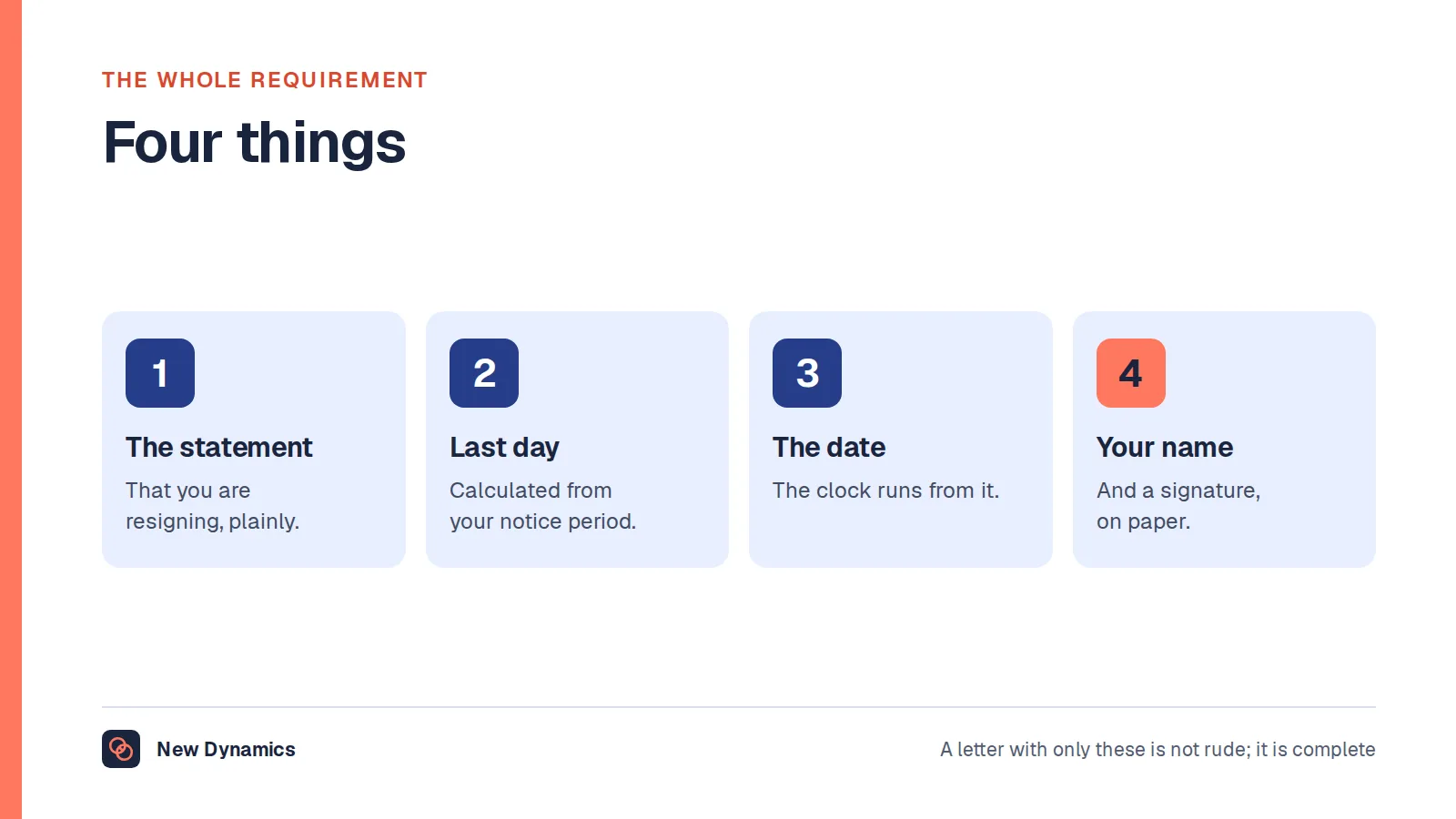
One mechanical point. Acas advises an employee that "In your resignation letter you should explain clearly your reasons for leaving." Our guide to writing a resignation letter covers the mechanics; the reasons are what matters, because they are the first document anyone reads.
Examples of constructive dismissal in the United Kingdom
Jurisdiction: United Kingdom. Illustrative, and not legal advice.
The official lists are short, and worth quoting rather than paraphrasing, because the wording is narrower than most summaries of it. Acas gives four examples: "regularly not being paid the agreed amount without a good reason", "being bullied or discriminated against", "raising a grievance that the employer refuses to look into", and "making unreasonable changes to working patterns or place of work without agreement". It adds the point that decides many real situations: "It could be because of one serious incident or a series of things."
GOV.UK frames its examples differently. The reasons must be serious, for example where an employer does "not pay you or suddenly demote you for no reason", where they "force you to accept unreasonable changes to how you work", or where they "let other employees harass or bully you".
Three deserve more attention than the rest.
A grievance that is not looked into. The complaint may turn out to be unfounded, and the refusal to examine it can still be the breach.
Unilateral change. Changing pay, hours or place of work without agreement is the commonest self-inflicted version, usually done by someone who believes a business reason is enough. Acas is blunt about the paperwork once a change is agreed: "By law, you must put a change in writing within 1 month of the change." Our article on the employment contract covers what can be changed.
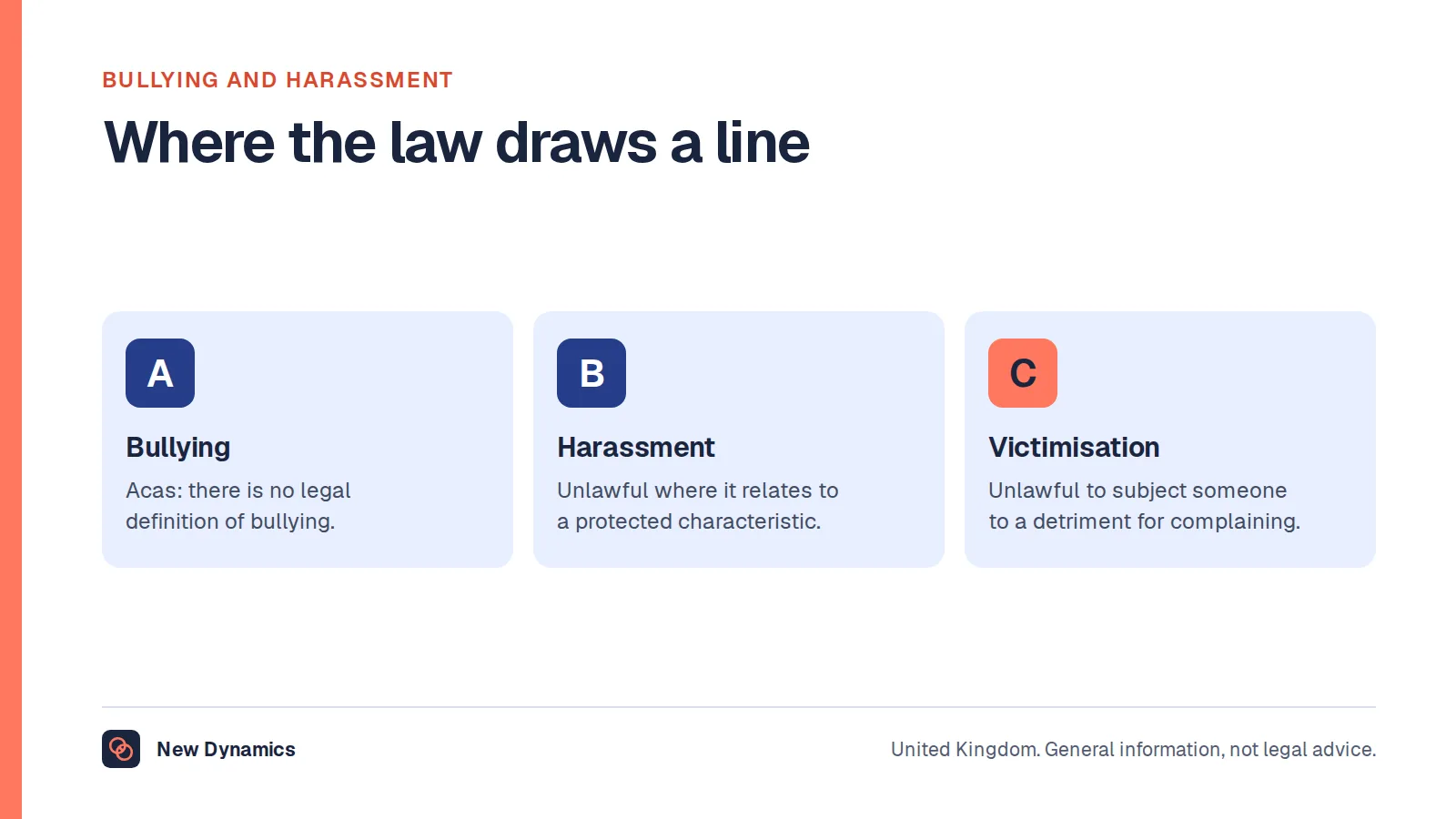
Bullying that was reported. Workplace bullying has no standalone legal definition in the United Kingdom, which is why it reaches a tribunal through this door.
Why a United Kingdom claim is hard to win, and how long it takes
Jurisdiction: United Kingdom. General information, not legal advice.
Acas does not hedge: "Resigning is a big step to take, and a constructive dismissal claim can be difficult to win at an employment tribunal."
The difficulty is structural. The employee has to establish the breach, show the resignation was a response to it, meet the argument that waiting amounted to acceptance, and has given up the income that would fund the wait. The employer works from its own record of what was reported and done, which is why records decide these cases.
The wait is real and lengthening. The Ministry of Justice's Tribunals statistics quarterly: April to June 2026, published on 10 September 2026 and last updated on 20 October 2026, reports that "In Q1 2026, the Employment Tribunal received 14,000 single claim receipts and disposed of 6,100 single claim cases. There were 70,000 single claim cases in the open caseload at the end of June", and that this caseload "has reached its highest level in the timeseries in Q1 2026/27, up 51% compared to the same period in 2025/26".
One honest limit: it covers all single claims rather than constructive dismissal claims, and the release does not break outcomes down by category, so it tells you about delay rather than anyone's chances. See our HR statistics hub for figures with their sources.
The clocks in both countries, and the one that just changed
Jurisdiction: both, with Northern Ireland noted separately. General information, not legal advice.
Read this before the rest: a missed deadline ends a good case.
United States. The EEOC's page on time limits for filing a charge states the rule: "In general, you need to file a charge within 180 calendar days from the day the discrimination took place", extended "to 300 calendar days if a state or local agency enforces a law that prohibits employment discrimination on the same basis". For anyone hoping to exhaust an internal process first: "Time limits for filing a charge with EEOC generally will not be extended while you attempt to resolve a dispute through another forum such as an internal grievance procedure, a union grievance, arbitration or mediation."
United Kingdom. The statutory limit has moved, and the official sources have not all caught up. Section 111 of the Employment Rights Act 1996 now requires a complaint to be presented "before the end of the period of six months beginning with the effective date of termination", and the annotation records that word being substituted with effect from 1 October 2026 by the Employment Rights Act 2025. So six months is the provision in force. GOV.UK's employment tribunals guide agrees: "6 months, if the problem happened on or after 1 October 2026" and "3 months, if the problem happened before 1 October 2026". So does Acas's page on employment tribunal time limits, last updated 1 October 2026.
Now the discrepancy, because this is the sort of thing that costs someone a claim. The Acas constructive dismissal page quoted throughout this article, last updated 27 October 2026, still says that "You might only have 3 months minus 1 day", running from the last day of the notice period, or from the day of resignation where no notice was given. We read all four pages on 6 November 2026. Do not assume you are out of time on the shorter figure, do not assume you have the longer one either, and check your own dates with Acas, a union or a solicitor. Acas makes the same point as the EEOC about internal processes: "Going through grievance, disciplinary or appeal procedures does not change your time limit."
The qualifying period, which is also changing. GOV.UK's page on eligibility to claim unfair dismissal states the current rule and a future one together. Current: "Employees can usually only claim unfair dismissal if they've worked for a qualifying period. This is usually 2 years." Future: "From 1 January 2027, most employees will be able to claim unfair dismissal after 6 months." And separately: "In Northern Ireland, the qualifying period is still usually 1 year."
Which is in force. On the date on this article, two years applies and six months does not. Section 108 still reads "not less than two years ending with the effective date of termination", and that page lists, among changes yet to be applied, words in section 108(1) to be substituted by the Employment Rights Act 2025. Acas's page on unfair dismissal agrees: "This change will happen in January 2027 and is not yet law." If you are reading after 1 January 2027, check GOV.UK rather than this paragraph.
Two qualifications. Acas lists reasons for resigning that may support a claim with less service, including "pregnancy, childbirth or maternity leave", "health and safety" and "whistleblowing". And the claim needs "the legal status of employee", which our article on employment status covers.
Does it differ by state, and what about Northern Ireland
Jurisdiction: both. General information, not legal advice.
People search for this with a state attached, and Colorado is one of the common ones. For the federal claims the EEOC enforces, the doctrine above travels with the statute rather than the state line. What varies is the surrounding state law: states have their own civil rights statutes, their own courts interpreting which conditions count as intolerable, their own deadlines and their own agencies. That parallel structure is why the EEOC's deadline extends from 180 to 300 days where a state or local agency enforces a comparable law. The federal sources used here do not state the position in any individual state, and this article does not guess at one. Ask a lawyer licensed where you work, and ask early.
The United Kingdom has its own version of the trap. The provisions quoted here carry an extent of England, Wales and Scotland. Northern Ireland has separate employment legislation, a qualifying period GOV.UK says "is still usually 1 year", and "a different way to make a claim to an employment tribunal". So "UK law" is not one answer either.
For managers: the behaviours that create this exposure
Jurisdiction: both. General information, not legal advice.
Almost nothing on this list is done by a manager trying to force somebody out. The exposure is built out of ordinary decisions taken quickly, in good faith, without a record.
- Changing terms without agreement. Pay, hours, shift pattern, place of work, reporting line, job title. In the United Kingdom this is the archetype, and it is on both official example lists. A business reason is not consent.
- Letting a reported problem run. The EEOC formula is "action or inaction". Acas lists a grievance the employer "refuses to look into". Both systems treat silence after a complaint as conduct in its own right.
- Scrutiny aimed at one person. Monitoring or standards that would be unremarkable applied to everybody, applied to one person only. What answers it is the record of how the same issue was handled for others.
- Managing someone out through performance process. A sudden rating change, a target that was never written down, an improvement plan that starts the week after a complaint. Sequence and dates do the talking, in either country.
- A demotion, stripped duties or a relocation offered as the alternative to dismissal. Formally reasonable, practically impossible, documented as neither.
- Leaving the person complained about in charge of the complaint. The Acas Code says a grievance should be raised "with a manager who is not the subject of the grievance", and an appeal heard "wherever possible by a manager who has not previously been involved in the case".
None of these is a verdict. Each is a situation where the only useful difference between an awkward management problem and a claim is a dated record of what was decided, and why.
Hear the grievance properly, before anyone resigns
Jurisdiction: United Kingdom for the Code, useful practice in both. Not legal advice.
In the United Kingdom this is not a nice-to-have. The Acas Code of Practice on disciplinary and grievance procedures, published 11 March 2015, is statutory, and Acas's guidance on the formal grievance procedure states the consequence: "The procedure you've followed will be taken into account if the case reaches an employment tribunal."
The Code's own words are worth pinning up. Employers "should carry out any necessary investigations, to establish the facts of the case", and "should inform employees of the basis of the problem and give them an opportunity to put their case in response before any decisions are made". The employee raises a grievance formally "and without unreasonable delay with a manager who is not the subject of the grievance", in writing. Then: "Employers should arrange for a formal meeting to be held without unreasonable delay after a grievance is received." Employees "should be allowed to explain their grievance and how they think it should be resolved", and there is a statutory right to be accompanied by a fellow worker or a trade union representative. Decisions "should be communicated to the employee, in writing, without unreasonable delay", and the employee should be told they can appeal.
Acas notes the Code scales with size rather than disappearing: "Regardless of the size of your organisation, all employers should follow a full and fair grievance procedure". In a very small business one manager may have to run it alone, which is a scaling note rather than an exemption.

This is the cheapest answer in either jurisdiction. A grievance heard, investigated and answered in writing removes the clearest example on the Acas list, and the American investigator questions below are largely about whether a complaint was made and what happened next. See what a grievance is and workplace investigations.
When someone resigns citing conditions: the first week
Jurisdiction: both. General information, not legal advice.
Treat the resignation letter as the first document in a file someone else may read.
- Read what the letter actually says. Separate the reasons from the tone. The reasons get tested, and Acas advises employees to set them out clearly, so they are usually there.
- Do not accept it in silence. Reply, name a person, and say what you are doing about the reasons given. A resignation accepted with thanks and no answer to the substance is a document you will be shown later.
- Pull the history before memories move. Every complaint, grievance, one-to-one note, rating, shift change and contract variation involving that person, with dates. The EEOC's Compliance Manual sets out what it asks the employer in a constructive discharge investigation: "The reason charging party gave for his/her resignation", "Whether charging party ever complained about being subjected to discriminatory employment practices, and if so, when", and if so, "whether any action was taken to eliminate these practices, and if so, describe". Those three make a usable audit in either country, and if your records cannot answer them, that is the gap.
- Offer the grievance route even now, where realistic. Acas's position in the United Kingdom is that internal routes come first, and a grievance heard after a resignation is still better evidence of a fair employer than no process at all.
- Hold the line on the clocks, and take advice. Neither an internal process nor a goodwill conversation extends a deadline in either country. Take advice from an employment lawyer in the relevant country and state.
Frequently asked questions
Each answer names the jurisdiction. All of it is general information rather than legal advice, and anyone considering resigning should take advice first.
What is constructive discharge?
Constructive discharge is the American term for a resignation the law does not treat as voluntary, because the employer's conduct caused it. The EEOC's Compliance Manual says it "occurs when an employee resigns from his/her employment because (s)he is being subjected to unlawful employment practices", and that an employer is responsible for it "in the same manner that it is responsible for the outright discriminatory discharge of a charging party". It is argued as part of a discrimination or retaliation claim, with the test turning on whether a reasonable person would have found the working conditions intolerable. The British equivalent, constructive dismissal, is statutory: section 95(1)(c) of the Employment Rights Act 1996 treats a resignation as a dismissal where the employee was entitled to resign without notice because of the employer's conduct. Northern Ireland has its own legislation.
What are examples of constructive discharge?
Acas's examples of the British equivalent are "regularly not being paid the agreed amount without a good reason", "being bullied or discriminated against", "raising a grievance that the employer refuses to look into", and "making unreasonable changes to working patterns or place of work without agreement". GOV.UK adds a sudden demotion for no reason and an employer who lets other employees harass or bully you. The EEOC's illustrations are resignations during harassment a supervisor declined to act on. Both accept one serious incident or a series taken together. Illustrative, not benchmarks.
Is constructive dismissal illegal?
It is not a criminal offence and nobody is prosecuted for it. In the United Kingdom it is the name of a claim: if a tribunal accepts that the resignation was a dismissal and that the dismissal was unfair, the employer loses and a remedy follows, usually compensation. The conduct behind it may be separately unlawful, for example as harassment under the Equality Act 2010. Not legal advice, and anyone considering resigning should take advice first.
How long do you have to claim constructive dismissal in the United Kingdom?
Check the date rather than relying on a figure. Section 111 of the Employment Rights Act 1996 now requires a complaint "before the end of the period of six months beginning with the effective date of termination", that word having been substituted with effect from 1 October 2026. Acas and GOV.UK both give six months minus one day for problems on or after that date, and three months minus one day before it, while the Acas constructive dismissal page still states three months minus one day. Notify Acas within your time limit and get advice on your own dates.
Do you have to resign immediately to claim constructive dismissal?
The official United Kingdom guidance pulls two ways and this article cannot resolve it for you. GOV.UK says that if you have a case "you should leave your job immediately", and warns that an employer "may argue that, by staying, you accepted the conduct or treatment". Acas advises raising the problem informally, then formally through a grievance, and says "If you're going to resign, you should get legal advice first". Take advice on your own facts before resigning, from Acas, a trade union or a solicitor.
Your next step: make the record answer the question
Neither system asks whether you meant to push anyone out. Both ask what was reported, what you did about it, and when. That holds in the United States, in England, Wales and Scotland, and in Northern Ireland, which has its own legislation.
- Decide which country's and which state's law applies to each person, and write it down before you need it.
- Put the grievance route in writing, name a manager who is not the usual subject of complaints, and publish the appeal stage.
- Answer every complaint in writing with a date, including the ones you think are unfounded.
- Never change pay, hours or place of work without a recorded agreement, and put the change in writing within the month.
- Take advice from an employment lawyer in the relevant country and state. If you are the person thinking of resigning, take advice before you do.
For setting a written standard, including the grievance and appeal stages this article keeps returning to, read and download our employee handbook guide. The guide is free to read, and the PDF uses our short download form.
Want complaints, approvals and decisions held against each person with the dates intact? Book a New Dynamics demo and bring the process you run today, or email contact@new-dynamics.com.
For the surrounding vocabulary, read our articles on workplace bullying, what a grievance is, at-will employment and the disciplinary procedure. General information, not legal advice: employment law differs by state and by country, Northern Ireland has its own legislation, and anyone considering resigning should take advice first.