TL;DR
- No statute requires a private employer in Great Britain to have an equal opportunities policy. Acas calls a policy "a good start" and GOV.UK lists it among things that "can help" prevent discrimination. Neither says you must have one.
- The duties the policy exists to deliver are real. Section 109 of the Equality Act 2010 makes the employer liable for what its employees do, and gives a defence only to an employer who can show it "took all reasonable steps" to prevent it.
- Equality monitoring is where most employers slip. Schedule 1 paragraph 8 of the Data Protection Act 2018 covers four data categories only, requires an appropriate policy document, and bars using the data for "measures or decisions with respect to a particular data subject".
Almost everything written about an equal opportunities policy begins by telling you that you need one. Check the official sources and that claim does not survive. No statute in Great Britain requires a private employer to have a written equal opportunities policy at all.
That matters, because an employer who thinks the policy is the duty adopts a template, files it, and assumes the obligation is discharged. The obligation is to make the decisions correctly and to be able to show it afterwards, and that consistency comes from the process rather than the document, which is why New Dynamics workflows let you fix the stages, participants and approvals once and have every cycle follow them.
This post covers Great Britain, where the Equality Act 2010 applies. Northern Ireland has separate equality legislation and the duties below do not apply there. It is general information and not legal advice.
Is an equal opportunities policy a legal requirement?
No. Three official sources are asked this question and none answers yes.
Acas uses the language of good practice: "A good start is to have a workplace policy covering equality, diversity and inclusion. This might also be called an 'equal opportunities policy'". Its page for employers is firm about the duty and soft about the document, saying "By law (Equality Act 2010), all employers must take steps to prevent discrimination" and then "You might want to develop specific policies for your organisation".
GOV.UK does the same. Its page on discrimination in work says "You can help prevent discrimination by" having an equality, diversity and inclusion policy, training staff, and making clear how to complain. "Can help" is not "must have".
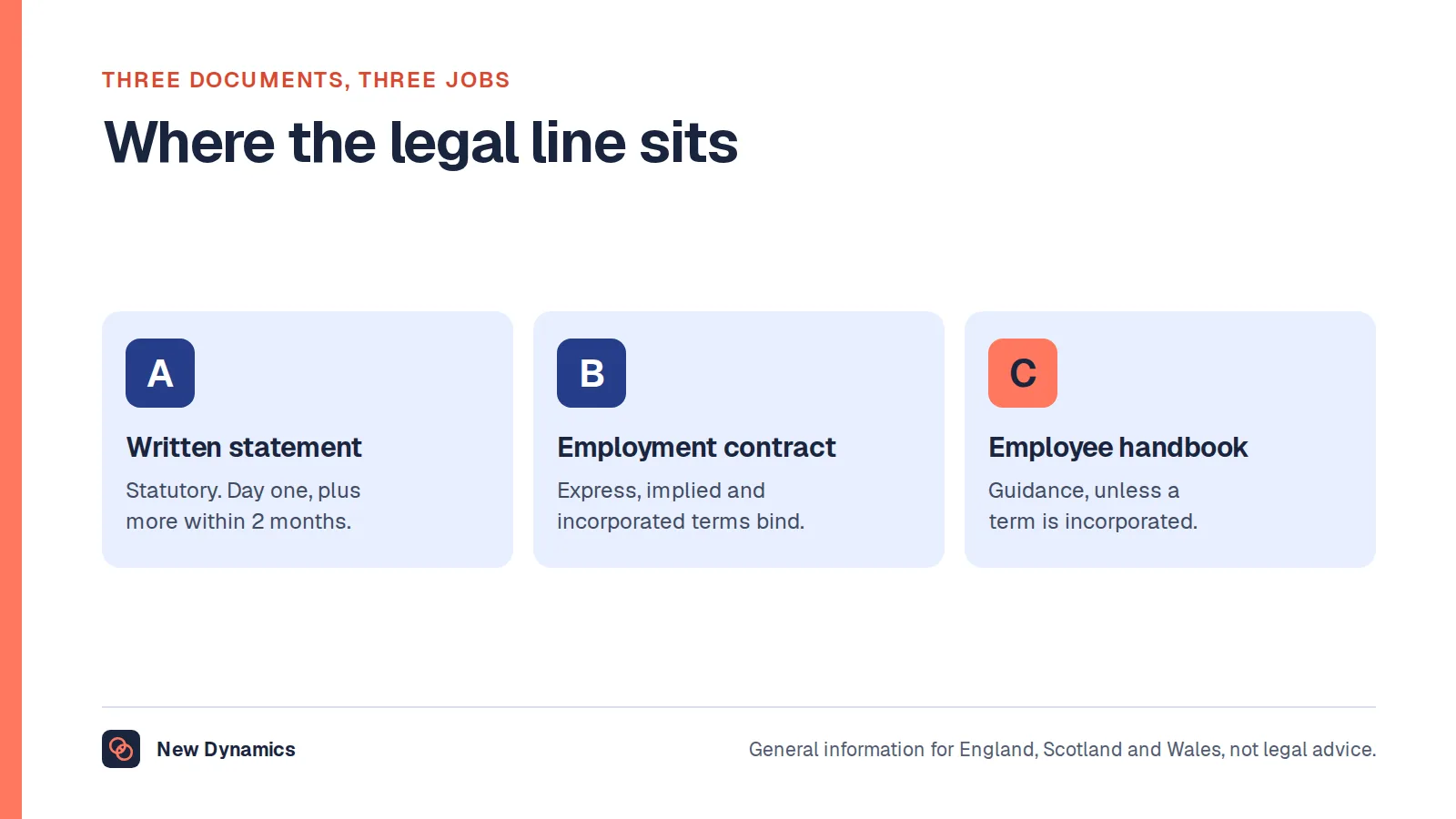
Compare a policy the law does require in writing. HSE states that "If you have five or more employees, you must write your policy down" for health and safety. The Equality Act 2010 says nothing equivalent. Our post on the employee handbook sets out which UK policies do have to exist on paper.

The Equality Act 2010 obligations a policy delivers
Section 4 lists nine protected characteristics: age, disability, gender reassignment, marriage and civil partnership, pregnancy and maternity, race, religion or belief, sex and sexual orientation. There is no tenth, and nothing in the Act protects a characteristic you add to your own list.
Prohibited conduct is defined section by section, more narrowly than everyday use suggests:
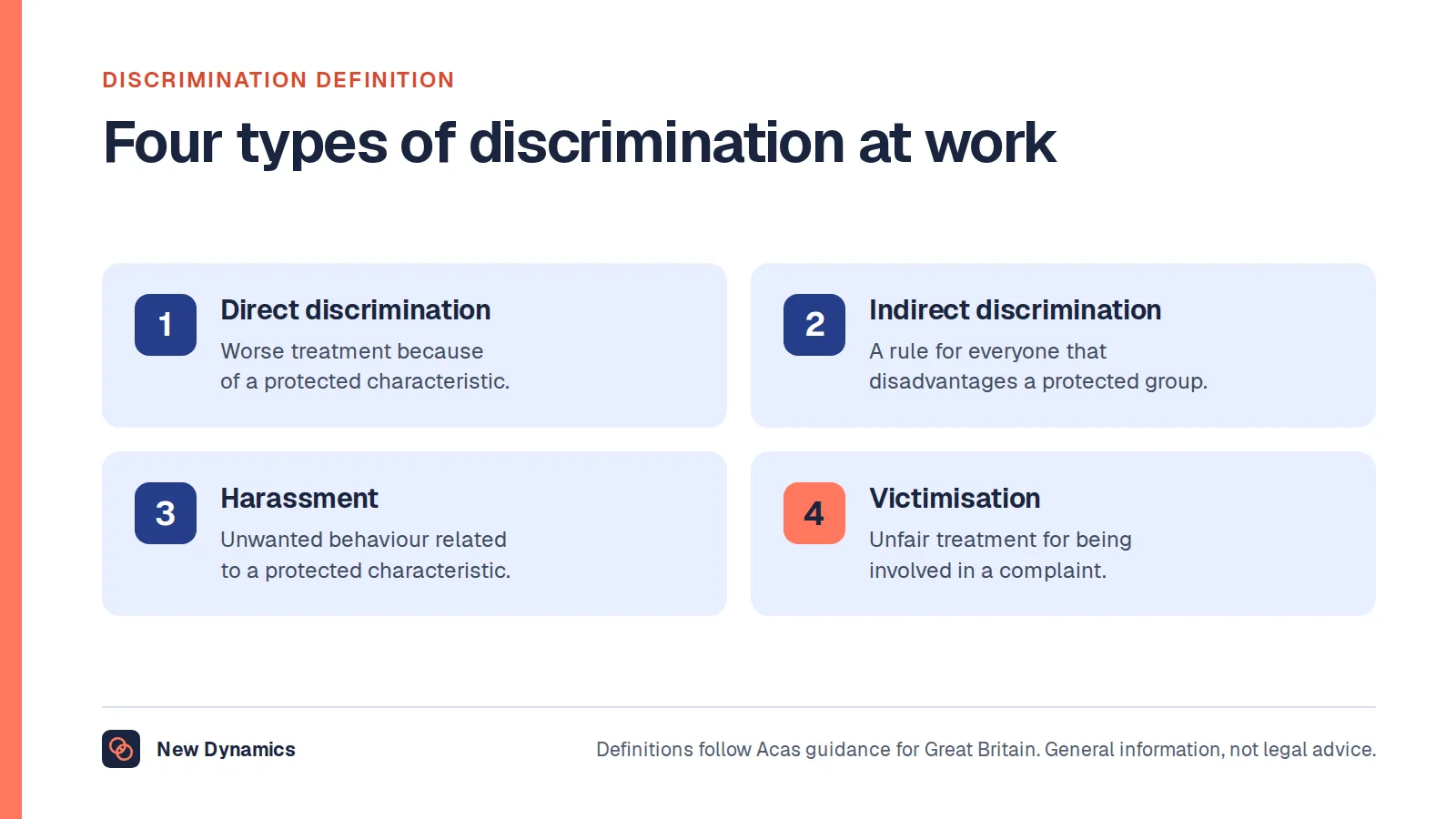
- Direct discrimination, section 13: "A person (A) discriminates against another (B) if, because of a protected characteristic, A treats B less favourably than A treats or would treat others."
- Indirect discrimination, section 19: applying "a provision, criterion or practice" that puts people sharing a characteristic at a particular disadvantage, unless it is a proportionate means of achieving a legitimate aim.
- Harassment, section 26: unwanted conduct related to a characteristic with the purpose or effect of "violating B's dignity" or creating an intimidating, hostile, degrading, humiliating or offensive environment.
- Victimisation, section 27: a detriment imposed because someone did a protected act, such as making an allegation.
- Discrimination arising from disability, section 15, and failure to make reasonable adjustments, sections 20 and 21, both disability only.
Our post on the definition of discrimination works through the main types with examples. A policy naming the characteristics but not the conduct leaves managers unable to recognise what they are meant to prevent.
Why the liability is yours, and what "all reasonable steps" means
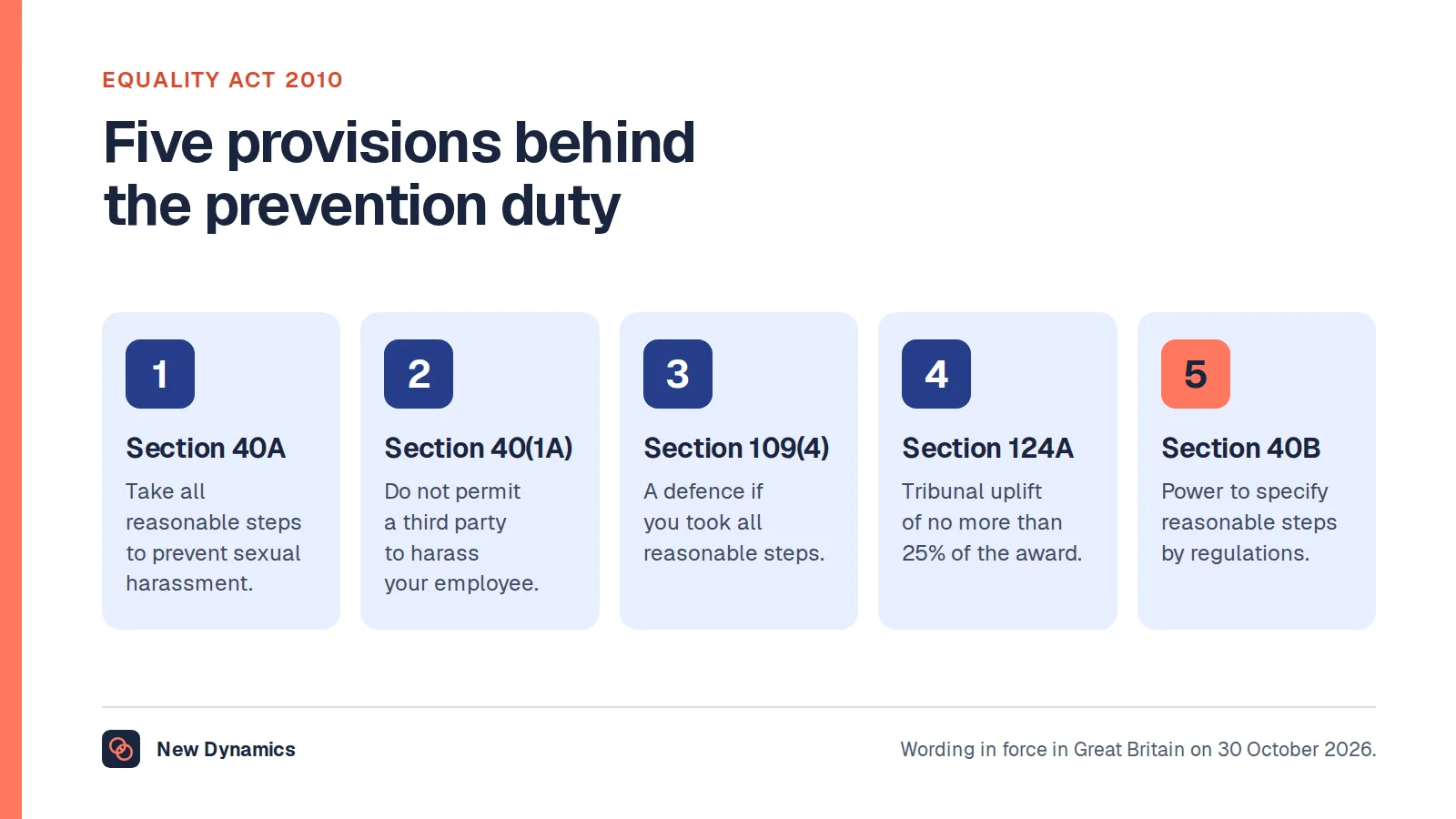
Section 109 explains why employers write these policies at all. It provides that "Anything done by a person (A) in the course of A's employment must be treated as also done by the employer", and that "It does not matter whether that thing is done with the employer's or principal's knowledge or approval".
Subsection (4) is the only way out. In proceedings against the employer, "it is a defence for B to show that B took all reasonable steps to prevent A" from doing that thing or anything of that description. GOV.UK states the rule plainly: "You're responsible for any instances of discrimination at work unless you can show you've done everything you reasonably could to prevent or stop it".
A policy nobody has read, nobody has been trained on and nobody applies is not a reasonable step taken. It is evidence that the step was considered and skipped. The useful test for any clause you write is what record it produces when followed, because that record is the defence. The queue for getting it wrong is lengthening: the Ministry of Justice's tribunal statistics for April to June 2026, published on 20 October 2026, report that "Single Employment Tribunal (ET) receipts increased by 28%, while disposals decreased by 6%" against the same quarter a year earlier, across all employment claims rather than discrimination claims alone. More figures sit in our HR statistics hub.
The public sector equality duty, and whether it binds you
This is a separate obligation, and it binds a defined list of bodies rather than every large employer. Section 149 requires a public authority, in the exercise of its functions, to have due regard to the need to "eliminate discrimination, harassment, victimisation and any other conduct that is prohibited by or under this Act", to "advance equality of opportunity" between people who share a relevant protected characteristic and those who do not, and to "foster good relations" between them. Section 149(2) extends it to anyone exercising public functions, for that part of what they do.
Which bodies are caught is set by Schedule 19. The EHRC records that "On 5 April 2011, the public sector equality duty (the equality duty) came into force", and flags a wrinkle in section 149(7): for marriage and civil partnership, "the first aim of the duty applies to this characteristic but that the other aims (advancing equality and fostering good relations) do not apply". The EHRC site returns an error to automated requests, so that is quoted from the UK Government Web Archive snapshot of 13 August 2026, of guidance last updated on 22 February 2023.
In England the specific duties add deadlines. Under the Equality Act 2010 (Specific Duties and Public Authorities) Regulations 2017, in force since 31 March 2017, a listed authority must publish compliance information "subsequently at intervals of not greater than one year beginning with the date of last publication" and equality objectives "at intervals of not greater than four years", each of which "must be specific and measurable". The workforce part "does not apply to a public authority with fewer than 150 employees". Scotland and Wales have their own.
If you are not in Schedule 19 and exercise no public functions, none of this binds you, and a public body's template will shape your policy around a duty you do not hold.
What to put in an equal opportunities policy
Acas publishes a free template, last updated on 7 January 2022, and reading it beats reading a list of headings. Two commitments in it are the ones usually missing from a borrowed policy: to "Review employment practices and procedures when necessary to ensure fairness" and update them for changes in the law, and to monitor the make-up of the workforce. It also tells staff something most policies omit: "All staff should understand they, as well as their employer, can be held liable for acts of bullying, harassment, victimisation and unlawful discrimination, in the course of their employment".
Acas is specific about how to produce it. "If you decide to create a specific equality, diversity and inclusion policy, you should do this in consultation with" a recognised trade union, or other employee representatives if you recognise none. It also asks for an action plan covering training, how you will measure whether the policy works, and who will apply it by when.
One correction if you adapt the Acas text. It tells employees that using the internal procedure does not affect the right to claim at a tribunal "within 3 months of the alleged discrimination". Section 123(1)(a) of the Equality Act 2010 now gives "the period of 6 months starting with the date of the act to which the complaint relates", substituted on 1 October 2026 by the Employment Rights Act 2025. The legislation governs, and the template is out of date here.
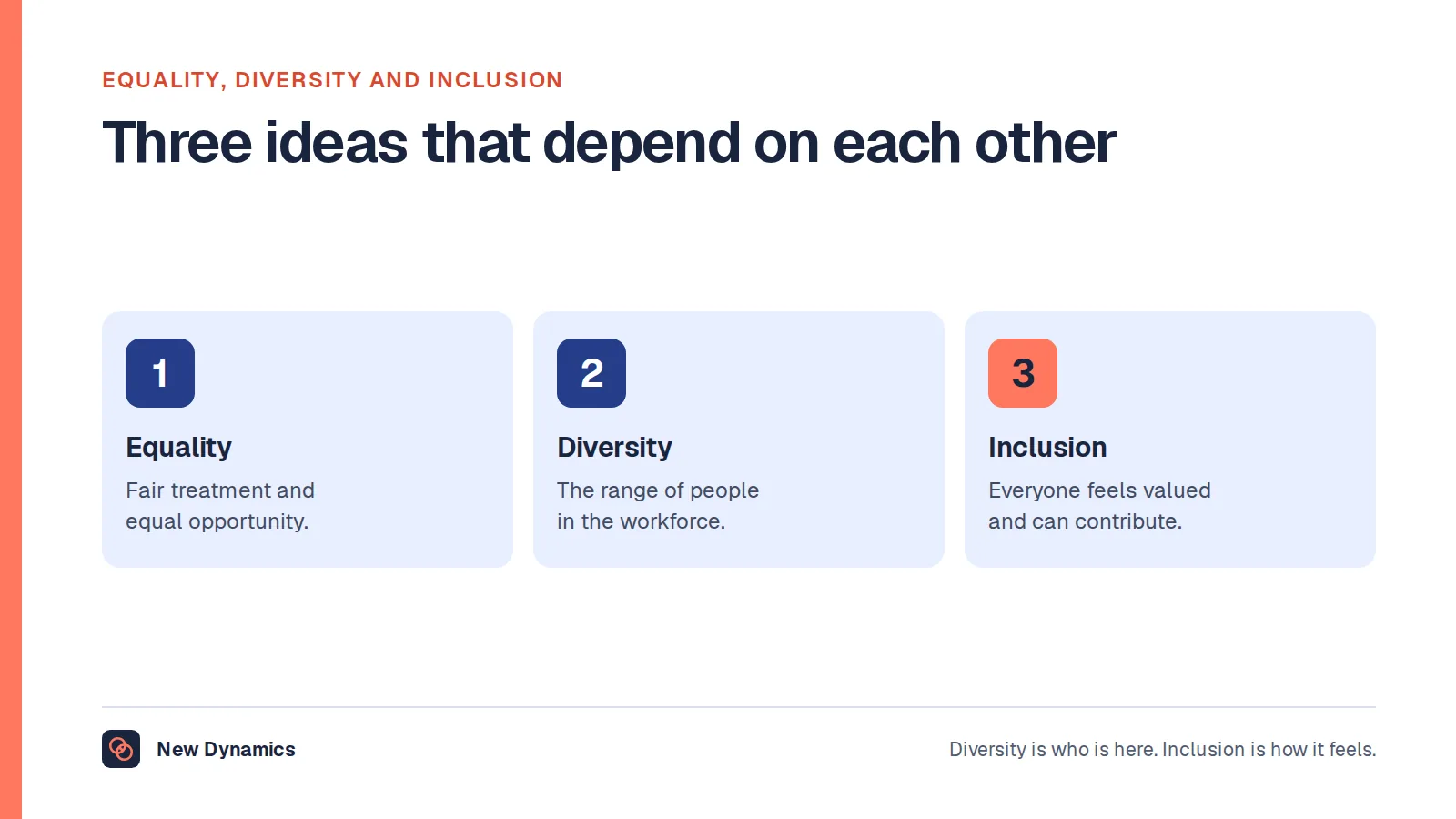
For the full framework, with a worksheet and worked examples, read and download our equal employment opportunity guide. Our post on diversity in the workplace separates equality, diversity and inclusion, which a policy should not treat as one idea.
Equality monitoring: what you may collect, and on what basis
This is where good intentions become a data protection breach. Asking people to declare their ethnicity, religion, health or sexual orientation is processing special category data, and that needs an Article 6 lawful basis and an Article 9 condition before the form goes out.

The route most employers need is Article 9(2)(g) with paragraph 8 of Schedule 1 to the Data Protection Act 2018, "equality of opportunity or treatment". The ICO describes it directly: "This condition is met if you're using information that is necessary for monitoring equality of opportunity or treatment of candidates in the following categories", namely people of different racial or ethnic origins, people holding different religious or philosophical beliefs, people with different states of physical or mental health, and people of different sexual orientation. Four categories, and no others. Sex and age are not special category data at all, so monitoring them needs a lawful basis but no Article 9 condition.
Three limits then apply. "You can only use this information for promoting or maintaining equality of opportunity between the above groups", says the ICO, and the condition fails if the processing relates to decisions about a particular person, is likely to cause substantial damage or substantial distress, or if someone gives notice to stop. Paragraph 8(3) puts the first in statutory terms: processing does not meet the condition "if it is carried out for the purposes of measures or decisions with respect to a particular data subject". So if monitoring reveals a problem affecting one named person, the ICO is explicit that "You must have another lawful basis and special category condition to be able to take action".
Paragraph 8 also requires an appropriate policy document, under paragraph 5 of the same Schedule. The ICO calls it "a short document outlining your compliance measures and retention policies for special category data", and paragraph 39 requires it to explain your procedures for the Article 5 principles and your retention and erasure policies, with an indication of how long the data is kept. You "must keep your appropriate policy document until six months after the date you stop the relevant processing". Note the irony: the one document the law requires you to hold here is a data protection document, not the equal opportunities policy.
Order matters too. The ICO says you "must determine your special category condition before you begin the processing" and must document that decision, so adding the question and finding the basis later is backwards. Acas notes that small employers may not be able to use monitoring forms at all because they cannot guarantee confidentiality, and suggests an anonymous, voluntary staff survey instead. The ICO's recruitment chapter is draft guidance under review following the Data (Use and Access) Act, which the page states; the statutory wording it describes is unchanged.
The harassment duties your policy has to carry
Two duties changed on 30 October 2026, so a policy written before then is behind the law. Section 40A now reads: "An employer (A) must take all reasonable steps to prevent sexual harassment of employees of A in the course of their employment." The word "all" was inserted that day by the Employment Rights Act 2025; the section itself was inserted on 26 October 2024 by the Worker Protection (Amendment of Equality Act 2010) Act 2023. Also on 30 October 2026, section 40(1A) made it unlawful to permit a third party to harass an employee, which happens where the employer "failed to take all reasonable steps to prevent the third party from doing so". Our post on the sexual harassment prevention duty covers the risk assessment, third parties and the compensation uplift.
Reviewing the policy: does any source set a frequency?
No statute or regulation prescribes how often an employer must review an equal opportunities policy. The nearest thing to an interval is Acas's own template, which commits the employer to assessing how the policy and any action plan are working in practice, "reviewing them annually, and considering and taking action to address any issues". The one-year and four-year intervals in the 2017 Regulations are legal deadlines, but they bind listed public authorities and govern publication, not policy review.
So annually is defensible, sourced to Acas, and not a legal requirement. The bigger trigger is a change in the law, which has happened twice in two years. Attach the review to the evidence rather than the calendar: the record of a decision cycle shows whether the policy is applied, and performance reviews that keep goals, feedback and ratings attached to the cycle give you something to check across groups.
Frequently asked questions
Is an equal opportunities policy a legal requirement in the UK?
No. No provision of the Equality Act 2010 requires a private employer in Great Britain to have a written equal opportunities policy. Acas calls such a policy a good start, and GOV.UK lists having one among the things that can help prevent discrimination. The underlying duties not to discriminate, and to take all reasonable steps to prevent sexual harassment, are compulsory.
What should an equal opportunities policy contain?
Following the Acas template: a purpose section naming the nine protected characteristics and the decisions covered, commitments on training, complaints, merit-based decisions and workforce monitoring, a statement that individual staff can also be held liable, a link to the grievance and disciplinary procedures, and confirmation that senior management and employee representatives have agreed it.
What is the difference between an equal opportunities policy and the public sector equality duty?
The policy is a voluntary document. The public sector equality duty is a statutory obligation in section 149 of the Equality Act 2010 binding the bodies listed in Schedule 19 and anyone exercising public functions. It requires due regard to eliminating prohibited conduct, advancing equality of opportunity and fostering good relations, and in England it carries publication deadlines for equality information and objectives.
Can we ask job applicants for equality monitoring data?
Yes, with care. For ethnicity, religion or belief, health and sexual orientation you need an Article 9 condition, usually paragraph 8 of Schedule 1 to the Data Protection Act 2018. Choose and document the condition before collecting anything, have an appropriate policy document in place, tell people what the data is for, keep it out of selection decisions, and stop processing someone's data if they give written notice.
Does having a policy protect us at a tribunal?
Only if it was applied. Section 109(4) of the Equality Act 2010 gives a defence to an employer who can show it took all reasonable steps to prevent the conduct. A policy that was never communicated, never trained on and never followed demonstrates the opposite. What counts is the record of steps actually taken.
How often should an equal opportunities policy be reviewed?
No official source prescribes a frequency for an employer's own policy. The Acas template commits to reviewing the policy and its action plan annually. Review it sooner when the law changes, as it did on 26 October 2024, 1 October 2026 and 30 October 2026.
Your next step: test the policy against one real decision
- Decide whether you are in Schedule 19 to the Equality Act 2010 or exercise public functions. If not, cut every objective-setting and publication clause borrowed from a public body.
- Mark each clause with the record it produces when followed. Clauses that produce nothing are the ones that will fail section 109(4).
- Check the policy names the forms of conduct, not just the characteristics, so a manager can recognise indirect discrimination and victimisation.
- Find your monitoring form and your appropriate policy document. If the second does not exist, stop collecting the data until it does.
- Update the harassment clauses for 30 October 2026, consult a recognised union or employee representatives, then set a review date and name an owner.
For the policy framework behind this, read and download our equal employment opportunity guide. The guide is free to read, and the PDF uses our short download form.
Want the decisions your policy covers to leave a record you can check across groups? Book a New Dynamics demo and bring your current review form. You can also email contact@new-dynamics.com.