TL;DR
- The duty holder is a role, not a job title. Article 3 of the Fire Safety Order makes the “responsible person” the employer “if the workplace is to any extent under his control”, so it can be more than one organisation at the same site and it is never the person who happens to hold the fire folder.
- The five-employee threshold for recording a fire risk assessment is gone. Article 9(6) used to require a record only where the responsible person employed five or more people. Since 1 October 2023 it requires a record of the assessment or review in every case, and GOV.UK now simply states: “You must keep a written record of your fire risk assessment.”
- No law sets a fire drill frequency. The word “drill” appears once in the whole Order, in article 15(1)(a), with no interval attached. The familiar annual figure comes from GOV.UK guidance, which says you “should” do it, not from the Order.
Ask who is responsible for fire safety and someone will point at whoever keeps the red folder. The law does not create a fire safety job. It creates a duty attached to control of the premises, and it lands on an employer whether or not anyone holds the title.
This article sets out the fire safety duties as the legislation states them: who holds them, what the risk assessment must contain, where "fire warden" comes from, what the rules say about drills and training, and who enforces it. Two of the most repeated claims here, the five-employee recording threshold and the annual fire drill, are not what most sources say they are. Everything below is the position in England and Wales unless a heading says otherwise, and it is general information rather than legal advice.
Fire safety training is a duty that falls due on day one, so it belongs in the process rather than beside it. See how New Dynamics onboarding brings induction tasks and manager conversations into one path, so a first-day duty has an owner before the first day arrives.
What the fire safety duties are
The governing instrument is the Regulatory Reform (Fire Safety) Order 2005, S.I. 2005 No. 1541. Article 1(3) brought the substantive provisions into force on "1st October 2006", and legislation.gov.uk records the text as up to date with all changes in force on or before 7 November 2026.
Article 8(1) is the core duty: take such general fire precautions "as will ensure, so far as is reasonably practicable, the safety of any of his employees", and for people who are not employees, "such general fire precautions as may reasonably be required in the circumstances of the case to ensure that the premises are safe". Article 4(1) says what those precautions cover: reducing the risk of fire and of its spread, the means of escape and keeping them usable "at all material times", the means of fighting fire, the means of detecting it and giving warning, and the arrangements for action in the event of fire, expressly including "measures relating to the instruction and training of employees".
Domestic premises are outside the Order under article 6(1)(a), subject to the common parts of buildings containing two or more homes. GOV.UK's guide on fire safety in the workplace states the scope plainly: non-domestic premises are "all workplaces and commercial premises", "all premises the public have access to" and "the common areas of multi-occupied residential buildings".
Who the responsible person is
Article 3 defines the role in three lines. For a workplace, it is "the employer, if the workplace is to any extent under his control". For other premises it is "the person who has control of the premises (as occupier or otherwise) in connection with the carrying on by him of a trade, business or other undertaking (for profit or not)", and failing that, the owner.
Three things follow. It is a legal role, not a job title: nobody appoints you to it, nobody can decline it, and no organisation chart creates it. It attaches to control, so an employer with desks in a serviced office is a responsible person for its own workplace even though it owns nothing. And "to any extent" means partial control is enough. GOV.UK lists who that catches: an employer, the owner, the landlord, an occupier, and "anyone else with control of the premises, for example a facilities manager, building manager, managing agent or risk assessor".

When more than one person has duties for the same premises
Article 22 was tightened on 1 October 2023 by section 156 of the Building Safety Act 2022. It now opens with paragraph (A1): a responsible person "must take such steps as are reasonably practicable to ascertain whether any other responsible person shares, or has duties in respect of, the premises". That is a duty to go and look, not one that waits to be triggered.
Under article 22(1)(za) and (zb) each one must then give the others its name and a UK address for service, and tell them "the part of the premises for which that person considers themselves to be a responsible person, and keep a record of that information". Article 22(1)(a) to (c) adds the older obligations to co-operate, co-ordinate and inform. For common parts, GOV.UK gives the default: "the responsible person is the landlord, freeholder or managing agent."
The fire risk assessment, and the recording rule that changed
Article 9(1) requires "a suitable and sufficient assessment of the risks to which relevant persons are exposed", to identify the general fire precautions needed to comply with the Order. Article 9(3) requires review "regularly so as to keep it up to date", and particularly where "there is reason to suspect that it is no longer valid" or "there has been a significant change in the matters to which it relates". No calendar interval is given.
Recording is where stale advice still circulates. As originally made, article 9(6) required a record only "where (a) he employs five or more employees; (b) a licence under an enactment is in force in relation to the premises; or (c) an alterations notice requiring this is in force". Section 156(3) of the Building Safety Act 2022 replaced that on 1 October 2023. Article 9(6) now requires the responsible person to "make a record of the assessment or review, which must in particular include the information prescribed by paragraph (7)", with no threshold at all. The same amendment deleted "significant" from article 9(7)(a), so what must be recorded is "the findings of the assessment, including the measures which have been or will be taken", plus "any group of persons identified by the assessment as being especially at risk". Article 11(2) changed the same way, and now reads: "The responsible person must record the arrangements referred to in paragraph (1)."
GOV.UK matches, in one sentence with no qualification: "You must keep a written record of your fire risk assessment." Any template or training slide still citing five employees predates October 2023.
On who may carry it out, GOV.UK is permissive and then specific. "You can do the fire risk assessment yourself with the help of standard fire safety risk assessment guides." If you lack the expertise or the time, "you need to appoint a 'competent person' to help, for example a professional risk assessor". And it closes off a common hope: your fire and rescue authority may be able to advise, "However, they cannot carry out risk assessments for you."

Competent persons, and where fire warden duties come from
Search the whole Order for "warden" and you get nothing. The word does not appear once, and nor does "marshal". What the Order has instead is three appointments, which is what an employer is really describing when it advertises fire warden duties. Article 18(1) requires one or more competent persons "to assist him in undertaking the preventive and protective measures". Article 15(1)(b) requires a sufficient number to implement the emergency procedures "in so far as they relate to the evacuation of relevant persons from the premises". Article 13(3)(b) requires competent persons nominated to implement fire-fighting measures.
Competence is defined, not assumed. Under article 18(5) a person is competent "where he has sufficient training and experience or knowledge and other qualities to enable him properly to assist in undertaking the preventive and protective measures". Article 18(8) adds a preference often reversed in practice: where there is a competent person already employed, "that person must be appointed for the purposes of paragraph (1) in preference to a competent person not in his employment".
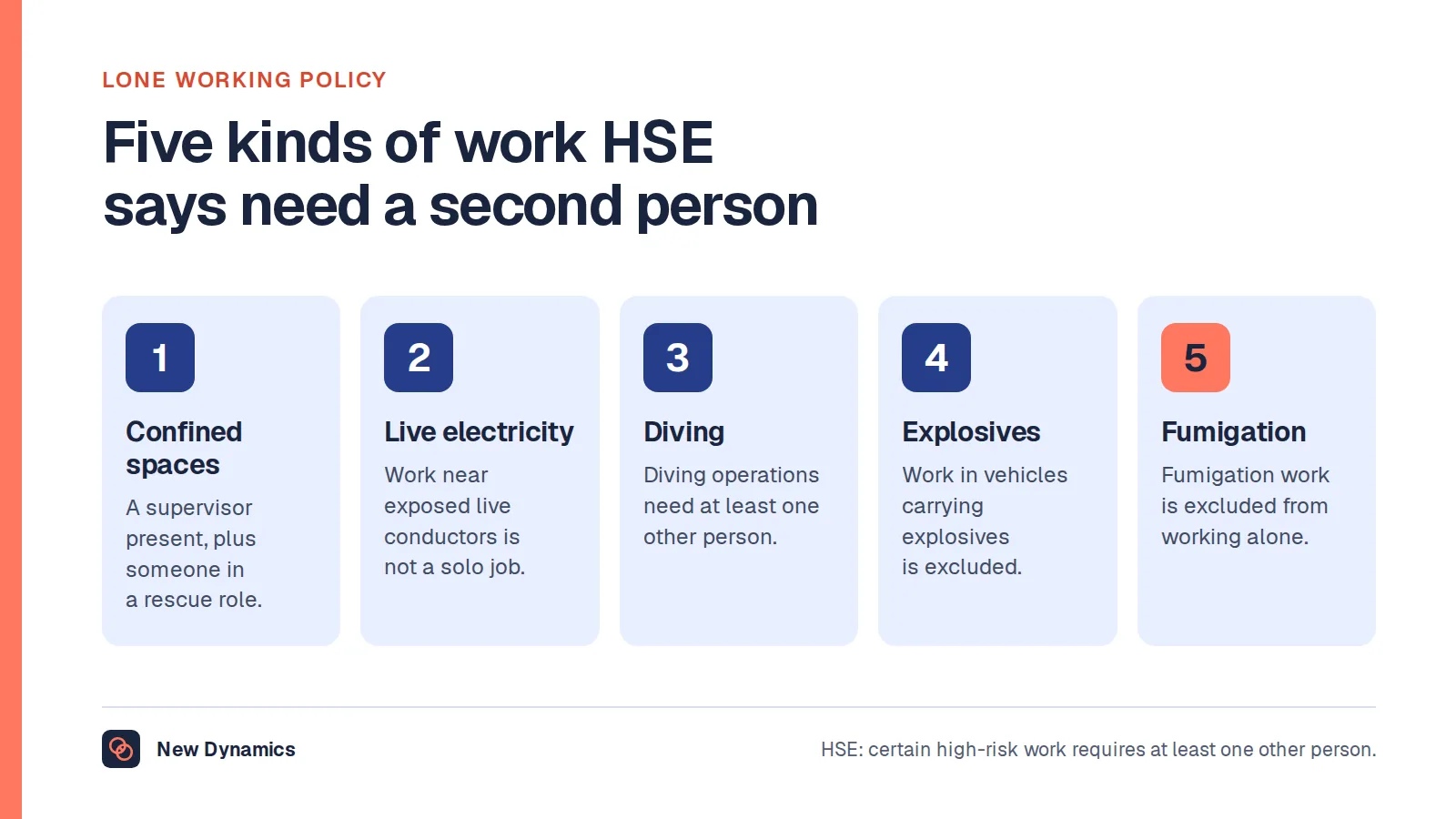
How many you need is not a number either. Article 18(3) makes it a judgement: the number appointed, the time available to them and the means at their disposal must be "adequate having regard to the size of the premises, the risks to which relevant persons are exposed and the distribution of those risks throughout the premises". Our post on lone working covers the related case of a site where nobody else is present to help.
Fire drills: what the Order requires, and what it does not
Article 15(1)(a) requires the responsible person to "establish and, where necessary, give effect to appropriate procedures, including safety drills, to be followed in the event of serious and imminent danger to relevant persons". That is the only place the word "drill" appears in the Order, and it carries no interval and no annual figure.
The annual drill everyone quotes comes from guidance, and the guidance says "should". GOV.UK states: "You should carry out at least one fire drill per year and record the results. You must keep the results as part of your fire safety and evacuation plan." So one a year is the standard GOV.UK recommends, and keeping the results is a must once you have them, but the Order prescribes no frequency. Premises whose risk assessment gives a reason for more, such as high turnover, shift working or a complex escape route, need more. "We do the annual one" is not an answer to article 15.
Training: when it must be given, and on what
Article 21(1) sets two trigger points. Employees must get adequate safety training "at the time when they are first employed", and again on being exposed to new or increased risks through a transfer or change of responsibilities, new or changed work equipment, new technology, or a new or changed system of work.
Article 21(2) says what it must be. It must cover "the appropriate precautions and actions to be taken by the employee in order to safeguard himself and other relevant persons on the premises", "be repeated periodically where appropriate", be adapted to new or changed risks, be "provided in a manner appropriate to the risk identified by the risk assessment", and "take place during working hours". Two of those are routinely missed. Training must follow the risk assessment rather than a generic course, so an assessment nobody has read cannot have shaped it. And it must happen in working hours, which means a module sent out to be done at home does not discharge article 21. Our post on HR compliance places fire safety among the other duties that arrive with employing someone.
Enforcement and penalties
Article 25(1) names the default enforcing authority as "the fire and rescue authority for the area in which premises are, or are to be, situated", with specialist exceptions such as the Health and Safety Executive for construction sites. GOV.UK sets out the notices that follow, from an informal notice to an alterations, enforcement or prohibition notice, with an appeal "to your local magistrates' court within 21 days".
Article 32(1)(a) makes it an offence to fail to comply with the duties in articles 8 to 22B and 38 "where that failure places one or more relevant persons at risk of death or serious injury in case of fire". Article 32(3) sets the penalty: "on summary conviction to a fine not exceeding the statutory maximum" or "on conviction on indictment, to a fine, or to imprisonment for a term not exceeding two years, or to both". Article 32(8) extends liability to a director, manager or secretary where the offence involved their "consent or connivance" or their neglect.
Two official sources diverge on the money. GOV.UK says "Minor penalties can be up to £5,000. Major penalties can have unlimited fines and up to 2 years in prison." But section 85(1) of the Legal Aid, Sentencing and Punishment of Offenders Act 2012 provides that an offence which "would, apart from this subsection, be punishable on summary conviction by a fine or maximum fine of £5,000 or more (however expressed)" is instead "punishable on summary conviction on or after that day by a fine of any amount". The statutory maximum in article 32(3)(a) and level 5 in article 32(6) both sat at £5,000, so the statute governs and the £5,000 ceiling on the GOV.UK page reads as out of date.
Article 32(11) closes the obvious escape route: nothing in the Order affords an employer a defence by reason of any act or default of an employee, or of a person nominated under article 13(3)(b) or 15(1)(b), or appointed under article 18(1). You can delegate the work. You cannot delegate the duty.
For scale: the Ministry of Housing, Communities and Local Government's fire and rescue incident statistics for the year ending June 2026, published for England on 28 October 2026, record "39,478 building fires (dwelling and other building fires) attended by FRSs in the year ending June 2026". More workforce figures sit in our HR statistics hub.
Scotland and Northern Ireland
The Order does not extend beyond England and Wales, and neither devolved regime uses the phrase "responsible person". Scotland's duties sit in Part 3 of the Fire (Scotland) Act 2005 and the Fire Safety (Scotland) Regulations 2006, S.S.I. 2006 No. 456, where section 53(1) puts the workplace duty on the employer and section 54(1) adds a duty on any person who "has control to any extent of relevant premises". Northern Ireland's are the Fire and Rescue Services (Northern Ireland) Order 2006 and the Fire Safety Regulations (Northern Ireland) 2010, S.R. 2010 No. 325. If you operate across the UK, check each nation rather than assuming the article numbers above travel.
Frequently asked questions
Who is the responsible person for fire safety?
Article 3 of the Regulatory Reform (Fire Safety) Order 2005 defines it. For a workplace it is the employer, if the workplace is to any extent under their control. For other non-domestic premises it is whoever has control of them in connection with a trade, business or other undertaking, and failing that the owner. It is a legal role rather than a job title, so nobody appoints you to it and nobody can turn it down.
Does a fire risk assessment have to be written down?
Yes, in every case. Article 9(6) used to require a record only where the responsible person employed five or more people, held a licence for the premises or was subject to an alterations notice. Section 156(3) of the Building Safety Act 2022 removed that threshold on 1 October 2023, and GOV.UK now states: "You must keep a written record of your fire risk assessment."
How often should fire drills be carried out?
No frequency is set in law. Article 15(1)(a) requires appropriate procedures "including safety drills", and that is the only mention of drills in the Order. GOV.UK recommends that "You should carry out at least one fire drill per year and record the results", which is guidance rather than a prescribed interval. Your risk assessment decides whether once a year is enough.
Is "fire warden" a legal term?
No. The word "warden" does not appear anywhere in the Fire Safety Order, and nor does "marshal". The Order requires competent persons appointed under article 18(1) to assist with the preventive and protective measures, nominated under article 15(1)(b) to implement evacuation procedures, and nominated under article 13(3)(b) to implement fire-fighting measures. Fire warden duties are a workplace label for those statutory appointments.
How many fire wardens does a workplace need?
The Order gives a test, not a number. Article 18(3) requires the number appointed, the time available to them and the means at their disposal to be adequate having regard to the size of the premises, the risks relevant persons are exposed to and how those risks are distributed. Article 15(1)(b) separately requires a sufficient number for evacuation.
What are the penalties for breaching fire safety duties?
Under article 32(1)(a) it is an offence to fail to comply with the duties in articles 8 to 22B and 38 where that failure puts someone at risk of death or serious injury in case of fire. Article 32(3) sets the penalty: a fine on summary conviction, or on indictment a fine, up to two years in prison, or both. Article 32(8) can extend liability to a director, manager or secretary whose consent, connivance or neglect contributed.
Your next step
Start with the two questions that decide everything else. Who, by name, is the responsible person for each site you occupy, and is there a written fire risk assessment for each one, reviewed since the last change to the building, the people or the work? If either answer is vague, nothing further down the list is reliable.
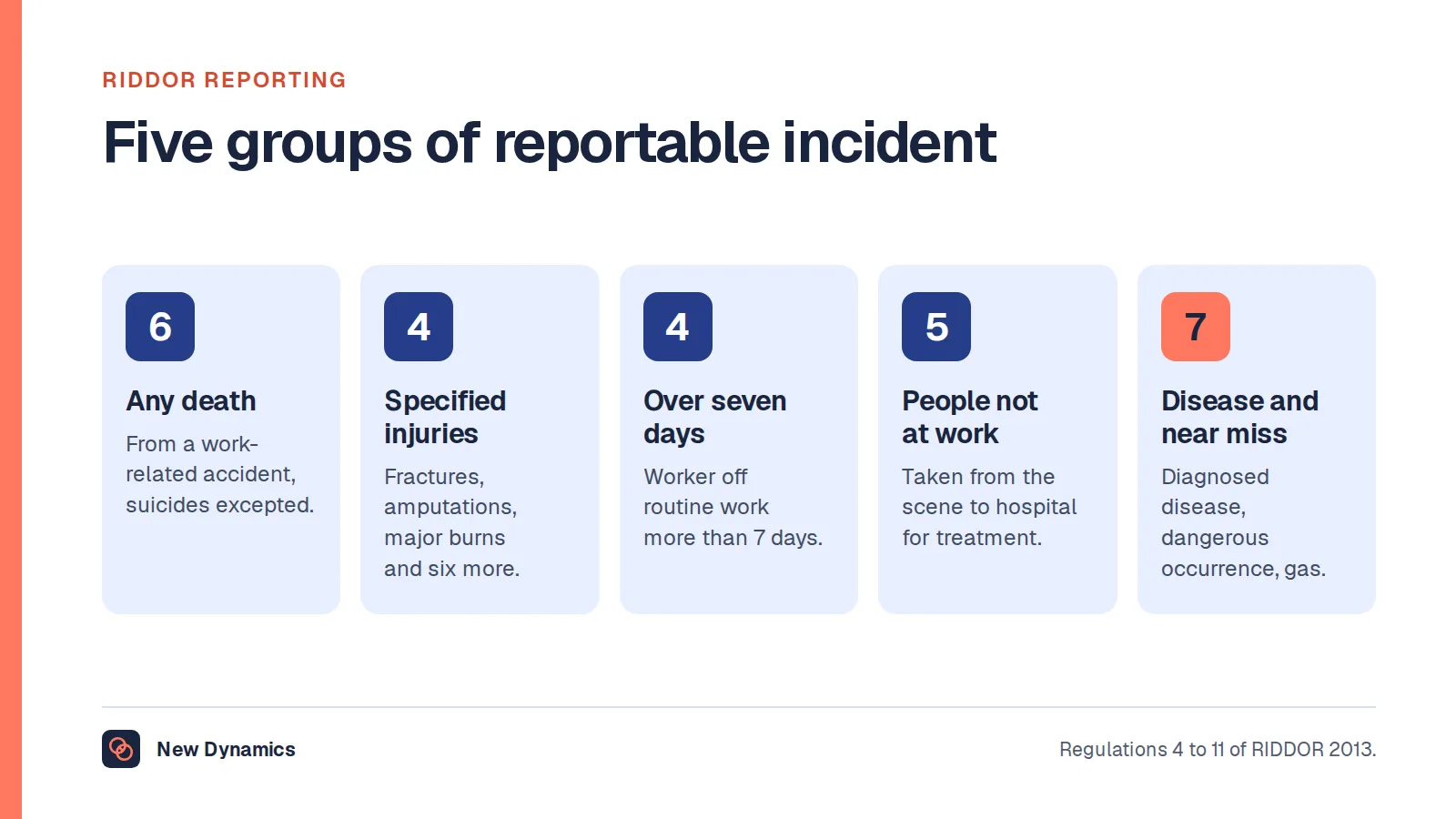
Then put the dated duties where they will be seen rather than filed: training at first employment under article 21(1), and the records required by articles 9(6) and 11(2). Read and download our employee onboarding guide for how to make a day-one duty part of the induction. Our post on workplace safety tips covers the wider health and safety picture, and RIDDOR reporting covers what happens when something does go wrong.
If you want induction and training duties tracked alongside the rest of the employee record, Book a New Dynamics demo and bring your current induction checklist. You can also email contact@new-dynamics.com.