TL;DR
- The duty sits with the employer, not the injured person. Regulation 3 of RIDDOR 2013 makes the “responsible person” the employee's employer, and HSE's own guidance tells an injured person not to use the reporting system unless they are self-employed.
- Three deadlines, not one. Deaths, specified injuries, injuries to non-workers taken to hospital and dangerous occurrences must be notified “without delay” with a report inside 10 days. An over-seven-day injury is reported within 15 days. A diagnosed occupational disease is reported without delay.
- Over three days is a recording duty, not a reporting one. Regulation 12(1)(c) requires a record where a worker is incapacitated for routine work for more than three consecutive days, and regulation 12(2) says every entry must be kept for at least three years.
Someone trips in the warehouse, cracks a wrist and is signed off for a fortnight. Three questions follow, and most workplaces get at least one of them wrong. Does this go to the Health and Safety Executive? Who sends it? And how long is there?
This article answers those three from the regulations themselves, then deals with the most common error in this area: treating "over three days" and "over seven days" as the same threshold. They are different durations attached to two different duties, one to record and one to report. Conflating them is how an employer ends up with a tidy accident book and a missed statutory report. Everything below is the position in Great Britain, and it is general information rather than legal advice.
Reporting runs on dates, so it helps when the process carries the dates. See how New Dynamics workflows let you set the stages, participants and reminders, so a deadline tied to a specific day has an owner before it passes.
What RIDDOR reporting is
RIDDOR is the Reporting of Injuries, Diseases and Dangerous Occurrences Regulations 2013, S.I. 2013 No. 1471. Regulation 1(2) is explicit: "Subject to paragraph (3), these Regulations come into force on 1st October 2013." HSE states the purpose in RIDDOR explained: "to inform the relevant enforcing authority that a work-related accident or incident has happened", so that "either HSE or the local authority can respond".
Two definitions do most of the work. An accident, HSE says, is "a type of incident which is separate, identifiable, unintended and causes physical injury", and this "specifically includes acts of non-consensual violence to people at work". Gradual exposures are out: "Gradual, cumulative exposures to hazards, which eventually cause injury (such as repetitive lifting), are not classed as 'accidents' under RIDDOR."
Work-relatedness is detached from fault. A work-related accident is one "arising out of or in connection with work", and HSE says that phrase "means an accident may still be reportable even if there had been no breach of health and safety law and no one was clearly to blame". The reverse error matters too: "An accident taking place at work premises does not, in itself, mean that it is work related."
Who has to report: the responsible person, not the injured person
Regulation 3 names the duty holder. For an injury, death or dangerous occurrence reportable under regulations 4 to 7 involving an employee, it is "that employee's employer". For a person not at work or a self-employed person, it is "the person who by means of their carrying on any undertaking was in control of the premises where the reportable or recordable incident happened". Regulation 3(2) substitutes specialist duty holders: the manager of a mine, the operator of a quarry or pipeline, the duty holder at an offshore installation, the diving contractor.
HSE's guidance on who should report turns that into an instruction. Reports "should only be submitted by the 'responsible person'", and you should not report if you are "an injured person (unless you are self-employed)", "a member of the public", or "others who do not have duties under RIDDOR". A worker who wants something looked at raises a concern with HSE instead. The injured employee has no reporting duty and no way to discharge their employer's.

What is reportable
Deaths
Regulation 6 covers work-related fatalities. HSE's types of reportable incidents page adds two points that are easy to miss: "With the exception of suicides, the death of any person must be reported if it resulted from a work-related accident", and if someone suffers a reportable injury and "dies due to that injury within one year (365 days), this must be reported as a work-related fatality." An earlier report does not close the file.
Specified injuries to workers
Regulation 4(1) lists them. For a person at work injured by a work-related accident, the specified injuries are:
- "any bone fracture diagnosed by a registered medical practitioner, other than to a finger, thumb or toe"
- "amputation of an arm, hand, finger, thumb, leg, foot or toe"
- "any injury diagnosed by a registered medical practitioner as being likely to cause permanent blinding or reduction in sight in one or both eyes"
- "any crush injury to the head or torso causing damage to the brain or internal organs in the chest or abdomen"
- "any burn injury (including scalding) which covers more than 10% of the whole body's total surface area; or causes significant damage to the eyes, respiratory system or other vital organs"
- "any degree of scalping requiring hospital treatment"
- "loss of consciousness caused by head injury or asphyxia"
- "any other injury arising from working in an enclosed space which leads to hypothermia or heat-induced illness; or requires resuscitation or admittance to hospital for more than 24 hours"
HSE's page on specified, reportable injuries settles the awkward cases. Fractures are reportable "when diagnosed or confirmed by a doctor, including when they are specified on a GP 'fit note'", while "Self-diagnosed 'suspected fractures' are not reportable". On unconsciousness, "The accident is reportable however long the person remains unconscious", but "Fainting from feeling unwell is not reportable." Where the extent is unclear, "there is no requirement to make precautionary reports of specified injuries", and the authority is updated "as soon as a specified injury has been confirmed".
Over-seven-day injuries to workers
This is the category most workplaces meet most often. Regulation 4(2): "Where any person at work is incapacitated for routine work for more than seven consecutive days (excluding the day of the accident) because of an injury resulting from an accident arising out of or in connection with that work, the responsible person must send a report to the relevant enforcing authority in an approved manner as soon as practicable and in any event within 15 days of the accident."
HSE spells out the counting: "This 7-day period does not include the day of the accident, but does include weekends and rest days." Incapacity is not only absence. HSE's test is "being away from work, or unable to do their normal work duties", so someone on lighter duties can still trigger it. If the injury surfaces late, "it must be reported as soon as it has prevented them from doing their normal work duties for more than 7 consecutive days".
Injuries to people who are not at work
Regulation 5 catches customers, visitors and volunteers. The trigger is that the person "is taken from the site of the accident to a hospital for treatment in respect of that injury", or suffers a specified injury on hospital premises. HSE narrows treatment: "Examinations and diagnostic tests, such as X-rays, do not count as 'treatment'." Reportable treatment is "a dressing applied", "stitches", "a plaster cast" or "surgery", and there is no need to report where someone goes to hospital "purely as a precaution when no injury is apparent".
Occupational diseases, dangerous occurrences and gas
Regulation 8 covers diagnosed disease. HSE's page on reportable occupational diseases lists six, each tied to a specified work exposure: carpal tunnel syndrome, cramp of the hand or forearm, occupational dermatitis, hand-arm vibration syndrome, occupational asthma, and tendonitis or tenosynovitis of the hand or forearm. The gate is medical. "A reportable disease must be diagnosed by a doctor", and "Employees must provide the diagnosis in writing to their employer." A self-employed person needs only "a doctor's verbal diagnosis". Occupational cancers and diseases caused by biological agents sit under regulation 9.
Regulation 7 covers dangerous occurrences, which HSE defines as events arising "out of or in connection with work" that could risk harm to others, with the warning that "Not all of these events need to be reported." The reportable list is Schedule 2, running through lifting equipment, pressure systems, overhead electric lines, electrical incidents causing explosion or fire, explosives, biological agents, radiation, breathing apparatus, diving, scaffolding collapse, train collisions, wells and pipelines, with separate parts for mines, quarries, transport systems and offshore workplaces.
Regulation 11 covers gas. Distributors, fillers, importers and suppliers of flammable gas must report incidents where someone "died", "lost consciousness" or has "been taken to hospital for treatment". Gas Safe Registered engineers must report appliances or fittings they consider dangerous, including in domestic premises.
The deadlines, which are not all the same
The reporting procedure is Schedule 1. Part 1, paragraph 1(1) requires the responsible person to "notify the relevant enforcing authority of the reportable incident by the quickest practicable means without delay", then to "send a report of that incident in an approved manner to the relevant enforcing authority within 10 days of the incident".
HSE's page on when to report applies that to each category and sharpens the 10 days into a received-by date: "NB: A report must be received within 10 days of the incident." For an over-seven-day injury, "you must notify the enforcing authority within 15 days of the incident". For disease, Schedule 1 paragraph 2(1) requires the report "without delay", which HSE puts as "as soon as the responsible person receives a diagnosis". Mines and quarries have their own timing in Schedule 1 paragraph 4: notification without delay, a report to any nominated person "within seven days of the incident", and one to the enforcing authority "within 10 days".

Over seven days to report, over three days to record
Here is the distinction that catches people out. Seven days is a reporting threshold. Three days is a recording threshold. Different provisions, and neither substitutes for the other.
Regulation 12(1)(c) requires a record of any "injury to a person at work resulting from an accident arising out of or in connection with that work, incapacitating that person for routine work for more than three consecutive days (excluding the day of the accident)". HSE states the consequence directly: accidents "must be recorded where they result in a worker being away from work, or unable to do their normal work duties, for more than 3 consecutive days", and "As an employer, you don't need to report this type of accident".
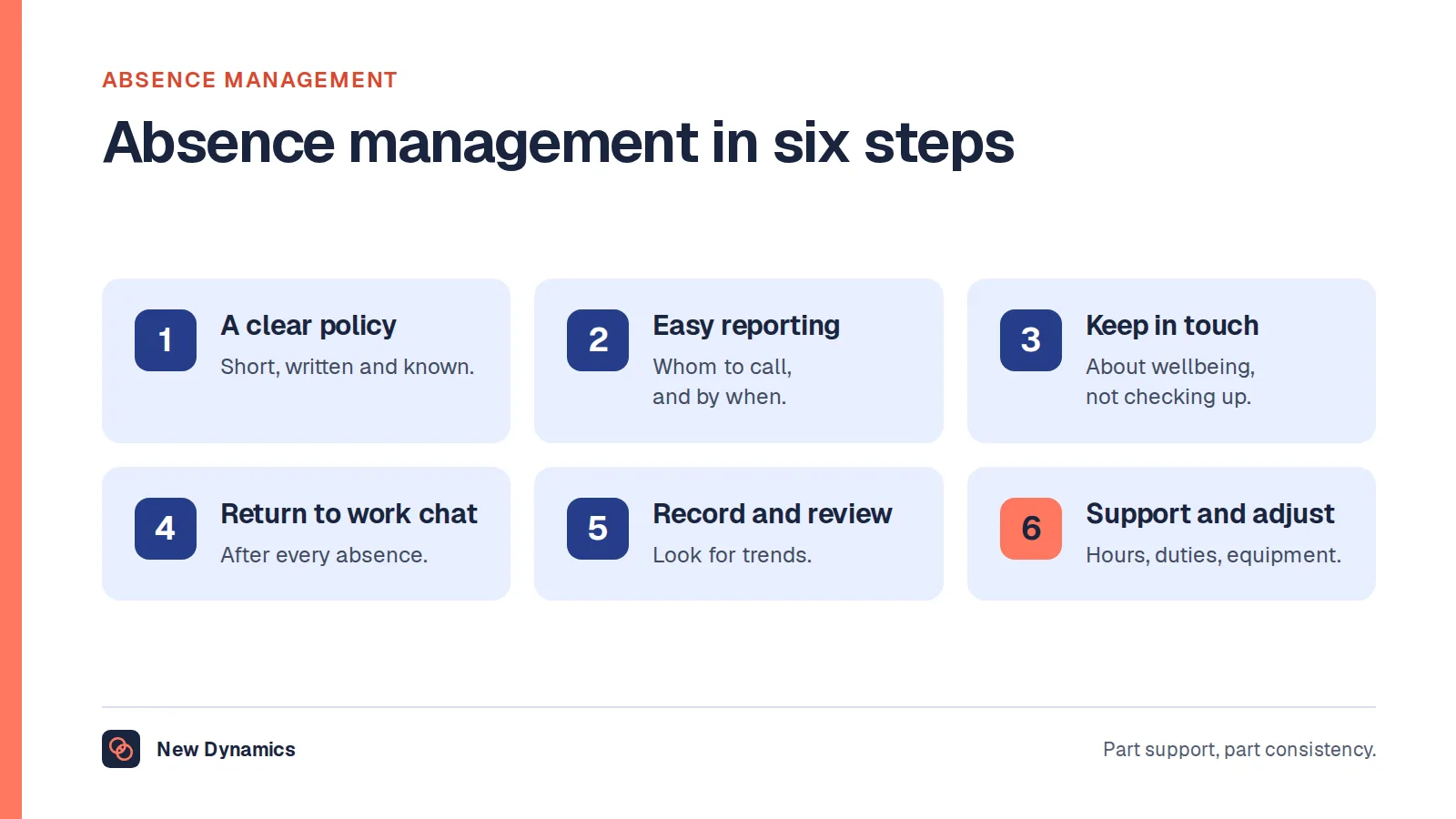
So an absence of four, five, six or seven consecutive days is recorded, not reported. The eighth consecutive day turns the same accident into a reportable over-seven-day injury, with the 15-day clock running from the date of the accident rather than from the day the threshold was crossed. A return-to-work date can therefore convert a closed accident-book entry into an overdue statutory report. Our post on absence management covers keeping those dates visible, and sick leave policy covers the fit note that usually sets them.

How to make the report, and what to keep
HSE's guidance on how to make a RIDDOR report is form-based: "Report of an injury", "Report of a dangerous occurrence", "Report of a case of disease", "Report of a flammable gas incident" and "Report of a dangerous gas fitting". Offshore incidents use the Report of an Oil and Gas Incident form, and nuclear sites go to the Office for Nuclear Regulation. The telephone route is narrow: "for fatal accidents or accidents resulting in specified injuries to workers only, you can phone 0345 300 9923". After submitting, "You will then have the option to download a copy for your records." Taking that copy is the cheapest way to satisfy the record duty.
Regulation 12(1) requires a record of each reportable incident under regulations 4 to 7, each reportable diagnosis under regulations 8 to 10, and each over-three-day injury, with the particulars in Part 2 of Schedule 1. For an accident, paragraphs 5 to 11 require the date and time; the injured person's "full name", "occupation" and "injury", or for someone not at work their "status (for example 'passenger', 'customer', 'visitor' or 'bystander')"; the place; "A brief description of the circumstances"; and the date and method of first notifying the enforcing authority. For a disease, paragraphs 12 to 17 require the date of diagnosis, the person's name and occupation, the name or nature of the disease, and the date and method of reporting.
Retention is fixed by regulation 12(2): "An entry in the record referred to in paragraph (1) must be kept for at least three years from the date on which it was made", held "at the place where the work to which it relates is carried on, or at the usual place of business of the responsible person". Regulation 12(4) lets an existing record do the job if it covers the recordable injuries and includes the Schedule 1 particulars. These records hold health data, so put them on a schedule: our post on employee records retention sets one out.
The accident book: a legal duty, under a different law
The accident book is often called good practice. That is not quite right. The duty is real, but it comes from social security law rather than RIDDOR.
Regulation 25(3) of the Social Security (Claims and Payments) Regulations 1979 applies to owners or occupiers of mines and quarries, to premises covered by the Factories Act 1961, and to "every employer by whom 10 or more persons are normally employed at the same time on or about the same premises". Those employers must "keep readily accessible a means (whether in a book or books or by electronic means), in a form approved by the Secretary of State, by which a person employed by the employer or some other person acting on his behalf may record the appropriate particulars", and must "preserve every such record for the period of at least 3 years from the date of its entry". Schedule 4 defines the particulars: the injured person's full name, address and occupation; the date and time; the place; the cause and nature of the injury; and the name, address and occupation of anyone giving notice on their behalf.
Three things follow. A physical book is not compulsory, because electronic means are permitted. HSE's printed BL510 Accident Book is one approved form, which HSE calls "an essential document for employers and employees, who are required by law to record and report details of specified work-related injuries and incidents", but the duty attaches to the record rather than to that product. And an employer of fewer than ten people, outside mines, quarries and factories, is not caught by regulation 25(3) at all, while still carrying the full RIDDOR record duty. HSE notes that where an accident book is kept it can hold the RIDDOR record of injuries, "although, a separate method will be needed for cases of disease".
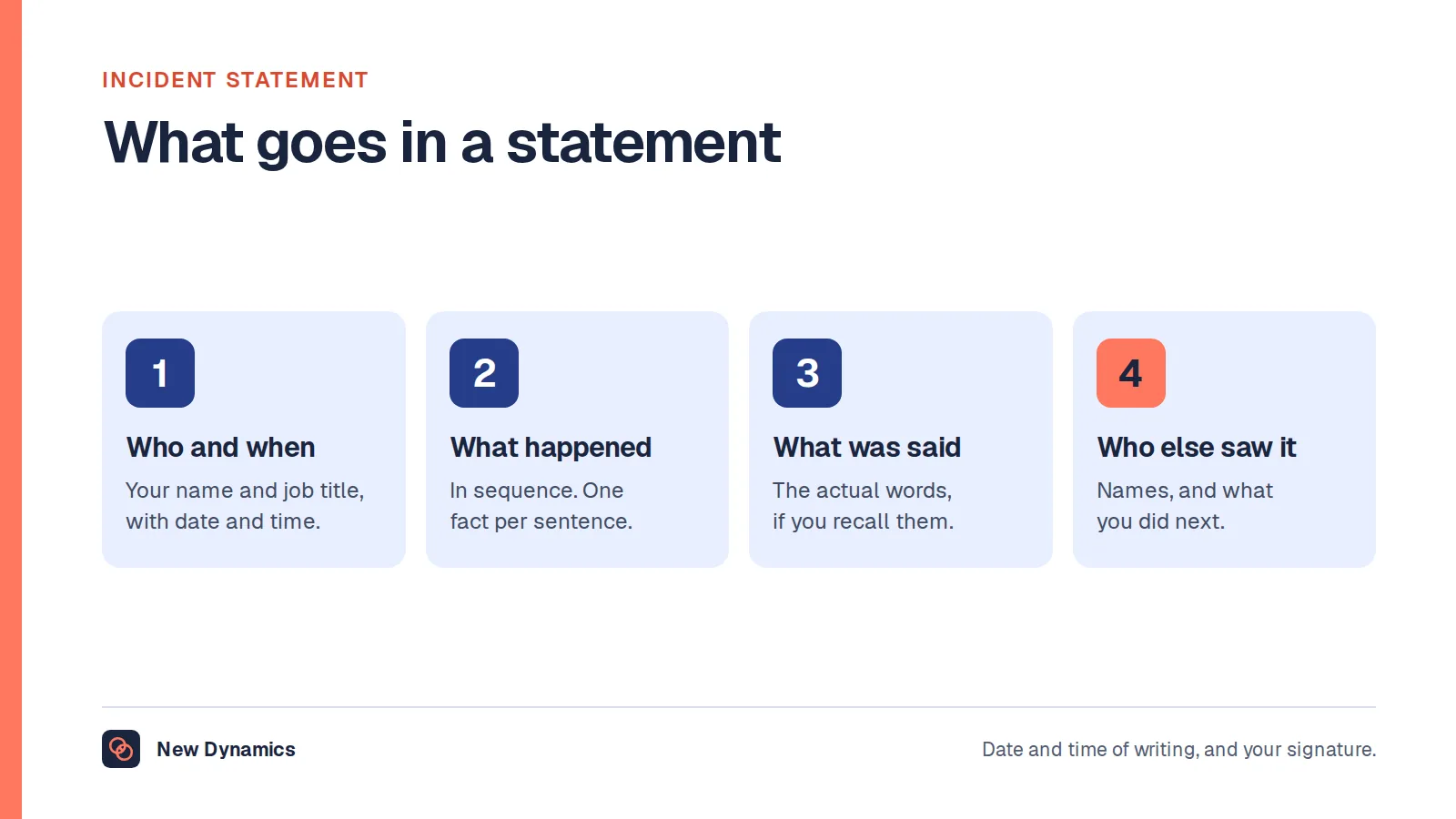
An accident-book entry and a witness account are different documents doing different jobs. Our post on how to write an incident statement covers the second, and workplace safety tips covers preventing the entry.
What happens if you fail to report
RIDDOR carries no penalties of its own. The footnote to regulation 16 says so: "These Regulations do not contain any offences. However, the contravention of any of these Regulations, or any requirement or prohibition imposed under them, is an offence under section 33(1) of the 1974 Act."
That is section 33 of the Health and Safety at Work etc. Act 1974. Section 33(1)(c) makes it an offence "to contravene any health and safety regulations". Schedule 3A to the Act sets the penalty: an offence under section 33(1)(c) is triable "Summarily or on indictment", and on indictment the maximum is "Imprisonment for a term not exceeding two years, or a fine, or both".
Regulation 16 does give a defence. It is "a defence for that person to prove that they were not aware of the circumstances which gave rise to that requirement, so long as that person had taken all reasonable steps to be made aware, in sufficient time, of such circumstances". That is a defence about systems, not memory. An organisation with no route by which an injury or a fit note reaches the person who reports has not taken all reasonable steps.
HSE's own figures show how often the route fails. On non-fatal injuries at work in Great Britain for 2024/25, HSE records 59,219 "Employee non-fatal injuries reported by employers in 2024/25 (RIDDOR)", against 680,000 workers who "sustained a non-fatal injury according to self-reports from the Labour Force Survey in 2024/25". The two count different things, since the survey includes injuries with no time off. HSE draws the conclusion anyway: "It is known that employers substantially under-report these non-fatal injuries: the level of overall employer reporting of RIDDOR defined non-fatal injuries to employees is estimated at around a half." The same release puts self-reported injuries with over seven days absence at 124,000 for 2024/25. For the wider picture, see our HR statistics hub.
Jurisdiction
RIDDOR 2013 is a Great Britain instrument, and HSE's guidance on it covers Great Britain. Regulation 19 extends it to premises and activities outside Great Britain to which the relevant sections of the 1974 Act apply. Northern Ireland has its own regime, the Reporting of Injuries, Diseases and Dangerous Occurrences Regulations (Northern Ireland) 1997, S.R. 1997 No. 455, amended by S.R. 2004 No. 196. Every list, threshold and deadline above is the Great Britain one. If you operate in Northern Ireland, check the 1997 rules rather than assuming they match. This article is general information and not legal advice.
Frequently asked questions
Who is responsible for making a RIDDOR report?
The employer, where an employee is involved. Regulation 3 of RIDDOR 2013 names the responsible person as "that employee's employer", or for a person not at work the person in control of the premises. HSE's guidance tells an injured person not to submit a report unless they are self-employed, and says the same about members of the public.
Is the accident book a legal requirement?
Yes for some employers, and under social security law rather than RIDDOR. Regulation 25(3) of the Social Security (Claims and Payments) Regulations 1979 applies to mines, quarries, Factories Act premises and "every employer by whom 10 or more persons are normally employed at the same time on or about the same premises". It permits a book or electronic means, and requires each record to be kept for at least three years.
What is the difference between an over-three-day and an over-seven-day injury?
Over three days is recorded, over seven days is reported. Regulation 12(1)(c) requires a record where a worker is incapacitated for routine work for more than three consecutive days. Regulation 4(2) requires a report to the enforcing authority where that incapacity exceeds seven consecutive days, within 15 days of the accident. The day of the accident is excluded from both counts.
How long do you have to report a RIDDOR incident?
It depends on the category. Deaths, specified injuries, non-workers taken to hospital for treatment and dangerous occurrences must be notified without delay, with the report received within 10 days of the incident. An over-seven-day injury is reported within 15 days of the accident. A diagnosed occupational disease is reported without delay.
Does a broken finger have to be reported under RIDDOR?
Not as a specified injury. Regulation 4(1)(a) covers "any bone fracture diagnosed by a registered medical practitioner, other than to a finger, thumb or toe". It would still become reportable if it kept the person from routine work for more than seven consecutive days, and it must be recorded if that period exceeds three consecutive days.
What happens if an employer does not report?
RIDDOR contains no offences itself. The footnote to regulation 16 states that contravening the regulations "is an offence under section 33(1) of the 1974 Act". Under Schedule 3A to that Act, an offence under section 33(1)(c) is triable summarily or on indictment, and on indictment carries up to two years' imprisonment, a fine, or both.
Do you have to report an accident involving a customer or visitor?
Only if the person is taken from the scene to hospital for treatment of the injury, or suffers a specified injury on hospital premises. HSE excludes examinations and diagnostic tests such as X-rays from "treatment", and says there is no need to report where someone is taken to hospital purely as a precaution with no apparent injury.
Your next step
Pick the three dates that decide a RIDDOR report and give each one an owner: the date of the accident, the date the person stopped doing their normal duties, and the date they resumed them. Most missed reports are missed because the third date arrives in a different system from the first two.
Then write the thresholds down where managers will see them, next to the absence rules rather than in a safety folder. Read and download our employee handbook guide for how to keep a policy short enough that people use it.
If you want the reporting clock inside the process rather than beside it, Book a New Dynamics demo and bring your current incident form. You can also email contact@new-dynamics.com.