TL;DR
- There is no Lone Working Act. A title search on legislation.gov.uk for "lone working" returns 16 results, every one of them about lone parents and social security. The duty is the general one in section 2(1) of the Health and Safety at Work etc. Act 1974, which received Royal Assent on 31 July 1974, plus the risk assessment duty in regulation 3 of the Management of Health and Safety at Work Regulations 1999, in force since 29 December 1999.
- Working alone is lawful, but not for everything. HSE states that "Certain high-risk work requires at least one other person" and names five kinds: confined spaces, work near exposed live electricity conductors, diving operations, vehicles carrying explosives, and fumigation.
- HSE names four risks that "particularly affect lone workers": violence in the workplace, stress and mental health or wellbeing, a person's medical suitability to work alone, and the workplace itself. Its own statistics release puts 689,000 incidents of violence at work in 2024/25, but HSE publishes no figure for how many lone workers there are.
A lone working policy usually gets written after a near miss. Someone did not call in from a site visit, or a care worker was threatened on a doorstep, and only then does anybody ask what the arrangement was supposed to be. The law did not wait for that moment. In Great Britain the duty to protect people who work by themselves already applies, and it has applied since 1974.
This post sets out who counts as a lone worker, what the legal duty actually is and which Act it is not, whether working alone is lawful, what a lone worker risk assessment has to consider, and what belongs in a lone working procedure that people will follow. Every rule below was taken from the Health and Safety Executive (HSE) or from legislation.gov.uk, with the date each source carries. It is general information about Great Britain and not legal advice.
A lone working procedure only works if the check-in, the training record and the review date sit somewhere other than one manager's memory. See how New Dynamics workflows let you shape the stages, participants, reminders and approvals around your own process, so an arrangement leaves a record instead of an assumption.
What a lone worker is, in HSE's own words
HSE's guidance for employers, Lone working: Protect those working alone (last updated 25 February 2025), gives the definition in one line: "Lone workers are those who work by themselves without close or direct supervision". Its examples are deliberately ordinary:
- "as delivery drivers, health workers or engineers"
- "as security staff or cleaners"
- "in warehouses or petrol stations"
- "at home"
Two things follow from that list. First, lone working is not only night work in remote places. A homeworker on a laptop is inside the definition. Second, the test is supervision, not solitude. Someone surrounded by members of the public all day, with no colleague and no supervisor, is a lone worker.
The same page is explicit about who the duty covers: "This applies to anyone contracted to work for you, including self-employed people." HSE's companion page for workers themselves repeats the definition from the other side: "You're a lone worker if you work by yourself without close or direct supervision."
HSE also states the reason the category exists at all: "There will always be greater risks for lone workers without direct supervision or anyone to help them if things go wrong."
There is no Lone Working Act, and that matters
Search results for this topic are full of references to lone working "legislation" as though a dedicated statute existed. It does not. A title search on legislation.gov.uk for "lone working" returns 16 results, and every one is a social security instrument about lone parents.
What applies instead is the general duty, pointed at a specific situation. Two sources do the work.
Section 2 of the Health and Safety at Work etc. Act 1974, which received Royal Assent on 31 July 1974. Section 2(1) reads: "It shall be the duty of every employer to ensure, so far as is reasonably practicable, the health, safety and welfare at work of all his employees." Section 2(2)(c) then names the part that lone working tests hardest: "the provision of such information, instruction, training and supervision as is necessary to ensure, so far as is reasonably practicable, the health and safety at work of his employees". Section 2(3) requires a written statement of general policy where more than four people are employed, which is where a lone working policy usually sits.
Regulation 3 of the Management of Health and Safety at Work Regulations 1999 (SI 1999/3242), which under regulation 1(1) "shall come into force on 29th December 1999". Regulation 3(1) requires every employer to "make a suitable and sufficient assessment of" the risks to employees at work and the risks to people not in their employment. Regulation 3(6) adds that an employer with five or more employees "shall record" the significant findings and "any group of his employees identified by it as being especially at risk". Lone workers are the textbook example of such a group. Regulation 3(3) requires a review where "there is reason to suspect that it is no longer valid" or "there has been a significant change in the matters to which it relates".
HSE puts the two together on its page Manage the risks of working alone: "Under the Management of Health and Safety at Work Regulations, you must manage the risk to lone workers."
Workers carry a duty too. Section 7 of the 1974 Act requires every employee "to take reasonable care for the health and safety of himself and of other persons who may be affected by his acts or omissions at work" and to co-operate with the employer. A lone working procedure that nobody follows is a problem on both sides of the line.
Regulation 3 is marked as extending to England, Wales and Scotland, and the 1974 Act applies to Great Britain, with Northern Ireland running a separate but closely similar regime. Name the jurisdiction in your own policy rather than writing "UK law" and hoping.
Is lone working legal? Yes, with named exceptions
Working alone is lawful in general. HSE frames the duty as a sequence rather than a ban: "As an employer, you must manage any health and safety risks before people can work alone." The risk assessment comes first, and the work follows from it.
Some work, though, is off the table. HSE states plainly that "Certain high-risk work requires at least one other person", and lists it:
- work "in a confined space, where a supervisor may need to be there, along with someone in a rescue role"
- work "near exposed live electricity conductors"
- work "in diving operations"
- work "in vehicles carrying explosives"
- work "with fumigation"

If your organisation does any of these, the policy needs to say so in words a supervisor can act on at 6am, not in a risk register nobody opens. HSE also sets an organisational limit that is easy to miss: "You should set limits on what can be done while working alone." A lone working policy that only describes monitoring, and never says which tasks stop, is half a policy.
One more duty applies the moment someone works on a third party's premises: "When a lone worker will be at someone else's workplace you must ask that employer about any risks and control measures to make sure they are protected." That is an active duty to ask, not a duty to assume the host has it covered.
What a lone worker risk assessment must consider
HSE does not hand out a template. It names the risks that change when the worker is on their own. On Manage the risks of working alone, under the heading "Risks to consider", it says: "Risks that particularly affect lone workers include:"
- "violence in the workplace"
- "stress and mental health or wellbeing"
- "a person's medical suitability to work alone"
- "the workplace itself, for example if it's in a rural or isolated area"

Alongside those, HSE states the baseline obligations in two bullets: "train, supervise and monitor lone workers" and "keep in touch with them and respond to any incident".
Medical suitability deserves a word, because it is where well-meaning policies go wrong. HSE's position is to get advice rather than guess: "if you are unsure whether someone's health condition means they are safe to work alone, get medical advice." It also asks you to consider more than the ordinary day: "Think about both routine work and possible emergencies that may put additional physical and mental burdens on the lone worker."
Emergencies need their own answer. HSE says your risk assessment may indicate lone workers should "carry first aid equipment", "receive first aid training, including how to use first aid on themselves", and "have access to adequate first aid facilities". Emergency procedures "should include guidance on how and when lone workers should contact their employer, including details of any emergency contact numbers".
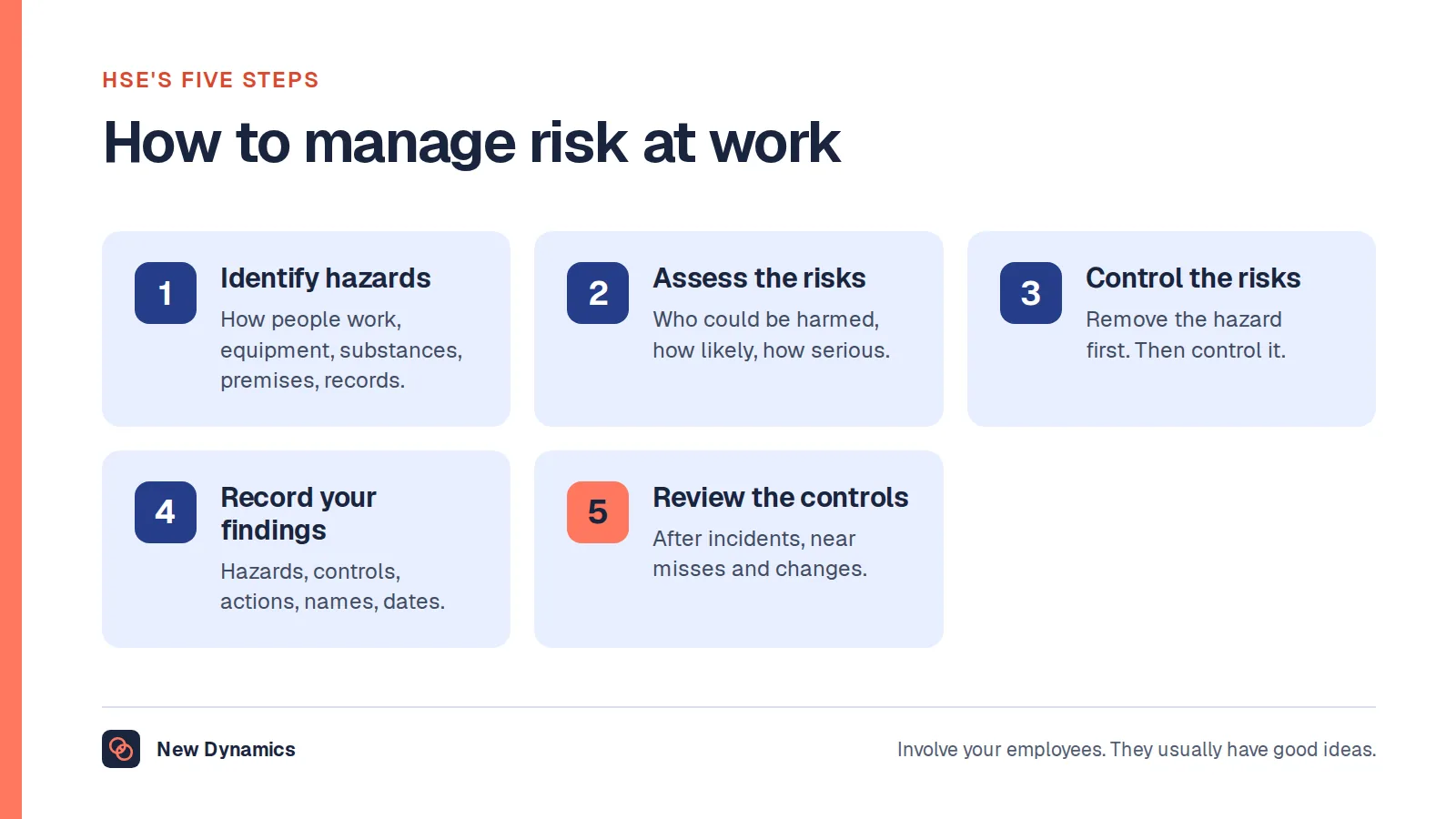
Our post on health and safety tips at the workplace covers the five-step risk management cycle that this assessment fits inside.
Training, supervision and monitoring: the operational half
HSE's page on training, supervision and monitoring is the most practical part of its guidance, and it is the part most policies summarise away.
On training: "It's harder for lone workers to get help, so they may need extra training." HSE says training matters particularly "where there is limited supervision to control, guide and help in uncertain situations" and "in enabling people to cope with unexpected situations, such as those involving violence". Workers should be "competent to deal with the requirements of the job", "trained in using any technical solutions" and "able to recognise when they should get advice".
On supervision, the rule is proportionality: "Base your levels of supervision on your risk assessment", because "the higher the risk, the more supervision they will need". New workers get particular attention when they are "being trained", "doing a job with specific risks" or "dealing with new situations".
On monitoring, HSE is direct: "You must monitor your lone workers and keep in touch with them. Make sure they understand any monitoring system and procedures you use." The arrangements it lists are the ones a policy should describe:
- "when supervisors should visit and observe lone workers"
- "knowing where lone workers are, with pre-agreed intervals of regular contact, using phones, radios, email etc"
- "other devices for raising the alarm, operated manually or automatically"
- "a reliable system to ensure a lone worker has returned to their base once they have completed their task"

Note what HSE says and does not say about devices. It describes a category, "other devices for raising the alarm, operated manually or automatically", and it names no product and endorses none. Nor does it require one. A device is a control measure your risk assessment may point to, not a substitute for the assessment. What HSE does require is testing: "Regularly test these systems and all emergency procedures to ensure lone workers can be contacted if a problem or emergency is identified."
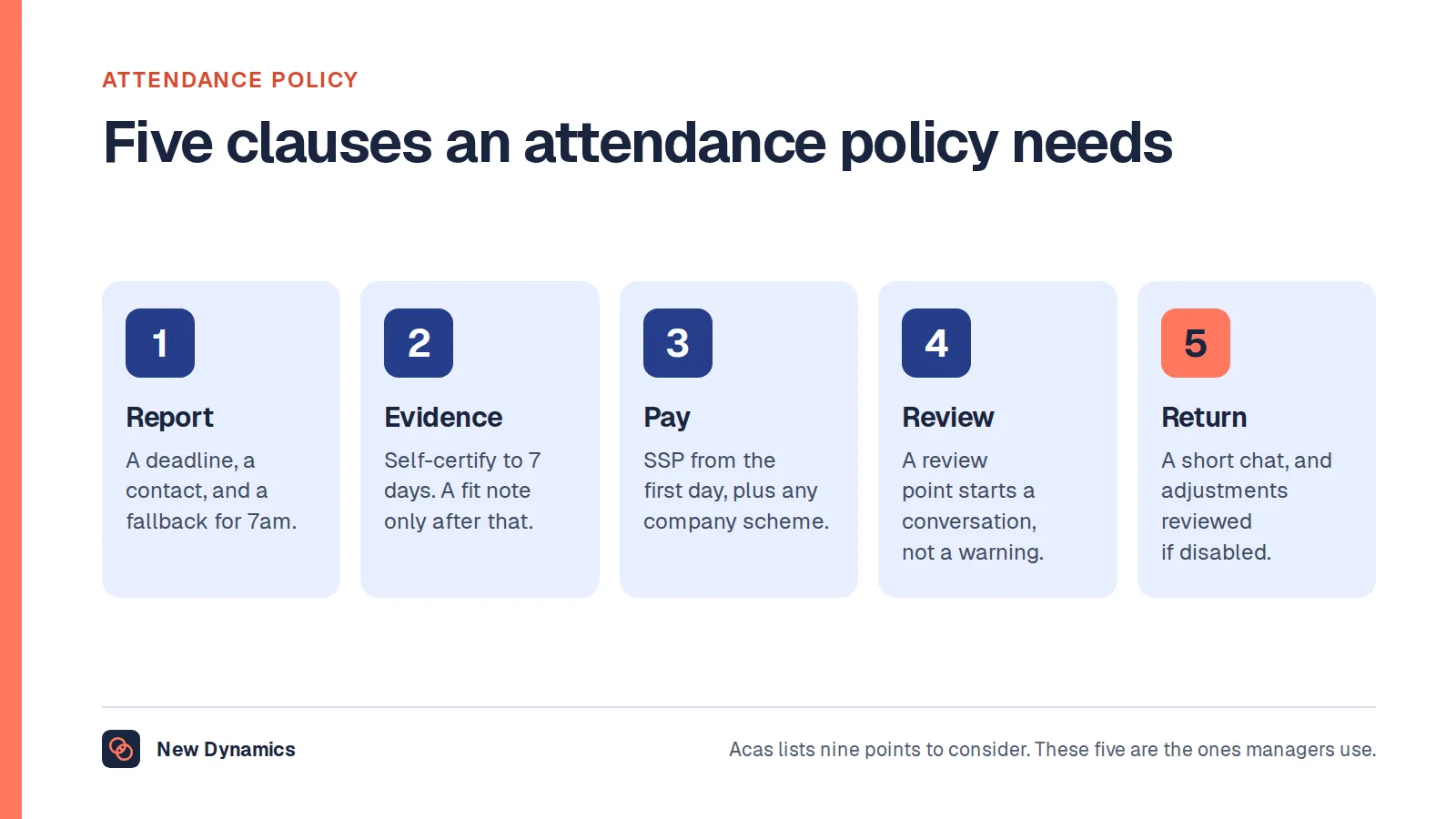
The return-to-base step is the one most often missing in practice. A policy can describe hourly check-ins in detail and still have nobody responsible for noticing that the last visit of the day never closed. Our post on the attendance policy covers the contact escalation that sits next to this.
HSE adds a point about language that applies to a lot of lone roles: workers from outside the UK "may come across unfamiliar risks, in a workplace culture very different from that in their own country", and "You must ensure they have received and understood the information, instruction and training they need to work safely."
Violence at work, and what the official figures actually say
Violence is the risk that moves lone working from a paperwork exercise to a serious one, and HSE is careful about the claim it makes. On its violence page for lone workers: "Lone working does not always mean a higher risk of violence, but it does make workers more vulnerable. The lack of nearby support makes it harder for them to prevent an incident."
The definition is HSE's own: it "defines violence as 'any incident in which a person is abused, threatened or assaulted in circumstances relating to their work'", and HSE notes that "this includes verbal threats". Its longer guidance on work-related violence adds that this covers "verbal abuse or threats, including face to face, online and via telephone" and "physical attacks".
HSE lists the key risk factors, which read like a description of many lone roles: "late evening or early morning work, when fewer workers are around"; "lone workers, such as security staff, who have authority over customers and are enforcing rules"; "people affected by alcohol or drugs"; and "carrying money or valuable equipment".
For scale, HSE's own statistics page Violence at work 2024 to 25 (last updated 7 January 2026), drawing on the Crime Survey for England and Wales, reports 689,000 "Incidents of violence at work in 2024/25" and 329,000 adults who "experienced violence at work in 2024/25". Of those incidents, 370,000 were assaults and 319,000 were threats, and 38% of assaults on adults of working age in employment resulted in injury. Combining the two years ending March 2024 and March 2025, 1.2% of working-age adults in employment were victims of violence at work at least once, rising to 6.8% in protective service occupations. The wider collection is in our HR statistics hub.
One honest gap: HSE does not publish a figure for how many lone workers there are in Great Britain, and no official UK source we could open does. Numbers in the millions circulate widely in marketing material for lone worker products. They are not HSE figures, so this post does not repeat them.
Stress, isolation and mental health
HSE treats the mental health dimension as part of the duty, not an extra. On stress and other health factors (last updated 21 March 2024): "Lone working can cause work-related stress and affect people's mental health."
Its reasoning connects straight to its stress framework: "HSE's Stress Management Standards include the importance of relationships with, and support from, other workers", and "Being away from managers and colleagues could make it difficult to get proper support." The Support standard itself asks that "employees indicate that they receive adequate information and support from their colleagues and superiors" and that "systems are in place locally to respond to any individual concerns."
The practical instruction is about contact quality, not contact frequency: "Put procedures in place that enable direct contact with the lone worker so their manager can recognise signs of stress as early as possible." And the warning about getting it wrong is specific: "If contact is poor, workers may feel disconnected, isolated or abandoned. This can affect their performance and potentially their stress levels and mental health."
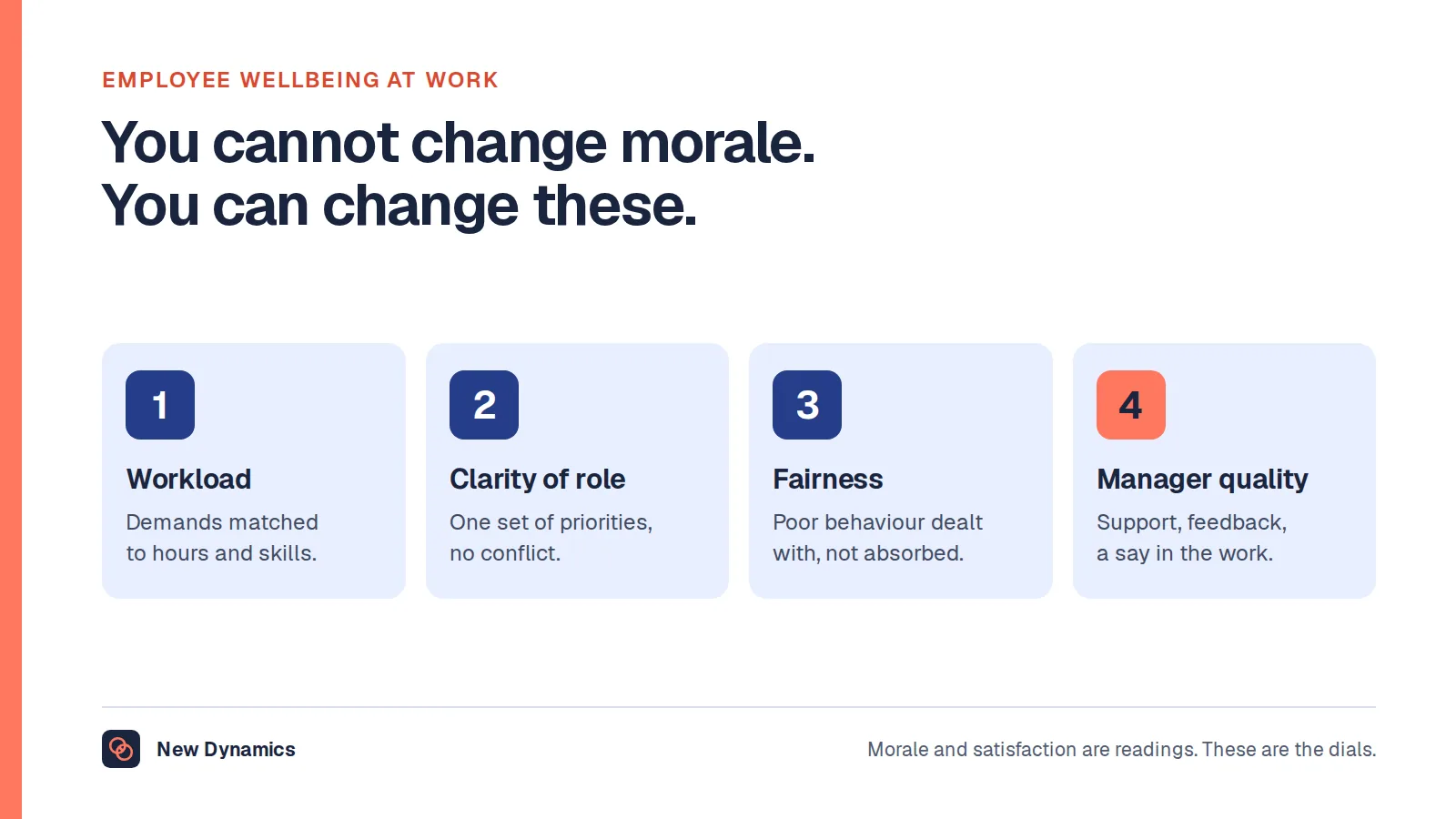
That is the argument for making the check-in a conversation rather than a ping. Our post on employee wellbeing at work covers the support structures around it.
Homeworkers are lone workers
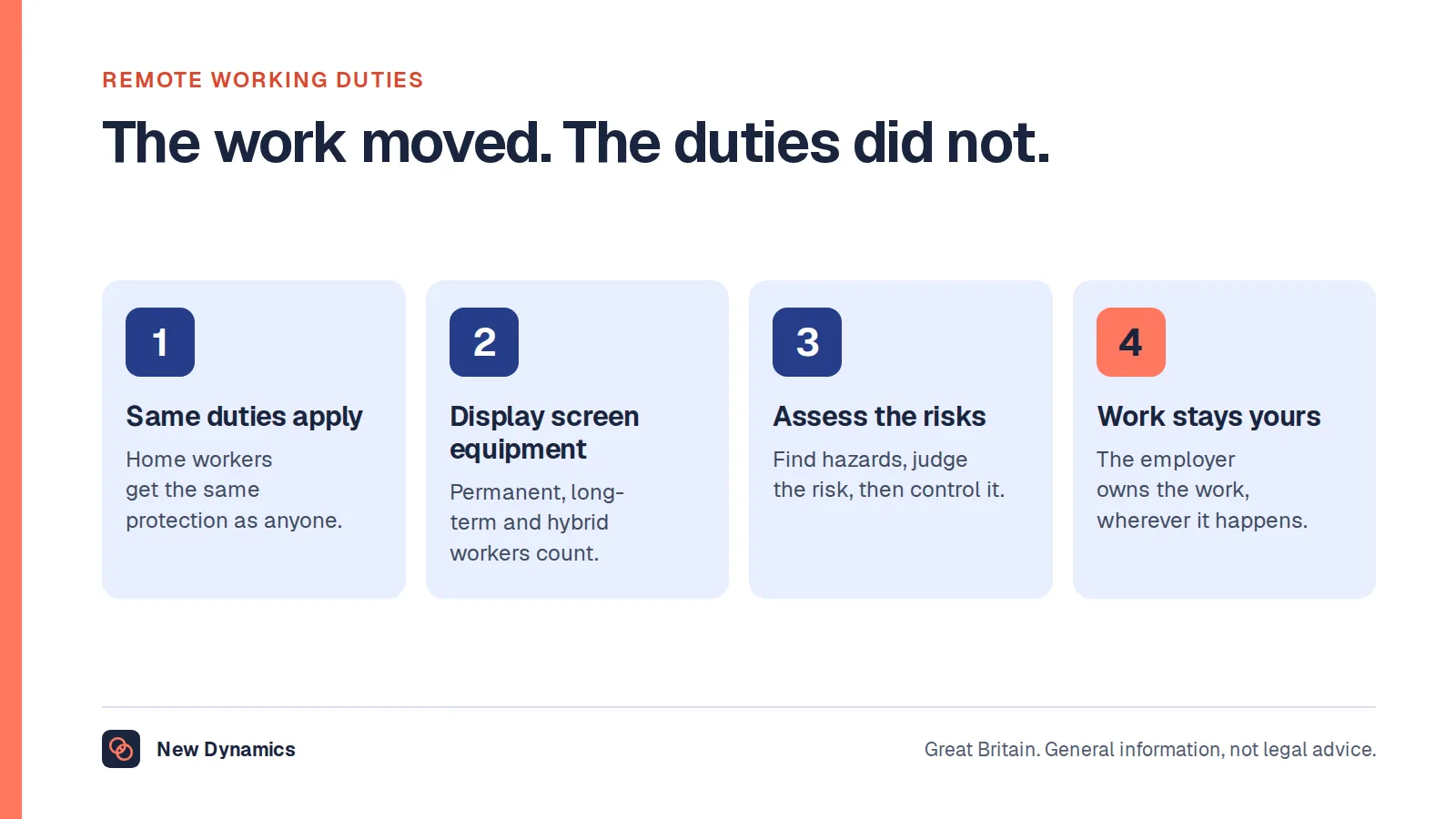
This is the part of the duty most employers have not written down. HSE treats working from home as a form of lone working, and says so inside the lone working guidance: "You have the same health and safety responsibilities for homeworkers and the same liability for accident or injury as for any other workers." It follows that with an instruction: "This means you must provide supervision, education and training, as well as implementing enough control measures to protect the homeworker."
HSE's separate guidance on managing home workers' health and safety covers people who "work at home long term" and those who "routinely split their time between their workplace and home (sometimes called hybrid working)". It names three things to consider in the risk assessment: "stress and poor mental health", "using equipment like computers and laptops safely" and "their working environment".
It also keeps the duty in proportion: "Most of the time, risks to home workers will be low and the actions you should take to protect them will be straightforward." And it adds a point about suitability that policies rarely make: "working from home may not be suitable for everyone", because "some people may not have an appropriate place to work or may prefer to come into the workplace for wellbeing, mental health or other reasons". Our post on remote working practice covers the arrangement side of that.
What to put in a lone working policy
Working from the sources above, a policy that holds up has nine parts.
- Who it covers. Use HSE's definition, and state that it includes contractors, freelancers and self-employed people engaged by you, plus homeworkers and hybrid workers.
- The legal basis, stated accurately. Section 2 of the 1974 Act and regulation 3 of the 1999 Regulations, with the jurisdiction named. Do not imply a bespoke statute.
- The risk assessment, recorded. HSE's four risks as headings, the significant findings written down, and lone workers named as a group especially at risk where you employ five or more people.
- The work nobody does alone. The five high-risk categories HSE names, plus any task your own assessment adds, and the limits on what can be done while working alone.
- Third-party premises. Who asks the host employer about risks and controls, and before when.
- Training and competence. What each lone role must be trained in, including unexpected situations and any technical solution, and where the record lives.
- Supervision, set by risk level. Including the extra supervision a new or newly transferred worker gets.
- Contact, alarm and return to base. The contact intervals, the method, how to raise an alarm, who notices a missed check-in, what they do next, and the emergency contact numbers.
- Testing and review. A date to test the systems and emergency procedures, and the regulation 3(3) triggers for reviewing the assessment.
Keep the document shorter than the list above suggests. A supervisor reading it at the start of a shift needs the contact rule and the escalation, not the legal background.
Frequently asked questions
Is lone working legal in the UK?
Yes, in general. There is no law banning work on your own. HSE states that an employer "must manage any health and safety risks before people can work alone", so the risk assessment comes first. Some work is excluded: HSE says certain high-risk work requires at least one other person, including confined spaces, work near exposed live electricity conductors, diving operations, vehicles carrying explosives and fumigation.
Is there a Lone Working Act?
No. A title search on legislation.gov.uk for "lone working" returns 16 results, all social security instruments about lone parents. The duty is the general one: section 2(1) of the Health and Safety at Work etc. Act 1974 requires every employer to ensure the health, safety and welfare at work of employees so far as is reasonably practicable, and regulation 3 of the Management of Health and Safety at Work Regulations 1999 requires a suitable and sufficient risk assessment.
Who counts as a lone worker?
HSE defines lone workers as "those who work by themselves without close or direct supervision". Its examples include delivery drivers, health workers, engineers, security staff, cleaners, people in warehouses or petrol stations, and people working at home. The duty applies to anyone contracted to work for you, including self-employed people.
What must a lone worker risk assessment consider?
HSE names four risks that particularly affect lone workers: violence in the workplace, stress and mental health or wellbeing, a person's medical suitability to work alone, and the workplace itself, for example if it is in a rural or isolated area. Alongside those, employers must train, supervise and monitor lone workers, keep in touch with them, and respond to any incident. Where five or more people are employed, regulation 3(6) requires the significant findings to be recorded.
Does an employer have to provide a lone worker device?
HSE does not require any particular device and names no product. Its monitoring list includes "other devices for raising the alarm, operated manually or automatically" alongside supervisor visits, pre-agreed contact intervals using phones, radios or email, and a reliable system confirming the worker has returned to base. Whether a device is needed follows from your risk assessment, and HSE does require that whatever you use is regularly tested.
Do the lone working rules apply to people working from home?
Yes. HSE treats homeworking as a form of lone working and states that employers have "the same health and safety responsibilities for homeworkers and the same liability for accident or injury as for any other workers". Its homeworking guidance asks employers to consider stress and poor mental health, safe use of equipment such as computers and laptops, and the working environment, while noting that risks to home workers are usually low.
How often should a lone worker check in?
There is no statutory interval. HSE's wording is "pre-agreed intervals of regular contact", which means the frequency comes from your risk assessment and is agreed in advance rather than left to judgement on the day. HSE also asks for a reliable system confirming the worker has returned to base once the task is complete, and for the arrangements to be tested regularly.
Your next step: close the gap between the policy and the shift
- List every role in your organisation that meets HSE's definition, including homeworkers and hybrid workers, and including contractors and self-employed people you engage.
- For each role, write the four HSE risks as headings and record the significant findings. If you employ five or more people, that record is a legal requirement, not good practice.
- Name the tasks nobody does alone, starting with HSE's five high-risk categories, and write the limits on what can be done while working alone.
- Write the contact arrangement end to end: interval, method, how to raise an alarm, who notices a missed check-in, what they do, and who confirms the safe return. Then test it on a real shift.
- Set the review date, and add the regulation 3(3) triggers so a change of site, vehicle, caseload or working pattern reopens the assessment.
For the arrangement side of homeworking and hybrid working, read and download our remote work guide. The guide is free to read, and the PDF uses our short download form.
Want the check-ins, training records and review dates to leave a trail instead of living in one manager's inbox? Book a New Dynamics demo and bring your current lone working procedure. You can also email contact@new-dynamics.com.