TL;DR
- Form 1040-ES is how an individual pays tax on income that nothing withholds from. The 2026 form gives the general rule as owing at least $1,000 in tax for 2026 after subtracting withholding and refundable credits, plus a second test on how much withholding covers.
- The four payment periods are not equal quarters. Publication 505 for 2026 sets them as January 1 to March 31, April 1 to May 31, June 1 to August 31 and September 1 to December 31, with 2026 due dates of April 15, June 15, September 15 and January 15, 2027.
- An employee with wages can usually skip the form altogether. The IRS estimated taxes page says so plainly: ask the employer to withhold more by filing a new Form W-4, using the line for an additional amount. That is the fix payroll can hand someone in a minute.
Everything in this article is about the United States federal tax system, and about nothing else. Form 1040-ES is an Internal Revenue Service form, estimated tax is a federal concept with no British equivalent, and a reader arriving from a Self Assessment question will find that none of these rules transfer. Every figure and date below comes from the IRS, with the tax year named each time, and this is general information rather than tax advice.
The question reaches HR more often than it should. Somebody has a side business, a rental or a block of vested shares, they have heard they are supposed to pay tax four times a year, and they want to know whether payroll should be doing something about it. The useful answer is the one the IRS gives first, and it is not "fill in the form".
Questions like this arrive at whoever is nearest rather than whoever owns them. See how New Dynamics workflows put a named owner and a due date on each step, so a payroll query stops being answered twice and differently.
What Form 1040-ES actually is
Form 1040-ES is the voucher and worksheet package an individual uses to work out and pay estimated tax. The IRS About Form 1040-ES page, last reviewed on 17 September 2026, states: "Use Form 1040-ES to figure and pay your estimated tax." It then defines the thing being paid: "Estimated tax is the method used to pay tax on income that is not subject to withholding (for example, earnings from self-employment, interest, dividends, rents, alimony, etc.)."
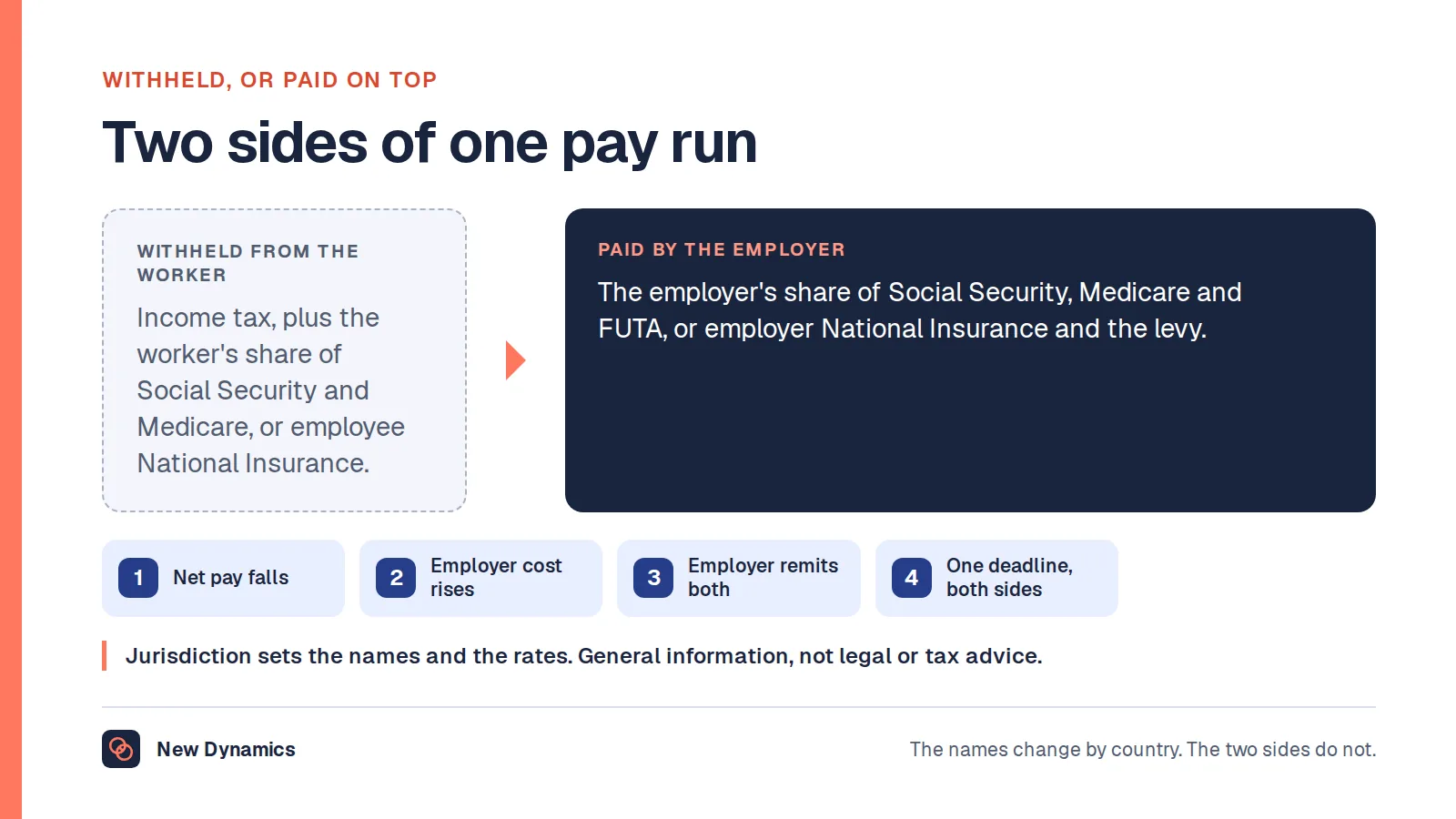
Publication 505 for 2026, on tax withholding and estimated tax, sets out why the form exists at all. "The federal income tax is a pay-as-you-go tax. You must pay the tax as you earn or receive income during the year. There are two ways to pay as you go." The two are withholding, where an employer or payer sends tax to the IRS in the worker's name, and estimated tax, which is what you use when nothing is withholding on your behalf or when what is withheld is not enough.
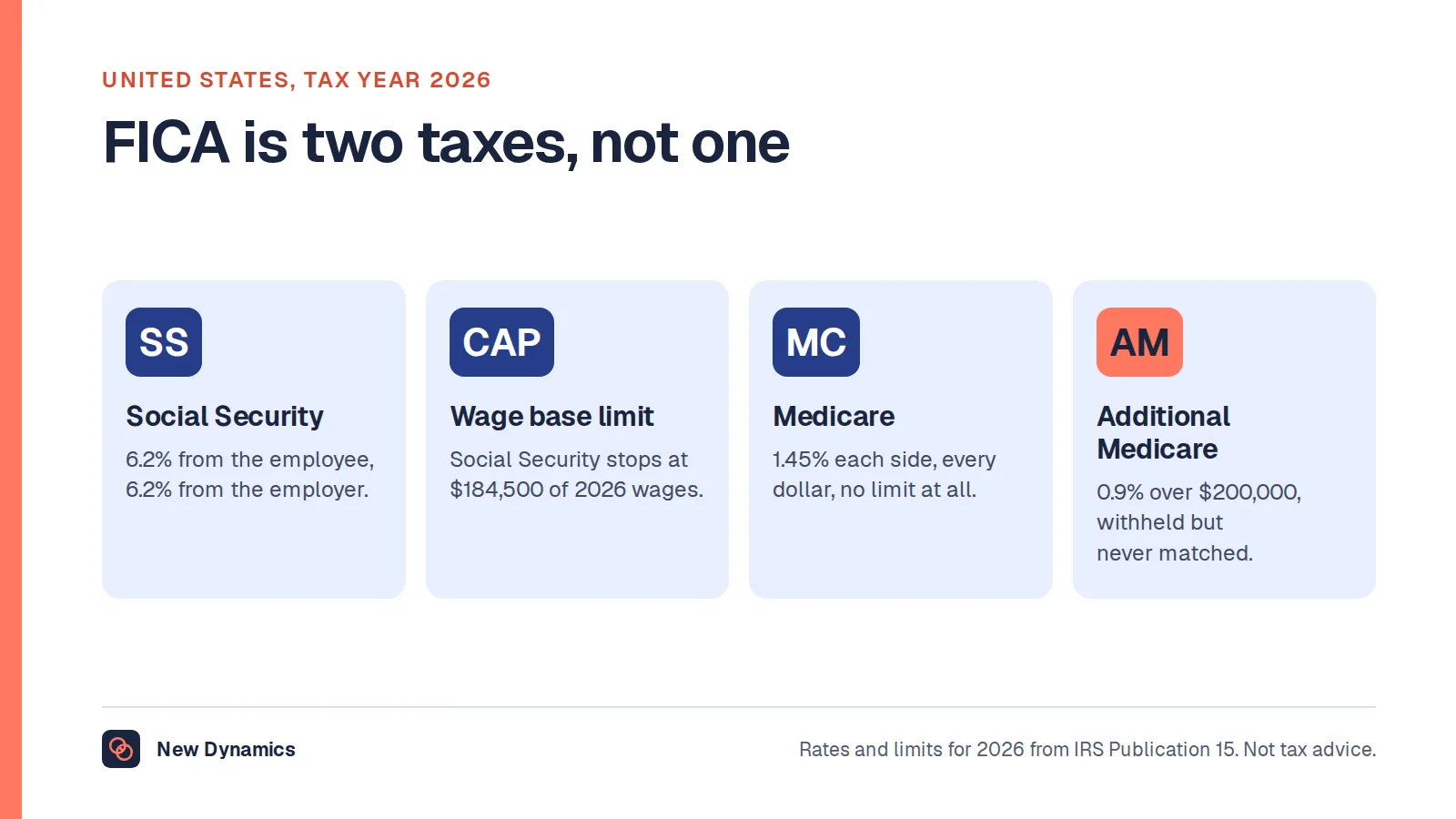
One point gets missed constantly. Estimated tax is not only income tax. Publication 505 says it "is used to pay both income tax and self-employment tax, as well as other taxes and amounts reported on your tax return", and the IRS estimated taxes page adds alternative minimum tax to the list. For a sole proprietor, the self-employment tax half is often the larger number. Our post on how FICA is calculated covers the employed side of those same Social Security and Medicare taxes, and payroll tax against income tax explains why the two sit in separate boxes.
The 2026 form applies the estimated tax rules to US citizens and resident aliens, to residents of Puerto Rico, the US Virgin Islands, Guam, the Northern Mariana Islands and American Samoa, and to nonresident aliens, who use Form 1040-ES (NR) instead.
The answer payroll should give first: file a new Form W-4
Before anybody downloads a voucher, this is the thing worth saying, and the IRS says it under the heading "Who does not have to pay estimated tax" on its estimated taxes page, last reviewed on 25 September 2026:
"If you receive salaries and wages, you can avoid having to pay estimated tax by asking your employer to withhold more tax from your earnings. To do this, file a new Form W-4 with your employer. There is a special line on Form W-4 for you to enter the additional amount you want your employer to withhold."
The 2026 Form 1040-ES itself carries the same advice under the heading "Increase Your Withholding": "If you also receive salaries and wages, you may be able to avoid having to make estimated tax payments on your other income by asking your employer to take more tax out of your earnings. To do this, file a new Form W-4, Employee's Withholding Certificate, with your employer."
Publication 505 names the line. "You can request that an additional amount be withheld from each paycheck by entering the additional amount in Step 4(c) of Form W-4." It also notes that where somebody holds two jobs, or is married filing jointly with a working spouse, the extra amount can go on one job's form or be split between them in any proportion, with a new Form W-4 given to each employer concerned.
So the reply to an employee is short. If the extra income is modest and wages are coming in, a revised Form W-4 with a figure in Step 4(c) replaces the whole 1040-ES exercise, because withholding counts towards the same tests. Both Publication 505 and the form give the Tax Withholding Estimator at IRS.gov/W4App for picking the figure. Payroll's job ends at processing the new form.
Two limits are worth being honest about. There has to be enough wage to take the extra withholding from, and this does nothing for someone with no wage job. For pensions and annuities the equivalent form is W-4P, for certain government payments W-4V, and for nonperiodic payments and eligible rollover distributions W-4R. Exempt status on Form W-4 is a different claim with its own two conditions, covered in our post on tax exemption.
Who must pay: the general rule for 2026
The 2026 Form 1040-ES gives the test as two conditions that both have to apply:
"1. You expect to owe at least $1,000 in tax for 2026, after subtracting your withholding and refundable credits. 2. You expect your withholding and refundable credits to be less than the smaller of: a. 90% of the tax to be shown on your 2026 tax return, or b. 100% of the tax shown on your 2025 tax return. Your 2025 tax return must cover all 12 months."
Both parts matter. Owing $1,000 is not by itself enough to require payments if withholding already clears one of the two percentage tests. Equally, falling short of the percentages does not require payments if the amount left owing is under $1,000.
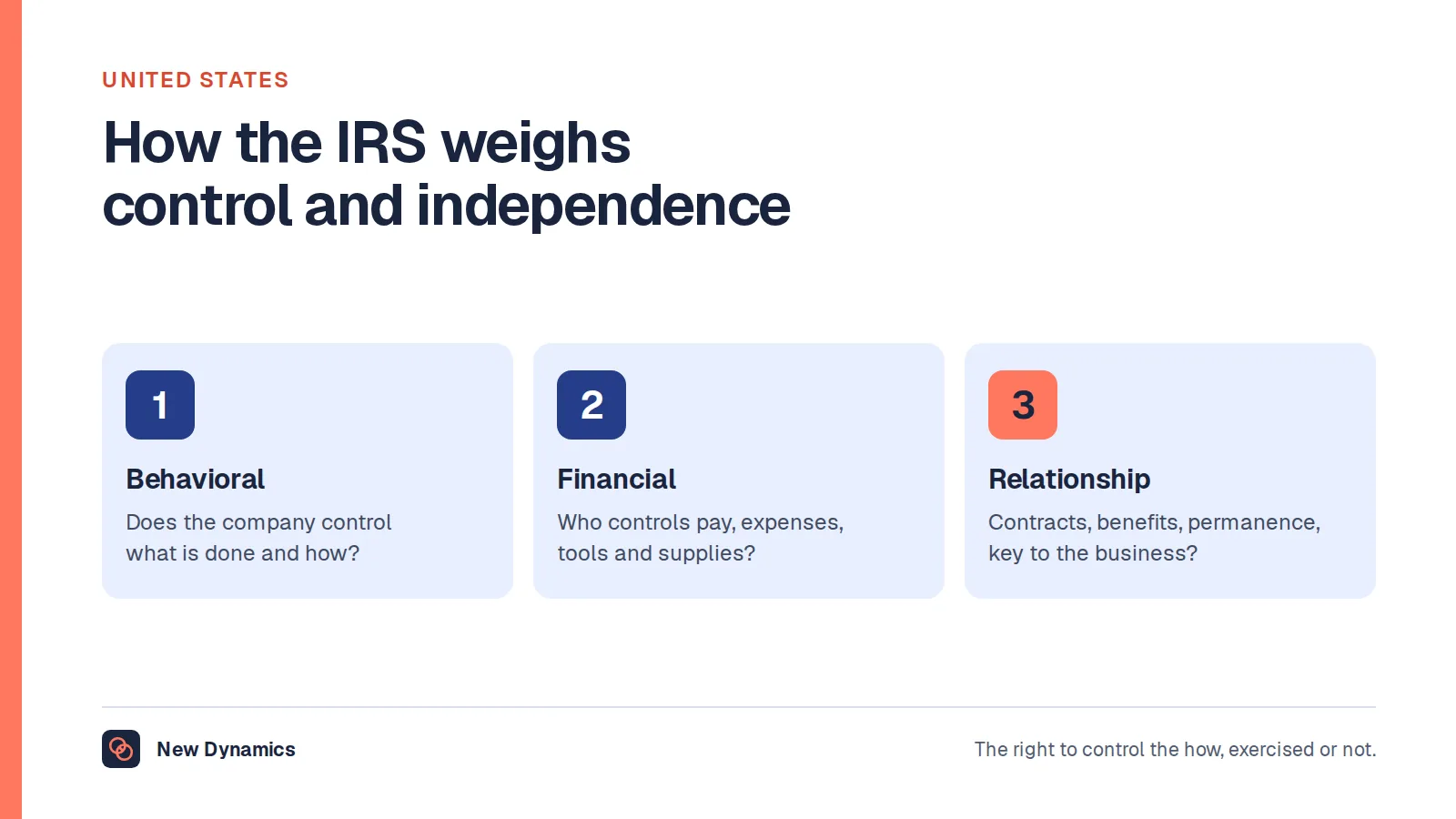
The IRS estimated taxes page states the same threshold in rounder language: "Individuals, including sole proprietors, partners, and S corporation shareholders, generally have to make estimated tax payments if they expect to owe tax of $1,000 or more when their return is filed." Partners and S corporation shareholders are on that list because nothing is withheld from a distribution. The IRS estimated tax FAQ, last reviewed on 16 October 2026, puts it directly: "Because partners aren't employees of the partnership, partnerships don't withhold tax from their distributions to pay the partners' income and self-employment taxes." Someone paid as a contractor rather than an employee is in the same position, which our post on independent contractor status goes into.
There is a clean way out for a first year. The 2026 form: "You don't have to pay estimated tax for 2026 if you were a U.S. citizen or resident alien for all of 2025 and you had no tax liability for the full 12-month 2025 tax year." The FAQ page defines no tax liability as the line labelled total tax on the prior-year Form 1040 being zero, or gross income being below the filing threshold.

The four payment periods, and why they are not quarters
Everyone calls these quarterly payments. The IRS does not, quite. Publication 505 and the estimated taxes page both say that "for estimated tax purposes, the year is divided into four payment periods" and that "each period has a specific payment due date". Four periods, yes. Four quarters, no. Publication 505 for 2026 gives them as:
| Period | General due date | Tax year 2026 due date |
|---|---|---|
| January 1 to March 31 | April 15 | April 15, 2026 |
| April 1 to May 31 | June 15 | June 15, 2026 |
| June 1 to August 31 | September 15 | September 15, 2026 |
| September 1 to December 31 | January 15 of the next year | January 15, 2027 |
Count the months: three, two, three, four. The second period is two months long and the fourth is four, so a calendar quarter and a payment period are not the same span. Anyone budgeting cash on a tidy three-month rhythm will be short in June and flush in January. The IRS penalty page lists the same four pairings, income earned January 1 to March 31 due by April 15 and so on, which confirms that the deadline attaches to the period rather than to a quarter.
The 2026 Form 1040-ES gives the same four dates, and adds that you may simply "pay all of your estimated tax by April 15, 2026, or in four equal amounts by the dates shown below". Paying the lot in April is allowed and is sometimes the least effort.
Those are the dates for tax year 2026, and they move. The rule is given identically on both pages: if a due date "falls on a Saturday, Sunday, or legal holiday, the payment will be on time if you make it on the next day that isn't a Saturday, Sunday or holiday", with Publication 509 named as the list of legal holidays. All four 2026 dates land on weekdays, so none of them shifted this year. Do not carry a date from one year to the next without checking it against the current form.
There is a published way to skip the last payment, and here the two IRS sources differ by one day. Publication 505 for 2026 says: "If you file your 2026 Form 1040 or 1040-SR by January 31, 2027, and pay the rest of the tax you owe, you don't need to make the payment due on January 15, 2027." The 2026 Form 1040-ES, dated 12 February 2026, gives it as February 1, 2027: "You don't have to make the payment due January 15, 2027, if you file your 2026 tax return by February 1, 2027, and pay the entire balance due with your return." January 31, 2027 is a Sunday and February 1 is the next business day, so the form is the publication's date with the weekend rule already applied. The form is the later and more specific document, so treat February 1, 2027 as the outside date, and file earlier if you can.

The safe harbours, including the higher-income percentage
The second condition of the general rule is where the familiar safe harbours come from. Pay in at least 90% of the tax shown on this year's return, or at least 100% of the tax shown on last year's return, and the underpayment penalty does not bite. You get the smaller of the two, which is why the prior-year figure is the one most people aim at: in January it is a known number rather than a guess about December.
The percentage changes above an income line. The 2026 Form 1040-ES, under "Higher income taxpayers": "If your adjusted gross income (AGI) for 2025 was more than $150,000 ($75,000 if your filing status for 2026 is married filing separately), substitute 110% for 100% in (2b) under General Rule, earlier." Publication 505 for 2026 repeats it and works it through: on a 2025 total tax of $42,581, expected 2026 tax of $71,253 and 2025 AGI of $180,000, the required annual payment is $46,839, being 110% of the prior-year tax and smaller than the $64,128 that 90% of the current-year estimate would give.
Take that $150,000 from the current form rather than from memory. The IRS page on the underpayment of estimated tax by individuals penalty, last reviewed on 20 August 2026, still illustrates the same rule using 2023 AGI and a 2024 filing status, so take the rule from that page and the years from the form.
Farmers and fishers get a different percentage. Where at least two-thirds of gross income for 2025 or 2026 comes from farming or fishing, the 2026 form says to substitute 66 and two-thirds per cent for the 90%, and the 110% rule does not apply.
How to pay
The 2026 form puts online payment first, through IRS.gov/ModernPayments, and lists the routes: an IRS online account, IRS Direct Pay for a free transfer from a checking or savings account, debit card, credit card or digital wallet through a provider that charges a fee, electronic funds withdrawal alongside an electronic filing, and the Electronic Federal Tax Payment System, which is free but needs enrolment. There is also a phone route, the IRS2Go app, and a cash option explained at IRS.gov/PayCash. Paper vouchers from the form still work by post, and the postmark date counts as the payment date.
Two details are easy to get wrong. The form states that "payments of U.S. tax must be remitted to the IRS in U.S. dollars" and that "digital assets are not accepted". And the postmark point now carries a caveat in the form's own words: a recent clarification means the postmark "is the date the return is processed at a facility", which "may or may not be the date you drop your payment off in the mailbox". Posting on the due date is no longer a safe habit.
Nothing obliges you to pay exactly four times. The estimated taxes page: "If it's easier to pay your estimated taxes weekly, bi-weekly, monthly, etc. you can, as long as you've paid enough in by the end of the quarter." The form adds that where you make more than four payments, the total paid during a payment period must still be at least the amount that period's due date required.
What happens if you miss one
The penalty is not a flat fee and it is not an all-or-nothing event. The 2026 Form 1040-ES, under "When a Penalty Is Applied": "The penalty is imposed on each underpayment for the number of days it remains unpaid. A penalty may be applied if you didn't pay enough estimated tax for the year or you didn't make the payments on time or in the required amount." The IRS penalty page says it calculates the charge from the amount of the underpayment, the period when it was due and underpaid, and the published quarterly interest rates for underpayments, and that it charges interest on penalties as well.
It can apply even when the year ends in your favour. Publication 505: "If you don't pay enough tax by the due date of each of the payment periods, you may be charged a penalty even if you are due a refund when you file your income tax return." A missed June payment made up in September is still late for the days in between.
The penalty is computed on Form 2210, and the IRS can work it out for you. Relief is narrow but real. The IRS penalty page says it "generally cannot be waived due to reasonable cause", but may be removed or reduced where the underpayment results from a casualty, a local disaster or another unusual circumstance making it unfair to impose, and may be reduced where you or your spouse retired in the past two years after reaching age 62, or became disabled, with reasonable cause for underpaying. Where income arrived unevenly, the annualised income installment method on Form 2210 Schedule AI can cut or remove the charge, and Publication 505 directs anyone whose income changes sharply after 31 March 2026 to that method and to filing Form 2210 with the return even if no penalty is owed.
Where this leaves HR
Nothing in Form 1040-ES is an employer obligation. The form is the individual's, the payment is the individual's, and HR has no filing duty attached to it. What HR has is the one lever that makes the form unnecessary for most of the people asking: a new Form W-4 with an amount in Step 4(c), a five-minute payroll change against four diary dates and a worksheet. Where there is no wage job, or the extra income is too large for withholding to absorb, point the person at the current Form 1040-ES and a tax adviser. Do not calculate anybody's safe harbour for them.
For the wider picture on pay data, our HR statistics hub collects the published figures we cite across the site.
Frequently asked questions
What is Form 1040-ES?
Form 1040-ES is the IRS form individuals use to figure and pay estimated tax. The IRS describes estimated tax as the method used to pay tax on income that is not subject to withholding, such as self-employment earnings, interest, dividends, rents and alimony. The package holds a worksheet and payment vouchers, and it covers self-employment tax as well as income tax.
Who has to pay estimated tax?
The 2026 Form 1040-ES gives two conditions that must both apply. You expect to owe at least $1,000 in tax for 2026 after subtracting withholding and refundable credits, and you expect withholding and refundable credits to be less than the smaller of 90% of the tax on your 2026 return or 100% of the tax on your 2025 return. The IRS names sole proprietors, partners and S corporation shareholders as the people most often caught.
When are estimated tax payments due?
Publication 505 for 2026 gives four payment periods and four due dates: January 1 to March 31 by April 15, 2026, April 1 to May 31 by June 15, 2026, June 1 to August 31 by September 15, 2026, and September 1 to December 31 by January 15, 2027. If a due date falls on a Saturday, Sunday or legal holiday, the next business day counts as on time, so check the dates against the current form each year.
Are estimated tax payments really quarterly?
Not in the ordinary sense. The IRS divides the year into four payment periods, and they run three months, two months, three months and four months. A payment period and a calendar quarter are different spans, which is why the June deadline covers only April and May of income.
Can I avoid Form 1040-ES by changing my withholding?
Usually, if you have wages. The IRS states that if you receive salaries and wages you can avoid having to pay estimated tax by asking your employer to withhold more, and that you do this by filing a new Form W-4 with the additional amount entered on the line provided. Publication 505 identifies that line as Step 4(c). Withholding counts towards the same tests that estimated tax payments do.
What is the 110% rule?
It is the higher prior-year safe harbour for higher earners. The 2026 Form 1040-ES says that if your adjusted gross income for 2025 was more than $150,000, or $75,000 if your 2026 filing status is married filing separately, you substitute 110% for 100% of the prior-year tax. It does not apply if at least two-thirds of your gross income for 2025 or 2026 came from farming or fishing.
What happens if I miss an estimated tax payment?
You may owe the Underpayment of Estimated Tax by Individuals Penalty. The IRS imposes it on each underpayment for the number of days it remains unpaid, using the published quarterly interest rates for underpayments, and it can apply even if you are due a refund when you file. Form 2210 works out the amount.
Do I have to make the January payment?
Not if you file and pay early enough. Publication 505 for 2026 says you do not need the January 15, 2027 payment if you file your 2026 return by January 31, 2027 and pay the rest of the tax owed. The 2026 Form 1040-ES gives the date as February 1, 2027, which is the next business day after a Sunday. Treat February 1, 2027 as the outside date.
Your next step: sort the wage earners from the rest
- Write one internal answer to the estimated tax question and put a named owner on it, so the same query is not answered three ways.
- In that answer, lead with the Form W-4 route. Link the Tax Withholding Estimator at IRS.gov/W4App and the current blank Form W-4, and say that extra withholding goes in Step 4(c).
- State plainly that Form 1040-ES is the individual's own form, that payroll does not file it, and that your team does not calculate anybody's estimated tax.
- Diary the four current-year due dates once, taken from the current Form 1040-ES rather than from last year's note, and reissue them each January.
For setting pay in a way you can explain to the people it applies to, read and download our compensation policy guide. The guide is free to read, and the PDF uses our short download form.
Want payroll questions to land with the person who owns them, with the answer recorded once? Book a New Dynamics demo and bring the three queries your team answers most. You can also email contact@new-dynamics.com.