TL;DR
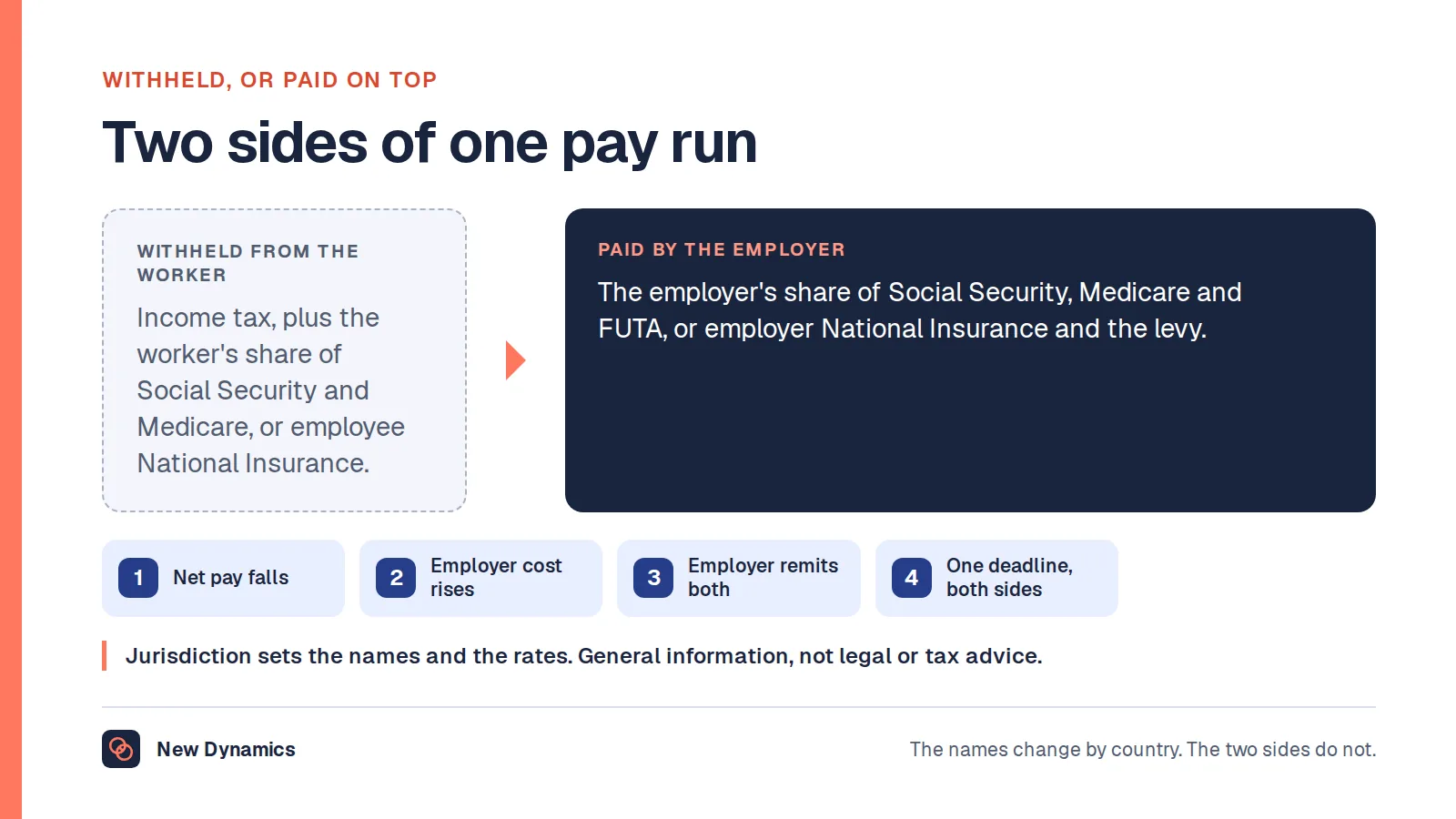
- FICA is two separate taxes with different rules. The IRS gives Social Security as 6.2% from the employer and 6.2% from the employee, and Medicare as 1.45% each side. Added together that is the familiar 7.65% withheld, matched by 7.65% the employer pays from its own funds.
- Only one of the two is capped. Publication 15 for 2026 states that the social security wage base limit is $184,500 and that there is no wage base limit for Medicare tax. The Social Security Administration has already published the 2027 base as $192,300, so a calculation has to name its year.
- Above $200,000 of wages the two sides stop matching. The employer withholds a further 0.9% Additional Medicare Tax from the employee, and the IRS is explicit that there is no employer share of Additional Medicare Tax.
Everything in this article is about the United States federal payroll taxes, and about nothing else. FICA has no British equivalent, and a reader arriving from a National Insurance question will find none of these rules transfer. The rates, the caps and the forms below come from the IRS and the Social Security Administration, with the tax year named every time a figure appears.
The question "how is FICA calculated" usually arrives because two numbers on a payslip do not agree, or because someone is pricing a hire and wants to know what the employer adds on top. Both answers are arithmetic. It feels harder than arithmetic because FICA is not one tax. It is two taxes with two different rates, one of which stops partway up the pay scale and one of which does not, plus a third rate charged to only one of the two parties.
Payroll figures go wrong when a step has no owner, not usually when someone cannot multiply. See how New Dynamics workflows make each step's owner and due date explicit.
New Dynamics does not run payroll and does not give tax advice. What follows is general information quoted from the publisher that sets each figure, with its tax year named. Check the rules for the year you are paying in and take advice on your own position.
What FICA is, and why it is two taxes rather than one
A nonresident alien claiming a tax treaty exemption uses a different form, and the employer carries the liability for getting it wrong: see Form 8233.
FICA stands for the Federal Insurance Contributions Act. IRS Topic no. 751, reviewed on 24 September 2026, defines the scope in one sentence: "Taxes under the Federal Insurance Contributions Act (FICA) are composed of the old-age, survivors, and disability insurance taxes, also known as Social Security taxes, and the hospital insurance taxes, also known as Medicare taxes. Different rates apply for these taxes."
Those last four words are the whole difficulty. People say "FICA" as though it were a single 7.65% deduction. It is two line items that happen to be withheld together, and the moment a salary is large enough they behave completely differently. Publication 15 (2026), (Circular E), Employer's Tax Guide, the primary source for American employers and last reviewed on 30 April 2026, says it plainly: "Social security and Medicare taxes have different rates and only the social security tax has a wage base limit."
Publication 15 also gives the method, and it is as simple as it sounds: "Determine the amount of withholding for social security and Medicare taxes by multiplying each payment by the employee tax rate." Each payment, not the annual salary. That detail matters later.

The FICA rates, and the tax year each one applies to
For wages paid in 2026, Publication 15 states: "the social security tax rate is 6.2% (amount withheld) each for the employer and employee (12.4% total). The social security wage base limit is $184,500. The tax rate for Medicare is 1.45% (amount withheld) each for the employee and employer (2.9% total). There is no wage base limit for Medicare tax; all covered wages are subject to Medicare tax."
So the employee's side is 6.2% plus 1.45%, which is 7.65%, and the employer pays the same 7.65% from its own money. The statutory rates have not moved for years. Publication 15's table of the three prior years gives the combined rate as 12.4% for Social Security and 2.9% for Medicare in 2025, 2024 and 2023 as well. It is the cap, not the rate, that changes annually.
The Social Security wage base limit, and why it must carry a year
The wage base limit is the only part of FICA that moves, and it is the part most often quoted out of date. Publication 15 for 2026 puts it at $184,500, and Topic no. 751 agrees: "For earnings in 2026, this base limit is $184,500."
The Social Security Administration publishes the same figure under its own name. Its Contribution and Benefit Base page explains where it comes from: the OASDI programme "limits the amount of earnings subject to taxation for a given year", that limit "changes each year with changes in the national average wage index", and it is "also commonly referred to as the taxable maximum".
Two things follow for anyone doing a calculation today.
The 2027 base is already published. The same SSA page states: "For earnings in 2027, this base is $192,300", and does the top-end arithmetic: "an individual with wages equal to or larger than $192,300 would contribute $11,922.60 to the OASDI program in 2027, and his or her employer would contribute the same amount." If you are modelling next year's employer cost, that is the figure, not the one in Publication 15 for 2026.
Older bases are not interchangeable. SSA's table of bases and Publication 15's table of prior years both give $176,100 for 2025, $168,600 for 2024 and $160,200 for 2023. A spreadsheet carrying last year's cap understates Social Security tax for every employee above it, and nothing in the pay run flags the error.
For 2026, the most Social Security tax one employee can pay is $184,500 times 6.2%, which is $11,439.00, matched by the employer. Past that point the Social Security line on the payslip stops for the rest of the calendar year.
Medicare has no cap, and then there is a surcharge the employer does not match
Medicare is the easier of the two to calculate and the easier of the two to get wrong on the employer's side. Topic no. 751 states: "There's no wage base limit for Medicare tax. All covered wages are subject to Medicare tax." Both sides pay 1.45% on every dollar, in every pay period, however large the salary.
Above a threshold a third rate appears. Publication 15 for 2026: "In addition to withholding Medicare tax at 1.45%, you must withhold a 0.9% Additional Medicare Tax from wages you pay to an employee in excess of $200,000 in a calendar year." The asymmetry is in the next sentence: "Additional Medicare Tax is only imposed on the employee. There is no employer share of Additional Medicare Tax."
Two practical points, both from the IRS, make this the part that catches payroll teams out.
The employer ignores filing status. The IRS questions and answers for the Additional Medicare Tax, reviewed on 25 October 2026, sets the individual's own thresholds by filing status: $250,000 married filing jointly, $125,000 married filing separately, and $200,000 for single, head of household and qualifying widow or widower with a dependent child. The employer, though, withholds on wages over $200,000 "without regard to the individual's filing status or wages paid by another employer", so withholding and final liability can differ. The individual settles the difference on Form 8959 with their return.
Withholding starts mid-year and then continues. Publication 15: "You're required to begin withholding Additional Medicare Tax in the pay period in which you pay wages in excess of $200,000 to an employee and continue to withhold it each pay period until the end of the calendar year." Asked whether the employer must tell the employee, the IRS answer is: "No. There is no requirement that an employer notify its employee." That is exactly the month in which somebody asks why their net pay fell.

A worked example for 2026 you can check by hand
Take an employee on $240,000 for the calendar year 2026, paid monthly, so $20,000 each month, with all of it subject to both FICA taxes. The figures are a worked example rather than anybody's actual pay, and they use the 2026 rates and limits quoted above.
Social Security, employee side. Cumulative wages reach $180,000 after nine months, so months one to nine are fully taxable: $20,000 times 6.2% is $1,240.00 a month, or $11,160.00. In month ten, only the slice of pay that brings the running total to $184,500 is taxable, which is $4,500, giving $279.00. Months eleven and twelve attract nothing. The total is $11,439.00, which is the cap times 6.2%, as it has to be.
Medicare, employee side. No cap, so 1.45% applies to all twelve payments: $20,000 times 1.45% is $290.00 a month, or $3,480.00 for the year.
Additional Medicare Tax, employee only. Cumulative wages pass $200,000 at the end of month ten, so months eleven and twelve carry the extra 0.9%: $20,000 times 0.9% is $180.00 a month, or $360.00. Checked against the year as a whole, $240,000 less $200,000 is $40,000, and 0.9% of that is the same $360.00.
The employee's FICA for the year is $11,439.00 plus $3,480.00 plus $360.00, which is $15,279.00.
The employer's FICA for the year mirrors the first two lines and stops there: $11,439.00 plus $3,480.00, which is $14,919.00. The employer does not match the $360.00.
Combined, the pay run sends $30,198.00 to the IRS in FICA on this one employee, of which the employer funds $14,919.00 out of its own pocket on top of the salary.
Two sanity checks are worth keeping. First, the two sides should differ by exactly the Additional Medicare Tax and nothing else. Second, below every limit the whole thing collapses to one multiplication: on a $52,000 salary paid biweekly, each $2,000 payment carries $124.00 of Social Security tax and $29.00 of Medicare tax, so $153.00 a period and $3,978.00 for the year, with the employer paying $3,978.00 as well.

What counts as FICA wages, and what does not
The rates are the easy half. The harder half is deciding what to multiply them by, because gross pay and FICA wages are not always the same figure. Publication 15 says that "Certain types of wages and compensation aren't subject to social security and Medicare taxes", and its section 15 sets out a long table of special rules by type of service and payment. Household workers, for instance, are inside the taxes only once you pay them "$3,000 or more in cash wages in 2026", and election workers only at "$2,500 or more in cash or an equivalent form of compensation in 2026".
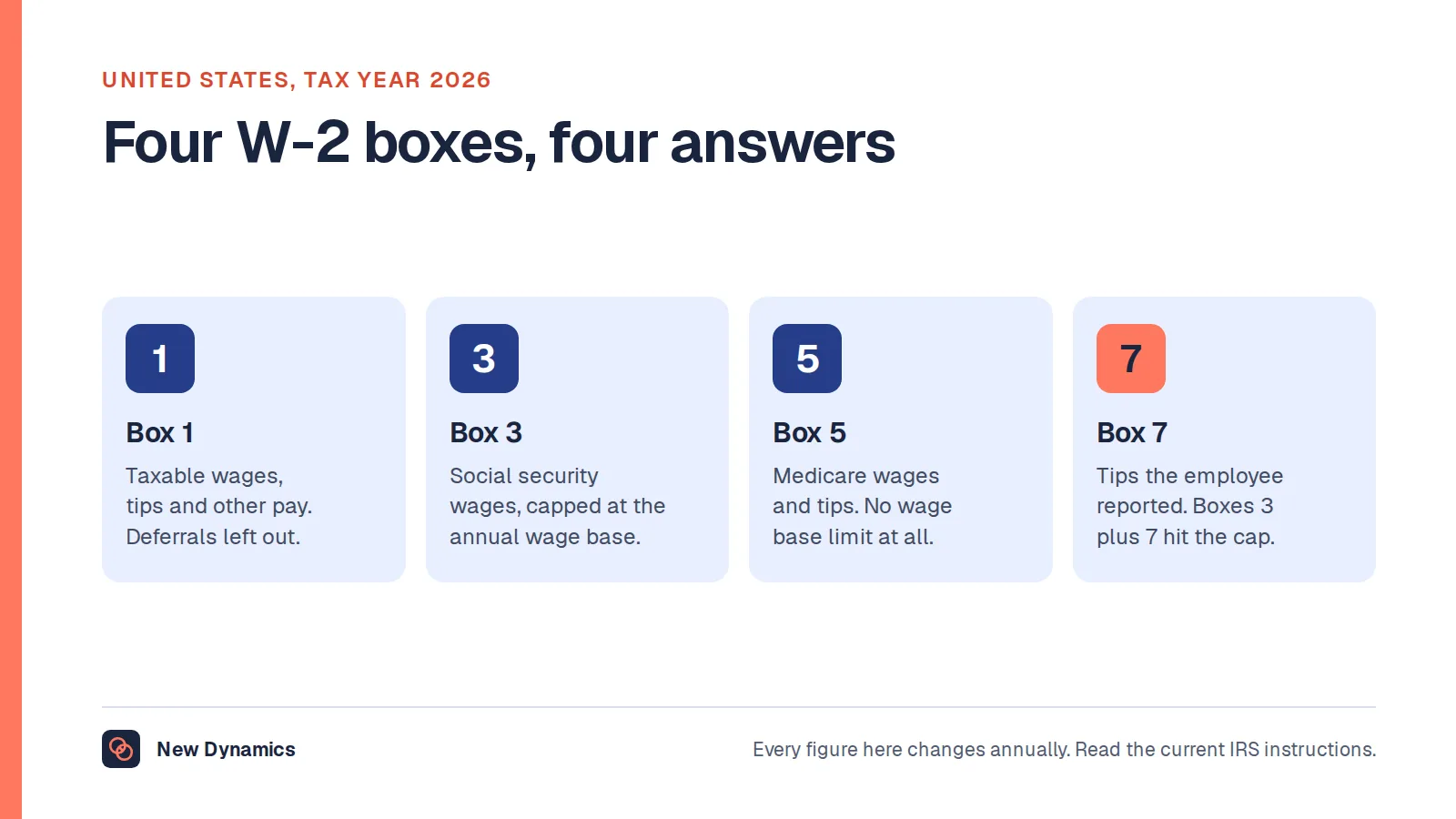
Two points matter before you reconcile anything. Pre-tax retirement deferrals generally leave the employee's taxable income for income tax but stay in the FICA wage base, which is why box 1 and boxes 3 and 5 of a Form W-2 so often disagree. And misclassification is expensive: Publication 15 warns that "You'll generally be liable for social security and Medicare taxes and withheld income tax if you don't deduct and withhold these taxes because you treated an employee as a nonemployee."
Self-employment and SECA: both halves, one person
A self-employed person pays the same two taxes under a different statute, and pays both halves. The IRS page on self-employment tax, reviewed on 30 October 2026, states: "The self-employment tax rate is 15.3%. The rate consists of two parts: 12.4% for social security (old-age, survivors, and disability insurance) and 2.9% for Medicare (hospital insurance)."
Those are the FICA employer and employee shares added together, and the same cap applies. For 2026 the page says that "the first $184,500 of your combined wages, tips, and net earnings is subject to any combination of the social security part of self-employment tax, social security tax, or railroad retirement (tier 1) tax". The Instructions for Schedule SE for 2026 give the same ceiling: "For 2026, the maximum amount of self-employment income subject to social security tax is $184,500." Medicare has no ceiling here either, and the 0.9% applies above the filing-status thresholds.
Three differences from employment are worth naming. The tax is figured by the taxpayer on Schedule SE rather than by a payroll system, and Schedule SE applies its own adjustment to net earnings before the rates bite, so the 15.3% is not applied to profit as reported. Filing is required once "Your net earnings from self-employment (excluding church employee income) were $400 or more", or church employee income was "$108.28 or more". And there is one compensation: "you can deduct the employer-equivalent portion of your SE tax when calculating your adjusted gross income. Wage earners cannot deduct Social Security and Medicare taxes." So the gross cost roughly doubles on a move from salary to self-employment, partly offset by that deduction against income tax.
Why the quarterly return never ties to the cent
One last thing worries people reconciling payroll for the first time, and should not. Because the tax is figured on each payment and rounded each time, the quarterly total will not match the arithmetic on the quarterly wage figure exactly. Publication 15 names the effect: "The IRS refers to rounding differences relating to employee withholding of social security and Medicare taxes as 'fractions-of-cents' adjustments."
Its test is a useful close for any FICA calculation. For 2026, multiply the quarter's wages and tips subject to Social Security tax by 6.2% (0.062), those subject to Medicare tax by 1.45% (0.0145), and those subject to Additional Medicare Tax by 0.9% (0.009), then compare the result with what your payroll records actually withheld. A small difference is a fractions-of-cents adjustment and goes on the return. A large one is a bug, and the usual culprits are a stale wage base or a cap applied to the calendar year instead of to the employee's cumulative wages with that employer.
Frequently asked questions
How is FICA calculated?
Multiply each wage payment by each rate separately, in the United States. For 2026 the IRS gives Social Security as 6.2% on the employee's wages until their cumulative wages for the year reach $184,500, and Medicare as 1.45% on every dollar with no limit, so 7.65% while the employee is below the cap. The employer calculates the same 6.2% and 1.45% again from its own funds. Publication 15 for 2026 says to "Determine the amount of withholding for social security and Medicare taxes by multiplying each payment by the employee tax rate."
What is the FICA rate for 2026?
Publication 15 (2026) gives the rate as 6.2% each for employer and employee for Social Security, which is 12.4% in total, and 1.45% each for Medicare, which is 2.9% in total. The employee therefore sees 7.65% withheld and the employer pays 7.65% on top. These statutory rates were the same in 2025, 2024 and 2023. The figure that changes each year is the Social Security wage base limit, not the percentage.
Is there a limit on FICA tax?
Only on the Social Security half. Topic no. 751 states that "Only the Social Security tax has a wage base limit" and that "For earnings in 2026, this base limit is $184,500", while "There's no wage base limit for Medicare tax." The Social Security Administration has published the 2027 base as $192,300. So the maximum Social Security tax for one employee in 2026 is $11,439.00 on each side, and Medicare keeps running at 1.45% on every dollar above it.
Does the employer match the Additional Medicare Tax?
No, and this is the one place the two sides stop being equal. Publication 15 for 2026 is explicit that "Additional Medicare Tax is only imposed on the employee. There is no employer share of Additional Medicare Tax." The employer still has to withhold it, at 0.9% on wages over $200,000 in the calendar year, starting in the pay period that crosses the threshold and continuing to the end of the year.
Why was Additional Medicare Tax withheld when my income is under the threshold?
Because the employer applies a single $200,000 test and ignores your circumstances. The IRS says withholding applies "without regard to the individual's filing status or wages paid by another employer". A married couple filing jointly has a $250,000 threshold, so one spouse earning $220,000 can have the tax withheld and not ultimately owe all of it. The individual reconciles withholding against actual liability on Form 8959 with their return.
How is self-employment tax different from FICA?
Same two taxes, both halves, one person. The IRS puts the self-employment tax rate at 15.3%, made up of "12.4% for social security" and "2.9% for Medicare", against the same $184,500 Social Security ceiling for 2026. It is figured on Schedule SE rather than withheld by an employer, filing is required once net earnings from self-employment reach $400, and the employer-equivalent portion is deductible in figuring adjusted gross income, which is not available to wage earners.
Your next step: pin the year, then check the two sides separately
Jurisdiction: United States, federal. General information, not legal or tax advice.
- Write the tax year next to every rate and cap in your own documents. The rates are stable and the cap is not. A FICA note without a year is the single most common cause of a wrong payroll figure.
- Confirm the wage base against the publisher before each January. Publication 15 for the coming year and the SSA contribution and benefit base page both carry it. For 2027 that is $192,300.
- Test the cap on cumulative wages with you, not on the calendar. A mid-year joiner's earlier wages from another employer do not count towards your Social Security cap, and the IRS treats a successor employer after a qualifying acquisition differently again.
- Reconcile the employee and employer totals against each other. They should differ by the Additional Medicare Tax and by nothing else. Any other gap is worth tracing before the quarterly return.
- Keep the United States rules and any other country's rules in separate documents. If you also pay people in the United Kingdom, read payroll tax against income tax for how the two systems fail to map onto one another.
For the wider picture on pay data, our HR statistics hub collects the published figures we cite across the site. For a way of setting pay that you can explain to the person affected, read and download our compensation policy guide. The guide is free to read, and the PDF uses our short download form.
Want every payroll and year end task to have an owner, a due date and a visible status rather than a reminder in someone's inbox? Book a New Dynamics demo and bring your payroll calendar. You can also email contact@new-dynamics.com.