TL;DR
- The United Kingdom mostly does not use the word. HMRC gives you allowances instead: GOV.UK states that the standard Personal Allowance is £12,570 for the tax year from 6 April 2026 to 5 April 2027, and that an employer applies £242 per week or £1,048 per month.
- Where GOV.UK does say exemption, it usually means something narrow. In the expenses and benefits rules it means you do not have to report a routine expense, and it replaced dispensations entirely.
- In the United States the personal exemption is zero, allowances have been removed from Form W-4, and exempt status from withholding is a separate claim with two conditions on the 2026 form. Tax-exempt organisations under section 501(c)(3) are a fourth, unrelated thing.
"What is a tax exemption" looks like a definition question with one answer. It is not. The word carries at least four unrelated meanings, two British and two American, and which one you need depends on whose form is in front of you.
New starter paperwork is where this bites, because the forms are country-specific and the words are not. See how New Dynamics onboarding gives every new joiner's paperwork step an owner and a due date, so nothing is signed on a guess.
New Dynamics does not run payroll and does not give tax or legal advice. Everything below is general information, quoted from the authority that publishes it, with the tax year named next to the figure. Check the rules for the country and year you are paying in, and take advice on your own position.
Jurisdiction and the four meanings
If the answer is that too little is being withheld rather than that anything is exempt, the form to look at is Form 1040-ES.
Jurisdiction: United Kingdom and United States. General information, not tax or legal advice.
Before any figures, separate the senses.
- A tax-free amount of income (United Kingdom). The Personal Allowance, the trading allowance, the property allowance. GOV.UK calls two of these an exemption and the rest an allowance.
- An exemption from reporting (United Kingdom). GOV.UK's own term for the narrow employer rules that remove the duty to report routine expenses and benefits to HMRC. They replaced dispensations.
- Exempt status from federal income tax withholding (United States). A claim an employee makes on Form W-4 that stops income tax coming out of their pay. It is not a deduction and not forgiveness of tax.
- A tax-exempt organisation (United States). An entity recognised under section 501(c)(3) of the Internal Revenue Code. Nothing to do with an individual's pay.
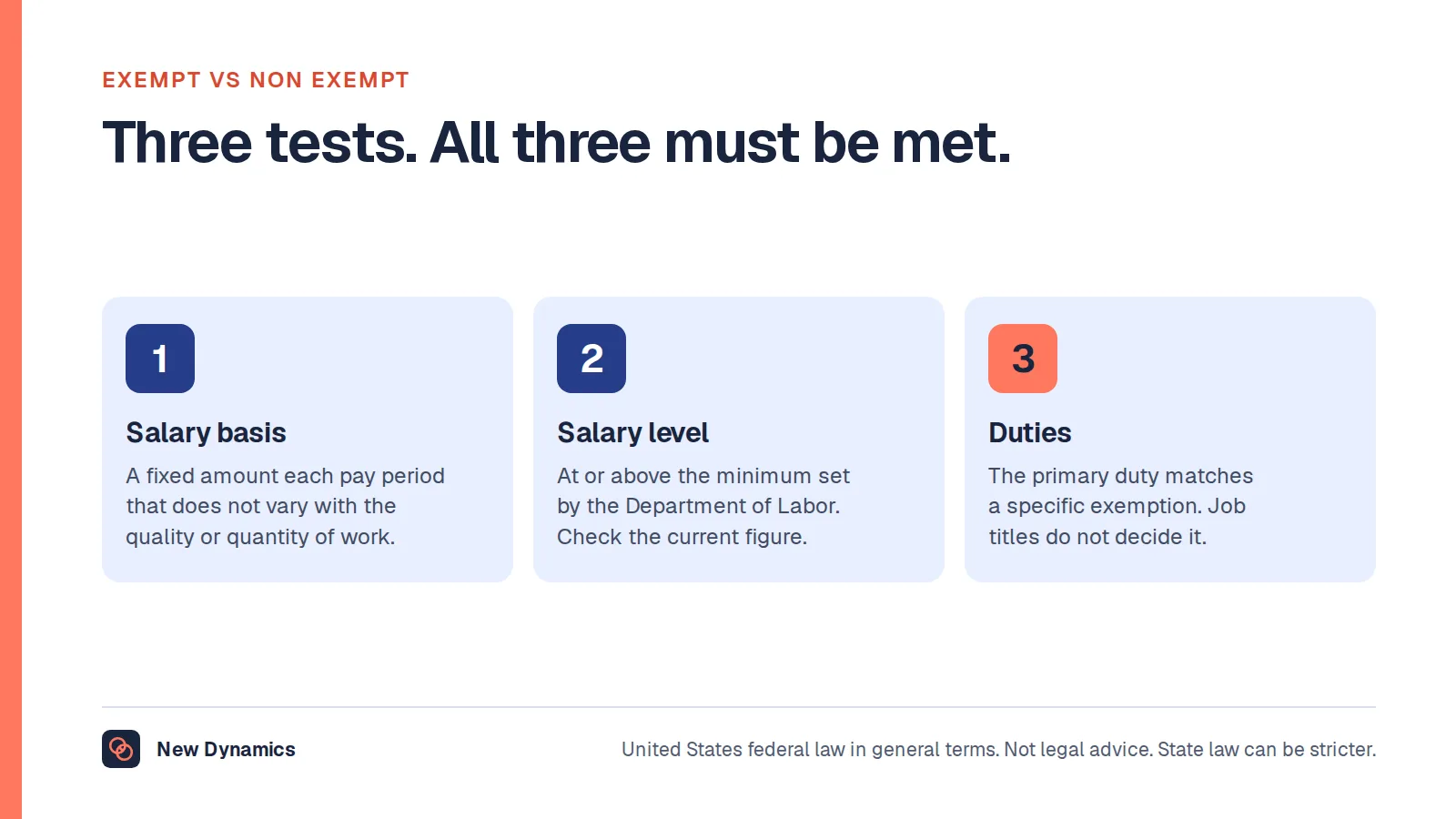
There is a fifth use of the word, and it is not about tax at all. In the United States, "exempt" also describes an employee who is not entitled to overtime under the Fair Labor Standards Act. That is a wage and hour classification with completely different tests. If that is what you came for, read our post on exempt vs non-exempt employees instead. Nothing in this article applies to it.

United Kingdom: allowances, not exemptions
British tax law gives you an amount you can have before tax starts, rather than an exemption you claim. GOV.UK's page on Income Tax rates and Personal Allowances states that "The current tax year is from 6 April 2026 to 5 April 2027" and that "The standard Personal Allowance is £12,570, which is the amount of income you do not have to pay tax on."
Three things follow from that wording.
It is automatic. Nobody claims it on a form each year. GOV.UK's guide to tax codes explains the mechanism: "Your tax code is used by your employer or pension provider to work out how much Income Tax to take from your pay or pension. HM Revenue and Customs (HMRC) will tell them which code to use." That is the structural difference from the American system. In the United Kingdom, HMRC tells the employer.
It is not the same for everyone. GOV.UK states that if you earn more than £100,000, "Your personal allowance goes down by £1 for every £2 that your adjusted net income is above £100,000. This means your allowance is zero if your income is £125,140 or above."
It is a payroll figure too. HMRC's rates and thresholds for employers 2026 to 2027 gives the standard employee personal allowance for the 2026 to 2027 tax year as £242 per week, £1,048 per month and £12,570 per year, in England and Northern Ireland, Scotland and Wales alike. The bands above it differ: that page gives Scotland a starter rate of 19% and a top rate of 48%, where England and Northern Ireland run from 20% to 45%. Allowances and thresholds are set for each tax year, so check the current page rather than carrying a figure forward.
The two allowances GOV.UK calls exemptions
Here the vocabulary shifts. HMRC's guidance on tax-free allowances on property and trading income says that "You can get up to £1,000 each tax year in tax-free allowances for property or trading income from 6 April 2017. If you have both types of income, you'll get a £1,000 allowance for each." It then uses the stronger word twice: "The trading allowance is a tax exemption of up to £1,000 a year for individuals with trading income", and "The property allowance is a tax exemption of up to £1,000 a year for individuals with income from land or property."
The page describes two kinds of relief. If gross income is £1,000 or less, you generally do not have to tell HMRC, which it calls "full relief". If it is more, you may deduct up to £1,000 instead of your actual expenses, which it calls "partial relief". You cannot do both, and the page notes that "If your expenses are more than your income it may be beneficial to claim expenses instead of the allowances."
Exempt income
Some income is simply outside Income Tax. GOV.UK's guide to Individual Savings Accounts states that "You do not pay tax on: interest on cash in an ISA" or on "income or capital gains from investments in an ISA", and adds that "If you complete a tax return, you do not need to declare any ISA interest, income or capital gains on it." The amount is capped by tax year: GOV.UK states that "In the 2026 to 2027 tax year, the maximum you can save in ISAs is £20,000."
Certain state benefits are also tax-free. GOV.UK lists Personal Independence Payment, Attendance Allowance, Disability Living Allowance, Universal Credit, Housing Benefit, Maternity Allowance and Pension Credit among "The most common state benefits you do not have to pay Income Tax on", while naming the State Pension, Carer's Allowance, Jobseeker's Allowance and contribution-based Employment and Support Allowance among the taxable ones.

United Kingdom: the one place HMRC really does mean "exemption"
If a British payroll or HR team says "we have an exemption", this is almost always what they mean, and GOV.UK frames it as a reporting rule rather than as relief an employee claims.
GOV.UK's page on exemptions and dispensations opens with the definition: "You do not have to report some routine employee expenses to HM Revenue and Customs (HMRC). This is called an 'exemption'." It then closes off the old route: "Exemptions have replaced dispensations. You cannot apply for a dispensation any more."
The page names two qualifying conditions, and they are alternatives rather than a pair you must both meet: "To qualify for an exemption, you must be either: paying a flat rate to your employee as part of their earnings - this must be either a benchmark rate or a special ('bespoke') rate approved by HMRC; paying back the employee's actual costs."
Three details on that page catch employers out.
The scope is limited. It covers "certain business expenses and benefits like: business travel, phone bills, business entertainment expenses, uniform and tools for work", and the page is blunt about the rest: "You must deduct and pay tax and National Insurance on all other expenses and benefits you give to your employees. Report them to HMRC as normal."
You usually do not apply. GOV.UK states that "You do not need to apply for an exemption if you're paying HMRC's benchmark rates for allowable expenses" and that "You only need to apply for an exemption if you want to pay bespoke rates to your employees."
A checking system is a condition of use. "You must have a system in place to check payments you make at benchmark or bespoke rates", and "Your employees cannot check their own expenses." One approver signing off their own travel claim fails that test.
United States: three different questions, often asked as one
American searches for "exemption on taxes" are usually one of three questions, and they have drifted apart.
The personal and dependency exemption is zero
Most older explanations get this wrong. The IRS release on inflation adjustments for tax year 2025 lists it under "Unchanged for tax year 2025" and states that "Personal exemptions for tax year 2025 remain at 0, as in tax year 2024. The elimination of the personal exemption was a provision in the Tax Cuts and Jobs Act of 2017."
The IRS's own frequently asked questions on the redesigned Form W-4, last reviewed on 14 September 2026, put it in the present tense: "Due to changes in law, currently you cannot claim personal exemptions or dependency exemptions." Revenue Procedure 2025-32, which sets the inflation-adjusted items for 2026, publishes no personal exemption amount at all. What it publishes instead, for taxable years beginning in 2026, is a standard deduction of $16,100 for unmarried individuals, $24,150 for heads of households and $32,200 for married individuals filing joint returns. That is the figure now doing the work the personal exemption used to do, so "how many exemptions should I claim" has no answer on a current form. There is nowhere to put the number.
Withholding allowances are gone from Form W-4
The second question is really about how much tax comes out of each paycheck. The IRS answers it directly: "What happened to withholding allowances? Allowances are no longer used for the redesigned Form W-4. This change is meant to increase transparency, simplicity, and accuracy of the form. In the past, the value of a withholding allowance was tied to the amount of the personal exemption."
The current form asks for other things instead: filing status, a step for multiple jobs or a working spouse, a step for dependents and credits, and a step for other income, deductions and extra withholding. The IRS adds on its tax withholding page that "You must specify a filing status on the Form W-4 and complete other parts of the form if you expect to have additional income, deductions beyond the standard deduction, or tax credits. You cannot specify only a dollar amount for your employer to withhold."
For anyone running onboarding, the IRS also states that "New employees first paid after 2019 who fail to furnish a Form W-4 will be treated as a single filer with no other adjustments." A missing form is not a neutral outcome.
One inconsistency is worth flagging, because it sends readers down the wrong path. The 2026 form is titled "Employee's Withholding Certificate", but the IRS tax withholding page, last reviewed on 20 July 2026, still lists it in its resources under the pre-2020 title "Form W-4, Employee's Withholding Allowance Certificate". The form governs. If a payroll instruction still says allowance certificate, it is describing a form that no longer exists in that shape.
Exempt from withholding is a separate claim with two conditions
This one still exists, and it is narrow. The 2026 Form W-4 carries an "Exempt from withholding" section with a certification: "I claim exemption from withholding for 2026, and I certify that I meet both of the conditions for exemption for 2026." Page 2 of Form W-4 sets out those conditions: "You may claim exemption from withholding for 2026 if you meet both of the following conditions: you had no federal income tax liability in 2025 and you expect to have no federal income tax liability in 2026."
The form tests the first condition against the return: "You had no federal income tax liability in 2025 if (1) your total tax on line 24 on your 2025 Form 1040 or 1040-SR is zero (or less than the sum of lines 27a, 28, 29, and 30), or (2) you were not required to file a return because your income was below the filing threshold for your correct filing status." It then warns: "If you claim exemption, you will have no income tax withheld from your paycheck and may owe taxes and penalties when you file your 2026 tax return."
It also expires. An employee claiming exempt status completes only Steps 1(a), 1(b) and 5, and the form states: "You will need to submit a new Form W-4 by February 16, 2027." That date is a diary item for payroll, not for the employee alone.
Tax-exempt organisations under section 501(c)(3)
The fourth meaning is about entities, not people. The IRS page on exemption requirements for 501(c)(3) organizations states that "To be tax-exempt under section 501(c)(3) of the Internal Revenue Code, an organization must be organized and operated exclusively for exempt purposes set forth in section 501(c)(3), and none of its earnings may inure to any private shareholder or individual." The same page adds that it "may not attempt to influence legislation as a substantial part of its activities and it may not participate in any campaign activity for or against political candidates". The IRS lists the qualifying purposes as "charitable, religious, educational, scientific, literary, testing for public safety, fostering national or international amateur sports competition, and preventing cruelty to children or animals".
Being a 501(c)(3) employer does not make your employees exempt from anything. It does not remove income tax withholding from their pay and it does not change their overtime status.

What this means for an HR or payroll team
Write the rule twice, once per country, and name the sense of the word each time. A policy line saying "exempt employees do not have tax deducted" is wrong in both countries at once: it borrows the American overtime sense of exempt and attaches it to a tax outcome that needs a separate certification.
Put the jurisdiction in the heading of any pay or tax document, not in a footnote. Name the tax year next to every figure, because the United Kingdom runs 6 April to 5 April, the United States runs on the calendar year, and the two never line up. Then diary the renewals: the American exempt-from-withholding claim has a hard expiry date on the form, and the British benchmark and bespoke rates need a checking system that someone owns.
For the policy structure behind this, read and download our compensation policy guide. The guide is free to read, and the PDF uses our short download form. For what else comes out of gross pay in each country, see our posts on payroll tax vs income tax and pay stub deductions.
Frequently asked questions
What is a tax exemption?
It depends on the country. In the United Kingdom, GOV.UK uses the word for a tax-free allowance such as the trading allowance, and also for a narrow employer rule that removes the duty to report routine expenses and benefits to HMRC. In the United States it usually means either exempt status from federal income tax withholding, claimed on Form W-4, or an organisation recognised as tax-exempt under section 501(c)(3).
What is an exemption on taxes in the United States?
On a current Form W-4 there is no line for a number of exemptions. The IRS states that allowances are no longer used for the redesigned form, and that you cannot currently claim personal exemptions or dependency exemptions. The only exemption left is exempt status from withholding, which is a yes or no certification rather than a count.
Does the United Kingdom have a tax exemption like the American one?
Not in the same shape. The United Kingdom gives a Personal Allowance instead, which GOV.UK puts at a standard £12,570 for the tax year from 6 April 2026 to 5 April 2027, and HMRC tells the employer which tax code to apply. No British form asks an employee to claim a number of exemptions.
How do I claim exempt from withholding?
The 2026 Form W-4 says you may claim exemption from withholding for 2026 if you meet both conditions: you had no federal income tax liability in 2025 and you expect to have none in 2026. You certify this by checking the box in the Exempt from withholding section, complete Steps 1(a), 1(b) and 5 only, and the form states you will need to submit a new Form W-4 by 16 February 2027.
Is exempt income the same as a tax exemption?
They overlap but are not identical. Exempt income is income the law does not tax at all, such as ISA interest, which GOV.UK says you do not pay tax on and do not need to declare on a tax return. An allowance is an amount of otherwise taxable income you can have before tax applies. The first takes the income out of the system, the second sets a starting point.
Does being tax-exempt mean an employee gets no tax taken off?
No. A tax-exempt organisation under section 501(c)(3) is exempt in its own right. Its employees are taxed on their pay in the ordinary way, and the organisation still operates withholding unless an individual employee has validly claimed exempt status on their own Form W-4.
Is "exempt" on a US job offer about tax?
No. In that context exempt refers to overtime status under the Fair Labor Standards Act, meaning the role is not entitled to overtime pay. It says nothing about tax. Our post on exempt vs non-exempt employees covers the tests that decide it.
Your next step: audit the word in your own documents
- Search your handbook, offer templates and payroll notes for the words exemption, exempt and allowance. List every hit.
- For each hit, write down which of the five senses it means: a UK tax-free allowance, a UK reporting exemption, US exempt status from withholding, a US tax-exempt organisation, or FLSA overtime status.
- Add the country to every line that lacks one, and the tax year to every figure that lacks one.
- Delete any reference to a number of exemptions or withholding allowances on Form W-4. Those lines no longer exist.
- Put two dates in the payroll diary: the renewal deadline for any employee claiming exempt status in the United States, and a yearly review of your United Kingdom benchmark or bespoke expense rates and the system that checks them.
Want new starter paperwork, approvals and renewals to carry a named owner and a date instead of living in somebody's inbox? Book a New Dynamics demo and bring your current onboarding checklist. You can also email contact@new-dynamics.com.