TL;DR
- Annual income is the total money you receive in a year, not just your salary. It can include overtime, bonus, commission, tips, a second job, taxable benefits from your job, pension income, rent and dividends.
- A form asking for annual income almost always wants the gross figure, before tax. Annual net income is the amount left after deductions, and a benefits claim is one of the few places where the net figure is the one that counts.
- Annualising a part-year amount produces a projection, not a record of what you were paid. Say which figure you are giving, name the period it covers and keep the paperwork that proves it.
A box on a form says "annual income". There is no note explaining it, no indication of whether it means before or after tax, and no hint about whether the second job, the bonus or the rent from a spare room belongs in it. People put their salary in the box, because that is the number they know. Often it is not the right one.
This article covers annual income as a total figure: what the words mean, what the total includes that your salary does not, gross against net, how to annualise a part-year amount honestly, and why a mortgage application, a tax return, a benefits claim and a rental reference can all ask for annual income and want four different numbers. It is general information about the position in the United Kingdom, and it is not tax or financial advice.
Employers are asked for this figure too, in references and mortgage letters, and the answer should come off a record rather than out of a conversation. See how New Dynamics performance reviews keep the year's goals, feedback and ratings attached to the cycle, so a pay decision and the figure that follows can be explained later.
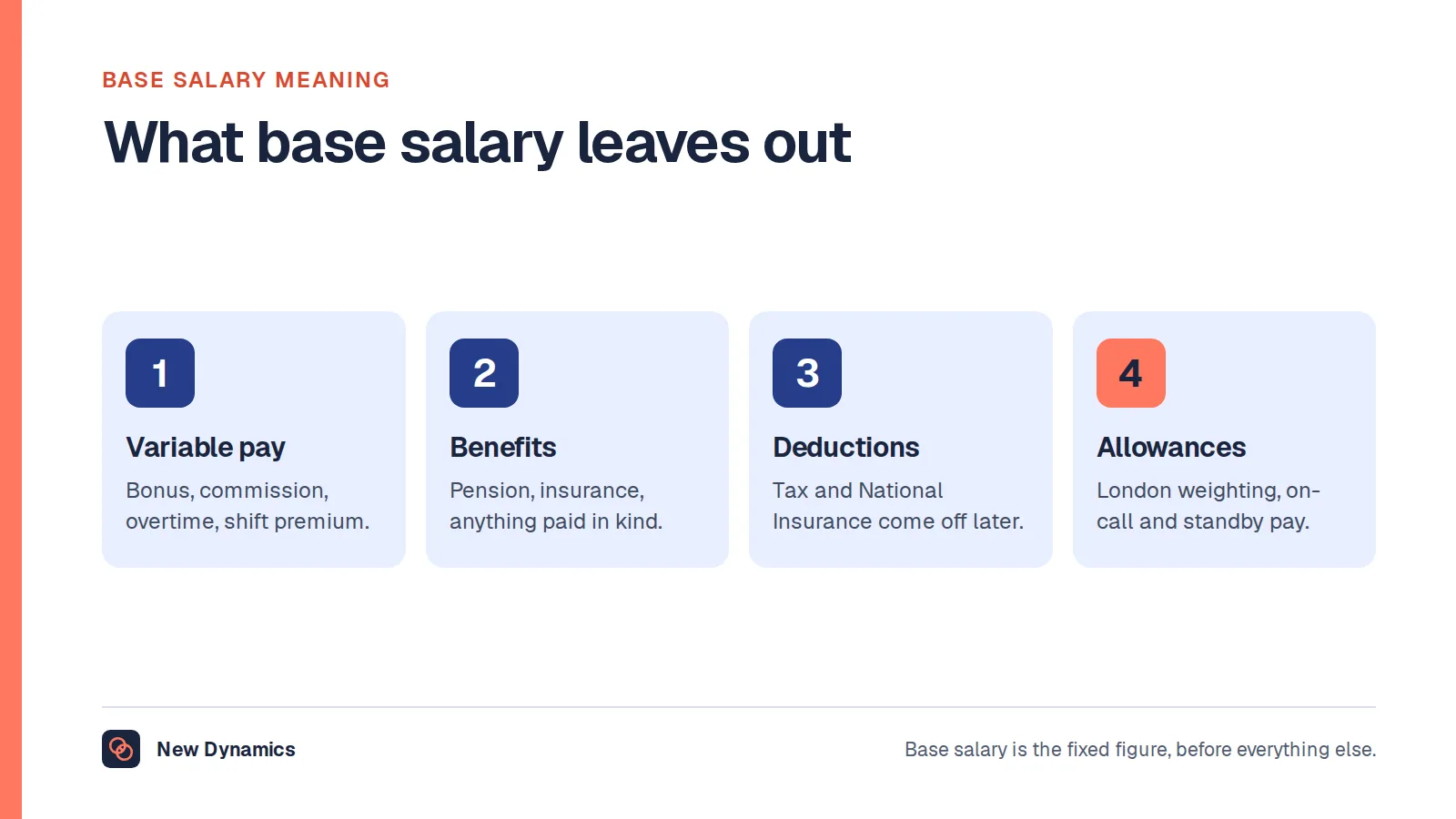
For the fixed element rather than the total, our post on base salary covers what base pay is, what it excludes and what being salaried means in the United Kingdom. This article picks up where that one stops.
Annual income: the plain meaning, and whether it is yearly or monthly
Annual income is the total amount of money you receive in a year. "Annual" means the year, so annual income is yearly, not monthly, and the same is true of annual net income. A monthly amount becomes an annual figure only once you have multiplied it out and said so.
The confusion is understandable, because most people experience income monthly. Pay arrives on the 25th, and nobody adds up the year except when a form asks. So the sum runs the wrong way: people scale the monthly figure rather than dividing the yearly one they agreed.
Three further distinctions do the real work.
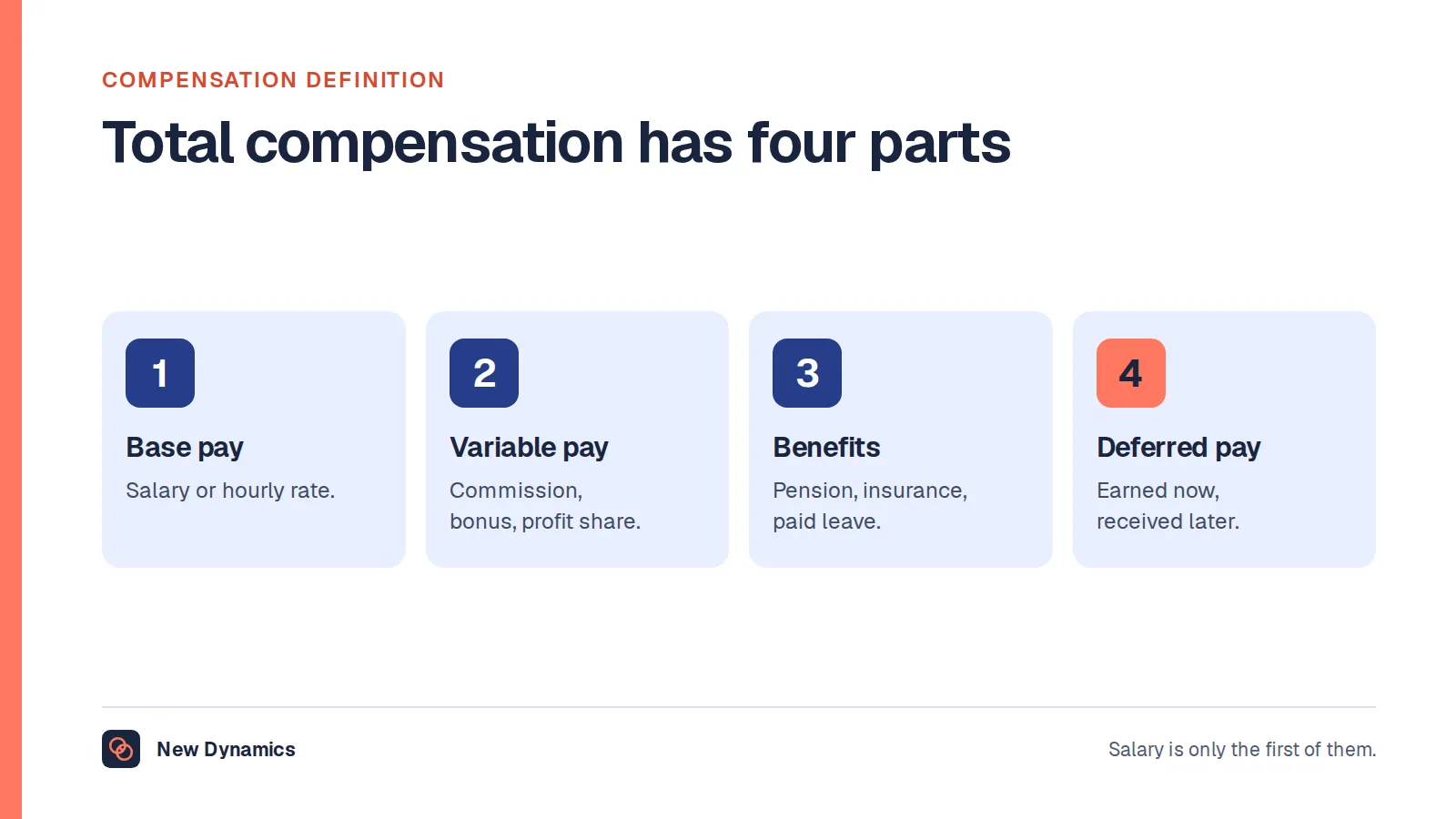
- Annual income against salary. Salary is one component; annual income is the total of all of them. Our post on the definition of compensation sets out the package an employer pays.
- Gross against net. Gross is before deductions. Net is after them.
- Actual against annualised. An actual figure covers a year that has happened. An annualised figure is a projection built by scaling something shorter.
Two people can answer "what is your annual income" honestly and be a long way apart, because one answered gross and projected while the other answered net and actual.
What annual income includes that base salary does not
Base salary is the fixed amount paid for the job. Annual income is the total, and the gap between them is where most filled-in forms go wrong.
GOV.UK's guidance on Income Tax is the clearest official statement of what counts. It opens with the principle: "Income Tax is a tax you pay on your income. You do not have to pay tax on all types of income." It then lists what you pay tax on, including "money you earn from employment", "some state benefits", "most pensions, including state pensions, company and personal pensions and retirement annuities", "benefits you get from your job", "income from a trust" and "interest on savings over your savings allowance", alongside self-employment profits and rental income.
That list is a good first draft of your annual income.

Overtime, bonus and commission. None is part of base salary, and all are part of annual income. GOV.UK's guide to PAYE and payroll for employers describes the gross figure an employer reports: "Payments to your employees include their salary or wages, as well as things like any tips or bonuses, or statutory sick or maternity pay." Our post on overtime pay covers extra hours, and our post on the meaning of OTE explains why on-target earnings is a forecast.
Tips. Tips are income even though they are not wages. GOV.UK's guidance on tips at work draws the line in one sentence: "If you get tips at work they do not count towards the National Minimum Wage. You still have to pay Income Tax on tips and may have to pay National Insurance." Cash taken straight from a customer still belongs in your annual income.
A second job, or freelance work alongside employment. Both count, and the threshold that trips people up is National Insurance rather than Income Tax. GOV.UK's National Insurance guidance says you pay mandatory National Insurance if you are 16 or over and are "an employee earning more than £242 per week from one job". The phrase "from one job" does a lot of work: that test applies job by job, while Income Tax looks at your total. GOV.UK's guidance on tax codes adds: "You'll get a tax code for each employment or pension you have."
Benefits in kind. Things provided rather than paid still count, and they are taxed. GOV.UK's guidance on tax on company benefits states that "As an employee, you pay tax on company benefits like cars, accommodation and loans", and that "You have to pay tax and National Insurance on things that are paid in cash, as they're treated as earnings." Some are tax-free, childcare and canteen meals among GOV.UK's examples. Our post on fringe benefits covers the categories.
Pension income. Retirement changes the source, it does not end annual income. GOV.UK's guidance on tax when you get a pension says "You'll usually pay tax on income from your pensions. This includes your State Pension", and that "The amount of tax you pay depends on the total income you receive during the tax year."
Rent. Rental income counts, but not the amount the tenant pays you. GOV.UK's guidance on paying tax when renting out a property says "You or your company must pay tax on the profit you make from renting out the property, after deductions for 'allowable expenses'", and that "The first £1,000 of your income from property rental is tax-free. This is your 'property allowance'." The figure for an annual income total is profit after allowable expenses, not the rent that arrives.
Dividends and savings interest. GOV.UK's guidance on tax on dividends says "You also get a dividend allowance of £500 each year", and gives the instruction that matters here: "To work out your tax band, add your total dividend income to your other income. You may pay tax at more than one rate." An allowance does not make money disappear from your income. It means no tax is due on that slice.
Some state benefits, but not all. GOV.UK's page on tax-free and taxable state benefits splits them. The taxable list includes "Jobseeker's Allowance (JSA)" and "the State Pension". The tax-free list includes "Attendance Allowance", "Housing Benefit", "Personal Independence Payment (PIP)" and "Universal Credit".
Gross annual income and annual net income
Gross annual income is the total for the year before any deductions, taken before Income Tax, National Insurance, pension contributions or student loan repayments. The phrase "annual income before taxes" means exactly this.
Annual net income is the amount left after deductions. For an employee, that is close to the money that reached the bank account across the year. For somebody self-employed, "net" often means after business expenses rather than after tax, which is one reason the words cause so much trouble.
For employees in the United Kingdom, two deductions apply to almost everybody. GOV.UK's guidance on Income Tax rates and Personal Allowances states that "The current tax year is from 6 April 2026 to 5 April 2027" and that "The standard Personal Allowance is £12,570, which is the amount of income you do not have to pay tax on." On that allowance the published bands run: up to £12,570 at 0%, £12,571 to £50,270 at 20%, £50,271 to £125,140 at 40%, and over £125,140 at 45%. The same page notes that "Income tax bands are different if you live in Scotland", so identical gross annual income can produce different net annual income. National Insurance follows the threshold quoted above.
Rates, thresholds and allowances change, and the tax year named on the page is part of the figure. Check GOV.UK for the current numbers. This summarises published guidance for the United Kingdom and is not tax advice.
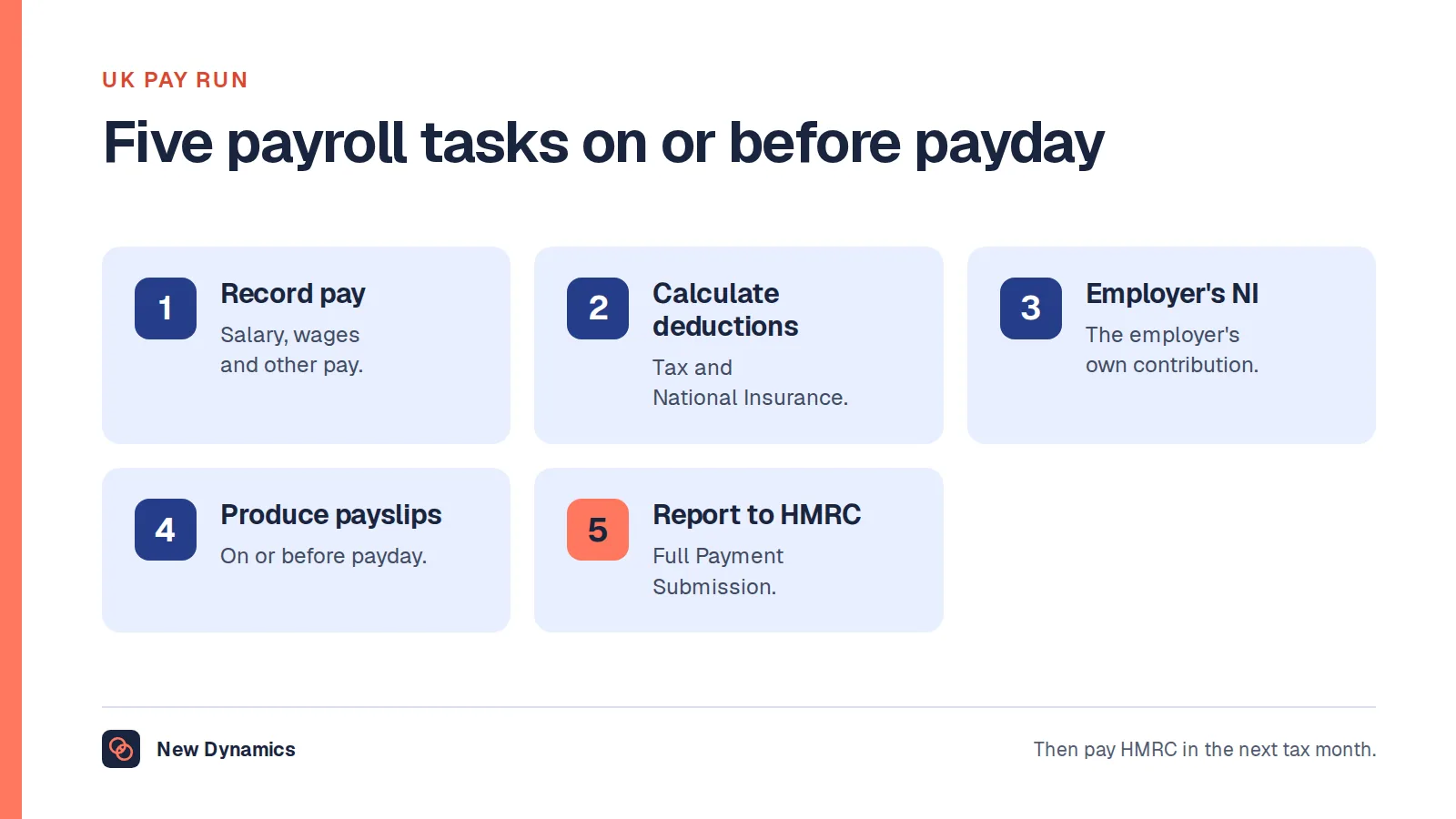
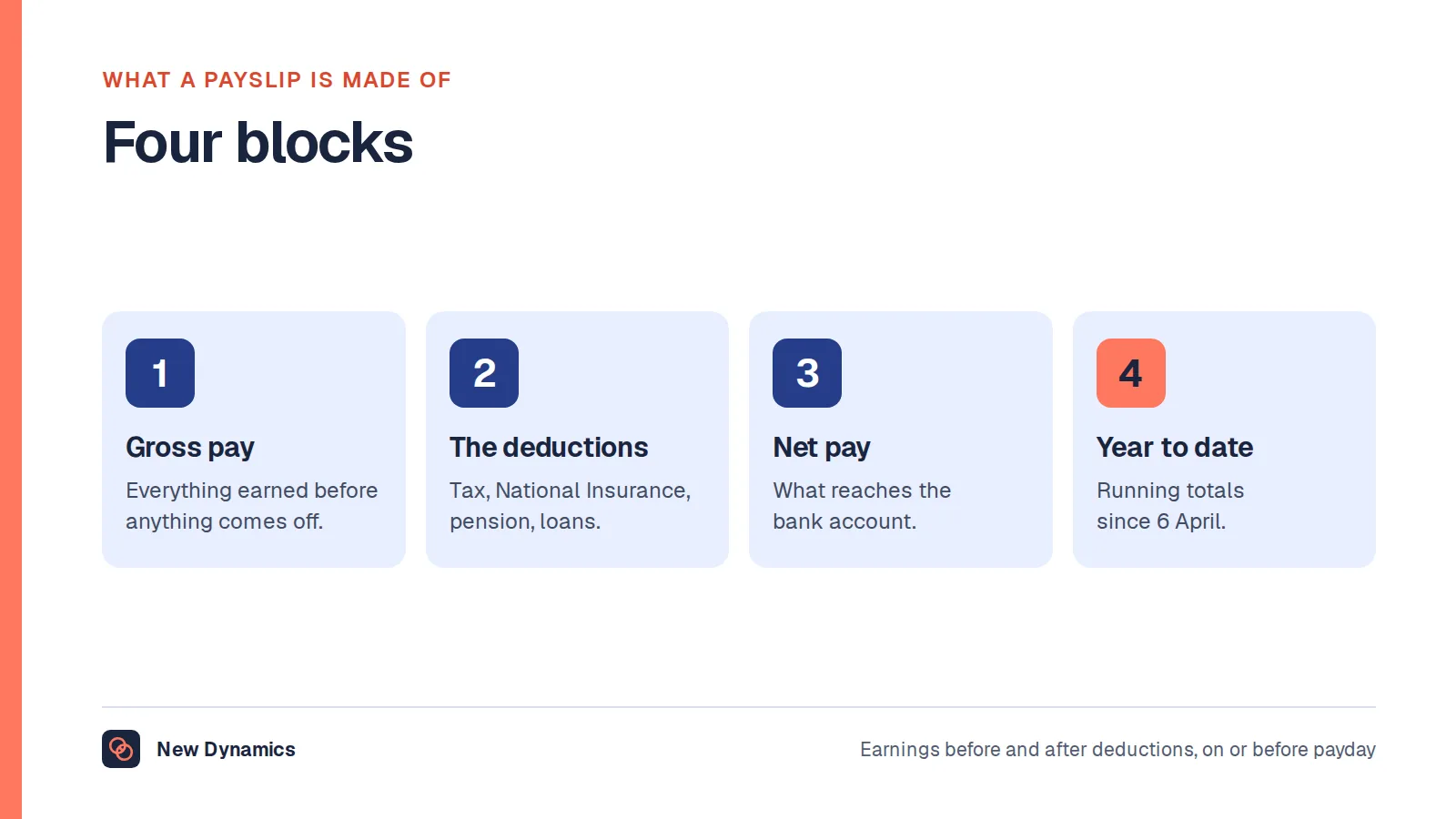
Our post on pay stub deductions reads a payslip line by line, and our post on payroll deductions covers lawful deductions. Our post on pay frequency covers how often money arrives, and our post on what payroll is covers the process behind the figures.
A worked example of the arithmetic
GOV.UK publishes its own worked example on the dividends page: "You get £3,000 in dividends and earn £29,570 in wages in the 2026 to 2027 tax year. This gives you a total income of £32,570." The page takes off the Personal Allowance of £12,570 "to leave a taxable income of £20,000", then applies 20% to £17,000 of wages, no tax to £500 of dividends because of the dividend allowance, and 10.75% to the remaining £2,500.
Three things there matter. Gross annual income is £32,570, the total of two sources. Taxable income is £20,000, a smaller figure after an allowance. And the tax is worked out in slices at more than one rate, which is why no single percentage converts gross annual income into net. Those are GOV.UK's own example figures, not a typical income.
Why a form asking for annual income usually means gross
If a form says "annual income" and gives you no further definition, the gross figure is the safer assumption, for three reasons.
The gross figure can be proved. Employees have a P60. GOV.UK's guide to your P45, P60 and P11D form explains that "Your P60 shows the tax you've paid on your salary in the tax year (6 April to 5 April)", that "You get a separate P60 for each of your jobs every tax year", and that you need it "as proof of your income if you apply for a loan or a mortgage". Outside PAYE there is the Self Assessment equivalent: GOV.UK's page on how to get your SA302 tax calculation says "You can get evidence of your earnings ('SA302') for the last 4 years once you've sent your Self Assessment tax return."
The gross figure compares between people. Net pay depends on a tax code, a pension rate, a student loan plan and a country within the United Kingdom, so two colleagues on the same salary take home different amounts. Gross income strips that out, which is why advertised pay, published statistics and lending assessments are built on it.
The net figure is ambiguous. Net of what? Tax only, or tax and pension? Before or after salary sacrifice? Without a definition, two people answering "net" are not answering the same question.
So give the gross figure and say so next to it. "£34,000 gross, before tax" removes the problem in four extra words. If the form defines the term, follow its definition rather than this article.
Annualising a part-year figure honestly
Annualising converts an amount covering a shorter period into a full-year equivalent. It is ordinary arithmetic, and the commonest way an income figure becomes misleading, because the result looks exactly like a record of what somebody was paid.

Scaling a part-year amount. Somebody starts in October, and by the following April has been paid a part-year amount. Double it and you have a projection of what a full year at the same rate would have paid. It is not what they were paid. If a form asks what you earned last year, give the actual amount and name the start date. If it asks what you earn, give the annual rate and call it that.
Scaling a variable income. Where pay includes overtime, commission or tips, a quarter is not a quarter of a year. Seasonal work, a good month of commission or a single bonus each distort a projection built on it. Give a longer period and say how long it is, or use a tax year that has finished.
Scaling a part-time salary into a full-time one. A full-time equivalent compares jobs, it is not an income. Quote it as income and you have inflated the figure in proportion to the hours not worked. Our post on the full-time equivalent covers the calculation.
Scaling from a monthly or weekly amount. Multiply by 52, 52.14 or 52.18 and one weekly amount yields three annual figures. Pick one, say which, and use it on both sides of any comparison.
The Office for National Statistics applies the same caution to its own figures. In Employee earnings in the UK: 2026, released on 22 October 2026, it warns that "ASHE annual pay figures capture pay in employee jobs for employees that have been in the job for a year or more, and include pay affected by absence (for example, special leave or parental leave). Therefore, ASHE annual figures are not directly comparable to weekly or hourly pay figures." The same bulletin reports that "median gross annual earnings for full-time employees who had been in their job for at least a year were £40,911 in April 2026, compared with £39,157 in April 2025, a 4.5% increase". All estimates for 2026 are provisional and relate to the pay period that includes 22 April 2026. Note what had to be specified to make one number usable: gross, annual, full-time, in the job at least a year, April 2026, provisional. Your own figure needs the same labels.
We do not publish typical or average income figures for particular jobs. Our post on UK pay statistics sets out which official measures exist and what each covers, and the wider collection sits in our HR statistics hub.
Where the figure is asked for, and why the answer differs
The same two words mean different things on different forms, because each form decides something different. Reading the question is the difference between an accurate answer and a wrong one.

A mortgage or loan application
Lending decisions rest on gross income that can be documented, which is why GOV.UK points people at the two documents above. The P60 page names the use directly, "as proof of your income if you apply for a loan or a mortgage". The SA302 page is more specific: "You might be asked for these documents as evidence of your income, for example if you're applying for a mortgage and you're self-employed." It adds a warning worth repeating: "Check that your mortgage provider accepts documents you've printed yourself."
Lenders set their own rules on which income they count and how much weight variable pay carries, and government does not publish those rules. Whatever the lender counts, it wants to see it on paper, so give a figure a document supports.
A tax return
A Self Assessment return does not ask for annual income. It asks for categories of income for a specific year. GOV.UK's guidance on Self Assessment tax returns explains why the return exists: "Tax is usually deducted automatically from wages and pensions. People and businesses with other income must report it in a Self Assessment tax return."
The year is fixed, and it is not the calendar year. GOV.UK states that the current tax year runs from 6 April 2026 to 5 April 2027, so income received on 3 April falls in a different year from income received on 8 April.
GOV.UK's page on who must send a tax return lists the triggers, including that you "were self-employed as a 'sole trader' and earned more than £1,000 (before taking off anything you can claim tax relief on)". GOV.UK also provides a tool to check if you need to send a Self Assessment tax return, which at the time of writing covers the 2025 to 2026 tax year.
A benefits claim
This is the clearest case where the gross assumption is wrong. Universal Credit works on net pay and on a monthly cycle, not on an annual gross figure. GOV.UK's guidance on Universal Credit and earnings states that "If you or your partner are working, how much Universal Credit you get will depend on how much you earn each month. These are called your 'assessment periods'." It gives the taper, "For every £1 you or your partner earns your payment goes down by 55p", and says which figure is in use: "A workplace pension run by your employer should already be taken into account, as Universal Credit is based on your net take-home pay."
Two further details matter. Statutory payments count: "Any statutory pay you receive is treated as earnings, in the same way as your regular wages", and the list includes Statutory Maternity Pay and Statutory Sick Pay. And pay frequency distorts a month: GOV.UK sets out that if you are paid every two weeks, "Twice a year, you'll have an assessment period with 3 paydays". An annual income divided by twelve will not match a given assessment period.
A rental reference or a credit application
A letting agent or landlord asking for annual income is testing affordability against the rent, and will want the gross figure plus evidence such as recent payslips. Where two people apply together, read whether the box wants your income or the household's. Guessing wrong hurts either way: understate it and the application fails, overstate it and the reference check contradicts you. Government does not publish rules for private referencing, so treat anything you read about agents' thresholds as background.
Adjusted net income, and other definitions with a threshold attached
Some official figures are neither gross nor net income but a third thing defined for one purpose. The most important in the United Kingdom is adjusted net income, which decides two outcomes that catch people by surprise.
HMRC's guidance on Personal Allowances: adjusted net income defines it as "total taxable income before any Personal Allowances and less certain tax reliefs", among them trading losses, Gift Aid donations and certain pension contributions. It names the two liabilities it affects: the income-related reduction to the Personal Allowance, where adjusted net income is over £100,000, and the High Income Child Benefit Charge, where it is above £60,000. The Income Tax rates and Personal Allowances page describes the first: "Your personal allowance goes down by £1 for every £2 that your adjusted net income is above £100,000. This means your allowance is zero if your income is £125,140 or above."
HMRC's worked example shows how far the defined figure sits from the headline one. In its second example, "Clara's total taxable income is £70,000", made up of £65,000 from employment and £5,000 of bank interest. After pension contributions her net income is "£65,250 (£70,000 less £4,750)", and after Gift Aid her adjusted net income is "£64,000 (£65,250 less £1,250)". Three legitimate figures for one person in one year, each correct for its own question. Answer a threshold question with the headline figure and you can reach the wrong conclusion about a charge, so check the definition that threshold uses and take advice where the amount matters.
Three GOV.UK pages, three answers on declaring untaxed income
One point to flag, because a reader checking for themselves will hit it. GOV.UK gives different answers on when untaxed income must be declared, and the pages are all current.
GOV.UK's page on how you pay Income Tax sets a threshold. It says "You must also fill in a Self Assessment tax return if you earned more than either", then lists "£1,000 from self-employment" and "£2,500 from other untaxed income, for example from tips or renting out a property".
GOV.UK's page on who must send a tax return sets no threshold for that second group. It says "You may also need to send a tax return if you have any untaxed income", then lists "money from renting out property or land", "tips and commission", "savings interest", "dividends, including investments" and "foreign income".
A third page adds a figure neither of the others mentions. GOV.UK's guidance on paying tax when renting out a property says rental income must be reported if it is more than "£2,500 after allowable expenses" or "£10,000 before allowable expenses".
So a reader with £3,000 of rent and £1,500 of allowable expenses can read one page and conclude a return is needed, a second and conclude it might be, and a third and find the answer turns on which test applies. We are not resolving that here. Each wording is quoted above with the page it came from. Use GOV.UK's checking tool, and ask HMRC or a qualified adviser where the answer matters. This is general information for the United Kingdom and not tax advice.
The common errors
Putting base salary in a box that asked for income. The commonest error. It understates income for anybody with a bonus, overtime, a second job or income outside employment.
Giving net when the form wanted gross, or the reverse. Four extra words next to the figure prevent it.
Scaling a part-year figure and presenting it as what you were paid. A projection and a record are different objects. Label the one you are giving.
Using the calendar year when the question meant the tax year. In the United Kingdom the tax year runs from 6 April to 5 April, and a tax return, a P60 and an SA302 all use it.
Giving rent received rather than rental profit. GOV.UK's rule is profit after allowable expenses, with a £1,000 property allowance.
Forgetting the taxable value of benefits in kind. A company car, accommodation or a taxable loan is income even though no money moved into your account.
Assuming a tax-free allowance means the money is not income. The dividend, savings, trading and property allowances remove tax from a slice of income, not the income.
Mixing household and individual income. Universal Credit looks at a couple's earnings together. Read the box.
Counting the employer's pension contribution as your income. It is a cost of employing you. Our post on labour costs covers the employer side.
Quoting an on-target or projected figure as income. On-target earnings is a forecast, and commission not yet earned is not income. If the figure includes anything variable, say what is fixed and what is not.
What an employer should put in writing
Lenders, letting agents and employees filling in forms all ask employers to confirm annual income. The answer is easier when the contract and the pay record already separate the parts. Six things to record.
- The base salary as a yearly figure, with the instalment amount and pay frequency underneath it.
- Every variable element named separately. Bonus, commission, overtime rate, shift premium, on-call payment, and whether each is contractual or discretionary.
- The benefits in kind and their reported taxable value, because an employee asked for total income will otherwise guess.
- The year's actual figures, so a request for last year's income is answered from the payroll record.
- A date and a label on every figure you confirm: the period, gross or net, actual or annual rate.
- One decision on who signs income confirmations, with consistent wording between them.
Point 4 is where the pain sits, because a year's actual figure is spread across twelve pay runs and whatever changed during them. Our post on payroll records covers what has to be kept, and our post on the salary increment and the annual pay review covers the decision that changes the figure.
Frequently asked questions
What is annual income?
Annual income is the total amount of money you receive in a year, not just your salary. In the United Kingdom it can include wages, overtime, bonus, commission, tips, self-employment profit, taxable benefits from your job, most pensions, rental profit, dividends and savings interest. GOV.UK's Income Tax guidance lists what tax is charged on.
Is annual income monthly or yearly?
Annual income is a yearly figure, because the word annual means the year. A monthly amount becomes an annual figure only when you multiply it out, and you should say that is what you have done: a projection from one month is not a record of a completed year.
Is annual net income monthly or yearly?
Annual net income is also yearly. It is the total you received across the year after deductions such as Income Tax, National Insurance, pension contributions and student loan repayments. For a monthly net figure, divide the annual one by twelve, remembering that the months will not be equal where pay varies.
What is gross annual income?
Gross annual income is your total income for the year before any deductions. It is the figure used in job adverts, in official earnings statistics and on most application forms. GOV.UK gives the standard Personal Allowance for the tax year from 6 April 2026 to 5 April 2027 as £12,570, with the basic rate of 20% from £12,571 to £50,270, and notes that bands differ in Scotland.
Does annual income mean before or after tax?
Usually before tax. A form asking for annual income without defining it almost always wants the gross figure, because that is what a P60 or an SA302 can evidence and what compares between people. The main exception is a benefits assessment: GOV.UK states that Universal Credit is based on net take-home pay, assessed monthly.
How do I work out my annual income with more than one job?
Add the gross pay from each job together, then add other income such as self-employment profit, rental profit, dividends or savings interest. Keep each P60, because GOV.UK states that you get a separate P60 for each of your jobs every tax year, and a tax code for each employment or pension you have.
Your next step: label the figure before you give it
- Decide which figure the question wants: gross or net, actual or annual rate, individual or household, calendar year or tax year.
- Write it with its labels attached, for example "£34,000 gross, annual rate, before tax", not as a bare number.
- Find the document that supports it: a P60, an SA302, or payslips for a recent period.
- Add the parts your salary leaves out: overtime, bonus, commission, tips, a second job, taxable benefits, pension, rental profit, dividends and interest.
- Where anything turns on a threshold, check the definition that threshold uses, and take advice from a qualified adviser.
For the policy behind the pay decisions that set the figure in the first place, read and download our compensation policy guide. The guide is free to read, and the PDF uses our short download form.
Want pay decisions, and the figures that follow from them, to rest on evidence that already exists? Book a New Dynamics demo and bring your current review form. You can also email contact@new-dynamics.com.