TL;DR
- Form 5498-SA is a United States information return. The IRS tells the "trustee or custodian" of an HSA, Archer MSA or Medicare Advantage MSA to "file Form 5498-SA for each person for whom you maintained an HSA, Archer MSA, or MA MSA", and a separate form goes in for each type of plan.
- The account holder gets a copy, not a filing job. Publication 969, for use in preparing 2025 returns, says "You should receive Form 5498-SA ... from the trustee showing the amount contributed to your HSA during the year", and the form the holder files with a return is Form 8889.
- It is a different report from the W-2. Publication 969 tells the employer: "You must report the contributions (including amounts the employee elected to contribute through a cafeteria plan) on Form W-2, box 12, code W." The two figures can differ honestly, because they count different windows.
A statement arrives in late May, months after the return went in, headed Form 5498-SA. The figure on it is not the figure the employee remembers putting into their health savings account, and it does not match the amount in box 12 of their W-2 either. The form goes to HR with a short question attached: which of these is wrong?
Usually neither. Form 5498-SA belongs to the United States federal tax system. It is an Internal Revenue Service information return, filed under IRS rules by the financial institution holding the account, and there is no British equivalent of it or of the account behind it. Most of this site covers the United Kingdom, so that is worth saying at the top: nothing in this article applies to a UK payroll.
This article covers what the form is, who files it and who receives it, what each of its six boxes reports, the deadlines, how it differs from Form 1099-SA, and the practical question behind most searches, which is why the number on it so rarely matches what anybody expected. It is general information and not tax advice.
The useful fix is almost never the form. It is writing down which annual task belongs to payroll and which to the account trustee, before January. See how New Dynamics workflows put a named owner and a date against each step, so the answer is given once instead of every spring.
What Form 5498-SA is
Its full title is the clearest definition available. The IRS page About Form 5498-SA, last reviewed on 30 March 2026, calls it "Form 5498-SA, HSA, Archer MSA, or Medicare Advantage MSA Information", and states the duty in one sentence:
"If you are the trustee or custodian of a Health Savings Account (HSA), Archer Medical Savings Account (Archer MSA), or Medicare Advantage MSA (MA MSA) file Form 5498-SA for each person for whom you maintained an HSA, Archer MSA, or MA MSA. A separate form is required for each type of plan."
So it is a report of money going in, account by account, made by the institution that holds the account. The Instructions for Forms 1099-SA and 5498-SA, revised 12/2026 and last reviewed on 30 April 2026, repeat the point and add the filing date: file it "with the IRS on or before May 31 of the subsequent year for each person for whom you maintained a health savings account (HSA), Archer medical savings account (Archer MSA), or Medicare Advantage MSA (MA MSA) during the calendar year", and "You are required to file if you are the trustee or custodian of an HSA, Archer MSA, or MA MSA."
Those instructions also name the revision to use. They say: "Use the April 2025 revision of Form 1099-SA, the December 2026 revision of Form 5498-SA, and these instructions to file and furnish 2026 information in early 2027." If you are checking a figure against a form, check the revision printed on it first.
Who files it, who receives it, and what to do with the copy

Jurisdiction: United States. Three roles, and only one of them files anything.
The trustee or custodian files it. Not the employer, not payroll, not the broker who introduced the plan. The instructions are addressed to the trustee throughout, and they are the only party with the account records the form needs.
The account holder receives a statement. The instructions say: "If you are required to file Form 5498-SA, you must provide a statement to the participant (generally Copy B) by May 31 of the subsequent year." Publication 969 puts it from the holder's side, in the section on reporting contributions: "You should receive Form 5498-SA, HSA, Archer MSA, or Medicare Advantage MSA Information from the trustee showing the amount contributed to your HSA during the year."
The holder does not file the 5498-SA with a return. The form the holder files is a different one. Publication 969, for use in preparing 2025 returns and last reviewed on 30 April 2026, says: "Report all contributions to your HSA on Form 8889 and file it with your Form 1040, 1040-SR, or 1040-NR." The 5498-SA copy is there to check against, which is why it is awkward that it arrives so late. Whether any particular figure belongs on a return is a question for a tax professional, not for HR.
Form 5498-SA and Form 1099-SA report opposite directions
The two forms are issued by the same party, for the same account, in the same year, and people treat them as versions of each other. They are not.
Form 5498-SA reports money in. Contributions, rollovers and the year-end value of the account.
Form 1099-SA reports money out. Distributions during the calendar year, with a code saying why the money left. Our post on Form 1099-SA covers that form, its box 3 distribution codes and whether receiving one creates a tax bill.
They also run on different clocks, which is the source of a lot of confusion. The 1099-SA recipient copy is an early-year document. The 5498-SA participant statement is due by 31 May of the following year, so the two halves of the same account's story reach the holder months apart.
What each box on Form 5498-SA reports

Jurisdiction: United States. Taken from the Specific Instructions for Form 5498-SA in the instructions revised 12/2026. The headings are the IRS wording.
- Box 1, Archer MSA contributions. Its full heading is "Employee or Self-Employed Person's Archer MSA Contributions Made in the Calendar Year and the Subsequent Year for the Calendar Year". It takes regular Archer MSA contributions "made in the calendar year and through the April 15 of the subsequent year, for the calendar year", and reports them gross: "Report gross contributions, including any excess contributions, even if the excess contributions were withdrawn." One line matters for most readers: "No HSA information is to be reported in box 1."
- Box 2, total contributions made in the calendar year. For an HSA or Archer MSA, "the total HSA or Archer MSA contributions made in the calendar year". The sentence that follows is the one people miss: "Include any contribution made in the calendar year for the prior year." Qualified HSA funding distributions from an IRA land here too.
- Box 3, contributions made in the subsequent year for the calendar year. "Enter the total HSA or Archer MSA contributions made in the subsequent year for the calendar year." This is the box that catches a top-up made in the new year and designated for the old one.
- Box 4, rollover contributions. "Enter rollover contributions to the HSA or Archer MSA received by you during the calendar year. These amounts are not to be included in box 2."
- Box 5, fair market value. "Enter the FMV of the account on December 31 of the calendar year." This is a balance, not a contribution, and it is the box most often mistaken for one.
- Box 6, checkbox. "Check the box to indicate if this account is an HSA, Archer MSA, or MA MSA."
One thing is deliberately absent. Trustee-to-trustee transfers are not reported: "Do not report a trustee-to-trustee transfer from one Archer MSA or MA MSA to another Archer MSA or MA MSA, from an Archer MSA to an HSA, or from one HSA to another HSA. For reporting purposes, contributions and rollovers do not include these transfers." Somebody who moved their account between providers will see nothing of that move on the form.
The deadlines, and why the form arrives after the return
Jurisdiction: United States. Both dates in the instructions revised 12/2026 are the same date.
- Filing with the IRS: "on or before May 31 of the subsequent year".
- Statement to the participant: "by May 31 of the subsequent year".
- Weekends and holidays: "If May 31 falls on a Saturday, Sunday, or a legal holiday, you must file by the next day that is not a Saturday, Sunday, or a legal holiday." That bites more often than it sounds. 31 May 2026 fell on a Sunday, so the next working day applied.
- An optional earlier statement: "You may, but you are not required to, provide the participant with a statement of the December 31 FMV of the participant's account by January 31 of the subsequent year." Many trustees do this, which is why a January statement showing a balance is not the 5498-SA and should not be treated as one.
There is also a case where no form comes at all. The instructions say that if a total distribution was made during the year and no contributions were made for that year, the trustee "need not file Form 5498-SA nor furnish a statement to the participant to reflect that the fair market value (FMV) on December 31 was zero".
Why the figure on it does not match what the employee thinks they contributed

Jurisdiction: United States. This is the real question behind the search, and there are five honest reasons, none of which means anybody made a mistake.
- Box 2 counts a calendar year, not a contribution year. It includes "any contribution made in the calendar year for the prior year". A payment made in March 2026 and designated for 2025 appears in box 2 of the 2026 form, even though for tax purposes it belongs to 2025.
- Box 3 is the mirror of that, so boxes 2 and 3 cannot simply be added. Box 3 reports contributions "made in the subsequent year for the calendar year". Adding the two boxes on one form counts two different windows and produces a figure that matches nothing.
- It includes the employer's money. The employee thinks of their salary reduction as theirs. Publication 969 does not: "Contributions to an employee's account by an employer using the amount of an employee's salary reduction through a cafeteria plan are treated as employer contributions." Box 2 is a total of everything that arrived, from whatever source.
- Rollovers are carved out, and transfers are invisible. Box 4 rollovers "are not to be included in box 2", and trustee-to-trustee transfers are not reported anywhere on the form. Anyone who consolidated accounts will see a smaller number than their own records show.
- Excess contributions still show. Box 1 for an Archer MSA takes gross contributions "including any excess contributions, even if the excess contributions were withdrawn". A correction after the event does not always erase the original figure.
Behind all of this sits a limit that changes. Publication 969 states it for one year at a time: "For 2025, if you have self-only HDHP coverage, you can contribute up to $4,300. If you have family HDHP coverage, you can contribute up to $8,550." It then adds the catch-up: "If you are an eligible individual who is age 55 or older at the end of your tax year, your contribution limit is increased by $1,000." Those are the 2025 figures. The limits are set annually, so check the current year on the IRS Publication 969 page rather than carrying a number forward.
The employer's angle: W-2 box 12 code W is a different report
Jurisdiction: United States. This is where an HR team can actually be useful, and it turns on one distinction. The 5498-SA is the trustee's report. The W-2 entry is the employer's report. They are two separate obligations, filed by two separate parties, and neither is a copy of the other.
Publication 969 is explicit about the employer's duty: "Amounts you contribute to your employees' HSAs aren't generally subject to employment taxes. You must report the contributions (including amounts the employee elected to contribute through a cafeteria plan) on Form W-2, box 12, code W." For an Archer MSA it names a different code: contributions must be reported "on Form W-2, box 12, code R", and from the employee's side the publication says those "should be shown on Form W-2, box 12, code R".
Now the timing, which explains most mismatches in one move. Publication 969 says: "Your employer can make contributions to your HSA from January 1, 2026, through April 15, 2026, that are allocated to 2025. Your employer must notify you and the trustee of your HSA that the contribution is for 2025. The contribution will be reported on your 2026 Form W-2, Wage and Tax Statement."
Read that against box 3 of the 5498-SA. The same payment is reported by the employer on the 2026 W-2 and by the trustee against the 2025 calendar year. Both are correct. The two documents will not agree, and an employee comparing them will conclude that one of them is wrong.
Two practical duties follow for the employer:
- Tell the trustee which year the money is for. The instructions put the obligation on the trustee to ask: "For HSA or Archer MSA contributions made between January 1 and April 15 of the subsequent year you should obtain the participant's designation of the year for which the contributions are made." If payroll does not say, the designation gets guessed, and box 2 and box 3 end up populated the wrong way round.
- Explain the two reports at enrolment, not in May. A single line in the benefits pack saying that the W-2 shows the employer's figure and the trustee's 5498-SA shows the account's figure removes most of the spring correspondence.
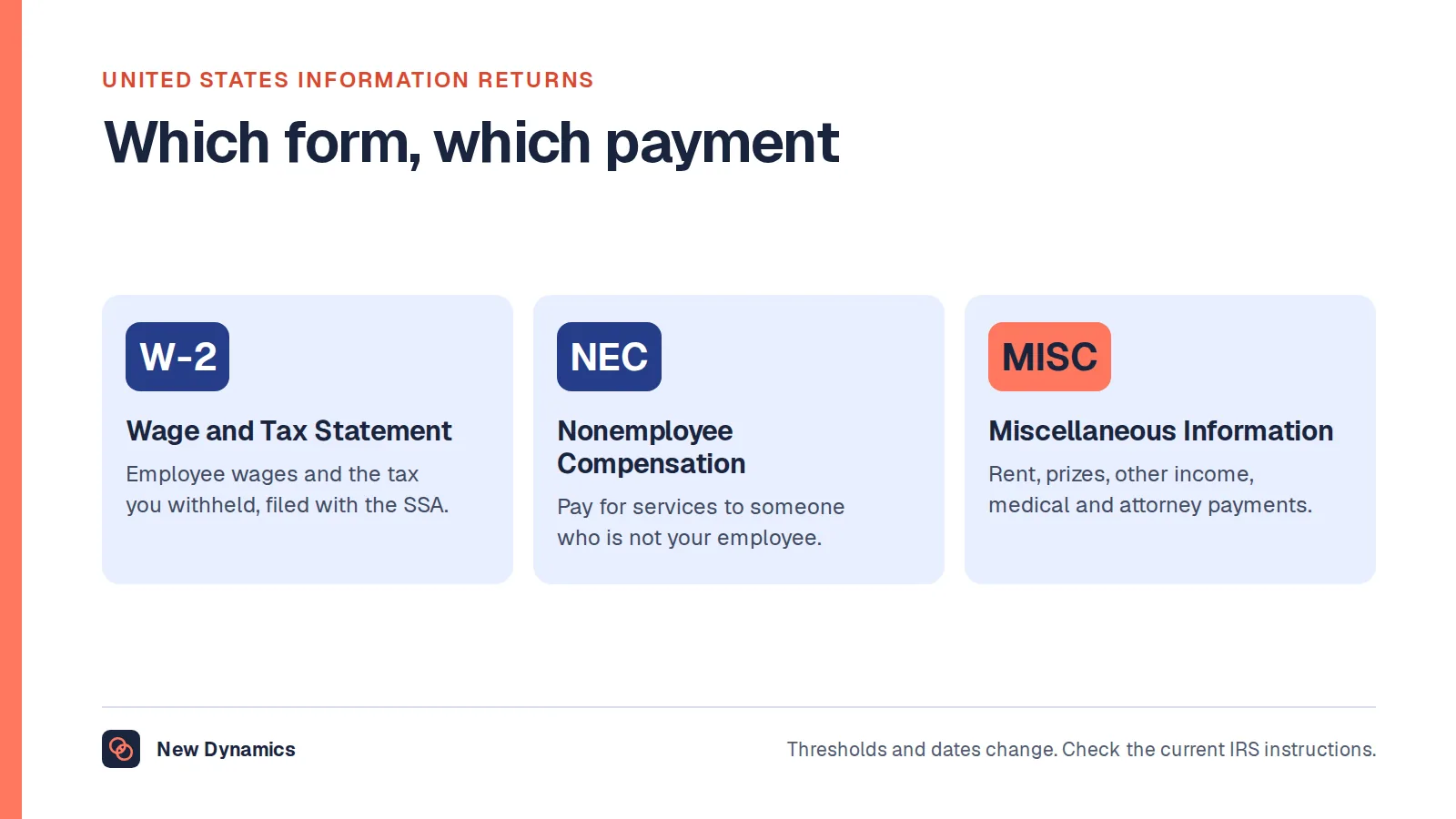
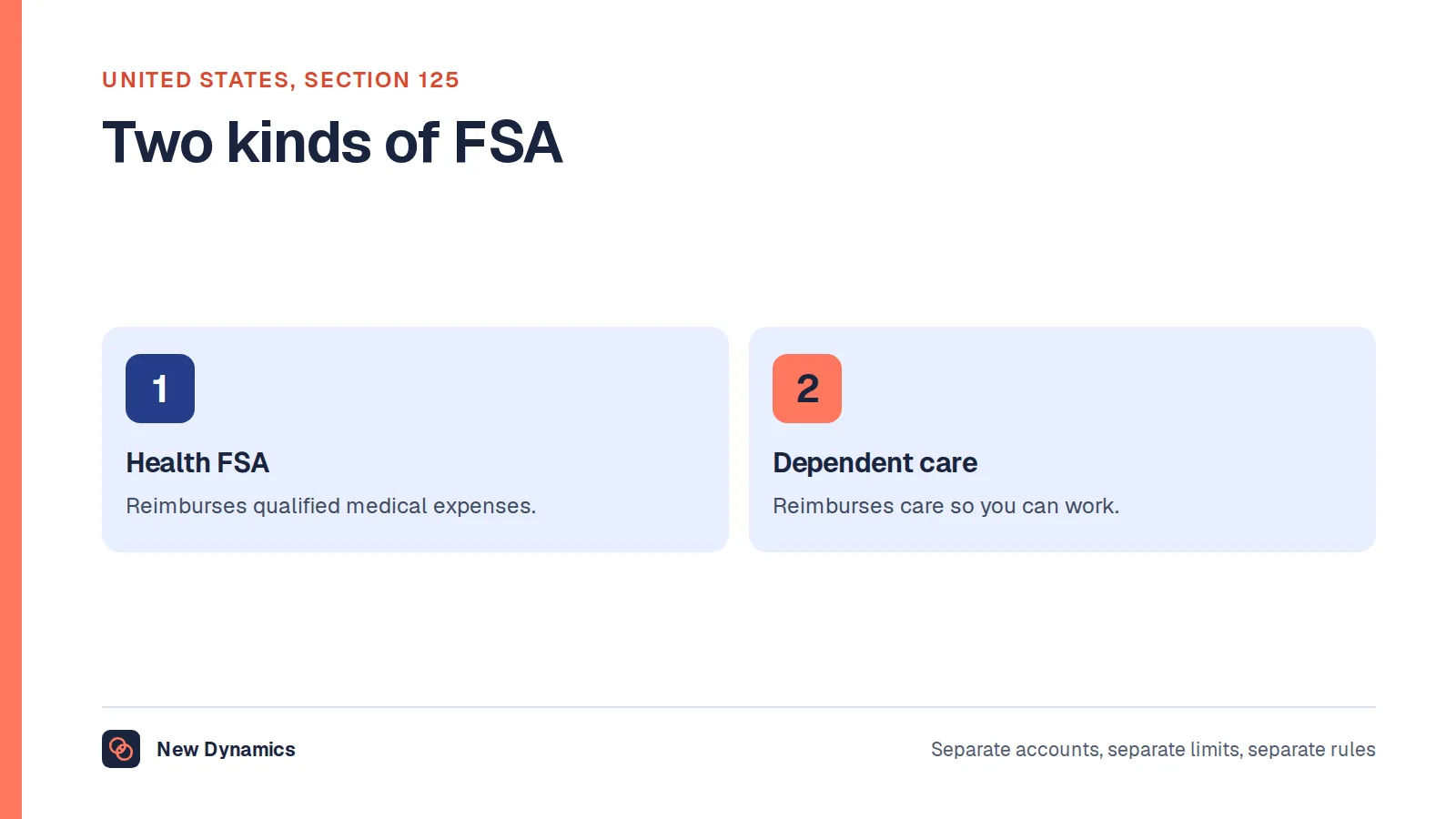
The cafeteria plan carrying the salary reduction is the same container a health FSA sits in; our post on the flexible spending account sets out how that plan works, so it is not repeated here. For the wider family of American information returns and which of them an employer actually files, see our post on IRS information returns. An employer's obligations depend on its own plan documents, and this is general information, not legal or tax advice.
Frequently asked questions
What is a 5498-SA tax form?
It is a United States information return reporting money paid into a tax-favoured medical savings account. The IRS titles it "Form 5498-SA, HSA, Archer MSA, or Medicare Advantage MSA Information" and tells the "trustee or custodian" to "file Form 5498-SA for each person for whom you maintained an HSA, Archer MSA, or MA MSA", with "A separate form is required for each type of plan." It carries contributions, rollovers and the account's 31 December value. This is general information and not tax advice.
Do I need to file Form 5498-SA with my tax return?
No. The trustee files it with the IRS and sends you a copy as a statement. IRS Publication 969, for use in preparing 2025 returns, says "You should receive Form 5498-SA ... from the trustee showing the amount contributed to your HSA during the year", and the form you file is a different one: "Report all contributions to your HSA on Form 8889 and file it with your Form 1040, 1040-SR, or 1040-NR." Check your own return with a tax professional.
What is the difference between Form 1099-SA and Form 5498-SA?
Direction. Form 1099-SA reports distributions, the money that left the account during the year. Form 5498-SA reports contributions, rollovers and the account's fair market value on 31 December. Both are filed by the trustee or custodian rather than the employer, and both cover an HSA, an Archer MSA or a Medicare Advantage MSA, with a separate form for each type of plan.
When should I receive my Form 5498-SA?
By 31 May of the year after the one it covers. The Instructions for Forms 1099-SA and 5498-SA, revised 12/2026, tell the trustee to file "on or before May 31 of the subsequent year" and to "provide a statement to the participant (generally Copy B) by May 31 of the subsequent year", with the next working day applying where 31 May falls on a weekend or a legal holiday. A separate 31 January statement of the account's value is optional for the trustee and is not the 5498-SA.
Why does my Form 5498-SA not match box 12 code W on my W-2?
Because they count different windows and are filed by different parties. Publication 969 tells the employer to report its contributions, "including amounts the employee elected to contribute through a cafeteria plan", on "Form W-2, box 12, code W", while the trustee's box 2 includes "any contribution made in the calendar year for the prior year" and box 3 captures contributions "made in the subsequent year for the calendar year". A prior-year employer contribution made between 1 January and 15 April is reported on the later year's W-2, so the two documents can both be right and still disagree.
Your next step: fix the boundary, not the form
- Write down who reports what. The trustee files Form 5498-SA and Form 1099-SA. The employer funds contributions and reports them in box 12 of the W-2, code W for an HSA and code R for an Archer MSA.
- Tell the trustee the contribution year. Where money goes in between 1 January and 15 April, the designation decides whether it lands in box 2 or box 3. Payroll holds that fact.
- Say at enrolment where each document comes from. Naming the account provider in the benefits record is what stops a May statement being forwarded to HR.
- Keep HR out of the tax answer. Point people at the IRS instructions and a tax professional. Whether a figure belongs on a return depends on records HR has never seen.
- Recheck the limits every year. The contribution limits are set annually and the form revisions change. The codes are stable; the numbers are not.
For a way of setting pay and benefits you can explain to the person affected, read and download our compensation policy guide. The guide is free to read, and the PDF uses our short download form.
Want every annual benefits task to have an owner, a deadline and a visible status? Book a New Dynamics demo and bring your benefits calendar, or email contact@new-dynamics.com.